Singapore Retail Industry Market Size, Share & Growth Rate
The Singapore Retail Industry Market was estimated at USD 281 Million in 2025 and is projected to reach USD 359 Million by 2032, growing at a CAGR of 3.6% from 2026 to 2032. This growth trajectory is primarily driven by the increasing integration of technology in retail, alongside the evolving shopping behaviors of Singapores digitally-savvy consumers. As local and international retailers adapt to these trends, e-commerce is expected to continue its upward momentum, offering convenience and a more tailored shopping experience.
Singapore Retail Industry Market Year-wise Growth Rate and Key Drivers
This graph highlights how the Singapore Retail Industry Market has steadily grown over the years, supported by major growth factors.
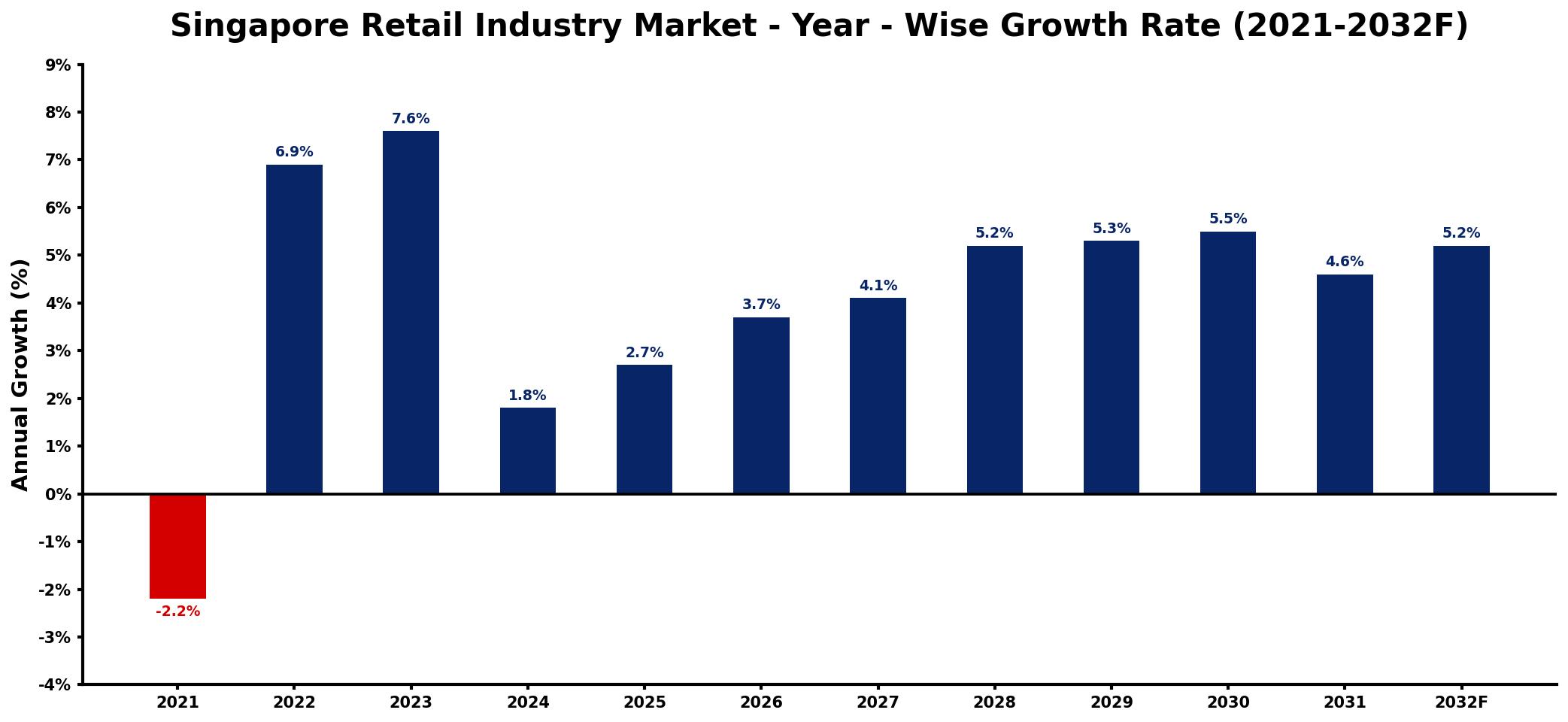
The table below presents the year‑wise growth rates along with the key drivers influencing the market
| Year | Growth Rate | Major Drivers |
| 2021 | -2.2% | reduced consumer spending patterns |
| 2022 | 6.9% | increased online shopping demand |
| 2023 | 7.6% | growing preference for convenience |
| 2024 | 1.8% | rising end-use demand growth |
| 2025 | 2.7% | rise in sustainable shopping habits |
| 2026 | 3.7% | enhanced digital payment solutions |
| 2027 | 4.1% | increased investment in logistics |
| 2028 | 5.2% | growing interest in local brands |
| 2029 | 5.3% | expansion of omnichannel strategies |
| 2030 | 5.5% | increased focus on personalization |
| 2031 | 4.6% | growing demand for health products |
| 2032 | 5.2% | growing emerging market penetration |
Note: Market size estimations and growth projections presented in this report are based on 6Wresearch's proprietary forecasting methodology, utilizing the latest available industry data, government publications, and primary research inputs.
Singapore Retail Industry Market Synopsis
The strongest force currently shaping the Singapore retail industry is the burgeoning e-commerce sector. This rapid digital transformation is not just redefining how consumers shop but also influencing the operational strategies of traditional retail outlets. As shopping habits evolve, there is an increasing demand for seamless online and offline integration, pushing retailers to enhance their digital presence.
Additionally, consumer preferences are rapidly changing, driven by a desire for convenience and personalization. Retailers are focusing on creating unique in-store experiences while also optimizing their online platforms to meet the expectations of todays discerning shoppers. This adaptability is crucial for maintaining competitiveness in a market that values innovation and responsiveness.
Singapore Retail Industry Market Key Takeaways
- The shift towards e-commerce is reshaping the retail landscape in Singapore.
- Consumers are increasingly seeking personalized and convenient shopping experiences.
- Technological advancements are vital for retailers aiming to thrive in a competitive market.
- Local and international players are diversifying their offerings to meet varied consumer demands.
- Growth in the retail sector is largely dependent on adapting to changing consumer behaviors.
Evaluation of Restraints in Singapore Retail Industry Market
While the Singapore retail industry is on a growth trajectory, several restraints can impede its progress. The rapid shift towards online shopping poses challenges for brick-and-mortar retailers, compelling them to re-evaluate their in-store strategies. Additionally, fluctuations in economic conditions may affect consumer spending, forcing retailers to remain agile and responsive. The constant evolution of technology necessitates ongoing investment from retailers, which can be a significant barrier for smaller players. Finally, the need to maintain relevance and engagement with consumers means that retailers must continuously innovate, which can strain resources.
Singapore Retail Industry Market Trends
A prominent trend shaping the Singapore retail industry is the growing emphasis on omnichannel retailing, where seamless integration between online and offline channels is prioritized. Retailers are enhancing their customer engagement through personalized marketing strategies that leverage data analytics to understand consumer behavior. Furthermore, sustainability is becoming increasingly important, with brands actively seeking to adopt eco-friendly practices and offer sustainable products, aligning themselves with the values of todays conscientious consumers.
Singapore Retail Industry Market Opportunities
The burgeoning demand for e-commerce presents a plethora of opportunities for investment in technology and logistics. Retailers can explore partnerships with tech firms to develop innovative solutions that enhance customer experiences. Additionally, there is potential for growth in niche markets, particularly in sustainable products and unique local offerings. As the retail sector continues to evolve, businesses that prioritize digital transformation and customer-centric strategies stand to benefit significantly in the coming years.
Government Initiatives in the Singapore Retail Industry Market
The Singapore government has introduced various initiatives aimed at bolstering the retail industry. These include support for digital transformation through grants and training programs for retailers to enhance their online capabilities. Additionally, policies encouraging innovation and sustainable practices within the retail sector are being implemented to foster a more competitive environment. Investments in infrastructure improvements also aim to provide retailers with the necessary support to thrive in a digitally-driven economy.
Future Insights of the Singapore Retail Industry Market
Looking ahead to 2026-2032, the Singapore retail industry is poised for substantial change, primarily influenced by advancements in technology and shifting consumer expectations. As retailers harness emerging technologies such as artificial intelligence and augmented reality, shopping experiences will become increasingly immersive and personalized. The industry will likely witness greater collaboration between retailers and tech companies to innovate and meet the needs of a digitally connected consumer base. Furthermore, the focus on sustainability will drive retailers to incorporate eco-friendly practices, ensuring long-term growth while maintaining consumer trust.
Singapore Retail Industry Market Latest Developments (2025 - 2026)
Recent developments in the Singapore retail industry indicate a continued pivot towards enhancing online and omnichannel shopping experiences. Many retailers are investing in technology upgrades to streamline logistics and improve customer interactions. Moreover, partnerships between brick-and-mortar stores and online platforms are emerging, aimed at providing a more cohesive shopping experience. Sustainability initiatives are gaining traction, with various brands launching eco-friendly product lines and promoting responsible consumer practices.
Singapore Retail Industry Market - Key Attractiveness of the Report
- 10 Years of Market Numbers
- Historical Data Starting from 2022 to 2025
- Base Year: 2025
- Forecast Data until 2032
- Key Performance Indicators Impacting the Market
- Major Upcoming Developments and Projects
Key Highlights of the Report:
- Singapore Retail Industry Market Outlook
- Market Size of Singapore Retail Industry Market, 2025
- Forecast of Singapore Retail Industry Market, 2032
- Historical Data and Forecast of Singapore Retail Industry Revenues & Volume for the Period 2022-2032F
- Singapore Retail Industry Market Trend Evolution
- Singapore Retail Industry Market Drivers and Challenges
- Singapore Retail Industry Price Trends
- Singapore Retail Industry Porter's Five Forces
- Singapore Retail Industry Industry Life Cycle
- Historical Data and Forecast of Singapore Retail Industry Market Revenues & Volume By Product for the Period 2022-2032F
- Historical Data and Forecast of Singapore Retail Industry Market Revenues & Volume By Food and Beverages for the Period 2022-2032F
- Historical Data and Forecast of Singapore Retail Industry Market Revenues & Volume By Personal and Household Care for the Period 2022-2032F
- Historical Data and Forecast of Singapore Retail Industry Market Revenues & Volume By Apparel, Footwear, and Accessories for the Period 2022-2032F
- Historical Data and Forecast of Singapore Retail Industry Market Revenues & Volume By Furniture, Toys, and Hobby for the Period 2022-2032F
- Historical Data and Forecast of Singapore Retail Industry Market Revenues & Volume By Electronic and Household Appliances for the Period 2022-2032F
- Historical Data and Forecast of Singapore Retail Industry Market Revenues & Volume By Other Products for the Period 2022-2032F
- Historical Data and Forecast of Singapore Retail Industry Market Revenues & Volume By Distribution Channel for the Period 2022-2032F
- Historical Data and Forecast of Singapore Retail Industry Market Revenues & Volume By Supermarkets/Hypermarkets for the Period 2022-2032F
- Historical Data and Forecast of Singapore Retail Industry Market Revenues & Volume By Convenience Stores for the Period 2022-2032F
- Historical Data and Forecast of Singapore Retail Industry Market Revenues & Volume By Department Stores for the Period 2022-2032F
- Historical Data and Forecast of Singapore Retail Industry Market Revenues & Volume By Specialty Stores for the Period 2022-2032F
- Historical Data and Forecast of Singapore Retail Industry Market Revenues & Volume By Online for the Period 2022-2032F
- Historical Data and Forecast of Singapore Retail Industry Market Revenues & Volume By Other Distribution Channels for the Period 2022-2032F
- Singapore Retail Industry Import Export Trade Statistics
- Market Opportunity Assessment By Product
- Market Opportunity Assessment By Distribution Channel
- Singapore Retail Industry Top Companies Market Share
- Singapore Retail Industry Competitive Benchmarking By Technical and Operational Parameters
- Singapore Retail Industry Company Profiles
- Singapore Retail Industry Key Strategic Recommendations






































