Singapore Retail Market Size, Share & Growth Rate
The Singapore Retail Market was estimated at USD 897 Million in 2025 and is projected to reach USD 1546 Million by 2032, growing at a CAGR of 8.1% from 2026 to 2032. This robust growth trajectory is underpinned by several factors including a resilient economy characterized by high disposable income, a rise in e-commerce adoption, and increasing tourist activity as Singapore remains a favored shopping destination. Additionally, as retailers pivot towards personalized and experiential services, the retail landscape is set to thrive even further.
Singapore Retail Market Year-wise Growth Rate and Key Drivers
This graph highlights how the Singapore Retail Market has steadily grown over the years, supported by major growth factors.
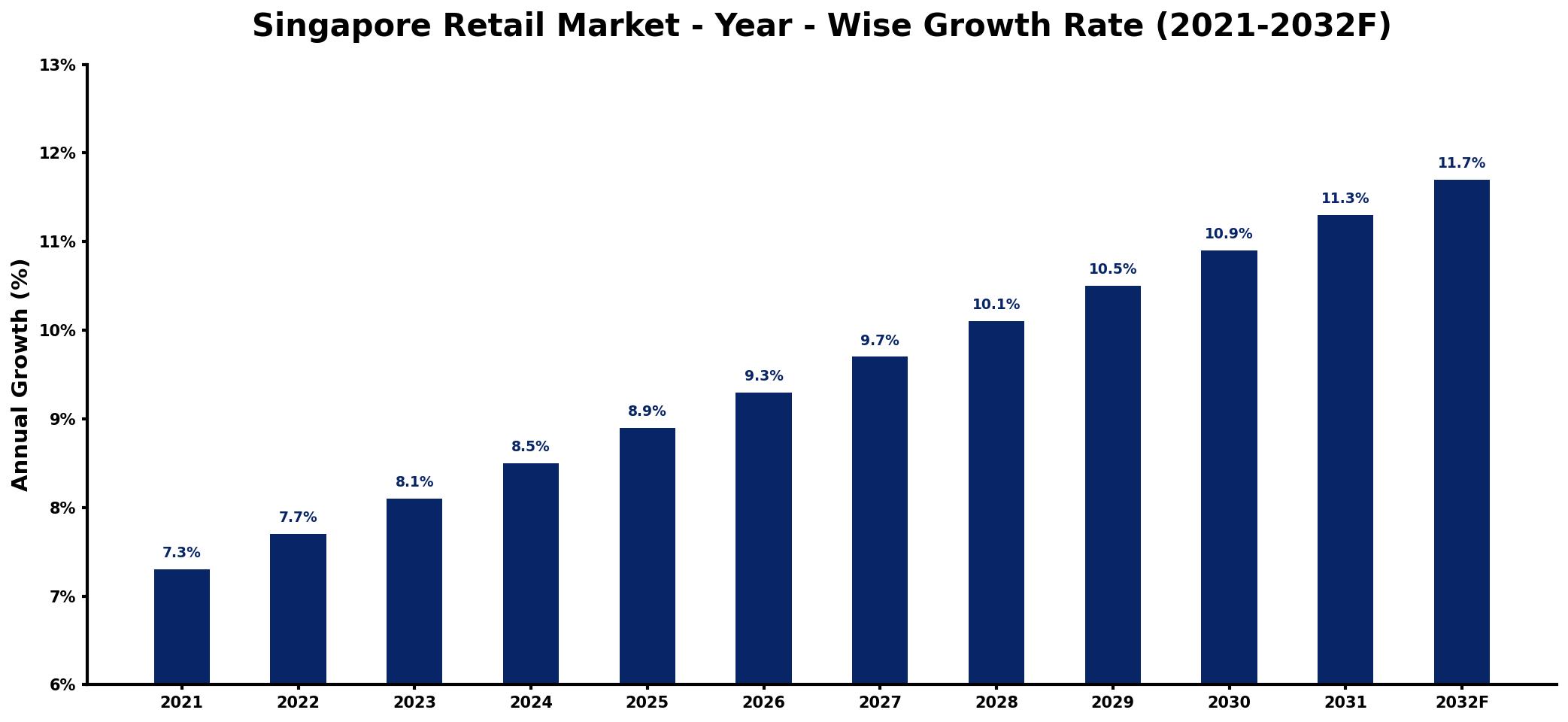
The table below presents the year‑wise growth rates along with the key drivers influencing the market
| Year | Growth Rate | Major Drivers |
| 2021 | 7.3% | E-commerce adoption accelerates significantly |
| 2022 | 7.7% | Consumer spending rebounds strongly |
| 2023 | 8.1% | Digital payment systems expand rapidly |
| 2024 | 8.5% | Sustainability initiatives gain traction |
| 2025 | 8.9% | Omnichannel strategies become essential |
| 2026 | 9.3% | Health and wellness trends rise |
| 2027 | 9.7% | Personalization in shopping experiences |
| 2028 | 10.1% | Technological innovations enhance convenience |
| 2029 | 10.5% | Experiential shopping drives engagement |
| 2030 | 10.9% | Global supply chains stabilize efficiently |
| 2031 | 11.3% | Local brands gain market prominence |
| 2032 | 11.7% | Investments in automation technologies |
Note: Market size estimations and growth projections presented in this report are based on 6Wresearch's proprietary forecasting methodology, utilizing the latest available industry data, government publications, and primary research inputs.
Singapore Retail Market Synopsis
The Singapore retail market has experienced a dynamic shift in recent years, primarily due to rapid technological advancements and evolving consumer preferences. Traditional brick-and-mortar retailers are now reimagining their strategies to offer more engaging and personalized shopping experiences, which is essential as they face stiff competition from digital platforms.
As the market continues to adapt, the focus has increasingly turned towards integrating online and offline channels seamlessly. This omnichannel approach is not just a response to changing consumer habits but also a proactive strategy to foster deeper customer relationships, ensuring that Singapore's retail environment remains vibrant and competitive.
Singapore Retail Market Key Takeaways
- The market is poised for significant growth, driven by high disposable income and increased e-commerce penetration.
- Brick-and-mortar stores are enhancing their offerings through experiential shopping and personalization.
- The COVID-19 pandemic has accelerated the shift towards online shopping and omnichannel strategies.
- Tourism remains a critical factor, sustaining demand for diverse retail experiences.
- Retailers are investing heavily in technology to improve logistics and customer engagement.
Evaluation of Restraints in Singapore Retail Market
Despite its promising outlook, the Singapore retail market contends with several restraints that hinder its potential growth. The fierce competition from e-commerce giants poses a significant challenge for traditional retailers, leading to diminishing foot traffic in physical stores. High rental costs in prime locations exert financial pressure on businesses, limiting their ability to innovate and expand. Furthermore, the limited geographical space necessitates that retailers optimize their operations effectively while providing unique in-store experiences that can lure back consumers.
Singapore Retail Market Trends
Current trends in the Singapore retail market highlight the increasing importance of digital engagement and omnichannel strategies. Retailers are leveraging advanced analytics and AI to gain insights into consumer behavior, leading to more targeted marketing campaigns. Sustainability is also becoming a focal point, with consumers favoring brands that demonstrate a commitment to environmentally friendly practices. As mobile shopping becomes ubiquitous, businesses are investing in mobile-optimized platforms to enhance user experience. These trends collectively shape the future of retail in Singapore, making it more interactive and consumer-centric.
Singapore Retail Market Opportunities
The Singapore retail market is rife with growth opportunities, especially in sectors that cater to the evolving consumer preferences. The expansion of e-commerce creates avenues for new entrants and existing players to innovate their service offerings. There is also significant potential in the luxury and experiential retail segments, as affluent local and international consumers seek unique shopping experiences. Moreover, the integration of technology in logistics and payment systems provides a competitive edge for retailers willing to invest in digital transformation.
Government Initiatives in the Singapore Retail Market
The Singapore government actively supports the retail sector through various initiatives aimed at enhancing the shopping environment and promoting tourism. Efforts such as the development of smart city frameworks incorporate advanced technologies into retail operations, ensuring a seamless consumer experience. Moreover, initiatives to attract global tourists, including festivals and events, further bolster the retail landscape. The governments commitment to infrastructure development plays a crucial role in maintaining Singapore's status as a premier shopping hub in the region.
Future Insights of the Singapore Retail Market
Looking ahead to 2026-2032, the Singapore retail market is likely to experience a paradigm shift influenced by technological integration and changing consumer expectations. The continuous growth of e-commerce, combined with the push for personalized shopping experiences, will redefine how retailers engage with customers. As the market rebounds post-pandemic, those businesses that effectively blend physical and digital strategies will likely emerge as market leaders. Investment in sustainable practices and technology will also be pivotal, as consumers increasingly demand transparency and ethical considerations from brands.
Singapore Retail Market Latest Developments (2025 - 2026)
Recent developments in the Singapore retail market highlight a strong recovery and ongoing transformation as retailers adapt to post-pandemic realities. Many businesses are focusing on enhancing their online presence while ensuring that in-store experiences remain unique and engaging. The integration of advanced technologies, such as augmented reality and artificial intelligence, is increasingly being seen as a way to attract and retain consumers. Additionally, ongoing government initiatives aimed at supporting the retail sector further pave the way for innovation and growth.
Singapore Retail Market - Key Attractiveness of the Report
- 10 Years of Market Numbers
- Historical Data Starting from 2022 to 2025
- Base Year: 2025
- Forecast Data until 2032
- Key Performance Indicators Impacting the Market
- Major Upcoming Developments and Projects
Key Highlights of the Report:
- Singapore Retail Market Outlook
- Market Size of Singapore Retail Market, 2025
- Forecast of Singapore Retail Market, 2032
- Historical Data and Forecast of Singapore Retail Revenues & Volume for the Period 2022-2032F
- Singapore Retail Market Trend Evolution
- Singapore Retail Market Drivers and Challenges
- Singapore Retail Price Trends
- Singapore Retail Porter's Five Forces
- Singapore Retail Industry Life Cycle
- Historical Data and Forecast of Singapore Retail Market Revenues & Volume By Product for the Period 2022-2032F
- Historical Data and Forecast of Singapore Retail Market Revenues & Volume By Food and Beverages for the Period 2022-2032F
- Historical Data and Forecast of Singapore Retail Market Revenues & Volume By Personal and Household Care for the Period 2022-2032F
- Historical Data and Forecast of Singapore Retail Market Revenues & Volume By Apparel for the Period 2022-2032F
- Historical Data and Forecast of Singapore Retail Market Revenues & Volume By Footwear and Accessories for the Period 2022-2032F
- Historical Data and Forecast of Singapore Retail Market Revenues & Volume By Furniture for the Period 2022-2032F
- Historical Data and Forecast of Singapore Retail Market Revenues & Volume By Toys for the Period 2022-2032F
- Historical Data and Forecast of Singapore Retail Market Revenues & Volume By Electronic and Household Appliances for the Period 2022-2032F
- Historical Data and Forecast of Singapore Food and Beverages Retail Market Revenues & Volume By Other Products for the Period 2022-2032F
- Historical Data and Forecast of Singapore Retail Market Revenues & Volume By Distribution Channel for the Period 2022-2032F
- Historical Data and Forecast of Singapore Retail Market Revenues & Volume By Supermarkets/Hypermarkets for the Period 2022-2032F
- Historical Data and Forecast of Singapore Retail Market Revenues & Volume By Convenience Stores for the Period 2022-2032F
- Historical Data and Forecast of Singapore Retail Market Revenues & Volume By Department Stores for the Period 2022-2032F
- Historical Data and Forecast of Singapore Retail Market Revenues & Volume By Specialty Stores for the Period 2022-2032F
- Historical Data and Forecast of Singapore Retail Market Revenues & Volume By Online for the Period 2022-2032F
- Historical Data and Forecast of Singapore Retail Market Revenues & Volume By Other Distribution Channels for the Period 2022-2032F
- Singapore Retail Import Export Trade Statistics
- Market Opportunity Assessment By Product
- Market Opportunity Assessment By Distribution Channel
- Singapore Retail Top Companies Market Share
- Singapore Retail Competitive Benchmarking By Technical and Operational Parameters
- Singapore Retail Company Profiles
- Singapore Retail Key Strategic Recommendations






































