Singapore Risk Analytics Market Size & Growth Rate (2026-2032)
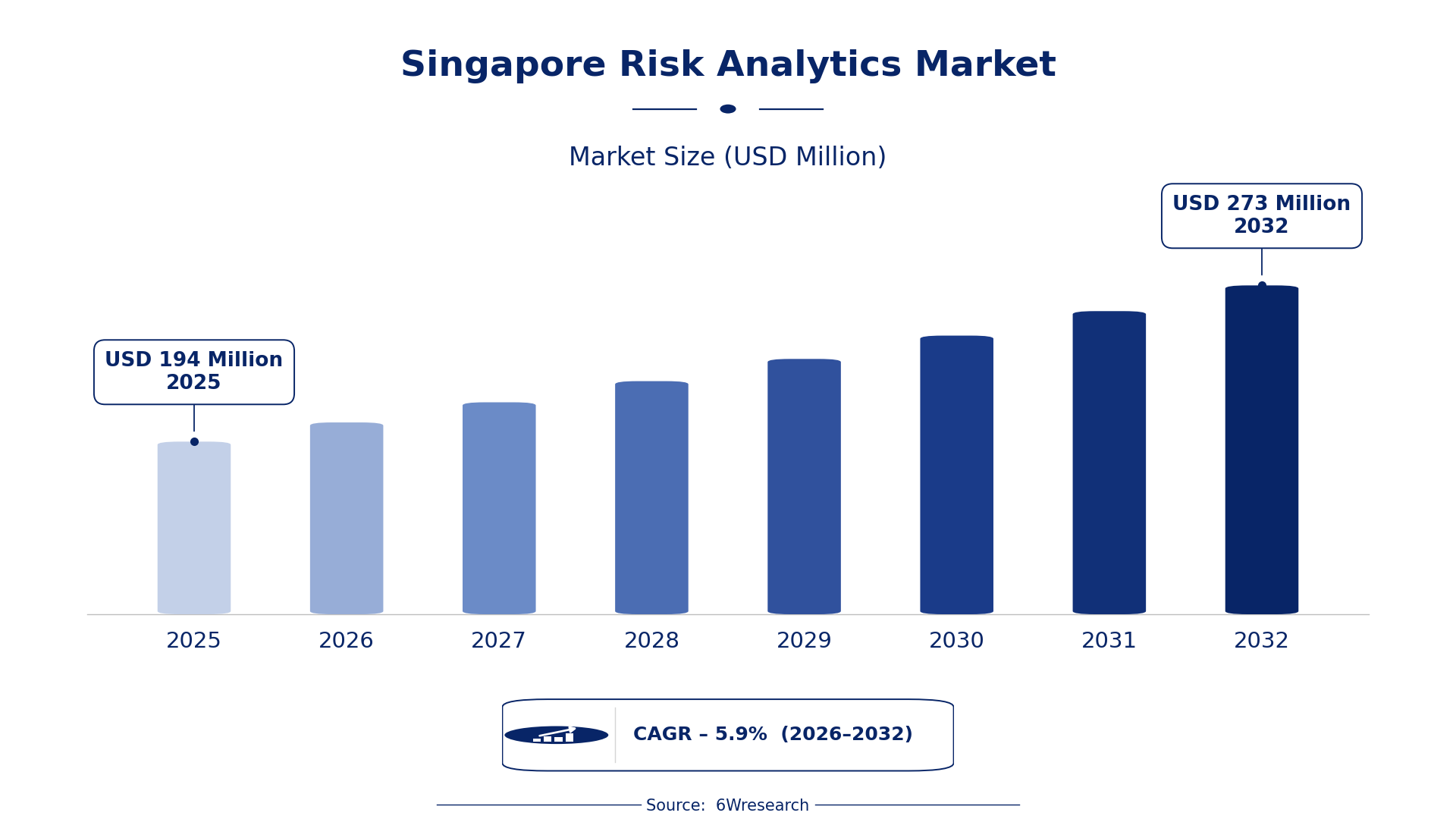
The Singapore Risk Analytics Market was estimated at USD 194 Million in 2025 and is projected to reach USD 273 Million by 2032, growing at a CAGR of 5.9% from 2026 to 2032.
Singapore Risk Analytics Market Synopsis
The Singapore Risk Analytics market has gained notable momentum, driven by heightened awareness of risk management across industries. As organizations grapple with the complexities of risk in a digital age, the demand for advanced analytics solutions is surging, particularly in finance, cybersecurity, and supply chain sectors.
Looking ahead, the market is positioned for substantial growth as businesses increasingly recognize the value of predictive analytics. The evolution of regulatory frameworks and a growing digital ecosystem will further catalyze investments in risk analytics, ensuring organizations are equipped to handle emerging threats effectively.
Singapore Risk Analytics Market Year-wise Growth Rate and Key Drivers
This graph illustrates the annual growth rates of the Singapore Risk Analytics Market from 2021 to 2032, highlighting a steady upward trajectory and projected expansion over the forecast period.
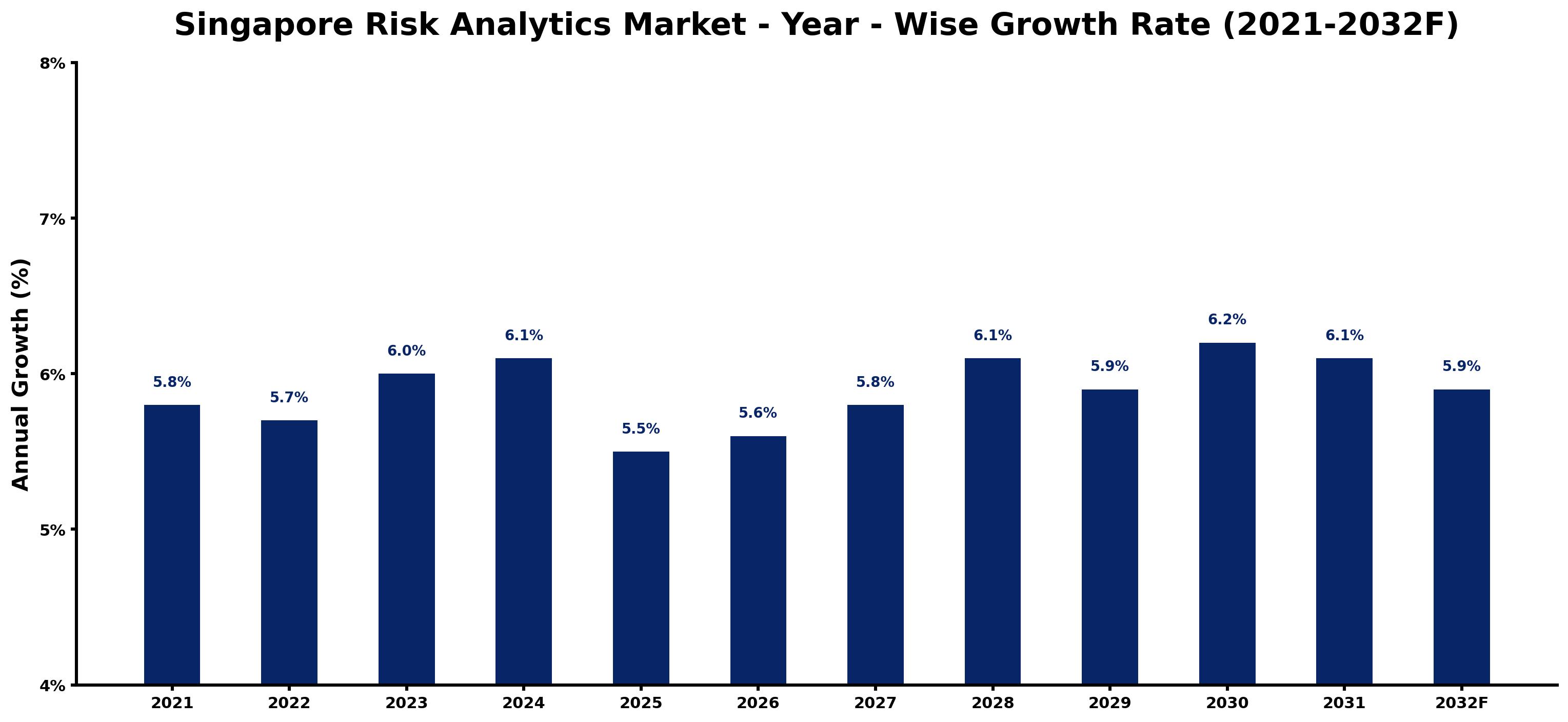
The table below presents the year‑wise growth rates along with the key drivers influencing the market
| Year | Growth Rate | Major Drivers |
| 2021 | 5.8% | Monetary Authority of Singapore's financial sector transformation push. |
| 2022 | 5.7% | Increase in regulatory compliance requirements for financial institutions. |
| 2023 | 6.0% | Growing use of AI in fraud detection systems. |
| 2024 | 6.1% | Focus on sustainable finance and risk management practices. |
| 2025 | 5.5% | Emergence of data privacy laws enhancing risk assessment needs. |
| 2026 | 5.6% | Rising adoption of blockchain for transparent audit trails. |
| 2027 | 5.8% | Increased digital payment penetration boosting transaction risk analytics. |
| 2028 | 6.1% | Government initiatives supporting fintech innovations in risk strategies. |
| 2029 | 5.9% | Demand for integrated risk solutions amidst economic uncertainty. |
| 2030 | 6.2% | Cybersecurity incidents prompting enhanced risk evaluation frameworks. |
| 2031 | 6.1% | Digital transformation of SMEs driving analytics demand and adoption. |
| 2032 | 5.9% | Increased regulatory pressure on ESG risk disclosures for firms. |
Note: Market size estimations and growth projections presented in this report are based on 6Wresearch's proprietary forecasting methodology, utilizing the latest available industry data, government publications, and primary research inputs.
Singapore Risk Analytics Market Key Takeaways
Below are some of the specific key takeaways from the market, including:
- The market is projected to witness a steady growth rate, reflecting the increasing need for robust risk management solutions.
- Financial institutions are leading the adoption of risk analytics, driven by regulatory compliance and the need for operational resilience.
- AI and big data technologies are transforming how organizations assess and mitigate risks.
- Cybersecurity threats are a primary concern, driving investments in risk analytics across various sectors.
- The COVID-19 pandemic has underscored the importance of agile risk management strategies.
Evaluation of Restraints in Singapore Risk Analytics Market
Despite its growth potential, the Singapore Risk Analytics market faces significant restraints. One primary concern is the challenge of adapting analytics models to emerging risks, which requires constant innovation and flexibility. Additionally, ensuring data quality for accurate risk assessment remains a critical hurdle. Organizations also struggle to keep pace with evolving regulatory requirements, which complicates compliance and necessitates ongoing investment in updated analytics solutions.
Singapore Risk Analytics Market Trends
Current trends indicate a shift towards more integrated risk management solutions that combine financial, operational, and cybersecurity analytics. Organizations are increasingly prioritizing real-time data analysis to respond promptly to potential threats. The growing adoption of cloud-based solutions is also reshaping the market, offering enhanced scalability and flexibility for businesses.
on top of that, the use of AI and machine learning in risk analytics is on the rise. These technologies enable organizations to not only predict risks with greater accuracy but also automate response strategies, streamlining operations and reducing human error.
Singapore Risk Analytics Market Opportunities
Investors and companies looking to enter the Singapore Risk Analytics market will find several growth opportunities. The ongoing digital transformation across industries presents a fertile ground for innovative analytics solutions. Additionally, the increasing focus on regulatory compliance in financial services creates demand for specialized risk analytics tools.
Emerging sectors such as e-commerce and fintech also present new avenues for investment, as these areas are particularly vulnerable to risks that require advanced analytics to manage effectively. As organizations prioritize cybersecurity, the demand for sophisticated risk assessment tools is likely to escalate, providing ample opportunities for growth.
Government Initiatives in the Singapore Risk Analytics Market
The Singapore government plays a crucial role in shaping the Risk Analytics market through various initiatives aimed at enhancing regulatory frameworks and supporting technological advancements. With a strong emphasis on cybersecurity and financial stability, government policies are geared towards fostering a resilient business environment, which is essential for attracting investment in risk analytics solutions.
- A recently completed initiative included the launch of a national cybersecurity strategy, focusing on enhancing the security posture of organizations across sectors.
- Currently, the government is conducting public consultations to update regulatory frameworks that govern risk management practices in financial institutions.
- Upcoming initiatives include a planned public-private partnership to develop a comprehensive risk analytics framework aimed at improving operational resilience in SMEs.
- The Monetary Authority of Singapore has introduced guidelines promoting the adoption of advanced analytics in financial services, emphasizing compliance and risk mitigation.
- Ongoing efforts include funding for research and development in AI-driven risk analytics solutions, aimed at boosting innovation in the sector.
Future Insights of the Singapore Risk Analytics Market
Looking toward 2026-2032, the Singapore Risk Analytics market is expected to expand significantly. As organizations increasingly integrate risk analytics into their core strategies, the emphasis will be on predictive capabilities and real-time risk assessment. The continuous evolution of regulatory requirements will further drive the need for sophisticated analytics solutions. Innovations in AI and data processing technologies will likely enhance the capabilities of risk analytics tools, solidifying their importance across various industries.
Singapore Risk Analytics Market Latest Developments
Recent developments in the Singapore Risk Analytics market indicate a vibrant and rapidly evolving sector. Companies are increasingly launching new products and services that integrate advanced analytics with risk management practices. As businesses respond to the dynamic risk environment, ongoing investments in technology are becoming a priority.
- A leading regional operator launched an AI-powered risk analytics platform in early 2025, enhancing capabilities for financial institutions to assess credit risks.
- In mid-2025, a major technology vendor began a partnership with local universities to develop innovative risk management solutions leveraging big data.
- A service upgrade was completed in late 2025, enabling businesses to access real-time analytics for supply chain risk management.
- Currently, an initiative is underway to expand the adoption of cloud-based risk analytics tools among SMEs, aimed at enhancing accessibility and affordability.
- Looking ahead, a rollout of a national risk analytics training program is expected to begin in late 2026, focusing on upskilling professionals in the sector.
Singapore Risk Analytics Market - Key Attractiveness of the Report
- 10 Years of Market Numbers
- Historical Data Starting from 2022 to 2025
- Base Year: 2025
- Forecast Data until 2032
- Key Performance Indicators Impacting the Market
- Major Upcoming Developments and Projects
Key Highlights of the Report:
- Singapore Risk Analytics Market Outlook
- Market Size of Singapore Risk Analytics Market, 2025
- Forecast of Singapore Risk Analytics Market, 2032
- Historical Data and Forecast of Singapore Risk Analytics Revenues & Volume for the Period 2022-2032F
- Singapore Risk Analytics Market Trend Evolution
- Singapore Risk Analytics Market Drivers and Challenges
- Singapore Risk Analytics Price Trends
- Singapore Risk Analytics Porter's Five Forces
- Singapore Risk Analytics Industry Life Cycle
- Historical Data and Forecast of Singapore Risk Analytics Market Revenues & Volume By Component for the Period 2022-2032F
- Historical Data and Forecast of Singapore Risk Analytics Market Revenues & Volume By Software (ETL Tools, Risk Calculation Engines, GRC Software) for the Period 2022-2032F
- Historical Data and Forecast of Singapore Risk Analytics Market Revenues & Volume By Services for the Period 2022-2032F
- Historical Data and Forecast of Singapore Risk Analytics Market Revenues & Volume By Risk Type for the Period 2022-2032F
- Historical Data and Forecast of Singapore Risk Analytics Market Revenues & Volume By Strategic Risk for the Period 2022-2032F
- Historical Data and Forecast of Singapore Risk Analytics Market Revenues & Volume By Operational Risk for the Period 2022-2032F
- Historical Data and Forecast of Singapore Risk Analytics Market Revenues & Volume By Financial Risk for the Period 2022-2032F
- Historical Data and Forecast of Singapore Risk Analytics Market Revenues & Volume By Deployment Mode for the Period 2022-2032F
- Historical Data and Forecast of Singapore Risk Analytics Market Revenues & Volume By Cloud for the Period 2022-2032F
- Historical Data and Forecast of Singapore Risk Analytics Market Revenues & Volume By On-premises for the Period 2022-2032F
- Historical Data and Forecast of Singapore Risk Analytics Market Revenues & Volume By Organization Size for the Period 2022-2032F
- Historical Data and Forecast of Singapore Risk Analytics Market Revenues & Volume By Large enterprises for the Period 2022-2032F
- Historical Data and Forecast of Singapore Risk Analytics Market Revenues & Volume By Small and medium-sized enterprises (SMEs) for the Period 2022-2032F
- Historical Data and Forecast of Singapore Risk Analytics Market Revenues & Volume By Vertical for the Period 2022-2032F
- Historical Data and Forecast of Singapore Risk Analytics Market Revenues & Volume By Banking and Financial Services for the Period 2022-2032F
- Historical Data and Forecast of Singapore Risk Analytics Market Revenues & Volume By Insurance for the Period 2022-2032F
- Historical Data and Forecast of Singapore Risk Analytics Market Revenues & Volume By Manufacturing for the Period 2022-2032F
- Historical Data and Forecast of Singapore Risk Analytics Market Revenues & Volume By Transportation and Logistics for the Period 2022-2032F
- Historical Data and Forecast of Singapore Risk Analytics Market Revenues & Volume By Retail and Consumer Goods for the Period 2022-2032F
- Historical Data and Forecast of Singapore Risk Analytics Market Revenues & Volume By IT and Telecom for the Period 2022-2032F
- Historical Data and Forecast of Singapore Risk Analytics Market Revenues & Volume By Government and Defense for the Period 2022-2032F
- Historical Data and Forecast of Singapore Risk Analytics Market Revenues & Volume By Healthcare and Life Sciences for the Period 2022-2032F
- Singapore Risk Analytics Import Export Trade Statistics
- Market Opportunity Assessment By Component
- Market Opportunity Assessment By Risk Type
- Market Opportunity Assessment By Deployment Mode
- Market Opportunity Assessment By Organization Size
- Market Opportunity Assessment By Vertical
- Singapore Risk Analytics Top Companies Market Share
- Singapore Risk Analytics Competitive Benchmarking By Technical and Operational Parameters
- Singapore Risk Analytics Company Profiles
- Singapore Risk Analytics Key Strategic Recommendations






































