Singapore Salon Service Market Size, Share & Growth Rate
The Singapore Salon Service Market was estimated at USD 233 Million in 2025 and is projected to reach USD 306 Million by 2032, growing at a CAGR of 4.0% from 2026 to 2032. This growth trajectory can be attributed to the increasing importance consumers place on personal grooming and well-being, along with a rise in disposable income that allows for greater investment in professional services. Coupled with an evolving landscape driven by beauty trends and social media influence, the market is poised for sustained expansion.
Singapore Salon Service Market Year-wise Growth Rate and Key Drivers
This graph highlights how the Singapore Salon Service Market has steadily grown over the years, supported by major growth factors.
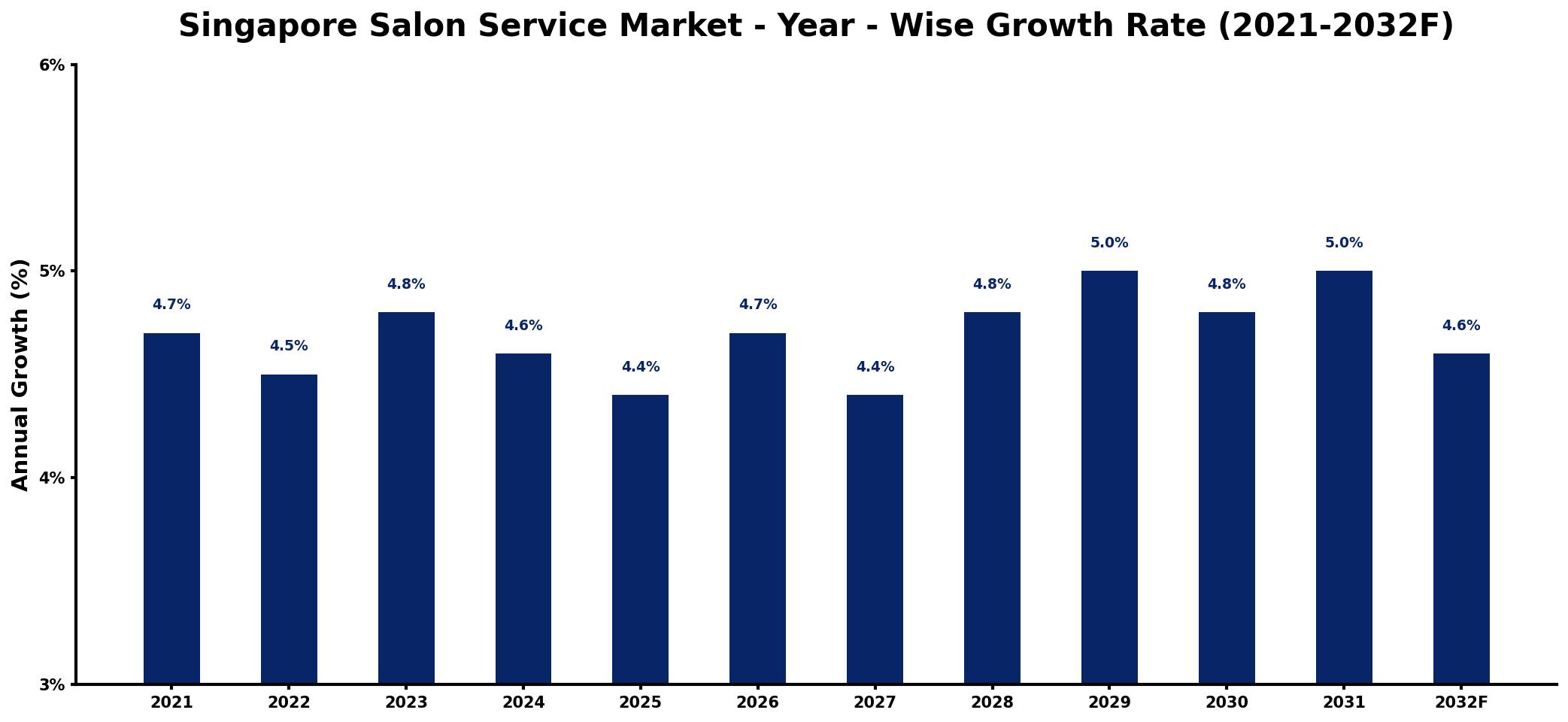
The table below presents the year‑wise growth rates along with the key drivers influencing the market
| Year | Growth Rate | Major Drivers |
| 2021 | 4.7% | Increased demand for beauty treatments |
| 2022 | 4.5% | Growth in personal grooming awareness |
| 2023 | 4.8% | Rise in disposable income levels |
| 2024 | 4.6% | Expansion of wellness tourism sector |
| 2025 | 4.4% | Emergence of new beauty trends |
| 2026 | 4.7% | Increase in online appointment bookings |
| 2027 | 4.4% | rising infrastructure development spending |
| 2028 | 4.8% | Surge in social media influence |
| 2029 | 5.0% | Investment in luxury wellness experiences |
| 2030 | 4.8% | Development of advanced beauty technologies |
| 2031 | 5.0% | rising procurement volume requirements |
| 2032 | 4.6% | rising demand from electronics |
Note: Market size estimations and growth projections presented in this report are based on 6Wresearch's proprietary forecasting methodology, utilizing the latest available industry data, government publications, and primary research inputs.
Singapore Salon Service Market Synopsis
The Singapore salon service market has demonstrated robust momentum in recent years, fueled by heightened consumer focus on grooming and wellness. Despite the challenges posed by the pandemic, the industry is now pivoting towards innovative solutions and personalized experiences that resonate with the modern consumer. This shift signifies not just a recovery, but a transformation in how salon services are perceived and utilized.
As we look ahead, the market is on the brink of further evolution, integrating advanced technologies and customized treatments that cater to individual preferences. This evolution is reflective of Singapores cultural emphasis on self-care and aesthetic appeal, ensuring that salon services remain a crucial component of the beauty and personal care sector.
Singapore Salon Service Market Key Takeaways
- The market shows a promising growth trajectory, with increasing consumer demand for professional services.
- Changing beauty trends and social media influence are significantly impacting consumer behavior.
- Salons are pivoting towards personalized and eco-friendly offerings to meet evolving preferences.
- Flexibility and adaptability remain critical for survival and success, particularly in response to fluctuating customer traffic.
- The importance of skilled personnel is paramount, driving salons to invest in staff training and development.
Evaluation of Restraints in Singapore Salon Service Market
While the Singapore salon service market is flourishing, it faces certain restraints that can impede growth. A significant challenge is the shifting consumer demand towards personalized and environmentally sustainable salon services. This shift necessitates salon owners to invest in advanced training and carefully sourced products, which can strain operational budgets. Moreover, the competitive landscape is intense, with the constant need for salons to differentiate themselves in a crowded market. The impact of external factors, such as economic fluctuations and public health crises like COVID-19, has highlighted the vulnerability of customer traffic to changing circumstances, necessitating robust strategies for resilience.
Singapore Salon Service Market Trends
In today's dynamic beauty landscape, several key trends are emerging within the Singapore salon service market. Firstly, the increasing preference for personalized services is reshaping offerings, with salons tailoring treatments to meet individual customer needs. Additionally, eco-friendly practices are gaining traction, as consumers express a growing awareness of sustainability and are drawn to salons that reflect their values. The integration of technology, such as online booking systems and virtual consultations, is also transforming the customer experience, making it more convenient and accessible. Moreover, the influence of social media and beauty influencers continues to accelerate awareness and demand for innovative services and trends.
Singapore Salon Service Market Opportunities
The Singapore salon service market is rife with opportunities for growth and investment. Emerging trends suggest that salons focusing on personalized experiences and sustainable practices will be well-positioned for success. Additionally, the rising demand for at-home and mobile salon services provides a pathway for salons to reach customers in innovative ways. Strategic partnerships with beauty brands and influencers can further enhance visibility and market reach, driving new customer acquisitions. As the market continues to rebound post-pandemic, theres an opportunity for salons to reinvent their service models, capitalizing on the growing emphasis on wellness and self-care.
Government Initiatives in the Singapore Salon Service Market
The Singapore government has shown a commitment to supporting the beauty and personal care industry through various initiatives and public spending programs. These include funding for skills training and development within the sector, aimed at equipping professionals with the latest techniques and best practices. Additionally, government agencies have introduced health and safety guidelines to support salons in maintaining a safe environment for both employees and customers, particularly in the wake of the COVID-19 pandemic. Such initiatives not only help to strengthen the industry but also promote consumer confidence in salon services.
Future Insights of the Singapore Salon Service Market
Looking forward to 2026-2032, the Singapore salon service market is poised for considerable growth and transformation. The ongoing emphasis on personal grooming, coupled with technological advancements, will redefine service offerings. As consumer preferences continue to evolve towards more personalized and sustainable practices, salons that adapt quickly will thrive. Additionally, emerging wellness trends are likely to drive the demand for spa and holistic treatments, expanding the scope of services that salons provide. With a combination of innovation and commitment to customer satisfaction, the market is expected to navigate potential challenges and seize new opportunities effectively.
Singapore Salon Service Market Latest Developments (2025 - 2026)
Recent months have witnessed significant shifts in the Singapore salon service market, reflecting evolving consumer needs and industry dynamics. Salons have increasingly embraced digital transformation, enhancing their online presence and offering virtual consultations to engage customers. Additionally, many establishments are incorporating eco-friendly products and practices in response to consumer demand for sustainable options. A renewed focus on health and safety protocols remains essential, as salons prioritize customer and staff well-being in their operations. As recovery efforts continue, these trends highlight the resilience of the industry amidst changing conditions.
Singapore Salon Service Market - Key Attractiveness of the Report
- 10 Years of Market Numbers
- Historical Data Starting from 2022 to 2025
- Base Year: 2025
- Forecast Data until 2032
- Key Performance Indicators Impacting the Market
- Major Upcoming Developments and Projects
Key Highlights of the Report:
- Singapore Salon Service Market Outlook
- Market Size of Singapore Salon Service Market, 2025
- Forecast of Singapore Salon Service Market, 2032
- Historical Data and Forecast of Singapore Salon Service Revenues & Volume for the Period 2022-2032F
- Singapore Salon Service Market Trend Evolution
- Singapore Salon Service Market Drivers and Challenges
- Singapore Salon Service Price Trends
- Singapore Salon Service Porter's Five Forces
- Singapore Salon Service Industry Life Cycle
- Historical Data and Forecast of Singapore Salon Service Market Revenues & Volume By Service Type for the Period 2022-2032F
- Historical Data and Forecast of Singapore Salon Service Market Revenues & Volume By Hair for the Period 2022-2032F
- Historical Data and Forecast of Singapore Salon Service Market Revenues & Volume By Skin for the Period 2022-2032F
- Historical Data and Forecast of Singapore Salon Service Market Revenues & Volume By Foot for the Period 2022-2032F
- Historical Data and Forecast of Singapore Salon Service Market Revenues & Volume By Nails for the Period 2022-2032F
- Historical Data and Forecast of Singapore Salon Service Market Revenues & Volume By Gender for the Period 2022-2032F
- Historical Data and Forecast of Singapore Salon Service Market Revenues & Volume By Men for the Period 2022-2032F
- Historical Data and Forecast of Singapore Salon Service Market Revenues & Volume By Women for the Period 2022-2032F
- Historical Data and Forecast of Singapore Salon Service Market Revenues & Volume By Services Taken for the Period 2022-2032F
- Historical Data and Forecast of Singapore Salon Service Market Revenues & Volume By Single for the Period 2022-2032F
- Historical Data and Forecast of Singapore Salon Service Market Revenues & Volume By Multiple for the Period 2022-2032F
- Singapore Salon Service Import Export Trade Statistics
- Market Opportunity Assessment By Service Type
- Market Opportunity Assessment By Gender
- Market Opportunity Assessment By Services Taken
- Singapore Salon Service Top Companies Market Share
- Singapore Salon Service Competitive Benchmarking By Technical and Operational Parameters
- Singapore Salon Service Company Profiles
- Singapore Salon Service Key Strategic Recommendations






































