Singapore Scissors and Shears Market Summary
The singapore scissors and shears market was estimated at USD 202 Million in 2025 and is projected to reach USD 286 Million by 2032, growing at a CAGR of 6.2% from 2026 to 2032.
Singapore Scissors and Shears Market Year-wise Growth Rate and Key Drivers
This graph highlights how the Singapore Scissors and Shears Market has steadily grown over the past five years, supported by major growth factors.
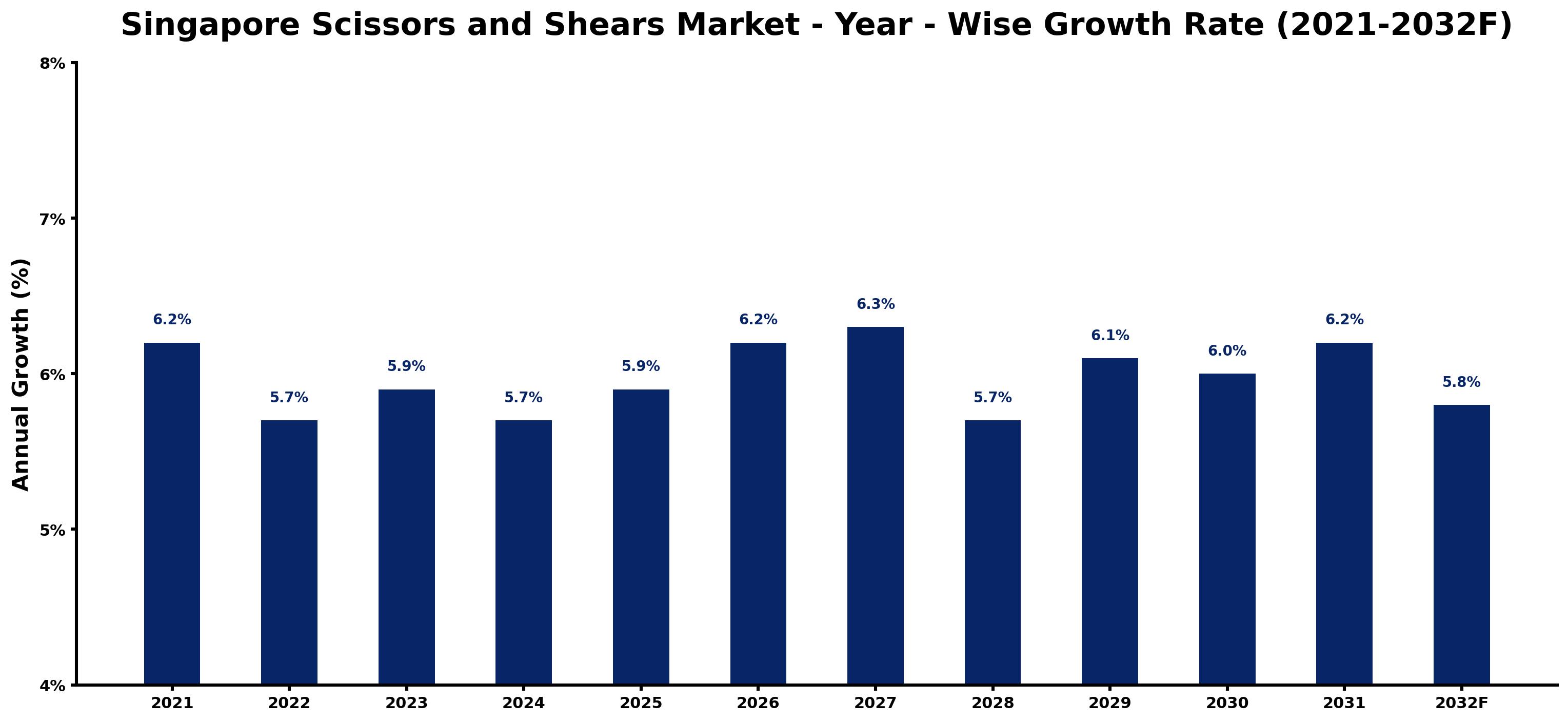
The table below presents the year wise growth rates along with the key drivers influencing the market
| Year | Growth Rate | Major Drivers |
| 2021 | 6.2% | Post-lockdown retail projects boost consumer interest in high-quality cutting tools. |
| 2022 | 5.7% | Urban gardening trends generate demand for specialized shears among hobbyist gardeners. |
| 2023 | 5.9% | E-commerce platforms influence purchasing behaviors, expanding market reach for scissors brands. |
| 2024 | 5.7% | Luxury home decor initiatives increase sales of designer scissors and shears. |
| 2025 | 5.9% | Innovative designs attract millennials seeking stylish, functional kitchen tools. |
| 2026 | 6.2% | Sustainability trends drive interest in eco-friendly materials for scissors production. |
| 2027 | 6.3% | Collaborations with local artists enhance product visibility in niche markets. |
| 2028 | 5.7% | Work-from-home culture solidifies need for high-quality office supplies, including shears. |
| 2029 | 6.1% | Education sector investments lead to bulk purchases of scissors for schools. |
| 2030 | 6.0% | Technological advancements introduce smart scissors, appealing to tech-savvy consumers. |
| 2031 | 6.2% | Health and wellness movements promote ergonomic scissors, enhancing user comfort. |
| 2032 | 5.8% | Export opportunities in Southeast Asia expand the market for premium shears. |
Note - Market size estimations and growth projections presented in this report are based on 6Wresearch's advanced forecasting approach, validated with industry datasets as of June 2026.
Singapore Scissors and Shears Market Synopsis
The Singapore Scissors and Shears Market is projected to reach 6.2% and witness significant growth during the forecast period (2026-2032). Scissors and shears, essential tools for various applications, are experiencing increasing demand attributed to a variety of factors influencing consumer behavior and market dynamics. Scissors, defined by their hand-operated design with two pivoted blades, are used for a range of cutting tasks, whereas shears possess a similar mechanism but are typically designed to cut through thicker materials.
Singapore Scissors and Shears Market Growth Drivers
The evolution of the Singapore scissors and shears market is primarily fueled by several key growth drivers:
- Rising disposable incomes among households in Singapore contribute significantly to spending on personal care items, including grooming tools.
- Consumer awareness regarding the importance of personal grooming is at an all-time high, leading to increased purchases of scissors and shears tailored for professional and home use.
- Innovations in product design, particularly ergonomic models, enhance user experience, making cutting tasks more comfortable and efficient.
- The proliferation of e-commerce platforms has expanded market reach, enabling consumers to access a wider variety of scissors and shears than ever before.
- Expansion of retail outlets across the region allows for greater physical availability of these tools, further boosting sales growth.
Singapore Scissors and Shears Market Trends and Opportunities
As the Singapore scissors and shears market evolves, several trends and opportunities are emerging:
- The increasing popularity of DIY home projects drives demand for high-performance scissors and shears, as consumers seek quality tools for craft and home improvement activities.
- As sustainability becomes a paramount concern, there is a growing demand for eco-friendly products, including scissors and shears made from recycled materials.
- Customization options offered by various manufacturers cater to specific consumer preferences, allowing for a personalized approach in tool selection.
- Social media and influencer marketing strategies are shaping consumer purchasing behavior, particularly among younger individuals who value trendy grooming tools.
- The healthcare and beauty sectors' growth further solidifies the need for scissors and shears, particularly in professional settings such as salons and medical facilities.
Singapore Scissors and Shears Market Challenges and Restraints
Despite the promising growth outlook, there are challenges and restraints that the Singapore scissors and shears market may encounter:
- The presence of counterfeit manufacturers in the market poses significant risks, undercutting legitimate businesses with substandard products.
- Potential health hazards associated with the use of poorly manufactured scissors and shears could lead to consumer hesitancy when making purchases.
- Stringent government regulations surrounding product quality and safety standards can create barriers for new entrants trying to establish themselves in the market.
- Market saturation in certain segments may limit growth opportunities for companies, necessitating innovation and differentiation strategies.
- Economic fluctuations could impact consumer spending habits, causing a ripple effect in the personal care and grooming tool market.
Singapore Scissors and Shears Market Government Investment and Initiatives
The Singapore government has recognized the importance of the personal care market, including the scissors and shears sector, and implemented several initiatives to support its growth:
- Investment in research and development is encouraged through various grants and funding opportunities aimed at enhancing product innovation.
- Government policies focus on promoting sustainable manufacturing practices, providing incentives for companies that prioritize eco-friendly production methods.
- Public spending on vocational training and skill development in the beauty and personal care sectors indirectly benefits the demand for professional grooming tools.
- Regulatory frameworks have been established to ensure product safety and quality, fostering consumer confidence and market integrity.
- Collaborations between government entities and private sector stakeholders aim to enhance the competitiveness of local manufacturers in the global market.
Singapore Scissors and Shears Market Latest Developments (May 2025 - June 2026)
Recent developments in the Singapore scissors and shears market indicate a positive shift towards recovery following the disruptions caused by the COVID-19 pandemic. With the easing of restrictions, consumer confidence is gradually rebuilding, leading to a resurgence in demand for grooming tools. Industry players are increasingly focusing on diversifying product offerings and enhancing online retail presence to capture the attention of a broader audience. Moreover, collaborations among manufacturers and technology providers are becoming more common, aimed at introducing innovative features that enhance user experience. Overall, the market development trajectory remains optimistic as consumer preferences continue to evolve.
Singapore Scissors and Shears Market - Key Attractiveness of the Report
- 10 Years of Market Numbers
- Historical Data Starting from 2022 to 2025
- Base Year: 2025
- Forecast Data until 2032
- Key Performance Indicators Impacting the Market
- Major Upcoming Developments and Projects
Key Highlights of the Report:
- Singapore Scissors and Shears Market Outlook
- Market Size of Singapore Scissors and Shears Market, 2025
- Forecast of Singapore Scissors and Shears Market, 2032F
- Historical Data and Forecast of Singapore Scissors and Shears Revenues & Volume for the Period 2022-2032F
- Singapore Scissors and Shears Market Trend Evolution
- Singapore Scissors and Shears Market Drivers and Challenges
- Singapore Scissors and Shears Price Trends
- Singapore Scissors and Shears Porter's Five Forces
- Singapore Scissors and Shears Industry Life Cycle
- Historical Data and Forecast of Singapore Scissors and Shears Market Revenues & Volume By Type for the Period 2022-2032F
- Historical Data and Forecast of Singapore Scissors and Shears Market Revenues & Volume By Scissors for the Period 2022-2032F
- Historical Data and Forecast of Singapore Scissors and Shears Market Revenues & Volume By Shears for the Period 2022-2032F
- Historical Data and Forecast of Singapore Scissors and Shears Market Revenues & Volume By Application for the Period 2022-2032F
- Historical Data and Forecast of Singapore Scissors and Shears Market Revenues & Volume By Residential for the Period 2022-2032F
- Historical Data and Forecast of Singapore Scissors and Shears Market Revenues & Volume By Non-Residential for the Period 2022-2032F
- Singapore Scissors and Shears Import Export Trade Statistics
- Market Opportunity Assessment By Type
- Market Opportunity Assessment By Application
- Singapore Scissors and Shears Top Companies Market Share
- Singapore Scissors and Shears Competitive Benchmarking By Technical and Operational Parameters
- Singapore Scissors and Shears Company Profiles
- Singapore Scissors and Shears Key Strategic Recommendations






































