Singapore Self-Driving Truck Market Size, Share & Growth Rate
The Singapore Self-Driving Truck Market was estimated at USD 240 Million in 2025 and is projected to reach USD 334 Million by 2032, growing at a CAGR of 4.8% from 2026 to 2032. This growth trajectory reflects increasing investments in logistics technology and a pressing demand for efficiency within the transportation sector. The rise of e-commerce and a focus on automation are poised to further bolster the adoption of self-driving trucks in Singapore, emphasizing safety and reliability in freight transportation.
Singapore Self-Driving Truck Market Year-wise Growth Rate and Key Drivers
This graph highlights how the Singapore Self-Driving Truck Market has steadily grown over the years, supported by major growth factors.
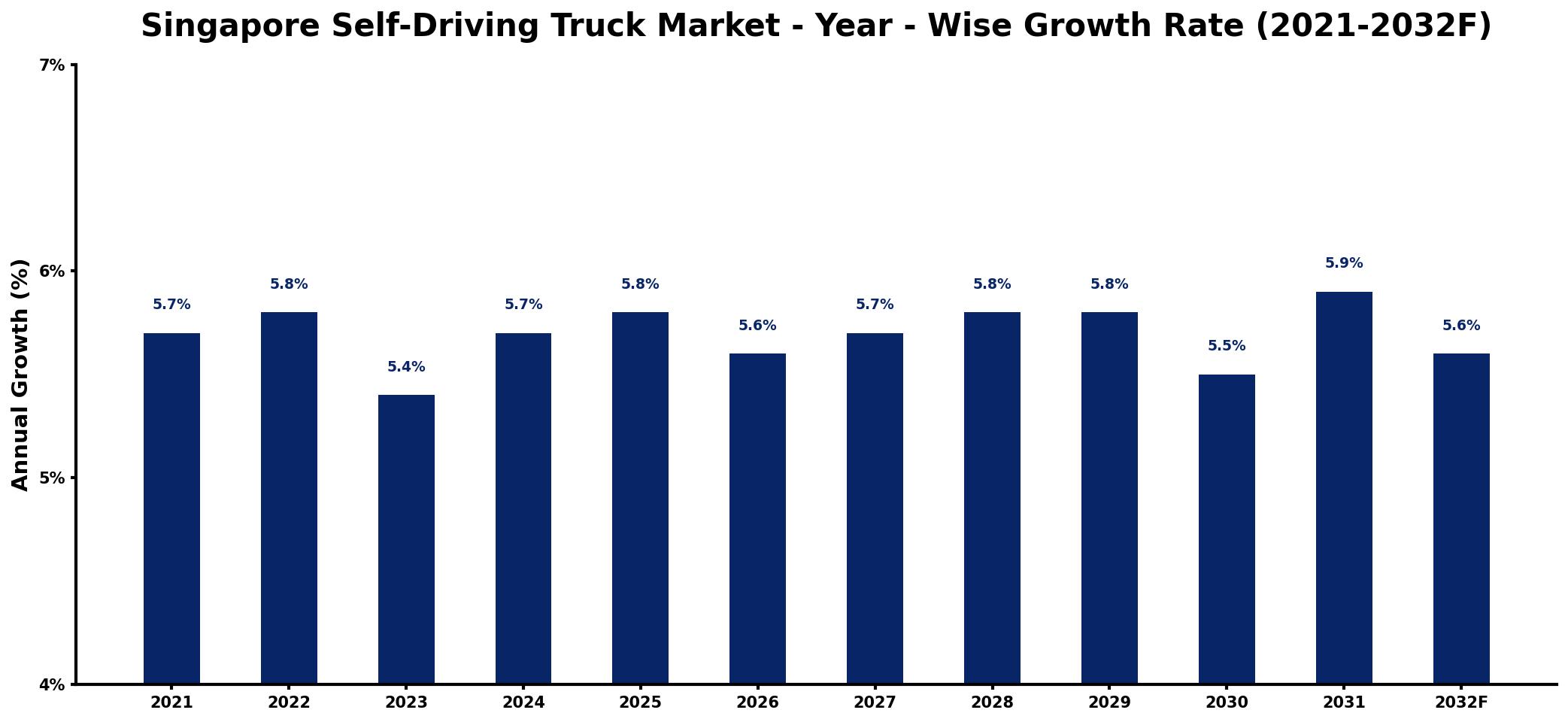
The table below presents the year‑wise growth rates along with the key drivers influencing the market
| Year | Growth Rate | Major Drivers |
| 2021 | 5.7% | Increased logistics automation adoption |
| 2022 | 5.8% | Growing demand for freight efficiency |
| 2023 | 5.4% | Expansion of smart city initiatives |
| 2024 | 5.7% | Rising infrastructure investment projects |
| 2025 | 5.8% | Higher focus on sustainability efforts |
| 2026 | 5.6% | Technological advancements in AI |
| 2027 | 5.7% | Surge in e-commerce logistics needs |
| 2028 | 5.8% | Development of autonomous fleet solutions |
| 2029 | 5.8% | Increased public-private partnerships initiatives |
| 2030 | 5.5% | Growth in urban delivery services |
| 2031 | 5.9% | increased capital investment inflows |
| 2032 | 5.6% | Rising interest in cost reduction |
Note: Market size estimations and growth projections presented in this report are based on 6Wresearch's proprietary forecasting methodology, utilizing the latest available industry data, government publications, and primary research inputs.
Singapore Self-Driving Truck Market Synopsis
The demand for self-driving trucks in Singapore is largely driven by the need for enhanced supply chain efficiency and the integration of advanced technology in logistics. As businesses seek cost-effective solutions to meet growing consumer demands, autonomous trucks emerge as a viable option to streamline operations.
Furthermore, the implementation of smart city initiatives in Singapore is creating a conducive environment for the testing and deployment of autonomous vehicles. This holistic approach not only addresses traffic congestion but also promotes sustainability, making self-driving trucks an integral part of the future transportation landscape.
Singapore Self-Driving Truck Market Key Takeaways
- The market is expected to witness robust growth, driven by advancements in technology and logistics automation.
- Increased focus on supply chain efficiency is propelling the demand for reliable self-driving solutions.
- Regulatory developments will play a crucial role in shaping market dynamics and ensuring safety standards.
- The COVID-19 pandemic highlighted the importance of resilient logistics operations, boosting interest in autonomous transport.
- Collaboration between local authorities and tech developers will be essential for successful market penetration.
Evaluation of Restraints in Singapore Self-Driving Truck Market
Despite the promising outlook, several restraints may hinder the Singapore self-driving truck market. Foremost among these are regulatory complexities surrounding autonomous vehicle operations. Ensuring compliance with safety standards while navigating local traffic regulations presents a significant challenge. Moreover, the market must contend with competition from traditional trucking services, which remain deeply rooted in established operational practices. Addressing these hurdles will be crucial for realizing the full potential of autonomous freight logistics.
Singapore Self-Driving Truck Market Trends
Several key trends are emerging in the Singapore self-driving truck market. The push towards sustainability is driving interest in electric autonomous trucks that not only reduce emissions but also optimize operational costs. Additionally, the integration of AI and machine learning in logistics is enhancing route planning and freight tracking capabilities. As companies strive for efficiency, smart fleet management solutions incorporating autonomous technology are becoming increasingly appealing.
Singapore Self-Driving Truck Market Opportunities
The Singapore self-driving truck market offers numerous opportunities for growth and investment. Companies can capitalize on the increasing demand for automated logistics by developing tailored solutions that cater to the specific needs of local businesses. Furthermore, partnerships with government entities can pave the way for pilot programs and testbeds to facilitate the deployment of autonomous trucks, ultimately fostering innovation in the logistics sector.
Government Initiatives in the Singapore Self-Driving Truck Market
The Singapore government has shown a proactive stance in supporting the self-driving truck market through various initiatives. Public spending on infrastructure improvements aims to create a conducive environment for autonomous vehicles. Programs focusing on research and development, alongside regulatory frameworks designed to ensure safety and efficiency in autonomous operations, are critical components of the governments strategy. These initiatives aim to position Singapore as a leader in the adoption of autonomous transport technologies.
Future Insights of the Singapore Self-Driving Truck Market
Looking ahead to 2026-2032, the Singapore self-driving truck market is anticipated to evolve significantly. Technological advancements in autonomous vehicle capabilities will further enhance operational efficiency and safety, making self-driving trucks a staple in logistics. As the regulatory landscape matures, increased deployment of these vehicles is expected to reduce traffic congestion and support Singapores smart city vision. The interplay between innovation, regulatory support, and market demand will ultimately dictate the pace of growth and adoption in this transformative sector.
Singapore Self-Driving Truck Market Latest Developments (2025 - 2026)
Recent developments within the Singapore self-driving truck market indicate a growing focus on pilot projects and collaborations aimed at advancing autonomous vehicle technology. Increased investments in research and partnerships between logistics companies and tech developers reflect a strategic shift towards realizing the potential of self-driving solutions. Additionally, ongoing discussions about regulatory frameworks are shaping the future operational landscape, as stakeholders aim to establish safety standards that encourage innovation while ensuring public trust.
Singapore Self-Driving Truck Market - Key Attractiveness of the Report
- 10 Years of Market Numbers
- Historical Data Starting from 2022 to 2025
- Base Year: 2025
- Forecast Data until 2032
- Key Performance Indicators Impacting the Market
- Major Upcoming Developments and Projects
Key Highlights of the Report:
- Singapore Self-Driving Truck Market Outlook
- Market Size of Singapore Self-Driving Truck Market, 2025
- Forecast of Singapore Self-Driving Truck Market, 2032
- Historical Data and Forecast of Singapore Self-Driving Truck Revenues & Volume for the Period 2022-2032F
- Singapore Self-Driving Truck Market Trend Evolution
- Singapore Self-Driving Truck Market Drivers and Challenges
- Singapore Self-Driving Truck Price Trends
- Singapore Self-Driving Truck Porter's Five Forces
- Singapore Self-Driving Truck Industry Life Cycle
- Historical Data and Forecast of Singapore Self-Driving Truck Market Revenues & Volume By Level Of Autonomy for the Period 2022-2032F
- Historical Data and Forecast of Singapore Self-Driving Truck Market Revenues & Volume By Level One for the Period 2022-2032F
- Historical Data and Forecast of Singapore Self-Driving Truck Market Revenues & Volume By Level Two for the Period 2022-2032F
- Historical Data and Forecast of Singapore Self-Driving Truck Market Revenues & Volume By Level Three for the Period 2022-2032F
- Historical Data and Forecast of Singapore Self-Driving Truck Market Revenues & Volume By Level Four for the Period 2022-2032F
- Historical Data and Forecast of Singapore Self-Driving Truck Market Revenues & Volume By Industry Verticals for the Period 2022-2032F
- Historical Data and Forecast of Singapore Self-Driving Truck Market Revenues & Volume By Logistics for the Period 2022-2032F
- Historical Data and Forecast of Singapore Self-Driving Truck Market Revenues & Volume By Construction & Manufacturing for the Period 2022-2032F
- Historical Data and Forecast of Singapore Self-Driving Truck Market Revenues & Volume By Mining for the Period 2022-2032F
- Historical Data and Forecast of Singapore Self-Driving Truck Market Revenues & Volume By Port for the Period 2022-2032F
- Singapore Self-Driving Truck Import Export Trade Statistics
- Market Opportunity Assessment By Level Of Autonomy
- Market Opportunity Assessment By Industry Verticals
- Singapore Self-Driving Truck Top Companies Market Share
- Singapore Self-Driving Truck Competitive Benchmarking By Technical and Operational Parameters
- Singapore Self-Driving Truck Company Profiles
- Singapore Self-Driving Truck Key Strategic Recommendations






































