Singapore Semiconductors and Related Devices Market Summary
The singapore semiconductors and related devices market was estimated at USD 1240 Million in 2025 and is projected to reach USD 2114 Million by 2032, growing at a CAGR of 9.1% from 2026 to 2032.
Singapore Semiconductors and Related Devices Market Year-wise Growth Rate and Key Drivers
This graph highlights how the Singapore Semiconductors and Related Devices Market has steadily grown over the past five years, supported by major growth factors.
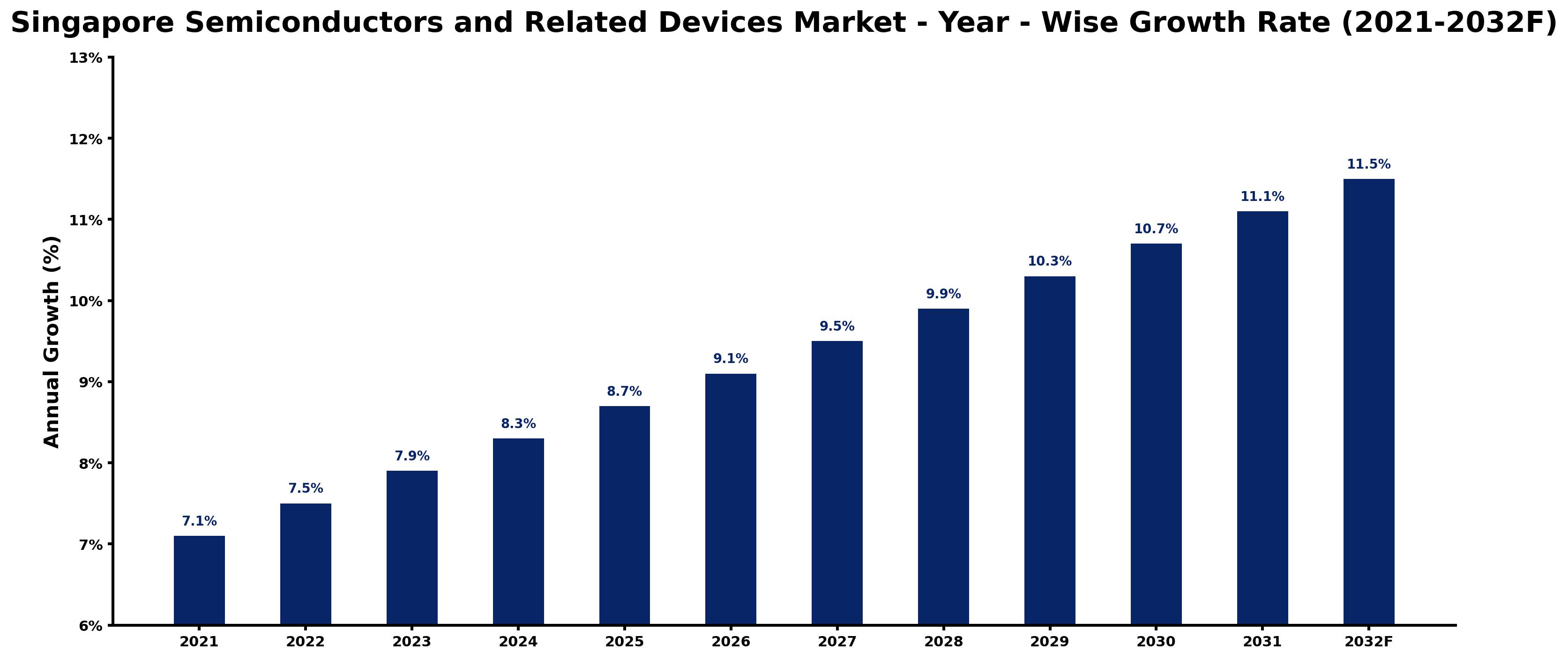
The table below presents the year wise growth rates along with the key drivers influencing the market
| Year | Growth Rate | Major Drivers |
| 2021 | 7.1% | The pandemic-induced digital shift sparked substantial semiconductor demand across multiple sectors. |
| 2022 | 7.5% | Supply chain disruptions revealed vulnerabilities, prompting local semiconductor production investments. |
| 2023 | 7.9% | Key players expanded R&D budgets, focusing on advanced chip technologies and efficiency. |
| 2024 | 8.3% | Increased competition from regional players led to diversification of semiconductor suppliers. |
| 2025 | 8.7% | Electric vehicle integration created exponential demand for specialized semiconductor components. |
| 2026 | 9.1% | IoT device proliferation highlighted the need for more efficient semiconductor solutions. |
| 2027 | 9.5% | Cloud computing investments drove up demand for high-performance semiconductor devices. |
| 2028 | 9.9% | Sustainability initiatives pushed for greener semiconductor manufacturing processes and materials. |
| 2029 | 10.3% | Cybersecurity concerns accelerated the development of secure semiconductor technologies. |
| 2030 | 10.7% | The emergence of 5G networks demanded faster, more reliable semiconductor infrastructure. |
| 2031 | 11.1% | Partnerships between tech firms and startups streamlined innovation in semiconductor applications. |
| 2032 | 11.5% | Market maturation led to consolidation, increasing the focus on specialized semiconductor segments. |
Note - Market size estimations and growth projections presented in this report are based on 6Wresearch's advanced forecasting approach, validated with industry datasets as of June 2026.
Singapore Semiconductors and Related Devices Market Synopsis
The Singapore Semiconductors and Related Devices Market is projected to reach 9.1% and witness significant growth during the forecast period (2026-2032). The country has positioned itself as a pivotal electronics hub, leveraging its advanced operational capabilities, robust basic research, development, and prototyping environments. This strategic focus has enabled local enterprises to innovate and produce an array of technological products, including integrated circuits, semiconductors, optoelectronic components, smart cards, and various display technologies that are integral to consumer electronics.
Singapore Semiconductors and Related Devices Market Growth Drivers
The growth trajectory of the Singapore Semiconductors and Related Devices Market can be attributed to several compelling factors:
- Increasing Demand for Smart Devices: The shifting consumer preference towards smart devices, including smartphones, wearables, and gaming consoles, drives the demand for advanced chipsets. This trend is generating significant opportunities for semiconductor manufacturers to cater to the evolving technological landscape.
- Government Initiatives: With initiatives like the Smart Nation Vision 2030, the Singapore government is emphasizing the adoption of cutting-edge technologies across various sectors. This commitment is expected to escalate the demand for high-performance processors integrated with IoT applications, further propelling the market.
- Investment in Emerging Technologies: Substantial government investment in emerging technologies such as artificial intelligence (AI) and the Internet of Things (IoT) is anticipated to stimulate growth within the semiconductor sector. This focus on innovation is vital for maintaining Singapore's competitive edge in the global market.
- Advancements in Manufacturing Techniques: Continuous innovations in manufacturing processes are enhancing the efficiency and effectiveness of semiconductor production. These advancements are critical in reducing production costs and improving yield rates, which benefit the overall market.
- Growing Adoption of Electric Vehicles: The increasing adoption of electric vehicles (EVs) is contributing to heightened demand for semiconductors due to their extensive use in electric drivetrains and battery management systems.
Singapore Semiconductors and Related Devices Market Challenges and Restraints
Despite the promising growth outlook, the Singapore Semiconductors and Related Devices Market faces several challenges:
- High Competition from Imported Goods: Domestic manufacturers are contending with stiff competition from cheaper imported products, notably from countries like China. This competition poses pricing challenges and can result in tighter profit margins for local firms.
- Supply Chain Disruptions: The global semiconductor supply chain has been significantly impacted by the COVID-19 pandemic, leading to production delays and increased costs. This ongoing instability in the supply chain continues to create uncertainties for domestic manufacturers.
- Rapid Technological Changes: The rapid evolution of technology necessitates continuous investment in research and development. Companies that fail to keep pace with these changes may struggle to remain competitive in this dynamic landscape.
- Regulatory Challenges: Navigating the regulatory environment can be complex for semiconductor companies, particularly when dealing with export controls and compliance with international trade regulations.
- Market Volatility: The semiconductor market is subject to fluctuations driven by changing consumer demand, which can impact production capacity and revenue stability for local manufacturers.
Singapore Semiconductors and Related Devices Market Government Investment and Initiatives
The Singapore government plays a pivotal role in supporting the growth of the semiconductor sector through various initiatives and investments. The government's Smart Nation Vision 2030 acts as a cornerstone policy to enhance the integration of technology in everyday life, which in turn boosts the demand for semiconductors. Additionally, the government actively invests in research and development programs aimed at fostering innovation within the semiconductor industry. This includes funding for educational institutions and public-private collaborations focusing on advanced manufacturing techniques and IoT applications.
Furthermore, public spending on infrastructure enhancements aims to strengthen the country's positioning as a global hub for electronics. Efforts to develop skilled labor through education and training initiatives also contribute to creating a robust workforce that can meet the demands of the semiconductor industry.
Singapore Semiconductors and Related Devices Market Latest Developments (May 2025 - June 2026)
In the period from May 2025 to June 2026, the Singapore Semiconductors and Related Devices Market experienced several notable developments. The government announced further investments in advanced semiconductor manufacturing technologies, aiming to enhance the local production capabilities and reduce dependence on imported components. Additionally, there were efforts to strengthen collaborations between private companies and research institutions, focusing on next-generation semiconductor applications, including AI and machine learning.
Industry stakeholders began exploring new partnerships to address supply chain challenges exacerbated by previous disruptions, with an emphasis on diversification and resilience. Moreover, discussions surrounding sustainability in semiconductor manufacturing gained momentum, leading to the exploration of environmentally friendly production processes and materials.
Singapore Semiconductors and Related Devices Market - Key Attractiveness of the Report
- 10 Years of Market Numbers
- Historical Data Starting from 2022 to 2025
- Base Year: 2025
- Forecast Data until 2032
- Key Performance Indicators Impacting the Market
- Major Upcoming Developments and Projects
Key Highlights of the Report:
- Singapore Semiconductors and Related Devices Market Outlook
- Market Size of Singapore Semiconductors and Related Devices Market, 2025
- Forecast of Singapore Semiconductors and Related Devices Market, 2032F
- Historical Data and Forecast of Singapore Semiconductors and Related Devices Revenues & Volume for the Period 2022-2032F
- Singapore Semiconductors and Related Devices Market Trend Evolution
- Singapore Semiconductors and Related Devices Market Drivers and Challenges
- Singapore Semiconductors and Related Devices Price Trends
- Singapore Semiconductors and Related Devices Porter's Five Forces
- Singapore Semiconductors and Related Devices Industry Life Cycle
- Historical Data and Forecast of Singapore Semiconductors and Related Devices Market Revenues & Volume By Types for the Period 2022-2032F
- Historical Data and Forecast of Singapore Semiconductors and Related Devices Market Revenues & Volume By Integrated Circuits for the Period 2022-2032F
- Historical Data and Forecast of Singapore Semiconductors and Related Devices Market Revenues & Volume By Memory Chips for the Period 2022-2032F
- Historical Data and Forecast of Singapore Semiconductors and Related Devices Market Revenues & Volume By Microprocessors for the Period 2022-2032F
- Historical Data and Forecast of Singapore Semiconductors and Related Devices Market Revenues & Volume By Others ? for the Period 2022-2032F
- Historical Data and Forecast of Singapore Semiconductors and Related Devices Market Revenues & Volume By End-users for the Period 2022-2032F
- Historical Data and Forecast of Singapore Semiconductors and Related Devices Market Revenues & Volume By Information Technology for the Period 2022-2032F
- Historical Data and Forecast of Singapore Semiconductors and Related Devices Market Revenues & Volume By Aerospace & Defense for the Period 2022-2032F
- Historical Data and Forecast of Singapore Semiconductors and Related Devices Market Revenues & Volume By Consumer Electronics for the Period 2022-2032F
- Historical Data and Forecast of Singapore Semiconductors and Related Devices Market Revenues & Volume By Automotive for the Period 2022-2032F
- Historical Data and Forecast of Singapore Semiconductors and Related Devices Market Revenues & Volume By Healthcare for the Period 2022-2032F
- Historical Data and Forecast of Singapore Semiconductors and Related Devices Market Revenues & Volume By Others for the Period 2022-2032F
- Singapore Semiconductors and Related Devices Import Export Trade Statistics
- Market Opportunity Assessment By Types
- Market Opportunity Assessment By End-users
- Singapore Semiconductors and Related Devices Top Companies Market Share
- Singapore Semiconductors and Related Devices Competitive Benchmarking By Technical and Operational Parameters
- Singapore Semiconductors and Related Devices Company Profiles
- Singapore Semiconductors and Related Devices Key Strategic Recommendations






































