Singapore Smart Doorbell Market Size, Share & Growth Rate
The Singapore Smart Doorbell Market was estimated at USD 346 Million in 2025 and is projected to reach USD 640 Million by 2032, growing at a CAGR of 9.2% from 2026 to 2032. This growth is being driven by a notable increase in the adoption of home automation solutions, where smart doorbells serve as a pivotal element in enhancing security and convenience for homeowners. The heightened focus on integrated security systems reflects Singaporeans growing demand for innovative and reliable home security solutions.
Singapore Smart Doorbell Market Year-wise Growth Rate and Key Drivers
This graph highlights how the Singapore Smart Doorbell Market has steadily grown over the years, supported by major growth factors.
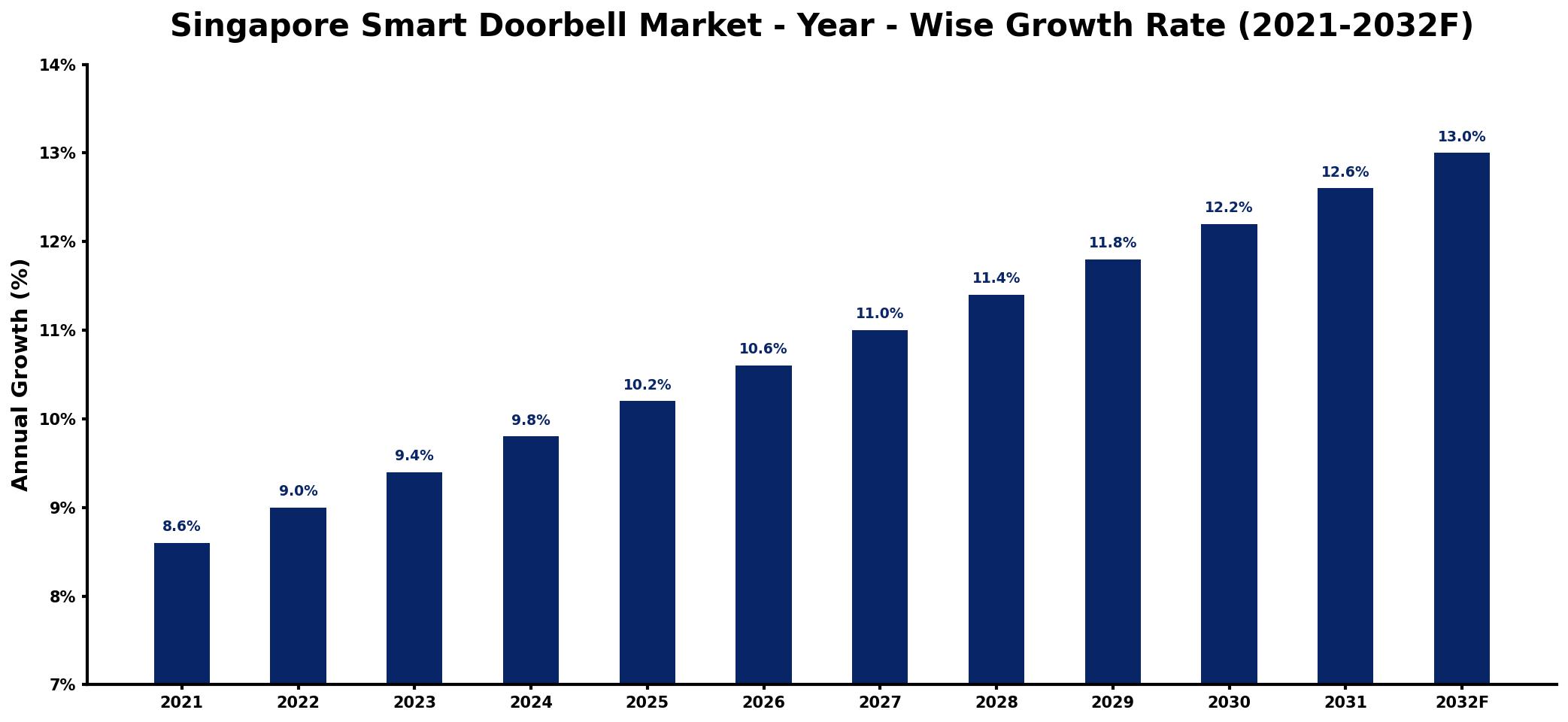
The table below presents the year‑wise growth rates along with the key drivers influencing the market
| Year | Growth Rate | Major Drivers |
| 2021 | 8.6% | Rising demand for home security |
| 2022 | 9.0% | Increased consumer technology adoption |
| 2023 | 9.4% | growing automotive sector requirements |
| 2024 | 9.8% | Surge in online retail channels |
| 2025 | 10.2% | Expansion of urban housing projects |
| 2026 | 10.6% | Investment in IoT infrastructure |
| 2027 | 11.0% | Growing emphasis on convenience features |
| 2028 | 11.4% | Development of advanced connectivity options |
| 2029 | 11.8% | Heightened awareness of home safety |
| 2030 | 12.2% | Increase in subscription service models |
| 2031 | 12.6% | Enhanced focus on energy efficiency |
| 2032 | 13.0% | Broader acceptance of automated solutions |
Note: Market size estimations and growth projections presented in this report are based on 6Wresearch's proprietary forecasting methodology, utilizing the latest available industry data, government publications, and primary research inputs.
Singapore Smart Doorbell Market Synopsis
In a country where home security is increasingly prioritized, smart doorbells are becoming essential tools for modern living. With features like remote monitoring and seamless integration into existing smart home ecosystems, these devices cater to the tech-savvy population eager to enhance their homes security. The growing awareness of surveillance options, particularly in urban environments, is accelerating the adoption of smart doorbells.
The Singapore Smart Doorbell Market stands out due to its blend of functionality and convenience. Homeowners are drawn to smart doorbells for their video recording capabilities, allowing users to monitor visitors remotely. This trend is further fueled by the increasing preference for contactless interactions in the wake of the COVID-19 pandemic, solidifying the demand for advanced security devices.
Singapore Smart Doorbell Market Key Takeaways
- The market is witnessing a surge in demand as homeowners prioritize safety and technological integration.
- Smart doorbells are increasingly recognized for their role in enhancing home communication and security.
- Privacy and data security concerns present ongoing challenges that must be addressed by manufacturers.
- Emerging technologies such as facial recognition are set to enhance the appeal of smart doorbells.
- The pandemic has accelerated the trend toward remote monitoring and contactless interaction solutions.
Evaluation of Restraints in Singapore Smart Doorbell Market
While the Singapore Smart Doorbell Market is on an upward trajectory, it faces significant restraints that could limit its potential. Privacy concerns loom large, as consumers become increasingly wary of how their personal data is managed. Manufacturers must prioritize data security to build trust and confidence among consumers. Additionally, connectivity issues remain a challenge, especially in urban environments with high interference. Established competition also poses a hurdle, compelling new entrants to differentiate themselves with innovative features and superior reliability.
Singapore Smart Doorbell Market Trends
The market is currently shaped by several key trends, notably the increasing integration of smart doorbells with broader home automation systems. Features like voice activation and mobile app control are gaining traction, making devices more user-friendly. There is also a noticeable shift towards environmentally-friendly products, as consumers show preference for energy-efficient models. Furthermore, the evolution of AI technology is pushing manufacturers to develop smarter systems capable of advanced functionalities like facial recognition and behavioral analysis.
Singapore Smart Doorbell Market Opportunities
The Singapore Smart Doorbell Market presents lucrative opportunities for growth, particularly in the realm of product innovation. Companies have the chance to capitalize on the rising demand for advanced features that enhance user convenience, such as integration with other smart home devices. The shift towards remote working arrangements has increased the emphasis on home security, positioning smart doorbells as vital components. Additionally, collaborations with local tech firms could foster the development of tailored solutions that cater to the unique needs of Singaporean consumers.
Government Initiatives in the Singapore Smart Doorbell Market
The Singaporean government has shown proactive support for the smart home sector through initiatives aimed at boosting technological innovation. Various programs are in place to encourage investment in smart technologies, including grants and incentives for R&D in security solutions. The government's commitment to creating a smart nation aligns with the growth of the smart doorbell market, promoting public safety and the adoption of advanced security technologies in residential areas.
Future Insights of the Singapore Smart Doorbell Market
Looking ahead to the period from 2026 to 2032, the Singapore Smart Doorbell Market is anticipated to evolve significantly. The focus will likely shift toward enhancing user experience with intuitive design and advanced functionalities, including AI-driven features. As more homeowners integrate smart technology into their lives, the market is set to expand, fueled by continuous innovations. By 2032, smart doorbells will not only serve as security devices but will also become integral to smart living ecosystems, fostering greater interconnectivity within the home.
Singapore Smart Doorbell Market Latest Developments (2025 - 2026)
In recent months, the Singapore Smart Doorbell Market has seen an uptick in product launches featuring enhanced connectivity options and improved user interfaces. Companies are focusing on rolling out devices with advanced surveillance capabilities and user-friendly mobile applications. Additionally, partnerships between tech firms and local security services are emerging, aiming to provide comprehensive security solutions tailored to the Singaporean market. The overall trend indicates a shift towards integrating smart doorbells with larger home security systems.
Singapore Smart Doorbell Market - Key Attractiveness of the Report
- 10 Years of Market Numbers
- Historical Data Starting from 2022 to 2025
- Base Year: 2025
- Forecast Data until 2032
- Key Performance Indicators Impacting the Market
- Major Upcoming Developments and Projects
Key Highlights of the Report:
- Singapore Smart Doorbell Market Outlook
- Market Size of Singapore Smart Doorbell Market, 2025
- Forecast of Singapore Smart Doorbell Market, 2032
- Historical Data and Forecast of Singapore Smart Doorbell Revenues & Volume for the Period 2022-2032F
- Singapore Smart Doorbell Market Trend Evolution
- Singapore Smart Doorbell Market Drivers and Challenges
- Singapore Smart Doorbell Price Trends
- Singapore Smart Doorbell Porter's Five Forces
- Singapore Smart Doorbell Industry Life Cycle
- Historical Data and Forecast of Singapore Smart Doorbell Market Revenues & Volume By Product Type for the Period 2022-2032F
- Historical Data and Forecast of Singapore Smart Doorbell Market Revenues & Volume By Wired Doorbell for the Period 2022-2032F
- Historical Data and Forecast of Singapore Smart Doorbell Market Revenues & Volume By Wireless Doorbell for the Period 2022-2032F
- Historical Data and Forecast of Singapore Smart Doorbell Market Revenues & Volume By Distribution Channel for the Period 2022-2032F
- Historical Data and Forecast of Singapore Smart Doorbell Market Revenues & Volume By Online for the Period 2022-2032F
- Historical Data and Forecast of Singapore Smart Doorbell Market Revenues & Volume By Offline for the Period 2022-2032F
- Historical Data and Forecast of Singapore Smart Doorbell Market Revenues & Volume By End User for the Period 2022-2032F
- Historical Data and Forecast of Singapore Smart Doorbell Market Revenues & Volume By Residential for the Period 2022-2032F
- Historical Data and Forecast of Singapore Smart Doorbell Market Revenues & Volume By Commercial for the Period 2022-2032F
- Singapore Smart Doorbell Import Export Trade Statistics
- Market Opportunity Assessment By Product Type
- Market Opportunity Assessment By Distribution Channel
- Market Opportunity Assessment By End User
- Singapore Smart Doorbell Top Companies Market Share
- Singapore Smart Doorbell Competitive Benchmarking By Technical and Operational Parameters
- Singapore Smart Doorbell Company Profiles
- Singapore Smart Doorbell Key Strategic Recommendations






































