Singapore Smart Waste Management Market Size & Growth Rate (2026-2032)
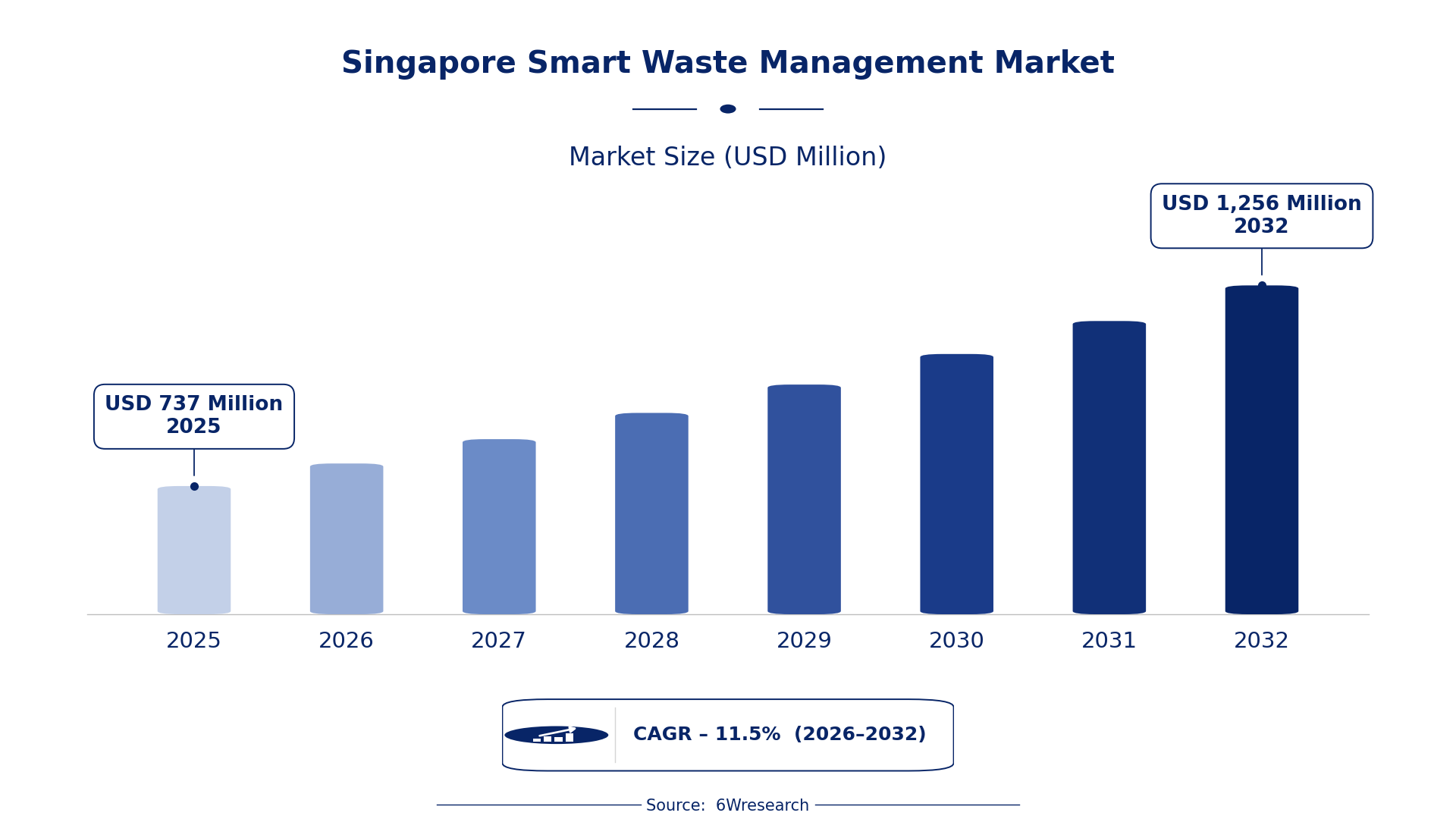
The Singapore Smart Waste Management Market was estimated at USD 737 Million in 2025 and is projected to reach USD 1256 Million by 2032, growing at a CAGR of 11.5% from 2026 to 2032.
Singapore Smart Waste Management Market Synopsis
The primary force shaping the Singapore Smart Waste Management Market is the urgent need for environmental sustainability. As urban areas grapple with waste management challenges, Singapore is leading the charge by integrating technology into waste collection and recycling processes.
Government initiatives aimed at promoting a cleaner environment further bolster this market. The city-state's commitment to adopting smart solutions is driven by its vision of becoming a leading green economy, making smart waste management an essential pillar of its sustainability strategy.
Singapore Smart Waste Management Market Year-wise Growth Rate and Key Drivers
This graph illustrates the annual growth rates of the Singapore Smart Waste Management Market from 2021 to 2032, highlighting a steady upward trajectory and projected expansion over the forecast period.
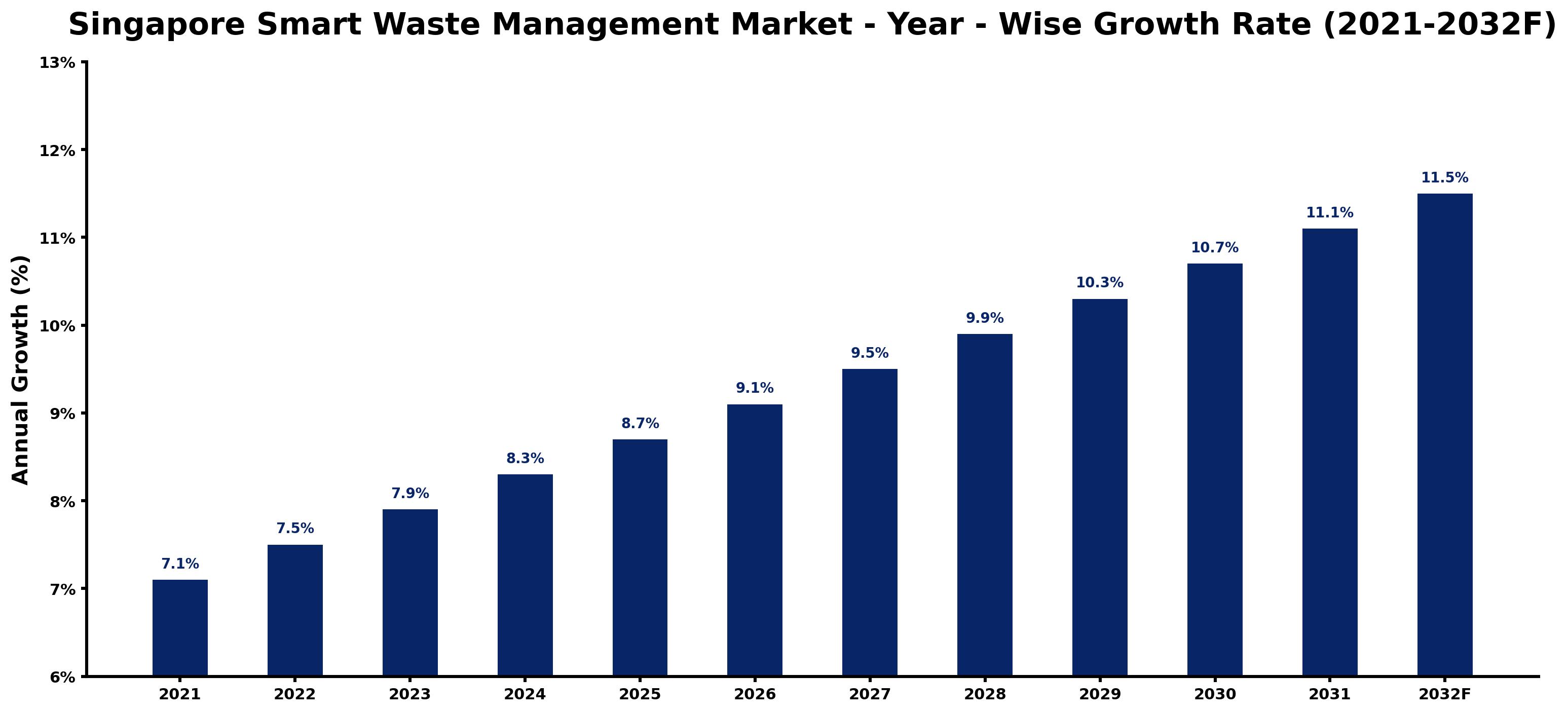
The table below presents the year‑wise growth rates along with the key drivers influencing the market
| Year | Growth Rate | Major Drivers |
| 2021 | 7.1% | SG Waste Management and Resource Recovery sector roadmap launched. |
| 2022 | 7.5% | Government’s zero waste goals boosting smart solutions adoption. |
| 2023 | 7.9% | Increased funding for innovative recycling technology initiatives. |
| 2024 | 8.3% | Partnerships with tech firms enhancing waste data analytics. |
| 2025 | 8.7% | Implementation of smart bins in urban areas increasing efficiency. |
| 2026 | 9.1% | Adoption of AI in waste sorting systems improving outcomes. |
| 2027 | 9.5% | Public awareness campaigns promoting sustainable waste disposal practices. |
| 2028 | 9.9% | Integration of IoT for real-time waste collection monitoring. |
| 2029 | 10.3% | Growing eco-conscious community pushing for advanced waste solutions. |
| 2030 | 10.7% | Regional collaboration on waste-to-energy projects enhancing sustainability. |
| 2031 | 11.1% | Emerging startups focusing on recycling tech innovation driving demand. |
| 2032 | 11.5% | Increased urbanization necessitating advanced waste management strategies. |
Note: Market size estimations and growth projections presented in this report are based on 6Wresearch's proprietary forecasting methodology, utilizing the latest available industry data, government publications, and primary research inputs.
Singapore Smart Waste Management Market Key Takeaways
Below are some of the specific key takeaways from the market, including:
- The market is experiencing rapid growth due to increasing awareness of environmental issues.
- Technological innovations are enhancing operational efficiencies in waste management.
- Government policies are strongly supporting the adoption of smart waste solutions.
- Public-private partnerships are emerging as key drivers for investment in this sector.
- The pandemic has accelerated demand for contactless waste management technologies.
Evaluation of Restraints in Singapore Smart Waste Management Market
Despite its potential, the Singapore Smart Waste Management Market faces real constraints that hinder its progress. One significant barrier is the integration of new systems with existing infrastructure. Companies must ensure their smart solutions work seamlessly with current waste management frameworks. on top of that, the necessity for real-time data to optimize collection routes remains a challenge. Additionally, adapting to fluctuating waste generation patterns and evolving environmental regulations adds further complexity to the market's growth trajectory.
Singapore Smart Waste Management Market Trends
Several trends are influencing the Singapore Smart Waste Management Market. The rise of data analytics is enabling more informed decision-making in waste collection strategies. Meanwhile, the use of IoT-enabled sensors in waste bins is enhancing monitoring and collection efficiency. There's also a growing focus on recycling and waste minimization, driven by public awareness campaigns. These trends are contributing to the overall evolution of waste management practices in Singapore.
Singapore Smart Waste Management Market Opportunities
Opportunities for growth in the Singapore Smart Waste Management Market abound. The increasing investment in digital infrastructure and smart city initiatives is likely to create a fertile ground for innovative waste management solutions. on top of that, partnerships between technology providers and waste management companies can lead to the development of advanced, efficient systems. The demand for sustainable waste practices is set to drive further investments, making this an appealing area for stakeholders.
Government Initiatives in the Singapore Smart Waste Management Market
Government policy plays a crucial role in shaping the Singapore Smart Waste Management Market. The Singaporean government is heavily invested in creating a sustainable environment, which significantly influences the adoption of smart waste solutions. With a clear focus on enhancing urban cleanliness and sustainability, recent and upcoming initiatives aim to integrate cutting-edge technologies into waste management practices.
- A national initiative to deploy smart waste bins equipped with sensors was successfully completed in early 2025, enhancing real-time monitoring of waste levels.
- Currently underway is a public-private partnership program designed to develop AI-driven waste management systems, expected to optimize collection routes by late 2026.
- Looking ahead, a planned policy framework set for introduction in 2027 will mandate the integration of smart waste technologies in all new urban developments.
- The government is also promoting educational campaigns focused on recycling, which are ongoing and aim to increase public participation in waste reduction efforts.
Future Insights of the Singapore Smart Waste Management Market
From 2026 to 2032, the Singapore Smart Waste Management Market is expected to evolve significantly. As technology becomes more integrated into daily operations, waste management will shift towards a more data-driven approach. Innovations in AI and machine learning will play a vital role in predictive analytics for waste generation, leading to more efficient collection methods. The commitment to sustainability will ensure that smart waste management remains a top priority for both government and industry stakeholders.
Singapore Smart Waste Management Market Latest Developments
Recent activity in the Singapore Smart Waste Management Market indicates a strong push towards technological advancements and system integration. Companies are increasingly adopting innovative solutions to meet the growing demands for efficiency and sustainability in waste management.
- A major technology vendor announced the rollout of a new waste tracking system in Q1 2025, enhancing transparency in waste disposal processes.
- In mid-2025, a leading regional operator launched an initiative to retrofit existing waste bins with IoT sensors, significantly improving collection efficiency.
- By late 2025, plans were unveiled for an AI-enhanced waste sorting facility, aimed at increasing recycling rates and reducing landfill waste.
- An ongoing pilot program is testing drone technology for waste collection in select urban areas, with results expected to be released in early 2026.
Singapore Smart Waste Management Market - Key Attractiveness of the Report
- 10 Years of Market Numbers
- Historical Data Starting from 2022 to 2025
- Base Year: 2025
- Forecast Data until 2032
- Key Performance Indicators Impacting the Market
- Major Upcoming Developments and Projects
Key Highlights of the Report:
- Singapore Smart Waste Management Market Outlook
- Market Size of Singapore Smart Waste Management Market, 2025
- Forecast of Singapore Smart Waste Management Market, 2032
- Historical Data and Forecast of Singapore Smart Waste Management Revenues & Volume for the Period 2022-2032F
- Singapore Smart Waste Management Market Trend Evolution
- Singapore Smart Waste Management Market Drivers and Challenges
- Singapore Smart Waste Management Price Trends
- Singapore Smart Waste Management Porter's Five Forces
- Singapore Smart Waste Management Industry Life Cycle
- Historical Data and Forecast of Singapore Smart Waste Management Market Revenues & Volume By Solution for the Period 2022-2032F
- Historical Data and Forecast of Singapore Smart Waste Management Market Revenues & Volume By Optimization Solutions for the Period 2022-2032F
- Historical Data and Forecast of Singapore Smart Waste Management Market Revenues & Volume By Analytics and Reporting Solutions for the Period 2022-2032F
- Historical Data and Forecast of Singapore Smart Waste Management Market Revenues & Volume By Asset Management for the Period 2022-2032F
- Historical Data and Forecast of Singapore Smart Waste Management Market Revenues & Volume By Network Management for the Period 2022-2032F
- Historical Data and Forecast of Singapore Smart Waste Management Market Revenues & Volume By Others for the Period 2022-2032F
- Historical Data and Forecast of Singapore Smart Waste Management Market Revenues & Volume By Service for the Period 2022-2032F
- Historical Data and Forecast of Singapore Smart Waste Management Market Revenues & Volume By Professional Services for the Period 2022-2032F
- Historical Data and Forecast of Singapore Smart Waste Management Market Revenues & Volume By Managed Services for the Period 2022-2032F
- Historical Data and Forecast of Singapore Smart Waste Management Market Revenues & Volume By Application for the Period 2022-2032F
- Historical Data and Forecast of Singapore Smart Waste Management Market Revenues & Volume By Food & Retail for the Period 2022-2032F
- Historical Data and Forecast of Singapore Smart Waste Management Market Revenues & Volume By Construction for the Period 2022-2032F
- Historical Data and Forecast of Singapore Smart Waste Management Market Revenues & Volume By Manufacturing & Industrial for the Period 2022-2032F
- Historical Data and Forecast of Singapore Smart Waste Management Market Revenues & Volume By HealthCare for the Period 2022-2032F
- Historical Data and Forecast of Singapore Smart Waste Management Market Revenues & Volume By Municipalities for the Period 2022-2032F
- Historical Data and Forecast of Singapore Smart Waste Management Market Revenues & Volume By Colleges & Universities for the Period 2022-2032F
- Singapore Smart Waste Management Import Export Trade Statistics
- Market Opportunity Assessment By Solution
- Market Opportunity Assessment By Service
- Market Opportunity Assessment By Application
- Singapore Smart Waste Management Top Companies Market Share
- Singapore Smart Waste Management Competitive Benchmarking By Technical and Operational Parameters
- Singapore Smart Waste Management Company Profiles
- Singapore Smart Waste Management Key Strategic Recommendations






































