Singapore Snowmobile Market Size, Share & Growth Rate
The Singapore Snowmobile Market was estimated at USD 452 Million in 2025 and is projected to reach USD 616 Million by 2032, growing at a CAGR of 4.5% from 2026 to 2032. This growth trajectory is being driven by an increasing interest in winter sports and recreational activities, highlighting the demand for snowmobiles among local enthusiasts and tourists. As Singapore continues to position itself as a hub for unique travel experiences, the appeal of eco-friendly snowmobiles and enhanced safety features is expected to further bolster market dynamics.
Singapore Snowmobile Market Year-wise Growth Rate and Key Drivers
This graph highlights how the Singapore Snowmobile Market has steadily grown over the years, supported by major growth factors.
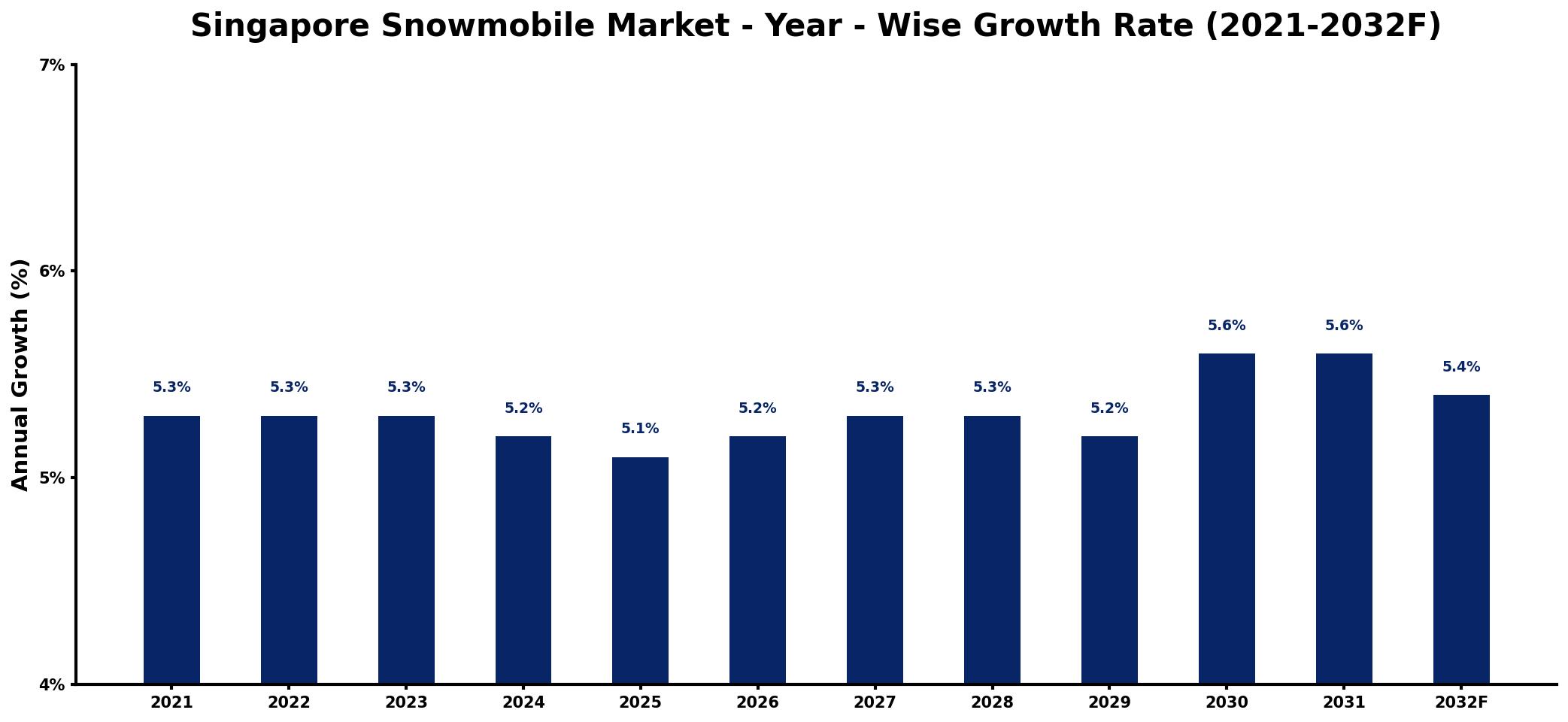
The table below presents the year‑wise growth rates along with the key drivers influencing the market
| Year | Growth Rate | Major Drivers |
| 2021 | 5.3% | Rising interest in winter sports |
| 2022 | 5.3% | Increased disposable income levels |
| 2023 | 5.3% | Growing tourism in colder regions |
| 2024 | 5.2% | Expansion of rental services offered |
| 2025 | 5.1% | Enhanced marketing strategies deployed |
| 2026 | 5.2% | Development of new adventure parks |
| 2027 | 5.3% | Increased participation in outdoor activities |
| 2028 | 5.3% | Emergence of electric models available |
| 2029 | 5.2% | Investment in infrastructure upgrades |
| 2030 | 5.6% | Collaborations with travel agencies grow |
| 2031 | 5.6% | Popularity of winter festivals rises |
| 2032 | 5.4% | Focus on sustainability initiatives increases |
Note: Market size estimations and growth projections presented in this report are based on 6Wresearch's proprietary forecasting methodology, utilizing the latest available industry data, government publications, and primary research inputs.
Singapore Snowmobile Market Synopsis
Recently, the Singapore snowmobile market has gained momentum, fueled by rising interest in winter sports tourism and recreational outings. However, the future points towards even greater opportunities as manufacturers adapt to a more environmentally conscious consumer base.
As winter sports capture the imagination of a growing audience, snowmobiles are likely to take center stage, offering thrilling experiences in simulated snowy environments. The confluence of technology, safety, and eco-friendliness positions the market for significant expansion in the years to come.
Singapore Snowmobile Market Key Takeaways
- Strong market growth is anticipated driven by increased interest in winter sports among both residents and tourists.
- The demand for eco-friendly snowmobiles is on the rise, reflecting broader environmental trends.
- Technological advancements are enhancing safety features, appealing to a safety-conscious demographic.
- Winter tourism is a key factor propelling market expansion, as Singapore attracts more enthusiasts seeking unique recreational experiences.
- Ongoing recovery from the COVID-19 pandemic is expected to reinvigorate outdoor recreational activities.
Evaluation of Restraints in Singapore Snowmobile Market
Despite the encouraging growth outlook, the Singapore snowmobile market faces several restraints that may hinder its progress. Seasonal fluctuations in demand pose a significant challenge, as the market is inherently tied to specific periods conducive to winter sports. Furthermore, the need for snowmobiles to meet stringent performance standards and regulations can complicate the production landscape. Additionally, there is competition from alternative winter sports that could divert interest and investment away from snowmobiles, affecting market growth. Addressing these challenges while promoting safety and accessibility will be crucial for stakeholders aiming to capitalize on this evolving market.
Singapore Snowmobile Market Trends
A significant trend shaping the Singapore snowmobile market is the growing preference for eco-friendly models. Manufacturers are increasingly focusing on developing sustainable options that utilize cleaner energy sources, appealing to environmentally conscious consumers. Another notable trend is the integration of advanced safety features and smart technology, enhancing the user experience and ensuring rider safety. These innovations are attracting new customers while boosting confidence among existing users. As winter sports become more popular, trends indicating collaboration between adventure tourism operators and snowmobile manufacturers are emerging, paving the way for enhanced outdoor experiences.
Singapore Snowmobile Market Opportunities
The potential for growth within the Singapore snowmobile market is substantial, particularly in harnessing the winter tourism sector. Establishing partnerships with resorts and adventure tourism companies can create unique packages and experiences that enhance consumer appeal. Furthermore, investments in R&D for innovative snowmobile designs and features will likely open new avenues for market expansion. As interest in winter sports rises, creating engaging experiences through rental services or guided tours can further penetrate the market and capture the attention of both local and international enthusiasts.
Government Initiatives in the Singapore Snowmobile Market
Government initiatives focusing on promoting sustainable tourism and outdoor recreation can significantly impact the snowmobile market. Efforts to improve infrastructure for winter sports and encourage investment in eco-friendly technologies are pivotal for market development. Additionally, programs aimed at enhancing public awareness of winter sports activities can boost participation rates, ultimately driving demand for snowmobiles. The collaboration between governmental bodies and private enterprises will also play a critical role in shaping the future landscape of the snowmobile market in Singapore.
Future Insights of the Singapore Snowmobile Market
Looking ahead, the Singapore snowmobile market is poised for growth, driven by a blend of increased consumer interest and innovative offerings from manufacturers. From 2026 to 2032, advancements in technology and a greater emphasis on sustainability will likely resonate with younger consumers. As the global travel and tourism industry rebounds post-pandemic, Singapore's positioning as a destination for winter sports will be vital in supporting market expansion. Additionally, the continued focus on safety and performance will ensure that snowmobiles remain an attractive option for outdoor recreational activities, promising a dynamic future for the market.
Singapore Snowmobile Market Latest Developments (2025 - 2026)
In the recent months, the Singapore snowmobile market has observed a series of strategic collaborations aimed at enhancing winter sports tourism. Notable advancements in snowmobile technology have emerged, focusing on eco-friendly designs and improved safety features to cater to growing consumer expectations. Additionally, industry events have successfully showcased the latest offerings, attracting enthusiasts and prospective buyers eager for innovative recreational options. The overall market sentiment remains positive as stakeholders work to adapt to changing consumer demands and preferences.
Singapore Snowmobile Market - Key Attractiveness of the Report
- 10 Years of Market Numbers
- Historical Data Starting from 2022 to 2025
- Base Year: 2025
- Forecast Data until 2032
- Key Performance Indicators Impacting the Market
- Major Upcoming Developments and Projects
Key Highlights of the Report:
- Singapore Snowmobile Market Outlook
- Market Size of Singapore Snowmobile Market, 2025
- Forecast of Singapore Snowmobile Market, 2032
- Historical Data and Forecast of Singapore Snowmobile Revenues & Volume for the Period 2022-2032F
- Singapore Snowmobile Market Trend Evolution
- Singapore Snowmobile Market Drivers and Challenges
- Singapore Snowmobile Price Trends
- Singapore Snowmobile Porter's Five Forces
- Singapore Snowmobile Industry Life Cycle
- Historical Data and Forecast of Singapore Snowmobile Market Revenues & Volume By Displacement Type for the Period 2022-2032F
- Historical Data and Forecast of Singapore Snowmobile Market Revenues & Volume By <500 CC for the Period 2022-2032F
- Historical Data and Forecast of Singapore Snowmobile Market Revenues & Volume By 500 CC to 800 CC for the Period 2022-2032F
- Historical Data and Forecast of Singapore Snowmobile Market Revenues & Volume By 800 CC & above for the Period 2022-2032F
- Historical Data and Forecast of Singapore Snowmobile Market Revenues & Volume By Engine Type for the Period 2022-2032F
- Historical Data and Forecast of Singapore Snowmobile Market Revenues & Volume By Two-Stroke Engine for the Period 2022-2032F
- Historical Data and Forecast of Singapore Snowmobile Market Revenues & Volume By Four-Stroke Engine for the Period 2022-2032F
- Historical Data and Forecast of Singapore Snowmobile Market Revenues & Volume By Distribution Channels for the Period 2022-2032F
- Historical Data and Forecast of Singapore Snowmobile Market Revenues & Volume By Offline for the Period 2022-2032F
- Historical Data and Forecast of Singapore Snowmobile Market Revenues & Volume By Online for the Period 2022-2032F
- Singapore Snowmobile Import Export Trade Statistics
- Market Opportunity Assessment By Displacement Type
- Market Opportunity Assessment By Engine Type
- Market Opportunity Assessment By Distribution Channels
- Singapore Snowmobile Top Companies Market Share
- Singapore Snowmobile Competitive Benchmarking By Technical and Operational Parameters
- Singapore Snowmobile Company Profiles
- Singapore Snowmobile Key Strategic Recommendations






































