Singapore Sodium Aluminium Phosphate Market Size, Share & Growth Rate
The Singapore Sodium Aluminium Phosphate Market was estimated at USD 257 Million in 2025 and is projected to reach USD 362 Million by 2032, growing at a CAGR of 5.0% from 2026 to 2032. This growth is propelled by the rapid expansion of the food and beverage sector, where sodium aluminium phosphate serves as a crucial leavening agent in various baked goods. Additionally, the surging demand for processed and convenience foods, combined with a booming construction industry employing SALP in fire-resistant materials, lays a robust foundation for this upward trajectory.
Singapore Sodium Aluminium Phosphate Market Year-wise Growth Rate and Key Drivers
This graph highlights how the Singapore Sodium Aluminium Phosphate Market has steadily grown over the years, supported by major growth factors.
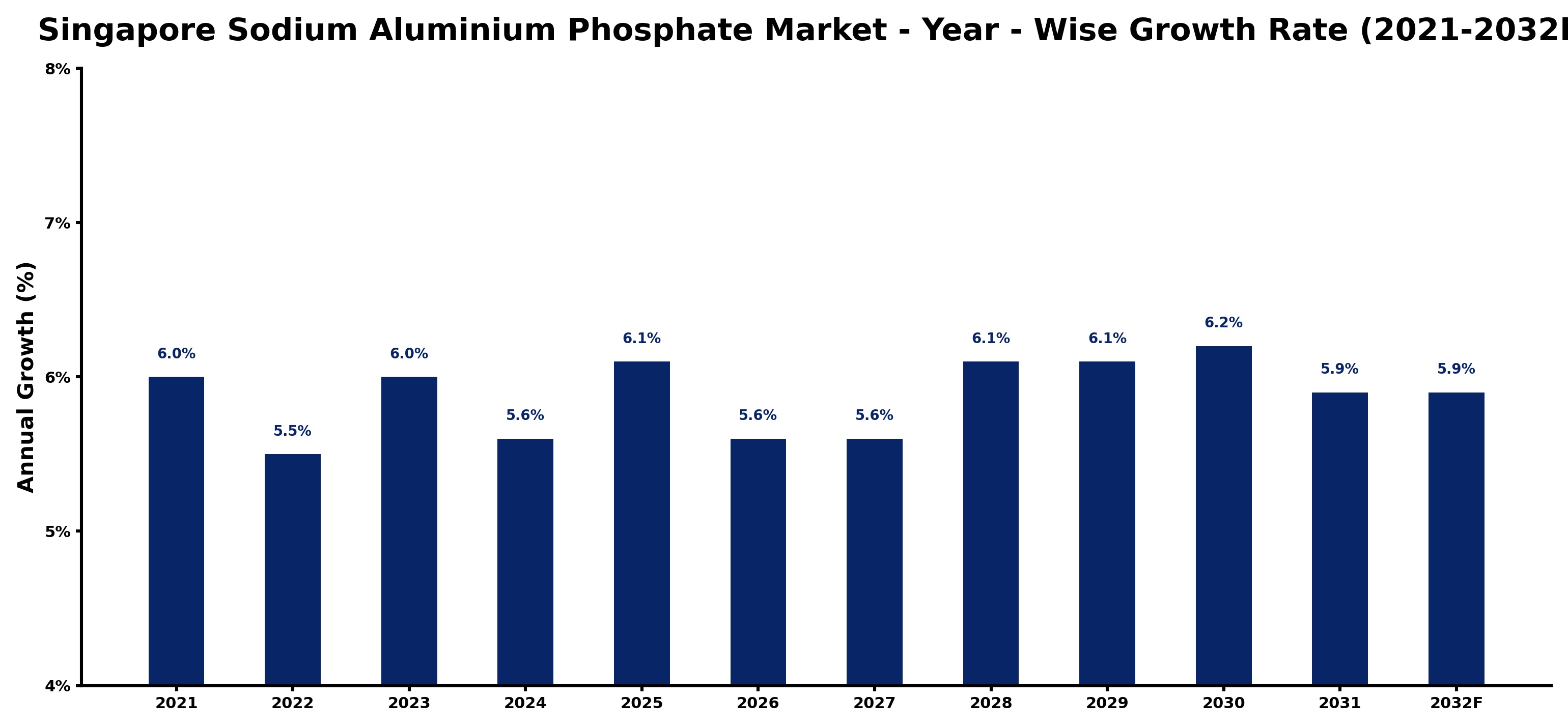
The table below presents the year‑wise growth rates along with the key drivers influencing the market
| Year | Growth Rate | Major Drivers |
| 2021 | 6.0% | Rising demand for processed foods |
| 2022 | 5.5% | Increased health awareness among consumers |
| 2023 | 6.0% | Growth in food industry innovations |
| 2024 | 5.6% | Expansion of food manufacturing sector |
| 2025 | 6.1% | Emergence of new culinary trends |
| 2026 | 5.6% | Rising popularity of convenience foods |
| 2027 | 5.6% | Increased focus on food safety |
| 2028 | 6.1% | Industrial activity supported growth |
| 2029 | 6.1% | Market expansion drove consumption |
| 2030 | 6.2% | Sector investment increased procurement |
| 2031 | 5.9% | Increased investment in food technology |
| 2032 | 5.9% | Output growth supported volumes |
Note - Market size estimations and growth projections presented in this report are based on 6Wresearch’s advanced forecasting approach, validated with industry datasets as of June 2026.
Singapore Sodium Aluminium Phosphate Market Synopsis
The Singapore Sodium Aluminium Phosphate market has recently exhibited resilience in the face of shifting consumer preferences and industry challenges. While the pandemic initially disrupted demand, the subsequent recovery phase has positioned the market on a path of steady growth, as innovations in food processing create new opportunities.
Looking ahead, market dynamics will continue to evolve as health-conscious consumers increasingly seek alternative ingredients in their diets. This shift is likely to redefine the applications of sodium aluminium phosphate, compelling manufacturers to diversify their offerings while adhering to stringent regulatory frameworks.
Singapore Sodium Aluminium Phosphate Market Key Takeaways
- The market is expected to thrive due to an expanding food and beverage industry.
- Health trends are reshaping consumer demands, pushing for innovative ingredient alternatives.
- The booming construction sector is increasing demand for sodium aluminium phosphate in building materials.
- Regulatory requirements around food safety and quality are becoming more stringent, impacting market practices.
- Competitive pressures from alternative food additives necessitate diversification among manufacturers.
Evaluation of Restraints in Singapore Sodium Aluminium Phosphate Market
Despite its growth prospects, the Singapore Sodium Aluminium Phosphate market faces several restraints that could hinder expansion. Fluctuations in global supply and demand directly affect pricing stability and availability, creating uncertainty for manufacturers and consumers alike. Furthermore, variations in product quality can lead to inconsistencies, impacting the performance of sodium aluminium phosphate in various applications. Coupled with rising consumer expectations for clean-label products, companies must navigate a complex landscape of regulatory compliance and market adaptation.
Singapore Sodium Aluminium Phosphate Market Trends
Current trends in the Singapore Sodium Aluminium Phosphate market highlight an increasing focus on health and sustainability. As consumers become more aware of ingredient transparency, there is a growing demand for natural and minimally processed food additives. Additionally, advancements in food technology are enabling the development of innovative applications, creating new growth avenues. The construction sector is also witnessing a push towards fire safety compliance, further boosting the demand for sodium aluminium phosphate in manufacturing robust building materials.
Singapore Sodium Aluminium Phosphate Market Opportunities
Genuine growth opportunities lie in the diversification of product applications beyond traditional food uses. The expanding ceramics and glass production sectors present significant potential for sodium aluminium phosphate, especially as infrastructure development continues to grow. Additionally, as the trend towards health-oriented products persists, companies that can innovate with sodium aluminium phosphate in cleaner, healthier formulations stand to gain a competitive edge in the market.
Government Initiatives in the Singapore Sodium Aluminium Phosphate Market
The Singapore government has implemented various initiatives aimed at enhancing food safety and promoting sustainable manufacturing practices. Regulatory frameworks governing food additives are becoming increasingly stringent, which drives manufacturers to comply with higher standards of quality and safety. Public spending on infrastructure development also contributes to the demand for fire-resistant materials, indirectly supporting the growth of sodium aluminium phosphate in construction applications.
Future Insights of the Singapore Sodium Aluminium Phosphate Market
Looking ahead to 2026-2032, the Singapore Sodium Aluminium Phosphate market is likely to experience dynamic shifts. With the anticipated recovery of the food industry post-pandemic and the increasing focus on health-conscious diets, demand for sodium aluminium phosphate is expected to rise. Furthermore, as infrastructure projects continue to flourish, the need for fire-resistant materials will bolster its applications in construction, solidifying its role as a multifaceted compound within the industry.
Singapore Sodium Aluminium Phosphate Market Latest Developments (May 2025 - June 2026)
Recent developments in the Singapore Sodium Aluminium Phosphate market highlight the ongoing evolution of regulatory standards and consumer preferences. Companies are increasingly focusing on reformulating products to meet clean-label demands, while innovation in processing techniques is enabling more effective applications. Additionally, collaborations between industry stakeholders are fostering a more integrated approach to addressing challenges related to supply chain disruptions and product quality.
Singapore Sodium Aluminium Phosphate Market - Key Attractiveness of the Report
- 10 Years of Market Numbers
- Historical Data Starting from 2022 to 2025
- Base Year: 2025
- Forecast Data until 2032
- Key Performance Indicators Impacting the Market
- Major Upcoming Developments and Projects
Key Highlights of the Report:
- Singapore Sodium Aluminium Phosphate Market Outlook
- Market Size of Singapore Sodium Aluminium Phosphate Market, 2025
- Forecast of Singapore Sodium Aluminium Phosphate Market, 2032
- Historical Data and Forecast of Singapore Sodium Aluminium Phosphate Revenues & Volume for the Period 2022-2032F
- Singapore Sodium Aluminium Phosphate Market Trend Evolution
- Singapore Sodium Aluminium Phosphate Market Drivers and Challenges
- Singapore Sodium Aluminium Phosphate Price Trends
- Singapore Sodium Aluminium Phosphate Porter's Five Forces
- Singapore Sodium Aluminium Phosphate Industry Life Cycle
- Historical Data and Forecast of Singapore Sodium Aluminium Phosphate Market Revenues & Volume By Product Type for the Period 2022-2032F
- Historical Data and Forecast of Singapore Sodium Aluminium Phosphate Market Revenues & Volume By Acidic Sodium Aluminium Phosphate for the Period 2022-2032F
- Historical Data and Forecast of Singapore Sodium Aluminium Phosphate Market Revenues & Volume By Basic Sodium Aluminium Phosphate for the Period 2022-2032F
- Historical Data and Forecast of Singapore Sodium Aluminium Phosphate Market Revenues & Volume By End use for the Period 2022-2032F
- Historical Data and Forecast of Singapore Sodium Aluminium Phosphate Market Revenues & Volume By Bakery Products for the Period 2022-2032F
- Historical Data and Forecast of Singapore Sodium Aluminium Phosphate Market Revenues & Volume By Confectionery for the Period 2022-2032F
- Historical Data and Forecast of Singapore Sodium Aluminium Phosphate Market Revenues & Volume By Tortillas for the Period 2022-2032F
- Historical Data and Forecast of Singapore Sodium Aluminium Phosphate Market Revenues & Volume By Donut and Cake Mixes for the Period 2022-2032F
- Historical Data and Forecast of Singapore Sodium Aluminium Phosphate Market Revenues & Volume By Cheese for the Period 2022-2032F
- Historical Data and Forecast of Singapore Sodium Aluminium Phosphate Market Revenues & Volume By Function for the Period 2022-2032F
- Historical Data and Forecast of Singapore Sodium Aluminium Phosphate Market Revenues & Volume By Dough Strengtheners and Conditioners for the Period 2022-2032F
- Historical Data and Forecast of Singapore Sodium Aluminium Phosphate Market Revenues & Volume By Leavening Agent for the Period 2022-2032F
- Historical Data and Forecast of Singapore Sodium Aluminium Phosphate Market Revenues & Volume By pH Control Agent for the Period 2022-2032F
- Historical Data and Forecast of Singapore Sodium Aluminium Phosphate Market Revenues & Volume By Acidulant for the Period 2022-2032F
- Singapore Sodium Aluminium Phosphate Import Export Trade Statistics
- Market Opportunity Assessment By Product Type
- Market Opportunity Assessment By End use
- Market Opportunity Assessment By Function
- Singapore Sodium Aluminium Phosphate Top Companies Market Share
- Singapore Sodium Aluminium Phosphate Competitive Benchmarking By Technical and Operational Parameters
- Singapore Sodium Aluminium Phosphate Company Profiles
- Singapore Sodium Aluminium Phosphate Key Strategic Recommendations






































