Singapore Sodium fluoride Market Size, Share & Growth Rate
The Singapore Sodium fluoride Market was estimated at USD 363 Million in 2025 and is projected to reach USD 502 Million by 2032, growing at a CAGR of 4.7% from 2026 to 2032. This positive trajectory is primarily fueled by the increasing application of sodium fluoride in dental care products, coupled with governmental support for public health initiatives. The commitment to water fluoridation in Singapore further solidifies the demand for sodium fluoride, ensuring both oral health and industrial application needs are met.
Singapore Sodium fluoride Market Year-wise Growth Rate and Key Drivers
This graph highlights how the Singapore Sodium fluoride Market has steadily grown over the years, supported by major growth factors.
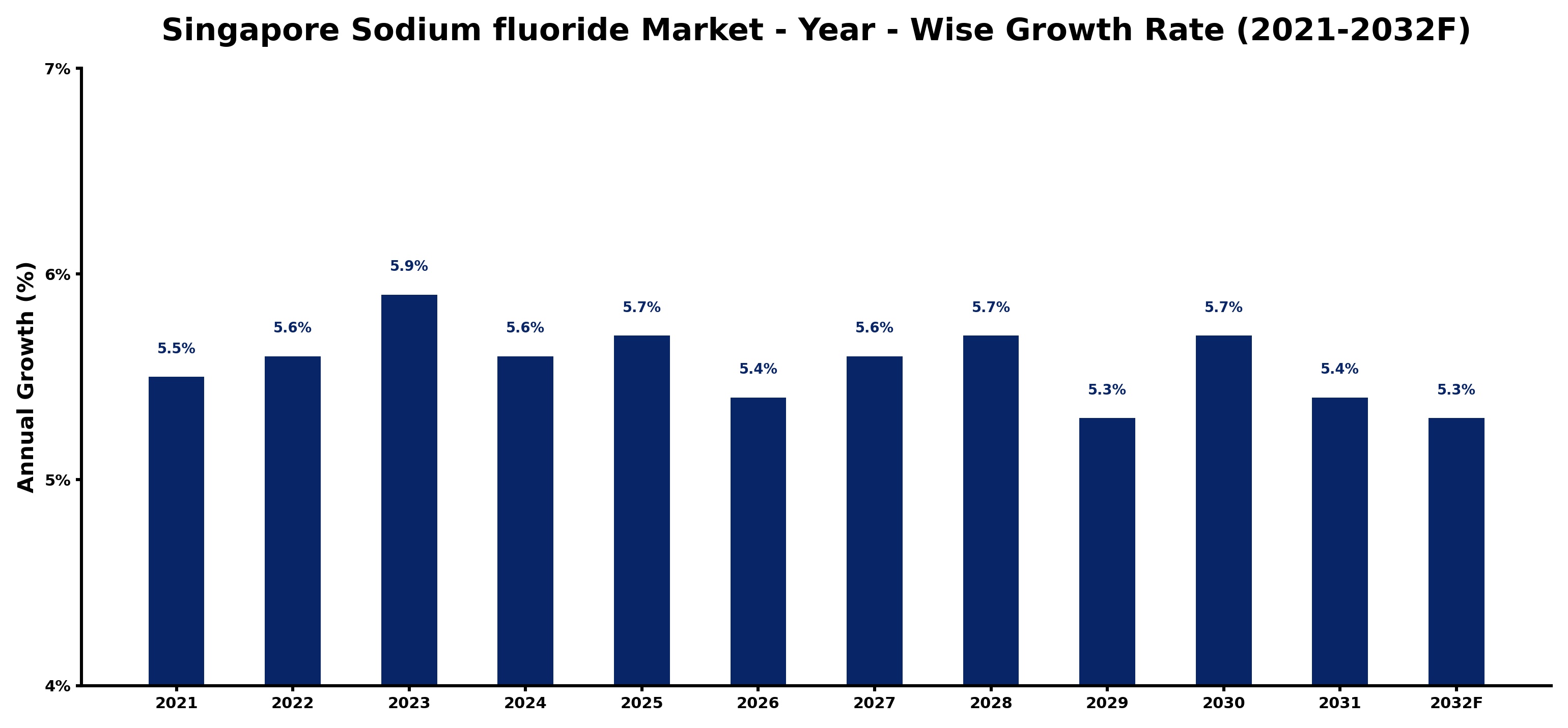
The table below presents the year‑wise growth rates along with the key drivers influencing the market
| Year | Growth Rate | Major Drivers |
| 2021 | 5.5% | Foreign investment in chemical manufacturing boosted sodium fluoride output |
| 2022 | 5.6% | Automation in sodium fluoride production streamlines operational efficiencies and costs |
| 2023 | 5.9% | Local chemical manufacturers boosted sodium fluoride production capacity |
| 2024 | 5.6% | Sodium fluoride manufacturing investments optimize production capabilities and output efficiency |
| 2025 | 5.7% | OEM investments in battery manufacturing boost sodium fluoride consumption |
| 2026 | 5.4% | Technological upgrades in chemical plants enhance sodium fluoride production efficiency |
| 2027 | 5.6% | New manufacturing facility boosts local sodium fluoride production capacity |
| 2028 | 5.7% | Improved production schedules boost sodium fluoride supply chain efficiency |
| 2029 | 5.3% | Improved chemical production capacity boosts sodium fluoride supply reliability |
| 2030 | 5.7% | Fluoride application advancements boost demand in water treatment facilities |
| 2031 | 5.4% | Manufacturing investments in pharmaceuticals boost sodium fluoride production capacity |
| 2032 | 5.3% | New semiconductor facility development boosts sodium fluoride demand |
Note - Market size estimations and growth projections presented in this report are based on 6Wresearch’s advanced forecasting approach, validated with industry datasets as of June 2026.
Singapore Sodium fluoride Market Synopsis
In recent years, the Singapore Sodium fluoride Market has demonstrated resilience despite external pressures such as the COVID-19 pandemic. As dental care regains momentum, there is a renewed focus on the significance of sodium fluoride in promoting oral health and wellness. Looking ahead, the market is poised for steady growth as the healthcare sector and industrial applications continue to expand, underpinned by robust regulatory frameworks.
The emphasis on environmental sustainability within Singapore will play a crucial role in shaping the future of the sodium fluoride market. As the regulatory landscape evolves, manufacturers will need to adapt to ensure the responsible use of sodium fluoride in both consumer and industrial contexts, preserving public trust while capitalizing on growth opportunities.
Singapore Sodium fluoride Market Key Takeaways
- The market is heavily influenced by the integration of sodium fluoride in dental care products and water fluoridation efforts.
- Government initiatives aimed at enhancing public dental health are driving sustained demand for sodium fluoride.
- Challenges related to regulatory compliance and environmental concerns continue to shape market dynamics.
- The COVID-19 pandemic resulted in temporary disruptions, but a robust recovery is anticipated as healthcare resumes normal operations.
- Future growth opportunities lie in innovative applications of sodium fluoride, particularly in emerging health and industrial sectors.
Evaluation of Restraints in Singapore Sodium fluoride Market
The Singapore Sodium fluoride Market faces several critical restraints that may impact its growth trajectory. Stringent safety regulations regarding the handling, distribution, and usage of sodium fluoride are paramount, given its potential health risks if mismanaged. These regulations create a challenging environment for manufacturers as compliance necessitates significant resources and ongoing monitoring. Furthermore, the government's control over water fluoridation policies poses another layer of limitation; shifts in public sentiment or policy changes can directly affect market demand. Lastly, competition from alternative oral care products that offer fluoride-free formulations has begun to emerge, potentially diverting consumer preference away from traditional sodium fluoride-based products.
Singapore Sodium fluoride Market Trends
Current trends within the Singapore Sodium fluoride Market are being shaped by the ongoing push for enhanced oral health standards and the integration of technology in dental care. Increased public awareness of dental hygiene is promoting a surge in demand for fluoride-containing products. Additionally, manufacturers are exploring innovative formulations that combine sodium fluoride with other beneficial ingredients to improve product efficacy and appeal. The trend toward eco-friendliness and sustainable practices also influences manufacturing processes, as companies seek to minimize their environmental footprint while meeting regulatory requirements.
Singapore Sodium fluoride Market Opportunities
There are significant growth opportunities within the Singapore Sodium fluoride Market, especially in the realm of product innovation. Manufacturers can capitalize on rising consumer demand for natural and organic dental care solutions by developing sodium fluoride products that align with these preferences. Additionally, the ongoing commitment to public health initiatives and dental hygiene campaigns presents avenues for collaboration with government agencies and healthcare providers. Expanding applications for sodium fluoride in various industrial sectors, such as metallurgy and water treatment, also represent potential growth areas, offering a diversified revenue stream beyond the traditional dental market.
Government Initiatives in the Singapore Sodium fluoride Market
The Singapore government has implemented various initiatives to bolster dental health and promote the responsible use of sodium fluoride. Public health campaigns focused on oral hygiene emphasize the importance of regular dental check-ups and the role of fluoride in cavity prevention. Moreover, the government's endorsement of water fluoridation is integral to maintaining the dental health of the population. Regulatory frameworks are continuously evolving to balance public health objectives with environmental sustainability, ensuring that sodium fluoride usage adheres to safety and health standards.
Future Insights of the Singapore Sodium fluoride Market
Looking ahead to 2026-2032, the Singapore Sodium fluoride Market is positioned for stable growth driven by both public health policies and industrial applications. As the emphasis on preventive oral care continues, demand for sodium fluoride in dental products will remain robust. Additionally, advancements in technology and formulation strategies will likely pave the way for new applications, enhancing market dynamics. Sustainability will become increasingly important, potentially leading to innovations that focus on eco-friendly practices while fulfilling health mandates. Overall, a collaborative approach among stakeholders will be essential for navigating future challenges and seizing growth opportunities in this evolving market.
Singapore Sodium fluoride Market Latest Developments (May 2025 - June 2026)
Recent developments in the Singapore Sodium fluoride Market reflect the industry's adaptive response to changing consumer demands and regulatory landscapes. Innovations in product formulations are emerging, with an emphasis on blending sodium fluoride with natural ingredients to cater to a growing preference for organic products. Additionally, government-led initiatives have increased awareness around dental hygiene, prompting manufacturers to align their marketing strategies with public health campaigns. The industry is also witnessing collaborations aimed at enhancing safety protocols in the handling and use of sodium fluoride, reinforcing the commitment to consumer protection and environmental stewardship.
Singapore Sodium fluoride Market - Key Attractiveness of the Report
- 10 Years of Market Numbers
- Historical Data Starting from 2022 to 2025
- Base Year: 2025
- Forecast Data until 2032
- Key Performance Indicators Impacting the Market
- Major Upcoming Developments and Projects
Key Highlights of the Report:
- Singapore Sodium fluoride Market Outlook
- Market Size of Singapore Sodium fluoride Market, 2025
- Forecast of Singapore Sodium fluoride Market, 2032
- Historical Data and Forecast of Singapore Sodium fluoride Revenues & Volume for the Period 2022-2032F
- Singapore Sodium fluoride Market Trend Evolution
- Singapore Sodium fluoride Market Drivers and Challenges
- Singapore Sodium fluoride Price Trends
- Singapore Sodium fluoride Porter's Five Forces
- Singapore Sodium fluoride Industry Life Cycle
- Historical Data and Forecast of Singapore Sodium fluoride Market Revenues & Volume By Grade for the Period 2022-2032F
- Historical Data and Forecast of Singapore Sodium fluoride Market Revenues & Volume By Food Grade for the Period 2022-2032F
- Historical Data and Forecast of Singapore Sodium fluoride Market Revenues & Volume By Pharmaceutical Grade for the Period 2022-2032F
- Historical Data and Forecast of Singapore Sodium fluoride Market Revenues & Volume By Industrial Grade for the Period 2022-2032F
- Historical Data and Forecast of Singapore Sodium fluoride Market Revenues & Volume By Applications for the Period 2022-2032F
- Historical Data and Forecast of Singapore Sodium fluoride Market Revenues & Volume By Dental Products for the Period 2022-2032F
- Historical Data and Forecast of Singapore Sodium fluoride Market Revenues & Volume By Water Treatment for the Period 2022-2032F
- Historical Data and Forecast of Singapore Sodium fluoride Market Revenues & Volume By Insecticides & Pesticides for the Period 2022-2032F
- Historical Data and Forecast of Singapore Sodium fluoride Market Revenues & Volume By Pharmaceuticals for the Period 2022-2032F
- Historical Data and Forecast of Singapore Sodium fluoride Market Revenues & Volume By Others for the Period 2022-2032F
- Singapore Sodium fluoride Import Export Trade Statistics
- Market Opportunity Assessment By Grade
- Market Opportunity Assessment By Applications
- Singapore Sodium fluoride Top Companies Market Share
- Singapore Sodium fluoride Competitive Benchmarking By Technical and Operational Parameters
- Singapore Sodium fluoride Company Profiles
- Singapore Sodium fluoride Key Strategic Recommendations






































