Singapore Sugar Centrifuge Market Size, Share & Growth Rate
The Singapore Sugar Centrifuge Market was estimated at USD 475 Million in 2025 and is projected to reach USD 643 Million by 2032, growing at a CAGR of 4.4% from 2026 to 2032. This growth trajectory is primarily fueled by the robust expansion of the food and beverage sector in Singapore, which necessitates efficient sugar processing solutions. As consumer preferences shift towards processed foods, the demand for high-quality sugar continues to surge, enhancing the need for reliable centrifuge technology in sugar production.
Singapore Sugar Centrifuge Market Year-wise Growth Rate and Key Drivers
This graph highlights how the Singapore Sugar Centrifuge Market has steadily grown over the years, supported by major growth factors.
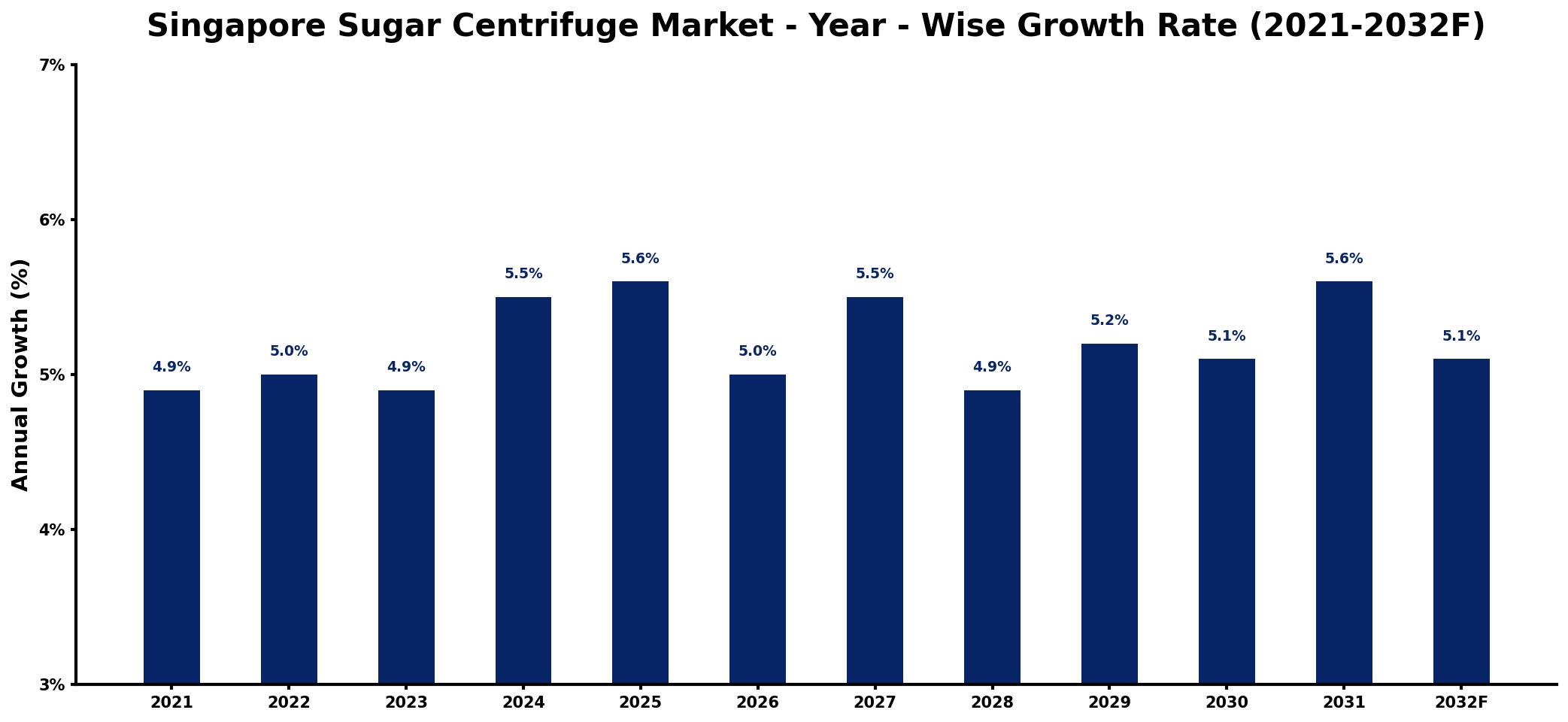
The table below presents the year‑wise growth rates along with the key drivers influencing the market
| Year | Growth Rate | Major Drivers |
| 2021 | 4.9% | Rising demand for renewable energy |
| 2022 | 5.0% | Increased investments in automation |
| 2023 | 4.9% | Expansion of food processing sector |
| 2024 | 5.5% | Growing emphasis on sustainability practices |
| 2025 | 5.6% | Strengthened supply chain efficiencies |
| 2026 | 5.0% | Technological advancements in processing |
| 2027 | 5.5% | Rising consumer health consciousness |
| 2028 | 4.9% | Growth in export opportunities |
| 2029 | 5.2% | Increased agricultural production capacity |
| 2030 | 5.1% | Emerging markets seeking modernization |
| 2031 | 5.6% | Enhanced regulatory support initiatives |
| 2032 | 5.1% | Development of innovative processing solutions |
Note: Market size estimations and growth projections presented in this report are based on 6Wresearch's proprietary forecasting methodology, utilizing the latest available industry data, government publications, and primary research inputs.
Singapore Sugar Centrifuge Market Synopsis
The Singapore Sugar Centrifuge Market is currently positioned to leverage the increasing sugar processing needs driven by a booming food and beverage industry. With a significant emphasis on quality and efficiency, sugar centrifuges are indispensable in extracting sugar crystals, thereby meeting both domestic and export demands.
Furthermore, advancements in centrifuge technology are improving the operational efficiency of sugar production facilities in Singapore. These innovations not only enhance output but also align with the rising consumer expectations for product quality, paving the way for a more sustainable production environment.
Singapore Sugar Centrifuge Market Key Takeaways
- The market is closely tied to the food and beverage industry's expansion in Singapore.
- Technological advancements are enhancing the efficiency of sugar centrifuges.
- High-capacity centrifuge demand is steady due to both local consumption and export activities.
- Compliance with stringent food safety standards is increasingly critical for manufacturers.
- Resilience during the COVID-19 pandemic highlighted the market's adaptability to challenges.
Evaluation of Restraints in Singapore Sugar Centrifuge Market
Despite its growth potential, the Singapore Sugar Centrifuge Market faces several constraints. Energy efficiency remains a major concern, as manufacturers strive to design centrifuges that minimize sugar loss while conserving energy. Additionally, stringent food safety regulations and high sanitation standards impose challenges that require continuous investment and innovation. These factors can create significant pressure on operating costs, impacting the overall market dynamics.
Singapore Sugar Centrifuge Market Trends
Emerging trends in the Singapore Sugar Centrifuge Market include a shift towards automation and smart technology in processing equipment. Increasingly, manufacturers are integrating IoT solutions to monitor and optimize centrifuge performance in real time. Sustainability is also becoming a paramount focus, with efforts to reduce waste and improve energy consumption. As global awareness of environmental impact grows, these trends are expected to shape the future landscape of the sugar processing industry.
Singapore Sugar Centrifuge Market Opportunities
Significant opportunities for growth lie within the pharmaceutical and industrial sectors, where the need for sugar centrifuges remains robust. As these sectors continue to expand, the demand for high-quality sugar products is projected to increase, offering lucrative prospects for manufacturers. Additionally, the push for modernization in sugar processing facilities provides a chance for companies to innovate and capture a larger market share by introducing advanced centrifuge technologies.
Government Initiatives in the Singapore Sugar Centrifuge Market
The Singapore government is actively promoting initiatives aimed at enhancing food production efficiency and sustainability. These initiatives often focus on improving technological capabilities in food processing, including the sugar sector. Public spending on research and development encourages innovation, and various grants and subsidies may be available to manufacturers investing in advanced equipment that meets stringent safety and quality standards.
Future Insights of the Singapore Sugar Centrifuge Market
Looking ahead, the Singapore Sugar Centrifuge Market is poised for steady growth, driven by ongoing technological advancements and an ever-increasing demand for processed sugar. By 2032, the market is expected to reflect the maturation of sugar production processes, emphasizing efficiency and sustainability. The industry will likely adapt to global trends, focusing on quality and innovation to meet evolving consumer preferences and regulatory requirements.
Singapore Sugar Centrifuge Market Latest Developments (2025 - 2026)
In recent months, the Singapore sugar industry has seen a push towards greater automation and energy-efficient processing technologies. The adoption of advanced centrifuge systems has gained traction among manufacturers aiming to improve operational efficiency while meeting strict sustainability benchmarks. Additionally, several manufacturers are exploring partnerships and collaborations to enhance product offerings and expand market reach.
Singapore Sugar Centrifuge Market - Key Attractiveness of the Report
- 10 Years of Market Numbers
- Historical Data Starting from 2022 to 2025
- Base Year: 2025
- Forecast Data until 2032
- Key Performance Indicators Impacting the Market
- Major Upcoming Developments and Projects
Key Highlights of the Report:
- Singapore Sugar Centrifuge Market Outlook
- Market Size of Singapore Sugar Centrifuge Market, 2025
- Forecast of Singapore Sugar Centrifuge Market, 2032
- Historical Data and Forecast of Singapore Sugar Centrifuge Revenues & Volume for the Period 2022-2032F
- Singapore Sugar Centrifuge Market Trend Evolution
- Singapore Sugar Centrifuge Market Drivers and Challenges
- Singapore Sugar Centrifuge Price Trends
- Singapore Sugar Centrifuge Porter's Five Forces
- Singapore Sugar Centrifuge Industry Life Cycle
- Historical Data and Forecast of Singapore Sugar Centrifuge Market Revenues & Volume By Product for the Period 2022-2032F
- Historical Data and Forecast of Singapore Sugar Centrifuge Market Revenues & Volume By Batch Type Centrifugal Machines for the Period 2022-2032F
- Historical Data and Forecast of Singapore Sugar Centrifuge Market Revenues & Volume By Continuous Centrifugal Machines for the Period 2022-2032F
- Historical Data and Forecast of Singapore Sugar Centrifuge Market Revenues & Volume By End Users for the Period 2022-2032F
- Historical Data and Forecast of Singapore Sugar Centrifuge Market Revenues & Volume By Cane Processing for the Period 2022-2032F
- Historical Data and Forecast of Singapore Sugar Centrifuge Market Revenues & Volume By Beet Processing for the Period 2022-2032F
- Historical Data and Forecast of Singapore Sugar Centrifuge Market Revenues & Volume By Other Applications for the Period 2022-2032F
- Singapore Sugar Centrifuge Import Export Trade Statistics
- Market Opportunity Assessment By Product
- Market Opportunity Assessment By End Users
- Singapore Sugar Centrifuge Top Companies Market Share
- Singapore Sugar Centrifuge Competitive Benchmarking By Technical and Operational Parameters
- Singapore Sugar Centrifuge Company Profiles
- Singapore Sugar Centrifuge Key Strategic Recommendations






































