Singapore Sulphate Resistant Cement Market Size, Share & Growth Rate
The Singapore Sulphate Resistant Cement Market was estimated at USD 292 Million in 2025 and is projected to reach USD 396 Million by 2032, growing at a CAGR of 4.4% from 2026 to 2032. This growth trajectory is primarily driven by increasing infrastructure development and ongoing construction projects that prioritize durability and resilience against sulfate exposure. As Singapore's urban landscape continues to evolve, the adoption of sulphate resistant cement becomes essential to maintain the longevity and structural integrity of new and existing constructions.
Singapore Sulphate Resistant Cement Market Year-wise Growth Rate and Key Drivers
This graph highlights how the Singapore Sulphate Resistant Cement Market has steadily grown over the years, supported by major growth factors.
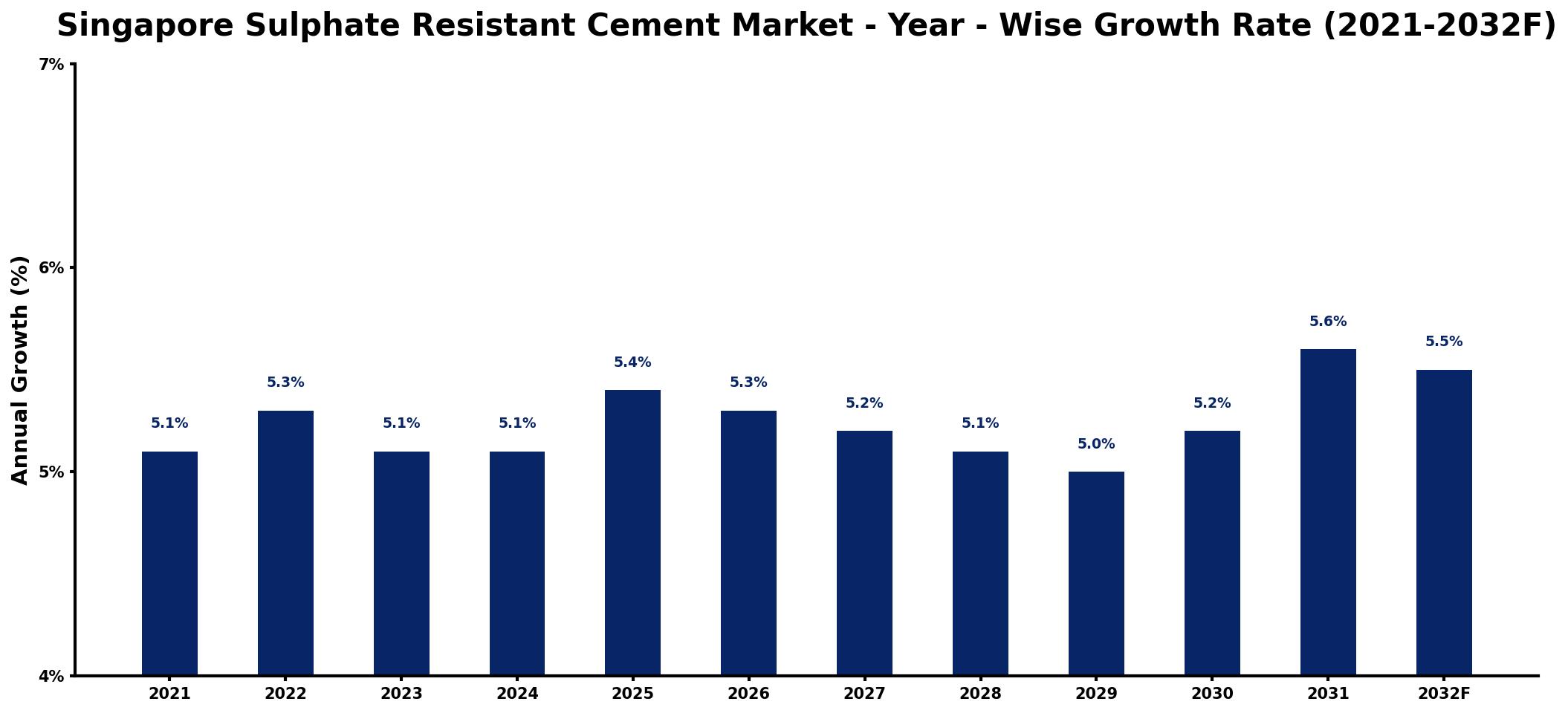
The table below presents the year‑wise growth rates along with the key drivers influencing the market
| Year | Growth Rate | Major Drivers |
| 2021 | 5.1% | Infrastructure projects driving demand |
| 2022 | 5.3% | Construction sector expansion ongoing |
| 2023 | 5.1% | Increased urbanization and development |
| 2024 | 5.1% | Government investments in infrastructure |
| 2025 | 5.4% | Rising residential construction activity |
| 2026 | 5.3% | Sustainable building practices gaining traction |
| 2027 | 5.2% | Enhanced focus on durable materials |
| 2028 | 5.1% | Growing commercial construction sector |
| 2029 | 5.0% | Emerging technologies in construction |
| 2030 | 5.2% | Public-private partnerships boosting investment |
| 2031 | 5.6% | International projects attracting attention |
| 2032 | 5.5% | Regulatory support for innovative solutions |
Note: Market size estimations and growth projections presented in this report are based on 6Wresearch's proprietary forecasting methodology, utilizing the latest available industry data, government publications, and primary research inputs.
Singapore Sulphate Resistant Cement Market Synopsis
A pivotal force shaping the Singapore sulphate resistant cement market is the booming construction and infrastructure sector. As urbanization accelerates, the demand for robust materials capable of withstanding harsh environmental conditions is more critical than ever. This has led to a marked preference for sulphate resistant cement, particularly in regions where soil and water contain high sulfate concentrations.
Additionally, the ongoing initiatives to renovate aging infrastructure bolster the market's growth. Projects that employ sulphate resistant cement are increasingly favored for their ability to combat deterioration associated with sulfate-induced attacks. This trend not only enhances structural durability but also aligns with Singapore's commitment to sustainable construction practices.
Singapore Sulphate Resistant Cement Market Key Takeaways
- The market is on a growth path, expected to reach USD 396 Million by 2032, driven by infrastructure projects.
- Durability against sulfate exposure is crucial for maintaining construction quality in Singapore's challenging environment.
- Innovation in product offerings and applications is vital for cement producers to remain competitive.
- Construction quality standards will continue to shape operational practices within the market.
- Limited disruptions from the COVID-19 pandemic allowed for ongoing infrastructure development without significant setbacks.
Evaluation of Restraints in Singapore Sulphate Resistant Cement Market
Despite a positive outlook, the Singapore sulphate resistant cement market contends with several restraints. Fluctuations in demand, influenced by broader economic trends and changes in construction activities, pose a challenge to consistent growth. Additionally, producers must navigate stringent construction quality standards that necessitate ongoing investment in compliance and innovation. As competition from alternative cement types increases, maintaining market share while diversifying product lines will be crucial for long-term viability.
Singapore Sulphate Resistant Cement Market Trends
Currently, there is a growing trend towards the integration of sustainable practices within the construction sector. This includes an increasing preference for materials that not only meet structural requirements but also have lower environmental impacts. Furthermore, advancements in manufacturing technology are facilitating the production of more efficient and effective sulphate resistant cement. These trends are likely to shape the future landscape of the market, influencing both consumer preferences and production methodologies.
Singapore Sulphate Resistant Cement Market Opportunities
The Singapore sulphate resistant cement market presents numerous opportunities for growth and investment. With the government's push for urban renewal and infrastructure expansion, companies can capitalize on projects requiring high-performance materials. Furthermore, tapping into emerging technologies and innovative applications can open new markets for sulphate resistant cement, reinforcing its role in sustainable construction. Investments in research and development will also be essential to enhance product formulations, catering to specific project needs and environmental challenges.
Government Initiatives in the Singapore Sulphate Resistant Cement Market
The Singapore government has been proactive in supporting the construction industry through various policies and initiatives aimed at enhancing sustainability and building resilience. Public investments in infrastructure projects align with the use of specialized materials like sulphate resistant cement, which are essential for ensuring long-lasting structures. Programs that promote innovation and the adoption of advanced materials further bolster the market, creating a conducive environment for growth.
Future Insights of the Singapore Sulphate Resistant Cement Market
Looking ahead to the period between 2026 and 2032, the Singapore sulphate resistant cement market is poised for steady growth. As construction demands evolve, there will likely be an increased emphasis on durability and sustainability, making sulphate resistant cement an integral component of future infrastructure projects. Additionally, ongoing advancements in material science could lead to improved formulations, enhancing the performance and appeal of sulphate resistant cement in various applications.
Singapore Sulphate Resistant Cement Market Latest Developments (2025 - 2026)
In recent months, there has been a notable increase in initiatives aimed at promoting the use of sulphate resistant cement in public construction projects. Industry players are also focusing on collaborative efforts with regulatory bodies to establish and refine quality standards for construction materials. Additionally, advancements in sustainable manufacturing practices are gaining traction, which may further solidify the market's growth trajectory as environmental concerns remain at the forefront of industry discussions.
Singapore Sulphate Resistant Cement Market - Key Attractiveness of the Report
- 10 Years of Market Numbers
- Historical Data Starting from 2022 to 2025
- Base Year: 2025
- Forecast Data until 2032
- Key Performance Indicators Impacting the Market
- Major Upcoming Developments and Projects
Key Highlights of the Report:
- Singapore Sulphate Resistant Cement Market Outlook
- Market Size of Singapore Sulphate Resistant Cement Market, 2025
- Forecast of Singapore Sulphate Resistant Cement Market, 2032
- Historical Data and Forecast of Singapore Sulphate Resistant Cement Revenues & Volume for the Period 2022-2032F
- Singapore Sulphate Resistant Cement Market Trend Evolution
- Singapore Sulphate Resistant Cement Market Drivers and Challenges
- Singapore Sulphate Resistant Cement Price Trends
- Singapore Sulphate Resistant Cement Porter's Five Forces
- Singapore Sulphate Resistant Cement Industry Life Cycle
- Historical Data and Forecast of Singapore Sulphate Resistant Cement Market Revenues & Volume By Types for the Period 2022-2032F
- Historical Data and Forecast of Singapore Sulphate Resistant Cement Market Revenues & Volume By C3A Content C3A Content 3%-5% for the Period 2022-2032F
- Historical Data and Forecast of Singapore Sulphate Resistant Cement Market Revenues & Volume By Sulphate Resistant Cement (SRC) for the Period 2022-2032F
- Historical Data and Forecast of Singapore Sulphate Resistant Cement Market Revenues & Volume By Applications for the Period 2022-2032F
- Historical Data and Forecast of Singapore Sulphate Resistant Cement Market Revenues & Volume By Effluent and Drainage Works for the Period 2022-2032F
- Historical Data and Forecast of Singapore Sulphate Resistant Cement Market Revenues & Volume By Coastal Protective Works for the Period 2022-2032F
- Historical Data and Forecast of Singapore Sulphate Resistant Cement Market Revenues & Volume By Road and Bridge Works for the Period 2022-2032F
- Historical Data and Forecast of Singapore Sulphate Resistant Cement Market Revenues & Volume By Others for the Period 2022-2032F
- Singapore Sulphate Resistant Cement Import Export Trade Statistics
- Market Opportunity Assessment By Types
- Market Opportunity Assessment By Applications
- Singapore Sulphate Resistant Cement Top Companies Market Share
- Singapore Sulphate Resistant Cement Competitive Benchmarking By Technical and Operational Parameters
- Singapore Sulphate Resistant Cement Company Profiles
- Singapore Sulphate Resistant Cement Key Strategic Recommendations






































