Singapore Tailors Scissor Market Size, Share & Growth Rate
The Singapore Tailors Scissor Market was estimated at USD 1336 Million in 2025 and is projected to reach USD 2290 Million by 2032, growing at a CAGR of 8.0% from 2026 to 2032. This growth trajectory is propelled by an increasing emphasis on fashion design and tailoring excellence, as both individual tailors and larger fashion houses seek precision tools to enhance their craft. Furthermore, the resurgence in local and bespoke tailoring practices is further fuelling demand for high-quality tailors scissors, solidifying their essential role in garment creation.
Singapore Tailors Scissor Market Year-wise Growth Rate and Key Drivers
This graph highlights how the Singapore Tailors Scissor Market has steadily grown over the years, supported by major growth factors.
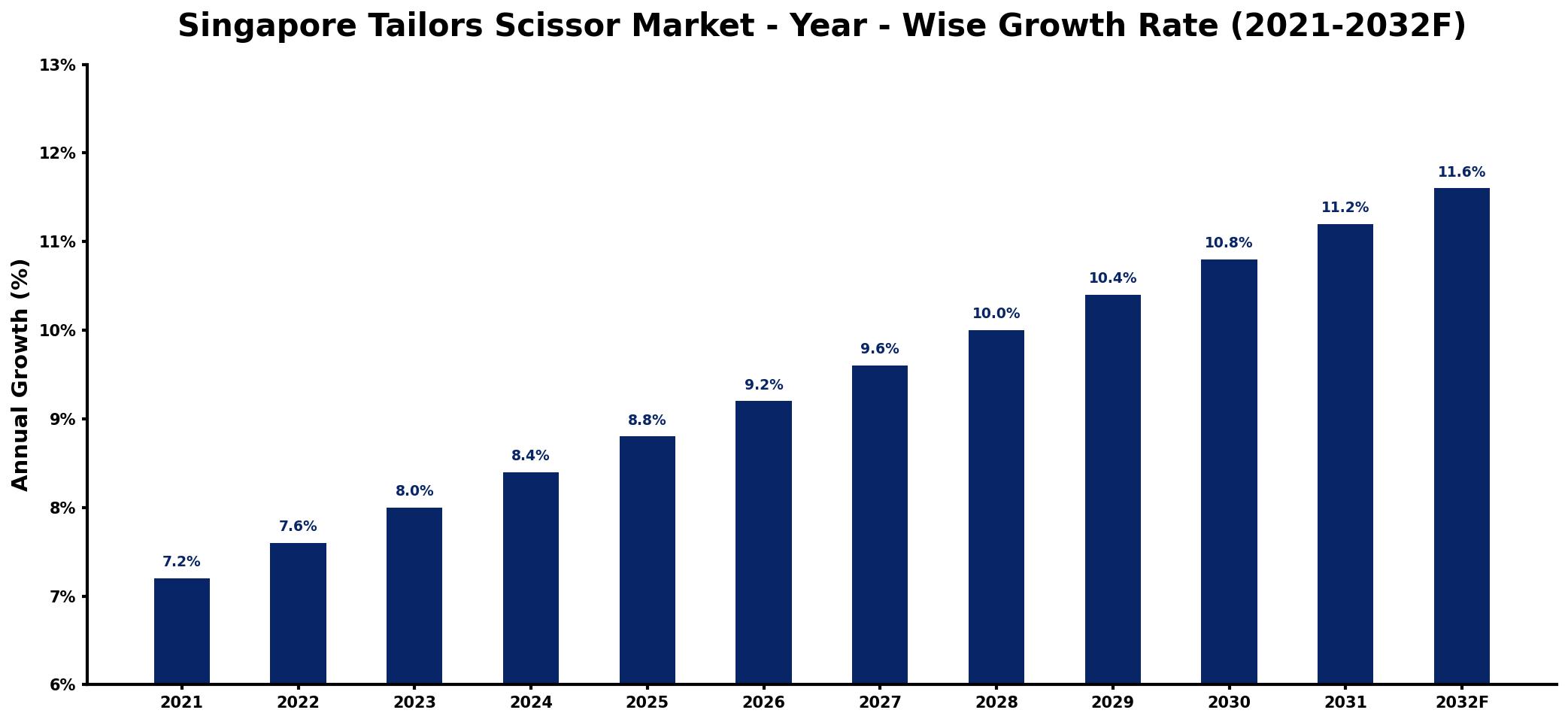
The table below presents the year‑wise growth rates along with the key drivers influencing the market
| Year | Growth Rate | Major Drivers |
| 2021 | 7.2% | Rising fashion industry investments |
| 2022 | 7.6% | Increased DIY crafting popularity |
| 2023 | 8.0% | Growth in textile manufacturing demand |
| 2024 | 8.4% | Surge in home tailoring services |
| 2025 | 8.8% | Expansion of online retail platforms |
| 2026 | 9.2% | Rising interest in sustainable fashion |
| 2027 | 9.6% | rising end-use demand growth |
| 2028 | 10.0% | Increased demand for customization services |
| 2029 | 10.4% | expanding industrial usage applications |
| 2030 | 10.8% | expanding manufacturing base activity |
| 2031 | 11.2% | growing regional consumption patterns |
| 2032 | 11.6% | Increase in home-based businesses |
Note: Market size estimations and growth projections presented in this report are based on 6Wresearch's proprietary forecasting methodology, utilizing the latest available industry data, government publications, and primary research inputs.
Singapore Tailors Scissor Market Synopsis
In recent years, the Singapore tailors scissor market has witnessed a revitalized demand driven by the flourishing fashion and textile industries. As consumers gravitate towards tailored apparel, tailors have increasingly relied on precision cutting tools to deliver quality outcomes. Looking ahead, this market is poised for continuous growth, supported by evolving fashion trends and innovations in scissor design that cater to diverse tailoring techniques.
Despite temporary setbacks caused by disruptions in the fashion industry, the market is recovering with resilience. The return of confidence in both consumer spending and the fashion sector bodes well for the future of tailors scissors. Craftsmanship remains a focal point, ensuring that high-quality cutting tools retain their indispensable status among professionals.
Singapore Tailors Scissor Market Key Takeaways
- Continued growth driven by rising demand for high-quality tailoring tools.
- Increased local fashion initiatives and bespoke tailoring are enhancing market dynamics.
- Innovations in scissor design are addressing modern tailoring needs.
- Resilience in market recovery post-COVID-19 indicates a rebound in consumer preferences.
- Craftsmanship and precision remain central themes in the market landscape.
Evaluation of Restraints in Singapore Tailors Scissor Market
The Singapore tailors scissor market faces several challenges that may impede growth. A significant concern is the competition from alternative cutting tools, which may attract some tailors seeking cost-effective solutions. Additionally, maintaining cutting precision and adhering to high tailoring standards is imperative, as any compromise could deter quality-focused professionals. Moreover, the evolving preferences in sewing techniques necessitate that scissor manufacturers keep pace with trends to remain relevant in a rapidly changing market.
Singapore Tailors Scissor Market Trends
Several trends are currently shaping the Singapore tailors scissor market. Notably, there is a growing inclination towards ergonomic designs that enhance user comfort during extended use. Additionally, advancements in materials, such as high-carbon stainless steel, offer improved sharpness and longevity. The rise of sustainability within the fashion industry is also influencing purchasing decisions, with consumers favoring tools that align with eco-friendly practices. Furthermore, digital platforms are facilitating greater access to specialized scissors, providing tailors with a wider array of options.
Singapore Tailors Scissor Market Opportunities
The Singapore tailors scissor market is ripe with opportunities for growth and investment. The surge in custom and bespoke tailoring presents a lucrative avenue for scissor manufacturers to introduce innovative products tailored to these niche markets. Furthermore, collaborations with local fashion designers can enhance brand visibility and drive sales. As online shopping continues to rise, leveraging e-commerce platforms to reach a broader audience can significantly expand market presence.
Government Initiatives in the Singapore Tailors Scissor Market
The Singapore government has been actively promoting the fashion and textile industries through various initiatives aimed at supporting local businesses and artisans. Policies that encourage skills development and training in tailoring are creating a conducive environment for industry growth. Additionally, grants and subsidies for local fashion enterprises help reduce operational costs, allowing tailors to invest in high-quality tools like precision scissors. This supportive framework ultimately enhances market potential and sustainability.
Future Insights of the Singapore Tailors Scissor Market
Looking ahead to 2026-2032, the Singapore tailors scissor market is likely to experience significant evolution driven by technological advancements and shifting consumer preferences. As digital technology becomes increasingly integrated into fashion design, scissor manufacturers may explore smart features to enhance usability. The emphasis on sustainability will further shape product development, compelling brands to innovate responsibly. Overall, the market is set to expand, with professionals demanding tools that not only meet but exceed traditional cutting standards.
Singapore Tailors Scissor Market Latest Developments (2025 - 2026)
Recently, the Singapore tailors scissor market has been witnessing a surge in interest from new entrants seeking to capitalize on the evolving landscape. Innovations in scissor design, particularly focusing on user comfort and cutting efficiency, are becoming more prevalent. Moreover, trade fairs and exhibitions dedicated to the textile industry have highlighted emerging trends and fostered collaborations among key players. As the market adapts to changes in consumer behavior and technology, these developments are shaping a vibrant future for tailoring tools.
Singapore Tailors Scissor Market - Key Attractiveness of the Report
- 10 Years of Market Numbers
- Historical Data Starting from 2022 to 2025
- Base Year: 2025
- Forecast Data until 2032
- Key Performance Indicators Impacting the Market
- Major Upcoming Developments and Projects
Key Highlights of the Report:
- Singapore Tailors Scissor Market Outlook
- Market Size of Singapore Tailors Scissor Market, 2025
- Forecast of Singapore Tailors Scissor Market, 2032
- Historical Data and Forecast of Singapore Tailors Scissor Revenues & Volume for the Period 2022-2032F
- Singapore Tailors Scissor Market Trend Evolution
- Singapore Tailors Scissor Market Drivers and Challenges
- Singapore Tailors Scissor Price Trends
- Singapore Tailors Scissor Porter's Five Forces
- Singapore Tailors Scissor Industry Life Cycle
- Historical Data and Forecast of Singapore Tailors Scissor Market Revenues & Volume By Product for the Period 2022-2032F
- Historical Data and Forecast of Singapore Tailors Scissor Market Revenues & Volume By Standard Scissors for the Period 2022-2032F
- Historical Data and Forecast of Singapore Tailors Scissor Market Revenues & Volume By Customized Scissors for the Period 2022-2032F
- Historical Data and Forecast of Singapore Tailors Scissor Market Revenues & Volume By Applications for the Period 2022-2032F
- Historical Data and Forecast of Singapore Tailors Scissor Market Revenues & Volume By Household for the Period 2022-2032F
- Historical Data and Forecast of Singapore Tailors Scissor Market Revenues & Volume By Commercial for the Period 2022-2032F
- Singapore Tailors Scissor Import Export Trade Statistics
- Market Opportunity Assessment By Product
- Market Opportunity Assessment By Applications
- Singapore Tailors Scissor Top Companies Market Share
- Singapore Tailors Scissor Competitive Benchmarking By Technical and Operational Parameters
- Singapore Tailors Scissor Company Profiles
- Singapore Tailors Scissor Key Strategic Recommendations






































