Singapore Television Broadcasting Market Size, Share & Growth Rate
The Singapore Television Broadcasting Market was estimated at USD 894 Million in 2025 and is projected to reach USD 1482 Million by 2032, growing at a CAGR of 7.5% from 2026 to 2032. This growth trajectory is fueled by the ongoing digital transformation, which has seen an increasing shift from traditional viewing methods to internet-based services. Additionally, the rising demand for high-quality, original content and the expansion of over-the-top (OTT) platforms are significantly shaping the industry's future.
Singapore Television Broadcasting Market Year-wise Growth Rate and Key Drivers
This graph highlights how the Singapore Television Broadcasting Market has steadily grown over the years, supported by major growth factors.
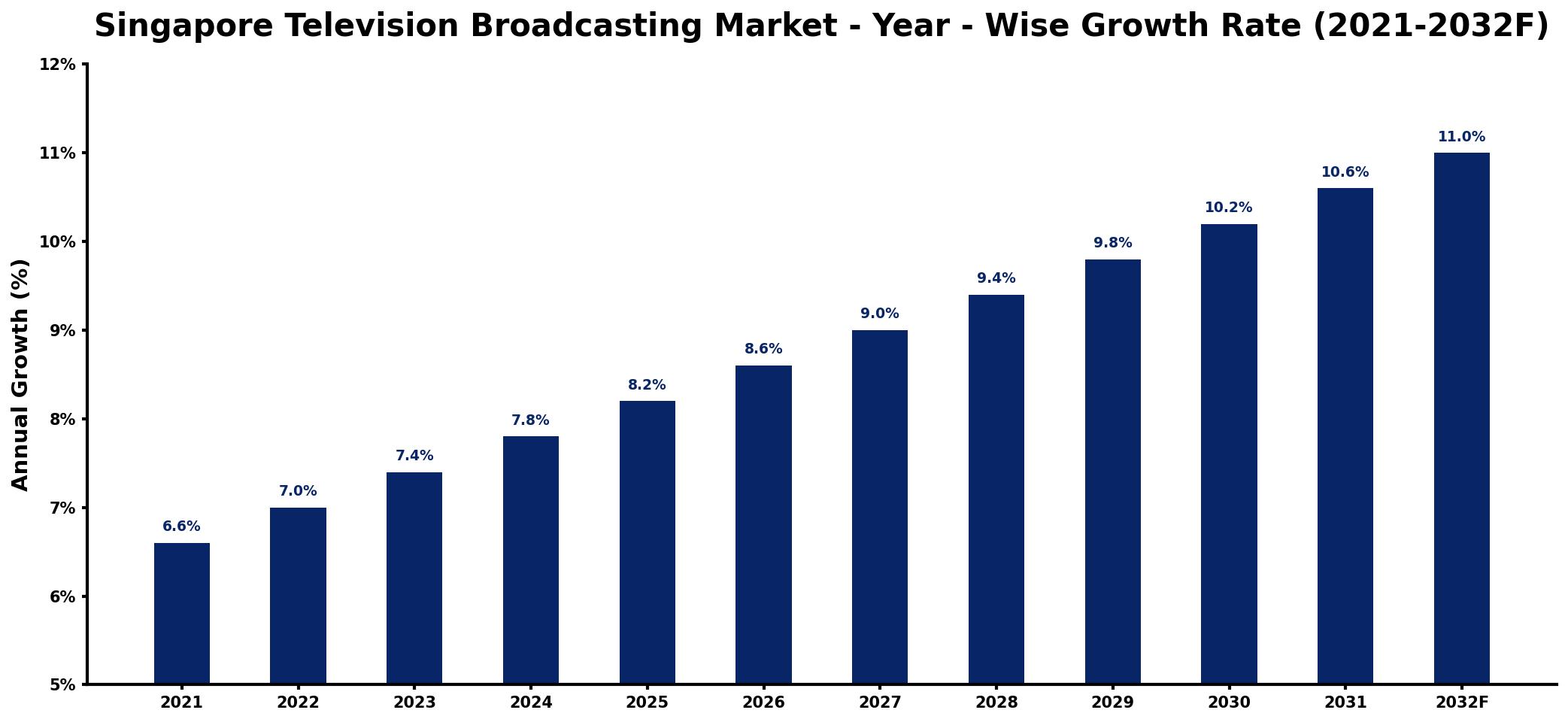
The table below presents the year‑wise growth rates along with the key drivers influencing the market
| Year | Growth Rate | Major Drivers |
| 2021 | 6.6% | Rising digital content consumption |
| 2022 | 7.0% | Increased investment in technology |
| 2023 | 7.4% | Expansion of streaming platforms |
| 2024 | 7.8% | Growing demand for local content |
| 2025 | 8.2% | Enhanced viewer engagement strategies |
| 2026 | 8.6% | Adoption of interactive experiences |
| 2027 | 9.0% | Development of 5G infrastructure |
| 2028 | 9.4% | Diversification of revenue streams |
| 2029 | 9.8% | Higher advertising expenditures forecast |
| 2030 | 10.2% | Emergence of new content genres |
| 2031 | 10.6% | Strengthening of international partnerships |
| 2032 | 11.0% | Advancements in content delivery |
Note: Market size estimations and growth projections presented in this report are based on 6Wresearch's proprietary forecasting methodology, utilizing the latest available industry data, government publications, and primary research inputs.
Singapore Television Broadcasting Market Synopsis
The television broadcasting market in Singapore has recently gained momentum as digital consumption rapidly evolves. Traditional cable and satellite services are now complemented by online streaming and video-on-demand options, responding to changing viewer preferences and behaviors.
Looking ahead, the market is poised for further evolution, necessitating broadcasters to innovate and produce high-quality original content. The ongoing demand for seamless viewing experiences across multiple platforms will be critical for retaining and expanding audience engagement.
Singapore Television Broadcasting Market Key Takeaways
- The market is expected to grow significantly due to the rise of OTT services and demand for high-quality content.
- Digital transformation is fundamentally altering how consumers engage with television content.
- Original programming is becoming a crucial focus for broadcasters seeking to differentiate themselves.
- Viewers are increasingly seeking on-demand and interactive content, challenging traditional broadcasting paradigms.
- Regulatory frameworks and content censorship remain vital considerations in shaping the market landscape.
Evaluation of Restraints in Singapore Television Broadcasting Market
The Singapore television broadcasting market grapples with substantial restraints stemming from the rapid shift towards internet-based streaming services. As more viewers migrate away from traditional cable and satellite offerings, broadcasters face the dual challenge of adapting their business models and investing in streaming infrastructure. Additionally, the saturation of online content presents fierce competition for viewer attention and advertising revenues, prompting an urgent need for innovation. Regulatory considerations, including content censorship, also impose limits on the types of programming and messaging broadcasters can pursue, further complicating their operational strategies.
Singapore Television Broadcasting Market Trends
Currently, the market is witnessing a significant trend towards the production of localized and original content, appealing to diverse demographic segments in Singapore. Furthermore, advancements in streaming technology and interactive features are enhancing user engagement, creating a more immersive viewing experience. Another emerging trend is the integration of social media platforms, allowing for real-time audience interaction and feedback. As consumer expectations evolve, broadcasters are increasingly focusing on personalized content delivery and tailored viewing options to meet individual preferences.
Singapore Television Broadcasting Market Opportunities
The Singapore television broadcasting market offers several promising growth and investment opportunities. With the rise of digital platforms, broadcasters have the chance to explore niche content areas and engage underserved audiences. Additionally, partnerships with tech companies to enhance streaming capabilities and user experiences can further expand market reach. The increased popularity of mobile viewing also presents opportunities for broadcasters to optimize content for mobile devices, facilitating access and driving engagement across varied demographics.
Government Initiatives in the Singapore Television Broadcasting Market
The Singaporean government has actively promoted the media and entertainment sector through various initiatives, including funding programs and incentives aimed at enhancing local content production. By fostering a conducive environment for innovation and creativity, these initiatives seek to strengthen the competitive edge of Singaporean broadcasters in the region. Regulatory bodies are also focused on ensuring fair competition and protecting consumer interests, which ultimately supports the sustainable growth of the television broadcasting market.
Future Insights of the Singapore Television Broadcasting Market
Between 2026 and 2032, the Singapore television broadcasting market is expected to experience significant transformation. As technology continues to evolve, broadcasters will need to harness new tools and platforms to meet the growing demand for diverse, high-quality content. A focus on integration across various media platforms will be essential to attract and retain viewers. Moreover, as the market landscape becomes increasingly competitive, the ability to innovate and adapt to viewer preferences will dictate success. Enhanced data analytics will also play a crucial role in tailoring content offerings and marketing strategies, allowing broadcasters to better understand and engage their audiences.
Singapore Television Broadcasting Market Latest Developments (2025 - 2026)
Recent developments in the Singapore television broadcasting market include a notable increase in collaborations between broadcasters and tech companies to enhance streaming capabilities and audience engagement. These partnerships are focused on delivering interactive viewing experiences and optimizing content for mobile platforms. Additionally, there has been a marked uptick in original local content production aimed at capturing the interests of a diverse audience base, alongside efforts to streamline content delivery across various digital channels.
Singapore Television Broadcasting Market - Key Attractiveness of the Report
- 10 Years of Market Numbers
- Historical Data Starting from 2022 to 2025
- Base Year: 2025
- Forecast Data until 2032
- Key Performance Indicators Impacting the Market
- Major Upcoming Developments and Projects
Key Highlights of the Report:
- Singapore Television Broadcasting Market Outlook
- Market Size of Singapore Television Broadcasting Market, 2025
- Forecast of Singapore Television Broadcasting Market, 2032
- Historical Data and Forecast of Singapore Television Broadcasting Revenues & Volume for the Period 2022-2032F
- Singapore Television Broadcasting Market Trend Evolution
- Singapore Television Broadcasting Market Drivers and Challenges
- Singapore Television Broadcasting Price Trends
- Singapore Television Broadcasting Porter's Five Forces
- Singapore Television Broadcasting Industry Life Cycle
- Historical Data and Forecast of Singapore Television Broadcasting Market Revenues & Volume By Type for the Period 2022-2032F
- Historical Data and Forecast of Singapore Television Broadcasting Market Revenues & Volume By Television Station for the Period 2022-2032F
- Historical Data and Forecast of Singapore Television Broadcasting Market Revenues & Volume By Television Network for the Period 2022-2032F
- Historical Data and Forecast of Singapore Television Broadcasting Market Revenues & Volume By Broadcaster Type for the Period 2022-2032F
- Historical Data and Forecast of Singapore Television Broadcasting Market Revenues & Volume By Public for the Period 2022-2032F
- Historical Data and Forecast of Singapore Television Broadcasting Market Revenues & Volume By Commercial for the Period 2022-2032F
- Historical Data and Forecast of Singapore Television Broadcasting Market Revenues & Volume By Revenue Source for the Period 2022-2032F
- Historical Data and Forecast of Singapore Television Broadcasting Market Revenues & Volume By Subscription-based for the Period 2022-2032F
- Historical Data and Forecast of Singapore Television Broadcasting Market Revenues & Volume By Advertisement-based for the Period 2022-2032F
- Singapore Television Broadcasting Import Export Trade Statistics
- Market Opportunity Assessment By Type
- Market Opportunity Assessment By Broadcaster Type
- Market Opportunity Assessment By Revenue Source
- Singapore Television Broadcasting Top Companies Market Share
- Singapore Television Broadcasting Competitive Benchmarking By Technical and Operational Parameters
- Singapore Television Broadcasting Company Profiles
- Singapore Television Broadcasting Key Strategic Recommendations






































