Singapore Thermostats Market Summary
The singapore thermostats market was estimated at USD 190 Million in 2025 and is projected to reach USD 269 Million by 2032, growing at a CAGR of 5.8% from 2026 to 2032.
Singapore Thermostats Market Year-wise Growth Rate and Key Drivers
This graph highlights how the Singapore Thermostats Market has steadily grown over the past five years, supported by major growth factors.
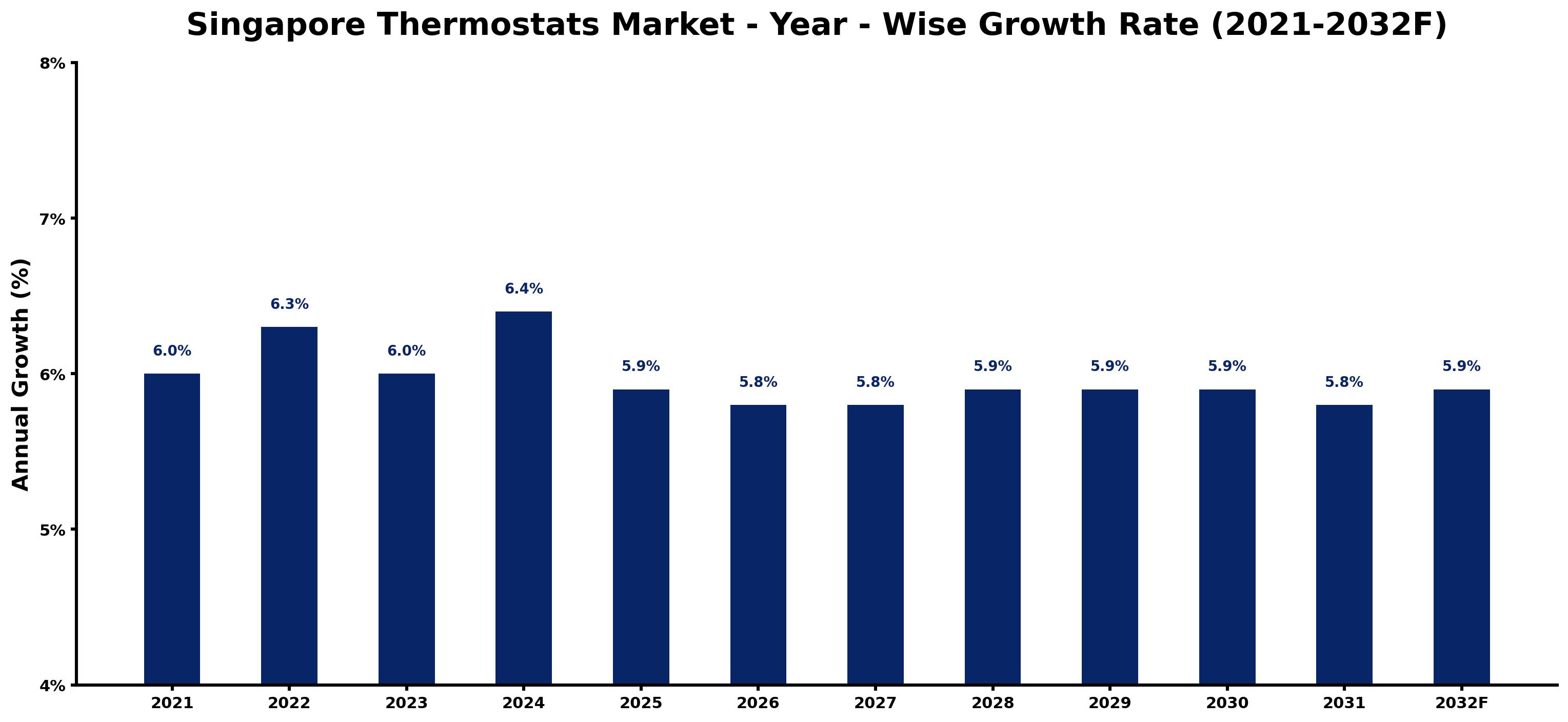
The table below presents the year wise growth rates along with the key drivers influencing the market
| Year | Growth Rate | Major Drivers |
| 2021 | 6.0% | Post-pandemic economic recovery sparked renewed interest in home automation technologies. |
| 2022 | 6.3% | Consumer awareness about energy efficiency shifted preferences toward smart thermostat solutions. |
| 2023 | 6.0% | Continued urbanization led to increased investments in residential construction and renovation projects. |
| 2024 | 6.4% | Technological integration in HVAC systems created opportunities for innovative thermostat designs. |
| 2025 | 5.9% | Remote working trends drove homeowners to optimize indoor comfort levels through smart devices. |
| 2026 | 5.8% | Corporate partnerships focused on sustainability aligned market offerings with environmental objectives. |
| 2027 | 5.8% | Emerging AI capabilities enhanced thermostat functionality, appealing to tech-savvy consumers. |
| 2028 | 5.9% | Rising disposable incomes enabled households to invest in high-end climate control products. |
| 2029 | 5.9% | Increased competition among manufacturers led to more affordable, advanced thermostat options. |
| 2030 | 5.9% | Growing emphasis on health and wellness influenced preferences for climate-responsive home environments. |
| 2031 | 5.8% | Market players emphasized seamless integration with IoT devices, enhancing user experience significantly. |
| 2032 | 5.9% | Focus on retrofitting older buildings with smart technology captured attention of developers. |
Note - Market size estimations and growth projections presented in this report are based on 6Wresearch's advanced forecasting approach, validated with industry datasets as of June 2026.
Singapore Thermostats Market Synopsis
The Singapore Thermostats Market is projected to reach 5.8% and witness significant growth during the forecast period (2026-2032). This growth is largely attributed to increasing residential constructions, heightened awareness regarding energy efficiency, and the rising demand for smart technology in temperature regulation systems. As urbanization progresses and the population continues to grow, the demand for effective temperature control devices is expected to surge.
Singapore Thermostats Market Growth Drivers
Several key factors are driving the growth of the Singapore Thermostats Market:
- Increasing number of residential constructions: The steady rise in Singapore's population has spurred substantial growth in residential building projects. With more homes being constructed, the demand for thermostats for efficient temperature control is escalating.
- Heightened awareness of energy savings: As electricity costs rise, consumers are increasingly conscious of the need to manage energy consumption. Thermostats offer an effective solution for optimizing energy usage, leading to lower utility bills and promoting sustainable living practices.
- Advancements in technology: The proliferation of smart thermostats equipped with Wi-Fi connectivity and automated features is attracting users who seek convenience and efficiency. These devices can be controlled remotely and programmed to adjust temperatures according to user preferences, enhancing overall user satisfaction.
- Regulatory support for energy efficiency: Government initiatives aimed at promoting energy-efficient appliances are further fuelling demand for modern thermostatic solutions. Incentives and rebates can influence consumer purchases and encourage upgrades from older systems.
- Maintenance advantages: Modern thermostats often require less maintenance than traditional HVAC systems. This feature appeals to both residential and commercial users, who seek long-term cost-effective solutions for temperature regulation.
Singapore Thermostats Market Challenges and Restraints
Despite the positive outlook, there are several challenges that may hinder the growth of the Singapore Thermostats Market:
- High initial setup costs: The installation of advanced thermostatic systems can be prohibitively expensive, especially if it involves retrofitting existing HVAC systems. The need for additional wiring and potential upgrades can deter some consumers.
- Complex installation processes: Dependence on professional installation can complicate the adoption of thermostats, adding to the overall cost and time required to implement the technology.
- Market competition: As multiple manufacturers produce similar products, price competition may drive down profit margins, making it challenging for companies to differentiate their offerings.
- Lack of consumer awareness: Although awareness is increasing, there remains a segment of the population that is not fully aware of the benefits associated with modern thermostatic technologies, which may slow market penetration.
- Impact of economic fluctuations: Economic uncertainties could potentially affect consumer spending on home renovation and energy-efficient upgrades, influencing market demand negatively.
Singapore Thermostats Market Government Investment and Initiatives
The Singapore government has actively pursued initiatives aimed at enhancing energy efficiency across various sectors, including residential and commercial buildings. Policies encouraging the adoption of smart technologies and sustainable practices play a crucial role in fostering the Singapore Thermostats Market. These initiatives include:
- Funding programs for energy-efficient technologies: Government funding aimed at advancing energy-efficient solutions encourages homeowners to invest in modern thermostatic systems.
- Regulatory frameworks promoting energy conservation: Building codes and regulations that mandate energy-efficient installations ensure a broader uptake of advanced thermostats among new constructions.
- Public awareness campaigns: Initiatives designed to educate the populace about energy savings and the benefits of modern technologies are crucial in driving consumer interest.
- Partnerships with industry stakeholders: Collaborative efforts between the public and private sectors aim to stimulate innovation in energy-saving technologies, which benefits the thermostats market significantly.
- Incentives for manufacturers: Providing tax incentives to companies that invest in research and development of sustainable temperature control solutions can accelerate technological advancements in the market.
Singapore Thermostats Market Latest Developments (May 2025 - June 2026)
The Singapore Thermostats Market has seen various developments from May 2025 to June 2026. Notable trends during this period include:
- Increased investments in smart home technologies: A surge in consumer interest in smart home ecosystems has catalyzed brands to innovate and integrate thermostats with other connected home devices.
- Focus on user-friendly interfaces: Manufacturers are increasingly prioritizing intuitive designs that facilitate ease of use, accommodating a broader demographic.
- Emphasis on sustainability: There has been a marked shift towards environmentally friendly products, with many companies committing to reducing their carbon footprints through innovative thermostat solutions.
- Online sales growth: The post-pandemic climate has accelerated the shift towards e-commerce, leading to a rise in online sales for thermostatic devices, catering to changing consumer preferences.
- Adaptation to new regulatory standards: Companies are aligning their products with emerging government regulations focused on energy efficiency, ensuring compliance while demonstrating their commitment to sustainability.
Singapore Thermostats Market - Key Attractiveness of the Report
- 10 Years of Market Numbers
- Historical Data Starting from 2022 to 2025
- Base Year: 2025
- Forecast Data until 2032
- Key Performance Indicators Impacting the Market
- Major Upcoming Developments and Projects
Key Highlights of the Report:
- Singapore Thermostats Market Outlook
- Market Size of Singapore Thermostats Market, 2025
- Forecast of Singapore Thermostats Market, 2032F
- Historical Data and Forecast of Singapore Thermostats Revenues & Volume for the Period 2022-2032F
- Singapore Thermostats Market Trend Evolution
- Singapore Thermostats Market Drivers and Challenges
- Singapore Thermostats Price Trends
- Singapore Thermostats Porter's Five Forces
- Singapore Thermostats Industry Life Cycle
- Historical Data and Forecast of Singapore Thermostats Market Revenues & Volume By Products for the Period 2022-2032F
- Historical Data and Forecast of Singapore Thermostats Market Revenues & Volume By Smart Thermostat for the Period 2022-2032F
- Historical Data and Forecast of Singapore Thermostats Market Revenues & Volume By Mechanical Thermostat for the Period 2022-2032F
- Historical Data and Forecast of Singapore Thermostats Market Revenues & Volume By Programmable Thermostat for the Period 2022-2032F
- Historical Data and Forecast of Singapore Thermostats Market Revenues & Volume By Distribution Channel for the Period 2022-2032F
- Historical Data and Forecast of Singapore Thermostats Market Revenues & Volume By Utility for the Period 2022-2032F
- Historical Data and Forecast of Singapore Thermostats Market Revenues & Volume By Retail for the Period 2022-2032F
- Historical Data and Forecast of Singapore Thermostats Market Revenues & Volume By Security for the Period 2022-2032F
- Historical Data and Forecast of Singapore Thermostats Market Revenues & Volume By HVAC for the Period 2022-2032F
- Historical Data and Forecast of Singapore Thermostats Market Revenues & Volume By Mode of Operations for the Period 2022-2032F
- Historical Data and Forecast of Singapore Thermostats Market Revenues & Volume By Line Voltage for the Period 2022-2032F
- Historical Data and Forecast of Singapore Thermostats Market Revenues & Volume By Low Voltage for the Period 2022-2032F
- Historical Data and Forecast of Singapore Thermostats Market Revenues & Volume By Millivolt for the Period 2022-2032F
- Historical Data and Forecast of Singapore Thermostats Market Revenues & Volume By Applications for the Period 2022-2032F
- Historical Data and Forecast of Singapore Thermostats Market Revenues & Volume By Residential for the Period 2022-2032F
- Historical Data and Forecast of Singapore Thermostats Market Revenues & Volume By Commercial for the Period 2022-2032F
- Singapore Thermostats Import Export Trade Statistics
- Market Opportunity Assessment By Products
- Market Opportunity Assessment By Distribution Channel
- Market Opportunity Assessment By Mode of Operations
- Market Opportunity Assessment By Applications
- Singapore Thermostats Top Companies Market Share
- Singapore Thermostats Competitive Benchmarking By Technical and Operational Parameters
- Singapore Thermostats Company Profiles
- Singapore Thermostats Key Strategic Recommendations






































