Singapore Time and Attendance Software Market Size, Share & Growth Rate
The Singapore Time and Attendance Software Market was estimated at USD 971 Million in 2025 and is projected to reach USD 1386 Million by 2032, growing at a CAGR of 5.2% from 2026 to 2032. This growth is primarily driven by businesses increasingly prioritizing operational efficiency and accuracy in workforce management. As organizations recognize the importance of precise time tracking and compliance with labor regulations, the demand for innovative software solutions continues to rise.
Singapore Time and Attendance Software Market Year-wise Growth Rate and Key Drivers
This graph highlights how the Singapore Time and Attendance Software Market has steadily grown over the years, supported by major growth factors.
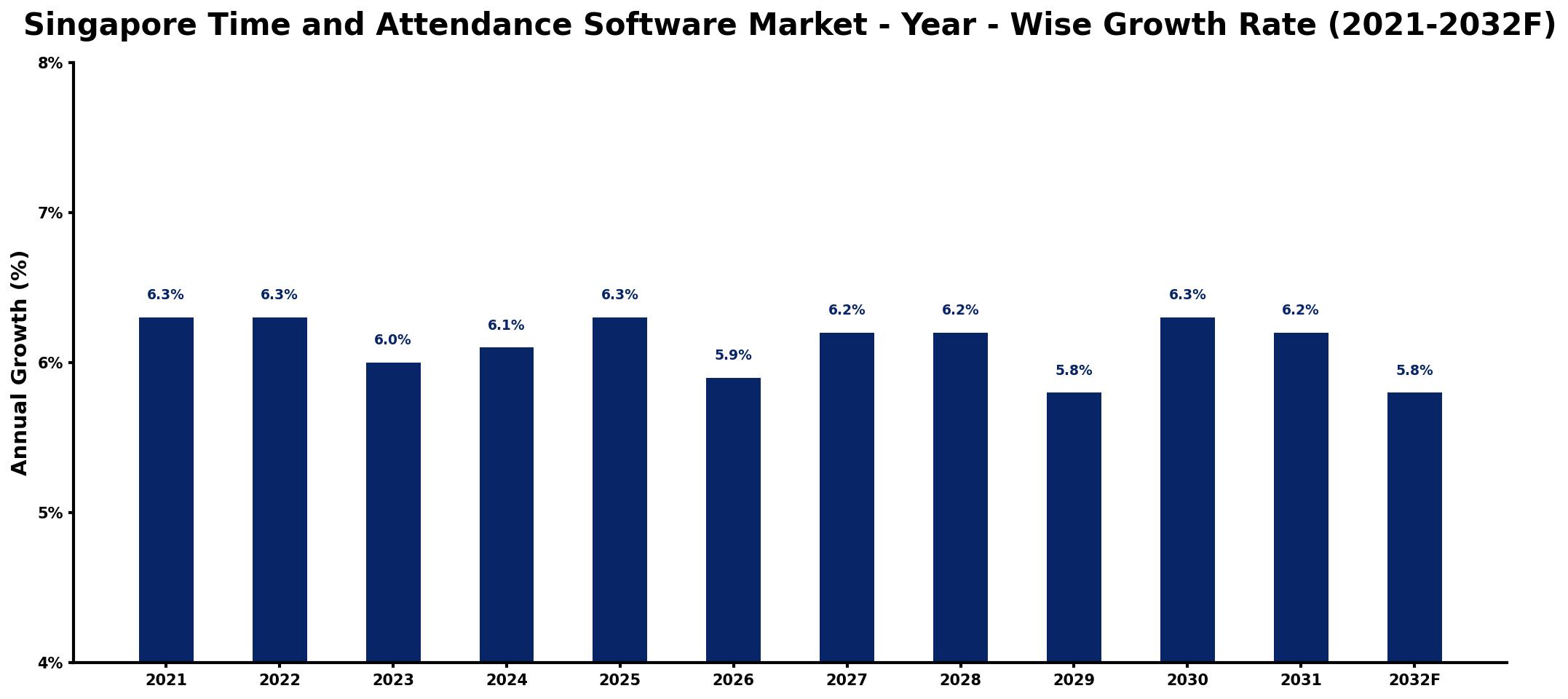
The table below presents the year‑wise growth rates along with the key drivers influencing the market
| Year | Growth Rate | Major Drivers |
| 2021 | 6.3% | Increased remote work adoption trends |
| 2022 | 6.3% | Growing need for workforce management |
| 2023 | 6.0% | Rising demand for automation solutions |
| 2024 | 6.1% | Expansion of cloud-based technologies |
| 2025 | 6.3% | Increased investment in HR technologies |
| 2026 | 5.9% | Emergence of mobile workforce solutions |
| 2027 | 6.2% | Focus on employee engagement strategies |
| 2028 | 6.2% | Growth in data analytics capabilities |
| 2029 | 5.8% | Shift towards integrated management systems |
| 2030 | 6.3% | Boost in regulatory compliance requirements |
| 2031 | 6.2% | Rising importance of employee wellness |
| 2032 | 5.8% | Development of AI-driven insights |
Note: Market size estimations and growth projections presented in this report are based on 6Wresearch's proprietary forecasting methodology, utilizing the latest available industry data, government publications, and primary research inputs.
Singapore Time and Attendance Software Market Synopsis
The demand for time and attendance software in Singapore is propelled by the growing complexity of labor regulations and the increasing need for businesses to ensure compliance while maximizing workforce productivity. In a competitive business landscape, organizations are investing in software solutions that not only track attendance but also integrate seamlessly with payroll systems to enhance operational efficiency.
With the rise of remote work culture, the need for flexible, cloud-based time and attendance solutions has surged, encouraging vendors to adapt their offerings. Organizations are now seeking mobile capabilities that allow real-time tracking and management of employee attendance, further catalyzing market expansion.
Singapore Time and Attendance Software Market Key Takeaways
- The market is projected to grow significantly as businesses emphasize workforce efficiency and compliance.
- Cloud-based solutions are becoming increasingly popular, driven by the need for flexibility in remote work arrangements.
- Integration with payroll systems enhances the value proposition of time and attendance software.
- Data privacy concerns are becoming more pronounced, necessitating robust security measures from software providers.
- Local vendors are emerging to compete with established global brands by offering tailored solutions for Singaporean businesses.
Evaluation of Restraints in Singapore Time and Attendance Software Market
Despite its promising growth trajectory, the Singapore time and attendance software market faces notable constraints. Data privacy remains a critical concern as organizations strive to comply with stringent regulations while managing employee information. Additionally, the rapid pace of technological change poses a challenge, as businesses must continually evaluate and adapt to emerging software solutions. Furthermore, the competition from both established players and innovative start-ups requires constant differentiation to maintain market relevance.
Singapore Time and Attendance Software Market Trends
Current trends in the Singapore time and attendance software market include the increased use of artificial intelligence and machine learning to enhance predictive analytics for workforce management. Furthermore, mobile accessibility continues to gain traction, enabling employees to clock in and out from their smartphones, which is particularly relevant in a hybrid work environment. Additionally, integration with other human resource technologies is becoming a key focus, ensuring seamless operations across various business functions.
Singapore Time and Attendance Software Market Opportunities
The Singapore time and attendance software market presents significant opportunities for growth, particularly in the areas of customization and advanced analytics. As organizations increasingly seek bespoke solutions tailored to their specific workforce management challenges, vendors who can offer tailored software and superior customer support will find themselves at an advantage. Additionally, the push for digital transformation among SMEs presents a fertile ground for investment and innovation in time and attendance solutions.
Government Initiatives in the Singapore Time and Attendance Software Market
The Singaporean government has been proactive in promoting digitalization within the workforce, providing incentives and support programs for businesses to adopt advanced technologies. Initiatives aimed at enhancing workplace productivity and ensuring compliance with labor laws are paving the way for increased adoption of time and attendance software. Such governmental support is essential for fostering innovation and ensuring that companies can meet evolving regulatory requirements while optimizing their operational practices.
Future Insights of the Singapore Time and Attendance Software Market
Looking ahead to 2026-2032, the Singapore time and attendance software market is expected to evolve significantly. As the workforce becomes more mobile and diverse, software solutions will increasingly incorporate sophisticated features such as biometric authentication and geolocation tracking. Moreover, the integration of AI-driven insights into attendance management will empower organizations to make data-driven decisions, fostering a more agile and responsive workforce management approach. Overall, this market is well-positioned for sustainable growth as it adapts to the changing needs of the workforce.
Singapore Time and Attendance Software Market Latest Developments (2025 - 2026)
Recently, the Singapore time and attendance software market has seen increased investment from both local and international players aiming to enhance their service offerings. Companies are focusing on cloud-based platforms that provide businesses with greater flexibility and ease of use. Additionally, there has been a noticeable shift towards incorporating AI technologies into time and attendance systems, with an emphasis on predictive analytics to aid in workforce planning. Such developments are indicative of a broader trend towards smart workforce management solutions in the region.
Singapore Time and Attendance Software Market - Key Attractiveness of the Report
- 10 Years of Market Numbers
- Historical Data Starting from 2022 to 2025
- Base Year: 2025
- Forecast Data until 2032
- Key Performance Indicators Impacting the Market
- Major Upcoming Developments and Projects
Key Highlights of the Report:
- Singapore Time and Attendance Software Market Outlook
- Market Size of Singapore Time and Attendance Software Market, 2025
- Forecast of Singapore Time and Attendance Software Market, 2032
- Historical Data and Forecast of Singapore Time and Attendance Software Revenues & Volume for the Period 2022-2032F
- Singapore Time and Attendance Software Market Trend Evolution
- Singapore Time and Attendance Software Market Drivers and Challenges
- Singapore Time and Attendance Software Price Trends
- Singapore Time and Attendance Software Porter's Five Forces
- Singapore Time and Attendance Software Industry Life Cycle
- Historical Data and Forecast of Singapore Time and Attendance Software Market Revenues & Volume By Component for the Period 2022-2032F
- Historical Data and Forecast of Singapore Time and Attendance Software Market Revenues & Volume By Software for the Period 2022-2032F
- Historical Data and Forecast of Singapore Time and Attendance Software Market Revenues & Volume By Services for the Period 2022-2032F
- Historical Data and Forecast of Singapore Time and Attendance Software Market Revenues & Volume By Deployment Mode for the Period 2022-2032F
- Historical Data and Forecast of Singapore Time and Attendance Software Market Revenues & Volume By On-premise for the Period 2022-2032F
- Historical Data and Forecast of Singapore Time and Attendance Software Market Revenues & Volume By Cloud for the Period 2022-2032F
- Historical Data and Forecast of Singapore Time and Attendance Software Market Revenues & Volume By Hybrid for the Period 2022-2032F
- Historical Data and Forecast of Singapore Time and Attendance Software Market Revenues & Volume By Organization Size for the Period 2022-2032F
- Historical Data and Forecast of Singapore Time and Attendance Software Market Revenues & Volume By Large Enterprises for the Period 2022-2032F
- Historical Data and Forecast of Singapore Time and Attendance Software Market Revenues & Volume By SMES for the Period 2022-2032F
- Historical Data and Forecast of Singapore Time and Attendance Software Market Revenues & Volume By Industry Vertical for the Period 2022-2032F
- Historical Data and Forecast of Singapore Time and Attendance Software Market Revenues & Volume By BFSI for the Period 2022-2032F
- Historical Data and Forecast of Singapore Time and Attendance Software Market Revenues & Volume By Manufacturing for the Period 2022-2032F
- Historical Data and Forecast of Singapore Time and Attendance Software Market Revenues & Volume By Healthcare for the Period 2022-2032F
- Historical Data and Forecast of Singapore Time and Attendance Software Market Revenues & Volume By Government for the Period 2022-2032F
- Historical Data and Forecast of Singapore Time and Attendance Software Market Revenues & Volume By Retail & E-commerce for the Period 2022-2032F
- Historical Data and Forecast of Singapore Time and Attendance Software Market Revenues & Volume By IT & Telecom for the Period 2022-2032F
- Historical Data and Forecast of Singapore Time and Attendance Software Market Revenues & Volume By Education for the Period 2022-2032F
- Historical Data and Forecast of Singapore Time and Attendance Software Market Revenues & Volume By Others for the Period 2022-2032F
- Singapore Time and Attendance Software Import Export Trade Statistics
- Market Opportunity Assessment By Component
- Market Opportunity Assessment By Deployment Mode
- Market Opportunity Assessment By Organization Size
- Market Opportunity Assessment By Industry Vertical
- Singapore Time and Attendance Software Top Companies Market Share
- Singapore Time and Attendance Software Competitive Benchmarking By Technical and Operational Parameters
- Singapore Time and Attendance Software Company Profiles
- Singapore Time and Attendance Software Key Strategic Recommendations






































