Singapore Titanium Market Summary
The singapore titanium market was estimated at USD 982 Million in 2025 and is projected to reach USD 1405 Million by 2032, growing at a CAGR of 6.3% from 2026 to 2032.
Singapore Titanium Market Year-wise Growth Rate and Key Drivers
This graph highlights how the Singapore Titanium Market has steadily grown over the past five years, supported by major growth factors.
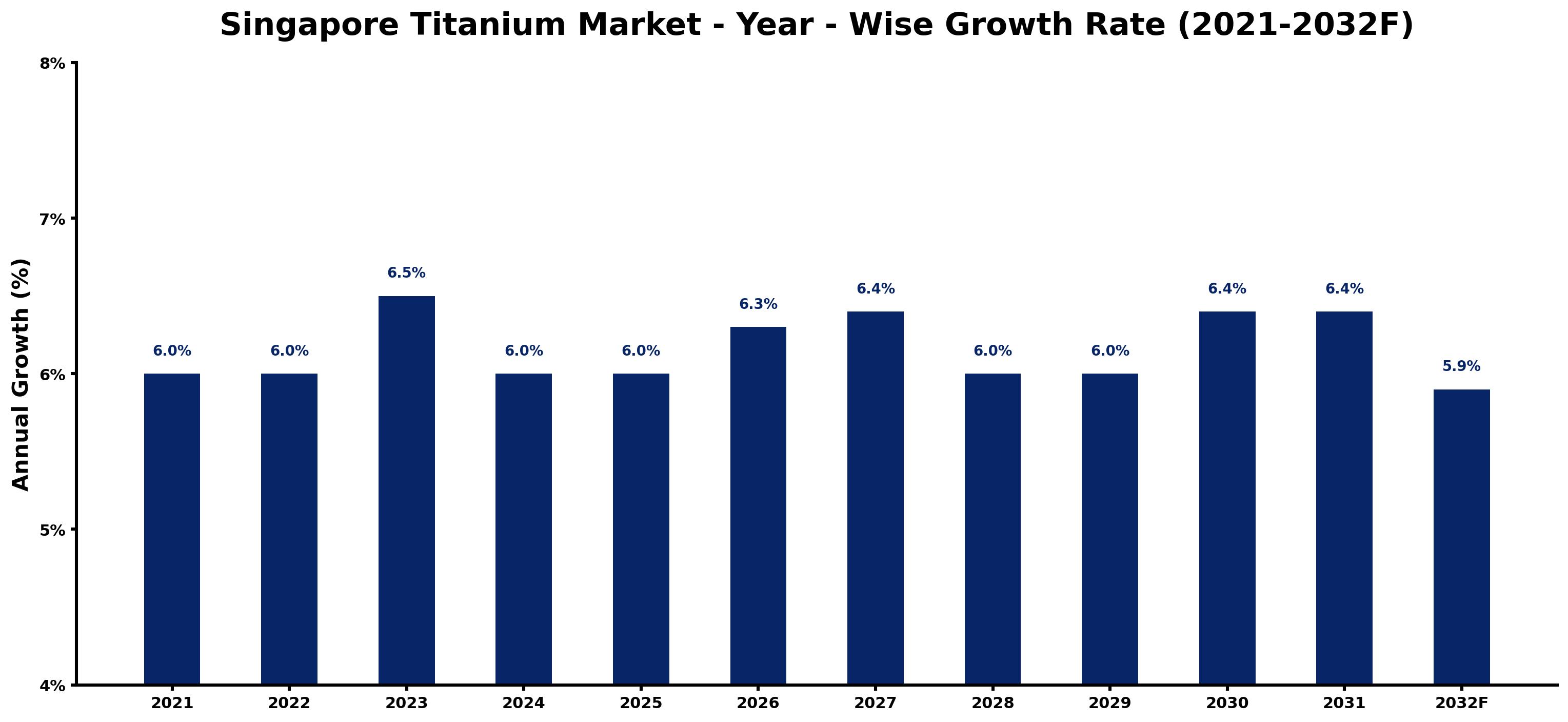
The table below presents the year wise growth rates along with the key drivers influencing the market
| Year | Growth Rate | Major Drivers |
| 2021 | 6.0% | Post-pandemic recovery in aerospace sectors leads to increased titanium usage in aircraft. |
| 2022 | 6.0% | Manufacturers respond to supply chain disruptions with localized titanium production initiatives. |
| 2023 | 6.5% | Rising demand for lightweight materials in automotive enhances titanium's market presence. |
| 2024 | 6.0% | Construction pipelines expand, stimulating interest in titanium for infrastructure projects. |
| 2025 | 6.0% | Emerging technologies in 3D printing elevate titanium's role in custom manufacturing solutions. |
| 2026 | 6.3% | Sustainable practices encourage titanium recycling, appealing to environmentally conscious businesses. |
| 2027 | 6.4% | Investments in research facilitate innovations, improving titanium's properties and applications. |
| 2028 | 6.0% | Increased collaboration between academia and industry enhances titanium research and development. |
| 2029 | 6.0% | Regional defense contracts boost titanium demand for military aircraft and equipment. |
| 2030 | 6.4% | A shift towards electric vehicles makes titanium components essential for battery efficiency. |
| 2031 | 6.4% | Rising consumer awareness of material sustainability influences titanium purchase decisions. |
| 2032 | 5.9% | Global market diversification opens new avenues for Singaporean titanium manufacturers and exporters. |
Note - Market size estimations and growth projections presented in this report are based on 6Wresearch's advanced forecasting approach, validated with industry datasets as of June 2026.
Singapore Titanium Market Synopsis
The Singapore Titanium Market is projected to reach 6.3% and witness significant growth during the forecast period (2026-2032). This growth trajectory is largely influenced by the increasing demand for lightweight materials necessary for various industrial applications, particularly in the automotive and aerospace sectors. Stringent government regulations aimed at reducing carbon emissions have also catalyzed a shift towards titanium products. Additionally, the rising investment from aerospace companies in the construction of commercial aircraft is expected to further fuel the titanium market in Singapore.
Singapore Titanium Market Growth Drivers
Several pivotal factors are driving the expansion of the Singapore titanium market. Firstly, the lightweight characteristic of titanium makes it an ideal material for industries needing to enhance fuel efficiency while minimizing the weight of their products. Secondly, regulatory pressures for reduced carbon emissions have prompted automotive manufacturers to seek materials that align with sustainability goals, making titanium highly desirable.
- Growing emphasis on lightweight materials in various applications has led to increased use of titanium in automotive and aerospace sectors.
- The stringent government initiatives promoting the reduction of carbon footprints are encouraging the adoption of titanium products.
- Ongoing investments in the aerospace industry to develop and construct commercial aircraft are significantly boosting demand for titanium.
- Enhanced environmental awareness has led to a preference for titanium alloys due to their superior properties, making them preferable substitutes for traditional metals.
- Technological advancements in manufacturing processes are increasing the efficiency and lowering the costs related to titanium production, driving market growth.
Singapore Titanium Market Trends and Opportunities
The trends emerging within the Singapore titanium market signify robust future opportunities. The materials' unique attributes, including high strength-to-weight ratios, excellent corrosion resistance, and high durability, are leading to an increased application range. Various organizations are focusing on research and development to innovate and enhance titanium alloys further. Additionally, as industries continuously adapt to the need for more sustainable solutions, titanium's status as an environmentally friendly alternative to heavier metals is likely to be reinforced.
- Research and development focusing on enhancing titanium alloys to improve performance is gaining momentum.
- The automotive sector's transition towards electric vehicles is likely to increase the demand for lightweight materials like titanium.
- Emerging applications in medical devices and equipment also present a growing opportunity for titanium usage.
- The trend of urbanization and construction of smart cities may drive the demand for titanium in infrastructure projects.
- Collaborations and partnerships among research institutions and industry players are becoming more common to foster innovation in titanium applications.
Singapore Titanium Market Government Investment and Initiatives
The Singapore government has been proactive in fostering the titanium market through various investment and policy initiatives. These actions include support for research in lightweight materials and providing incentives for companies to adopt sustainable manufacturing practices. The government's commitment to reducing carbon emissions within the automotive and aerospace sectors aligns with the growing emphasis on utilizing titanium products. Furthermore, public spending on infrastructure projects, where titanium's lightweight and durability attributes are crucial, enhances the prospects of the market. Initiatives facilitating collaboration between the private sector and research institutions have also been rolled out, aiming to advance the technological capabilities surrounding titanium applications.
Singapore Titanium Market Latest Developments (May 2025 - June 2026)
Recent developments within the Singapore titanium market highlight significant industry direction over the period from May 2025 to June 2026. The ongoing regulatory changes focused on environmental sustainability have motivated manufacturers to expand their titanium product lines. Increased investments in the aerospace sector have led to innovations in titanium alloy formulations tailored for advanced aircraft design. Moreover, collaborations between technology developers and academic institutions have commenced, enhancing the research efforts aimed at optimizing titanium applications in emerging technologies. Additionally, various forums and platforms have been established to address challenges and opportunities within the titanium supply chain, fostering a cohesive ecosystem conducive to growth.
Singapore Titanium Market - Key Attractiveness of the Report
- 10 Years of Market Numbers
- Historical Data Starting from 2022 to 2025
- Base Year: 2025
- Forecast Data until 2032
- Key Performance Indicators Impacting the Market
- Major Upcoming Developments and Projects
Key Highlights of the Report:
- Singapore Titanium Market Outlook
- Market Size of Singapore Titanium Market, 2025
- Forecast of Singapore Titanium Market, 2032F
- Historical Data and Forecast of Singapore Titanium Revenues & Volume for the Period 2022-2032F
- Singapore Titanium Market Trend Evolution
- Singapore Titanium Market Drivers and Challenges
- Singapore Titanium Price Trends
- Singapore Titanium Porter's Five Forces
- Singapore Titanium Industry Life Cycle
- Historical Data and Forecast of Singapore Titanium Market Revenues & Volume By Product Types for the Period 2022-2032F
- Historical Data and Forecast of Singapore Titanium Market Revenues & Volume By Titanium Concentrate for the Period 2022-2032F
- Historical Data and Forecast of Singapore Titanium Market Revenues & Volume By Titanium tetrachloride for the Period 2022-2032F
- Historical Data and Forecast of Singapore Titanium Market Revenues & Volume By Titanium Sponge for the Period 2022-2032F
- Historical Data and Forecast of Singapore Titanium Market Revenues & Volume By Ferrotitanium for the Period 2022-2032F
- Historical Data and Forecast of Singapore Titanium Market Revenues & Volume By Titanium pigment for the Period 2022-2032F
- Historical Data and Forecast of Singapore Titanium Market Revenues & Volume By Others for the Period 2022-2032F
- Historical Data and Forecast of Singapore Titanium Market Revenues & Volume By Applications for the Period 2022-2032F
- Historical Data and Forecast of Singapore Titanium Market Revenues & Volume By Aerospace & Marine for the Period 2022-2032F
- Historical Data and Forecast of Singapore Titanium Market Revenues & Volume By Industrial for the Period 2022-2032F
- Historical Data and Forecast of Singapore Titanium Market Revenues & Volume By Medical for the Period 2022-2032F
- Historical Data and Forecast of Singapore Titanium Market Revenues & Volume By Energy for the Period 2022-2032F
- Historical Data and Forecast of Singapore Titanium Market Revenues & Volume By Pigments, Additives & Coatings for the Period 2022-2032F
- Historical Data and Forecast of Singapore Titanium Market Revenues & Volume By Papers & Plastics for the Period 2022-2032F
- Historical Data and Forecast of Singapore Titanium Market Revenues & Volume By Others for the Period 2022-2032F
- Singapore Titanium Import Export Trade Statistics
- Market Opportunity Assessment By Product Types
- Market Opportunity Assessment By Applications
- Singapore Titanium Top Companies Market Share
- Singapore Titanium Competitive Benchmarking By Technical and Operational Parameters
- Singapore Titanium Company Profiles
- Singapore Titanium Key Strategic Recommendations






































