Singapore Trade management Market Size & Growth Rate (2026-2032)
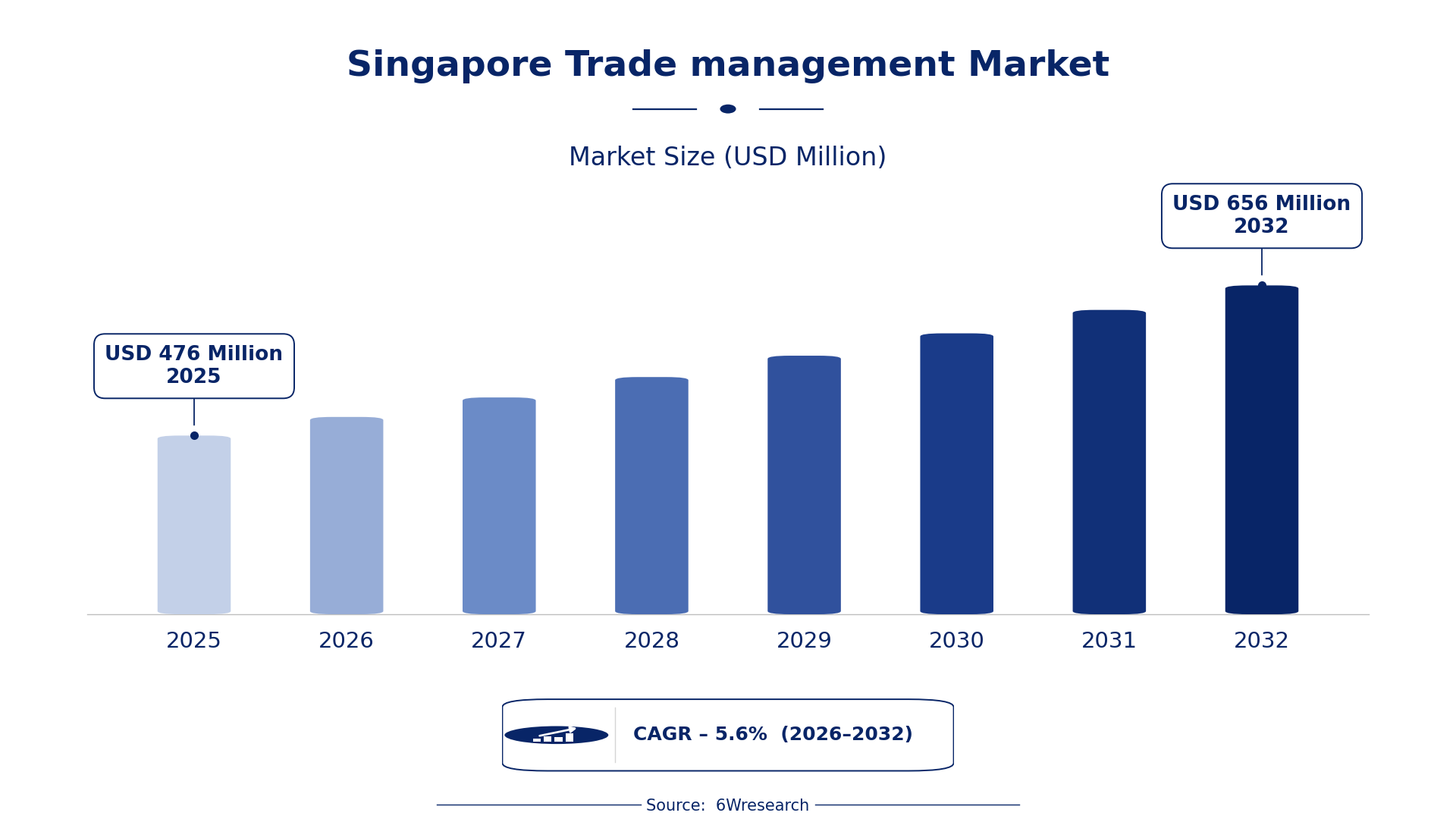
The Singapore Trade management Market was estimated at USD 476 Million in 2025 and is projected to reach USD 656 Million by 2032, growing at a CAGR of 5.6% from 2026 to 2032.
Singapore Trade management Market Synopsis
The Singapore Trade Management Market is currently experiencing momentum, driven by its pivotal role in global logistics. Businesses are increasingly adopting trade management solutions to streamline operations, enhance compliance, and maintain a competitive edge. However, the market is also on the cusp of transformation, with digital solutions and innovations reshaping the way companies approach trade.
As Singapore solidifies its status as a global trade hub, the demand for advanced trade management solutions continues to rise. Companies are not just looking for compliance but are also seeking ways to optimize their entire supply chain, which is critical in the current fast-paced market. The future is bright, yet the complexities of international regulations pose ongoing challenges.
Singapore Trade management Market Year-wise Growth Rate and Key Drivers
This graph illustrates the annual growth rates of the Singapore Trade management Market from 2021 to 2032, highlighting a steady upward trajectory and projected expansion over the forecast period.
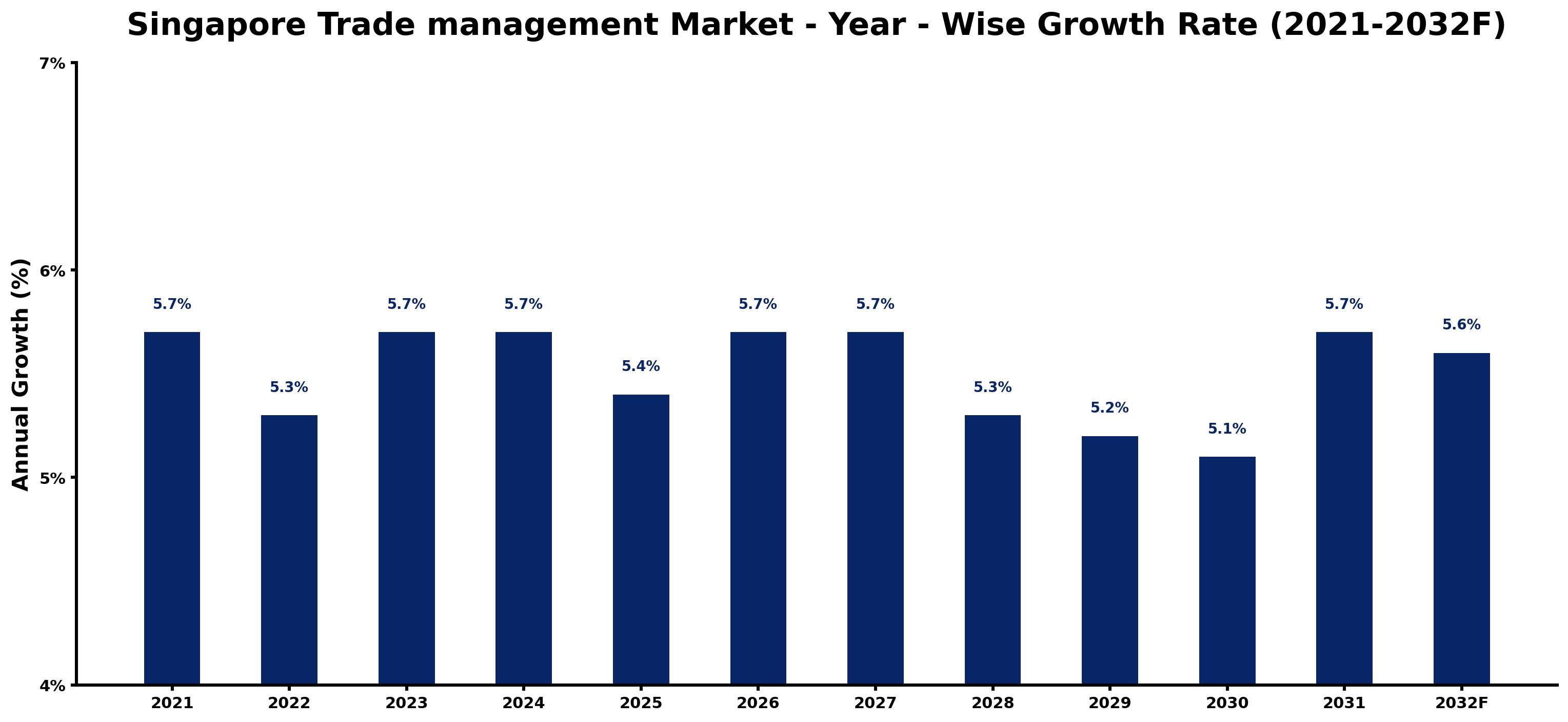
The table below presents the year‑wise growth rates along with the key drivers influencing the market
| Year | Growth Rate | Major Drivers |
| 2021 | 5.7% | Implementation of Singapore TradeNet 2.0 system enhancements. |
| 2022 | 5.3% | Increased digital trade agreements boosting cross-border commerce. |
| 2023 | 5.7% | Strengthened Trade Facilitation Agreement encouraging smoother processes. |
| 2024 | 5.7% | Emerging fintech solutions streamlining trade financing options. |
| 2025 | 5.4% | Growing focus on sustainability in supply chain management. |
| 2026 | 5.7% | Rise of e-commerce supporting export growth initiatives. |
| 2027 | 5.7% | Government support for SMEs in international trade expansion. |
| 2028 | 5.3% | Increased foreign direct investment in manufacturing sectors. |
| 2029 | 5.2% | Local startups innovating in logistics automation technologies. |
| 2030 | 5.1% | Enhanced data analytics improving trade decision-making capabilities. |
| 2031 | 5.7% | Strengthened bilateral trade relations with ASEAN partners. |
| 2032 | 5.6% | Government policies promoting digital transformation in trading processes. |
Note: Market size estimations and growth projections presented in this report are based on 6Wresearch's proprietary forecasting methodology, utilizing the latest available industry data, government publications, and primary research inputs.
Singapore Trade management Market Key Takeaways
Below are some of the specific key takeaways from the market, including:
- The market's growth is driven by Singapore's strategic position as a global trading hub.
- Digital transformation initiatives are accelerating the adoption of trade management solutions.
- Compliance with evolving regulations remains a critical focus for organizations in international trade.
- Investment in supply chain optimization is a priority for businesses seeking efficiency.
- Global trade disruptions, like those from the pandemic, highlighted the need for resilient trade management practices.
Evaluation of Restraints in Singapore Trade management Market
Despite its growth trajectory, the Singapore Trade Management Market faces significant constraints. The complexity of international trade regulations presents a formidable challenge for businesses. Companies must navigate a myriad of customs rules, tariffs, and trade agreements, all while ensuring compliance with shifting policies. This intricate web can lead to increased operational costs and delays, hindering efficiency. Additionally, the reliance on outdated systems in some organizations further complicates their ability to adapt to new regulations and streamline their processes.
Singapore Trade management Market Trends
Emerging trends in the Singapore Trade Management Market are indicative of a broader shift towards digitalization. Companies are increasingly integrating artificial intelligence and machine learning into their trade management systems to enhance decision-making and predictive analytics. on top of that, the rise of blockchain technology is fostering transparency and security in trade transactions. These innovations are not just trends; they represent a fundamental transformation in how trade operations are conducted, with the potential to redefine industry standards.
Singapore Trade management Market Opportunities
The market presents numerous avenues for growth and investment. Companies that focus on developing advanced analytics tools for trade compliance and logistics are well-positioned to capture market share. Additionally, partnerships with technology providers can enhance the capabilities of trade management systems, allowing for better integration and efficiency. As businesses increasingly prioritize sustainability, there’s also a growing demand for trade solutions that align with environmental regulations and practices.
Government Initiatives in the Singapore Trade management Market
Government policy is shaping the Singapore Trade Management Market significantly, with initiatives aimed at enhancing trade efficiency and compliance. Singapore’s public sector prioritizes digital innovation and the simplification of trade processes to bolster its status as a global trade hub. These initiatives foster an environment conducive to growth and technological advancement within the trade management sector.
- A recently completed initiative focused on upgrading customs technology to streamline clearance processes.
- A current effort to enhance digital infrastructure across logistics sectors, aimed at improving data sharing and compliance.
- A planned public-private partnership expected to develop a centralized trade data platform by 2028.
- An ongoing regulatory review initiated to simplify trade documentation requirements for businesses.
- A national campaign to promote e-commerce and digital trade solutions, launched in early 2025.
Future Insights of the Singapore Trade management Market
Looking ahead to 2026-2032, the Singapore Trade Management Market is expected to continue its upward trajectory. The emphasis on digital transformation and compliance will drive businesses to invest heavily in trade management solutions. As companies adapt to new regulations and seek to enhance supply chain efficiencies, the demand for innovative solutions will only grow. on top of that, as global trade dynamics evolve, Singapore's strategic initiatives will ensure its position as a leader in the trade management arena.
Singapore Trade management Market Latest Developments
In the past year, the Singapore Trade Management Market has seen significant activity, reflecting a shift towards greater efficiency and compliance. Businesses have increasingly recognized the need for advanced solutions to navigate the complexities of international trade. As a result, investments in technology and partnerships have surged, signaling a proactive approach to trade management.
- A major technology vendor launched a new trade compliance software suite in Q1 2025, designed to simplify documentation processes.
- An initiative that began in mid-2025 aims to integrate AI-driven analytics into existing trade management platforms.
- A partnership between local companies to create a digital marketplace for trade services is currently underway, expected to enhance accessibility for SMEs.
- A rollout of a trade facilitation program targeting small businesses is planned for late 2025.
- A pilot project integrating blockchain for cross-border transactions was completed in early 2025, with positive initial results.
Singapore Trade management Market - Key Attractiveness of the Report
- 10 Years of Market Numbers
- Historical Data Starting from 2022 to 2025
- Base Year: 2025
- Forecast Data until 2032
- Key Performance Indicators Impacting the Market
- Major Upcoming Developments and Projects
Key Highlights of the Report:
- Singapore Trade management Market Outlook
- Market Size of Singapore Trade management Market, 2025
- Forecast of Singapore Trade management Market, 2032
- Historical Data and Forecast of Singapore Trade management Revenues & Volume for the Period 2022-2032F
- Singapore Trade management Market Trend Evolution
- Singapore Trade management Market Drivers and Challenges
- Singapore Trade management Price Trends
- Singapore Trade management Porter's Five Forces
- Singapore Trade management Industry Life Cycle
- Historical Data and Forecast of Singapore Trade management Market Revenues & Volume By Component for the Period 2022-2032F
- Historical Data and Forecast of Singapore Trade management Market Revenues & Volume By Solutions for the Period 2022-2032F
- Historical Data and Forecast of Singapore Trade management Market Revenues & Volume By Services for the Period 2022-2032F
- Historical Data and Forecast of Singapore Trade management Market Revenues & Volume By Organization Size for the Period 2022-2032F
- Historical Data and Forecast of Singapore Trade management Market Revenues & Volume By Large enterprises for the Period 2022-2032F
- Historical Data and Forecast of Singapore Trade management Market Revenues & Volume By Small and medium-sized enterprises for the Period 2022-2032F
- Historical Data and Forecast of Singapore Trade management Market Revenues & Volume By Deployment Mode for the Period 2022-2032F
- Historical Data and Forecast of Singapore Trade management Market Revenues & Volume By On-Premises for the Period 2022-2032F
- Historical Data and Forecast of Singapore Trade management Market Revenues & Volume By Cloud for the Period 2022-2032F
- Historical Data and Forecast of Singapore Trade management Market Revenues & Volume By Vertical for the Period 2022-2032F
- Historical Data and Forecast of Singapore Trade management Market Revenues & Volume By Transportation and Logistics for the Period 2022-2032F
- Historical Data and Forecast of Singapore Trade management Market Revenues & Volume By Government and Public Sector for the Period 2022-2032F
- Historical Data and Forecast of Singapore Trade management Market Revenues & Volume By Manufacturing for the Period 2022-2032F
- Historical Data and Forecast of Singapore Trade management Market Revenues & Volume By Healthcare and Life Science for the Period 2022-2032F
- Historical Data and Forecast of Singapore Trade management Market Revenues & Volume By Retail and Consumer Goods for the Period 2022-2032F
- Historical Data and Forecast of Singapore Trade management Market Revenues & Volume By Energy and Utilities for the Period 2022-2032F
- Historical Data and Forecast of Singapore Trade management Market Revenues & Volume By Other Verticals for the Period 2022-2032F
- Singapore Trade management Import Export Trade Statistics
- Market Opportunity Assessment By Component
- Market Opportunity Assessment By Organization Size
- Market Opportunity Assessment By Deployment Mode
- Market Opportunity Assessment By Vertical
- Singapore Trade management Top Companies Market Share
- Singapore Trade management Competitive Benchmarking By Technical and Operational Parameters
- Singapore Trade management Company Profiles
- Singapore Trade management Key Strategic Recommendations






































