Singapore Used Car Market Summary
The singapore used car market was estimated at USD 175 Million in 2025 and is projected to reach USD 192 Million by 2032, growing at a CAGR of 1.4% from 2026 to 2032.
Singapore Used Car Market Year-wise Growth Rate and Key Drivers
This graph highlights how the Singapore Used Car Market has steadily grown over the past five years, supported by major growth factors.
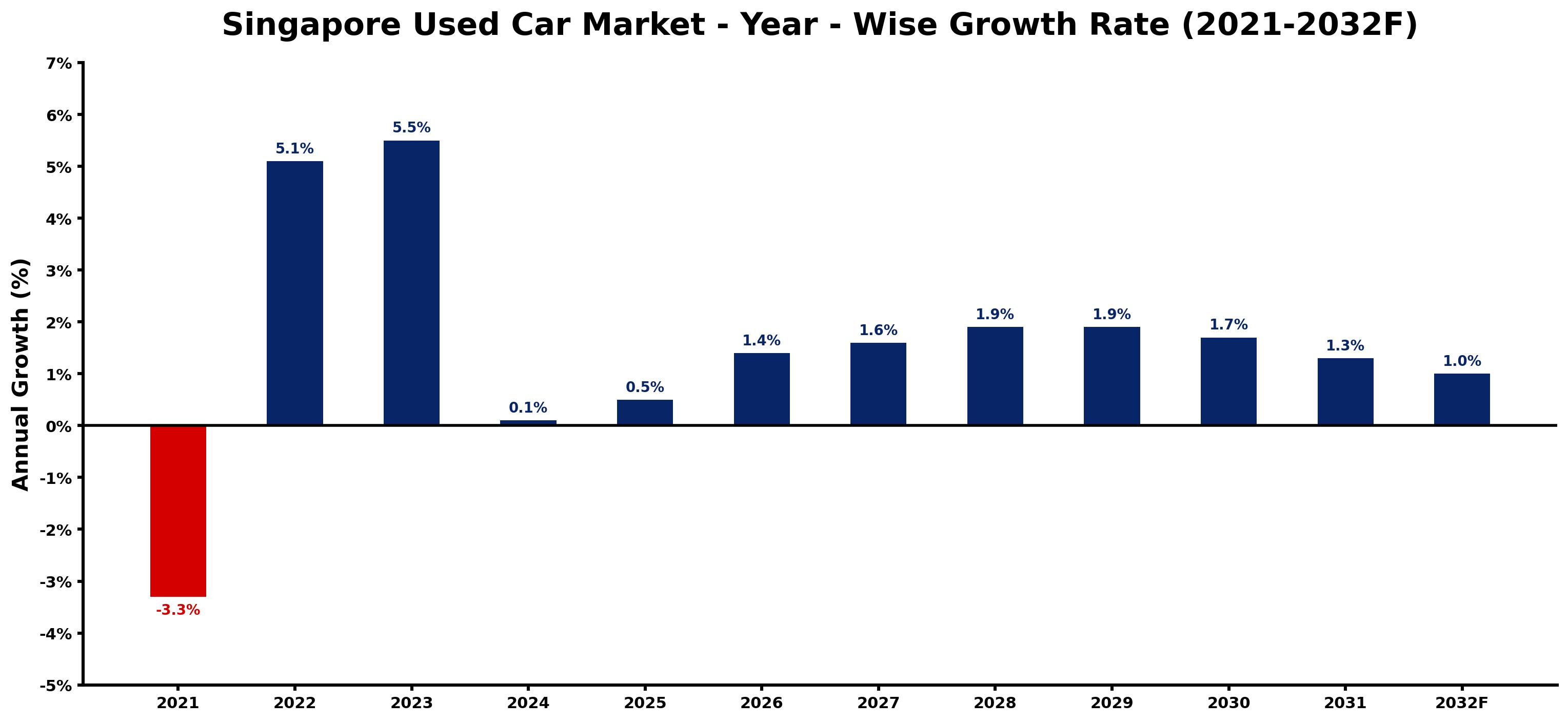
The table below presents the year wise growth rates along with the key drivers influencing the market
| Year | Growth Rate | Major Drivers |
| 2021 | -3.3% | Increased travel restrictions and economic uncertainty discouraged consumers from investing in used vehicles. |
| 2022 | 5.1% | Young professionals increasingly seek used vehicles as a cost-effective commuting solution. |
| 2023 | 5.5% | Digital platforms expand, enhancing transparency in used car transactions and valuations. |
| 2024 | 0.1% | Sustainability trends prompt consumers to consider pre-owned vehicles over new models. |
| 2025 | 0.5% | Financing options become more accessible, encouraging first-time buyers to enter market. |
| 2026 | 1.4% | Increased urbanization drives demand for compact and fuel-efficient used cars. |
| 2027 | 1.6% | Technological advancements in vehicle inspection improve buyer confidence in pre-owned purchases. |
| 2028 | 1.9% | Car-sharing services grow, leading to a heightened interest in used car ownership. |
| 2029 | 1.9% | Consumer preferences shift towards versatile vehicles, boosting demand for diverse models. |
| 2030 | 1.7% | Electric vehicle trends influence the availability of used conventional cars for budget buyers. |
| 2031 | 1.3% | Trade-in programs flourish, providing easier pathways for upgrading used vehicles. |
| 2032 | 1.0% | A stronger focus on online marketplaces reshapes how consumers shop for used cars. |
Note - Market size estimations and growth projections presented in this report are based on 6Wresearch's advanced forecasting approach, validated with industry datasets as of June 2026.
Singapore Used Car Market Synopsis
The Singapore Used Car Market is projected to reach 1.4% and witness significant growth during the forecast period (2026-2032). The market has experienced a steady upward trajectory over recent years, reaching an estimated value of USD 2.2 billion in 2020. Contributing factors include increasing disposable incomes, a growing pool of second-hand buyers, and burgeoning demand from the tourism sector. Government initiatives aimed at lowering the cost of vehicle ownership, such as the Certificate of Entitlement (COE) scheme, have also played a pivotal role in stimulating sales of used vehicles in Singapore. Furthermore, enhanced financing options have facilitated greater access for consumers, further propelling market growth.
Singapore Used Car Market Growth Drivers
The Singapore Used Car Market is buoyed by several critical drivers:
- The robust economic environment coupled with a rising population has fostered an increased demand for used cars. Consumers are drawn to the affordability of pre-owned vehicles relative to new car prices, making them a preferred choice for many.
- An escalating number of second-hand buyers can be attributed to improved financial access. More favorable financing alternatives allow prospective buyers to consider used vehicles that might have previously been out of reach.
- Government initiatives aimed at managing road congestion are another significant factor. By regulating vehicle ownership costs, authorities are indirectly promoting the purchase of used cars as a viable option for consumers.
- The increasing penetration of digital platforms has simplified the purchase process, allowing consumers to efficiently search for and acquire pre-owned vehicles without significant hurdles.
- The growing awareness of the benefits of sustainability is steering consumer preferences towards the acquisition of second-hand cars, which are perceived as environmentally friendly choices compared to new vehicles.
Singapore Used Car Market Challenges and Restraints
Despite its growth trajectory, the Singapore Used Car Market faces notable challenges that could impede its development:
- One of the primary challenges is the depreciation of used vehicles. High depreciation rates result in lower resale values, which can deter potential buyers who fear significant financial loss upon re-selling.
- Concerns regarding the reliability and maintenance of pre-owned vehicles can create hesitancy among buyers. Consumers often need assurances regarding the condition of the vehicle and maintenance history, which may not always be available.
- The existence of unscrupulous dealers can also pose risks, leading buyers to be cautious when engaging with the used car market. This can result in a prolonged decision-making process as consumers seek trustworthy sources.
- Market fluctuations, particularly influenced by global economic conditions or local regulatory changes, can introduce volatility that affects consumer confidence and spending patterns in the used car sector.
- Lastly, the increasing complexity of vehicle ownership regulations can contribute to confusion among consumers. Navigating paperwork and compliance requirements can be daunting, further complicating the purchasing process.
Singapore Used Car Market Government Investment and Initiatives
The Singapore government plays a pivotal role in shaping the dynamics of the used car market through various investments and initiatives. Key government policies aimed at fostering a sustainable automotive environment include:
- Regulatory frameworks that encourage responsible vehicle ownership and sustainable practices are essential. Initiatives such as the COE system are designed to control vehicle population growth and manage road congestion effectively.
- Investment in public transportation infrastructure serves as an indirect support for the used car market, as it encourages the ownership of smaller, more efficient vehicles while reducing reliance on larger models.
- Incentives for promoting electric and hybrid vehicles also influence the used car market by expanding the range of options available to consumers, thereby boosting overall market interest.
- Government campaigns aimed at raising awareness about vehicle ownership responsibilities and sustainable practices are vital for encouraging informed buying decisions among consumers.
- Public spending on automotive-related research and development paves the way for future innovations that can enhance vehicle longevity and reliability, crucial factors in the used car market.
Singapore Used Car Market Latest Developments (May 2025 - June 2026)
In the period from May 2025 to June 2026, the Singapore Used Car Market has seen several noteworthy developments that reflect the shifting landscape:
- The increasing shift toward digital transactions has gained momentum, as more buyers opt for online platforms to facilitate their used car purchases. This trend has resulted in enhanced convenience and transparency in the buying process.
- A surge in demand for electric and hybrid used vehicles has been observed, driven by greater consumer awareness and government incentives promoting green technologies in the automotive sector.
- The implementation of stricter regulations regarding vehicle emissions and safety standards has compelled dealers to offer higher quality vehicles, leading to improvements in consumer trust and market stability.
- The ongoing effects of the COVID-19 pandemic have continued to reshape consumer behavior, with many individuals prioritizing financial prudence, thus driving a preference for affordable used vehicles.
- Collaboration between automotive dealerships and financial institutions has improved financing options for consumers, resulting in more competitive loan offerings for pre-owned vehicles, further stimulating market activity.
Singapore Used Car Market - Key Attractiveness of the Report
- 10 Years of Market Numbers
- Historical Data Starting from 2022 to 2025
- Base Year: 2025
- Forecast Data until 2032
- Key Performance Indicators Impacting the Market
- Major Upcoming Developments and Projects
Key Highlights of the Report:
- Singapore Used Car Market Outlook
- Market Size of Singapore Used Car Market, 2025
- Forecast of Singapore Used Car Market, 2032F
- Historical Data and Forecast of Singapore Used Car Revenues & Volume for the Period 2022-2032F
- Singapore Used Car Market Trend Evolution
- Singapore Used Car Market Drivers and Challenges
- Singapore Used Car Price Trends
- Singapore Used Car Porter's Five Forces
- Singapore Used Car Industry Life Cycle
- Historical Data and Forecast of Singapore Used Car Market Revenues & Volume By Vehicle Type for the Period 2022-2032F
- Historical Data and Forecast of Singapore Used Car Market Revenues & Volume By Hatchbacks for the Period 2022-2032F
- Historical Data and Forecast of Singapore Used Car Market Revenues & Volume By Sedan for the Period 2022-2032F
- Historical Data and Forecast of Singapore Used Car Market Revenues & Volume By Sports Utility Vehicle for the Period 2022-2032F
- Historical Data and Forecast of Singapore Used Car Market Revenues & Volume By Others for the Period 2022-2032F
- Historical Data and Forecast of Singapore Used Car Market Revenues & Volume By Vendor for the Period 2022-2032F
- Historical Data and Forecast of Singapore Used Car Market Revenues & Volume By Organized for the Period 2022-2032F
- Historical Data and Forecast of Singapore Used Car Market Revenues & Volume By Unorganized for the Period 2022-2032F
- Historical Data and Forecast of Singapore Used Car Market Revenues & Volume By Fuel Type for the Period 2022-2032F
- Historical Data and Forecast of Singapore Used Car Market Revenues & Volume By Gasoline for the Period 2022-2032F
- Historical Data and Forecast of Singapore Used Car Market Revenues & Volume By Diesel for the Period 2022-2032F
- Historical Data and Forecast of Singapore Used Car Market Revenues & Volume By Alternative Fuel Vehicles for the Period 2022-2032F
- Singapore Used Car Import Export Trade Statistics
- Market Opportunity Assessment By Vehicle Type
- Market Opportunity Assessment By Vendor
- Market Opportunity Assessment By Fuel Type
- Singapore Used Car Top Companies Market Share
- Singapore Used Car Competitive Benchmarking By Technical and Operational Parameters
- Singapore Used Car Company Profiles
- Singapore Used Car Key Strategic Recommendations






































