Singapore Vegetable and Fruit Processing Machinery Market Size, Share & Growth Rate
The Singapore Vegetable and Fruit Processing Machinery Market was estimated at USD 151 Million in 2025 and is projected to reach USD 210 Million by 2032, growing at a CAGR of 4.8% from 2026 to 2032. This growth trajectory is fueled by a rising consumer preference for convenience-driven processed food products, driven by increasingly busy lifestyles. The ongoing push towards sustainable food production and waste reduction further solidifies the importance of efficient processing machinery within the local food supply chain.
Singapore Vegetable and Fruit Processing Machinery Market Year-wise Growth Rate and Key Drivers
This graph highlights how the Singapore Vegetable and Fruit Processing Machinery Market has steadily grown over the years, supported by major growth factors.
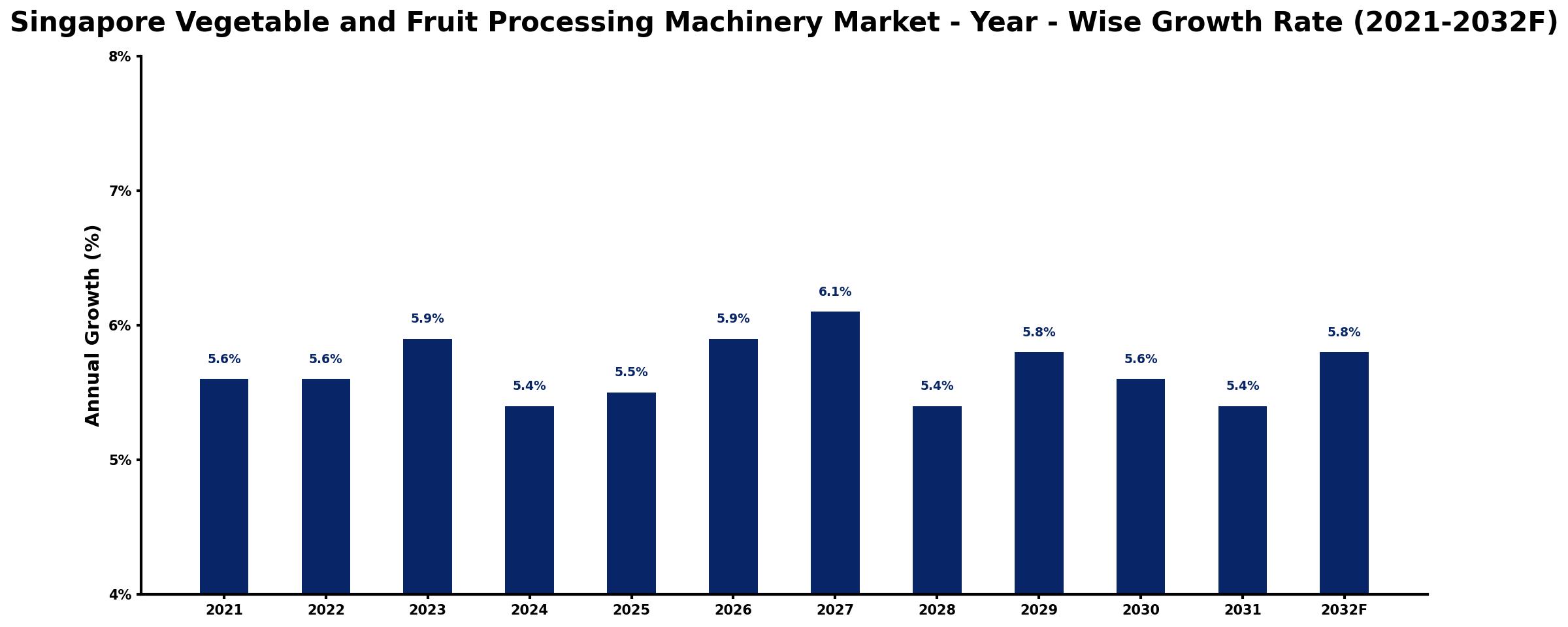
The table below presents the year‑wise growth rates along with the key drivers influencing the market
| Year | Growth Rate | Major Drivers |
| 2021 | 5.6% | Increased demand for automation solutions |
| 2022 | 5.6% | Rising health consciousness among consumers |
| 2023 | 5.9% | Expansion of food delivery services |
| 2024 | 5.4% | Growth in organic food market |
| 2025 | 5.5% | Investments in sustainable practices |
| 2026 | 5.9% | Technological advancements in equipment |
| 2027 | 6.1% | Higher production efficiency requirements |
| 2028 | 5.4% | Emergence of new culinary trends |
| 2029 | 5.8% | Strengthening of local supply chains |
| 2030 | 5.6% | Increased focus on food safety |
| 2031 | 5.4% | Growing interest in plant-based diets |
| 2032 | 5.8% | rising export shipment volumes |
Note: Market size estimations and growth projections presented in this report are based on 6Wresearch's proprietary forecasting methodology, utilizing the latest available industry data, government publications, and primary research inputs.
Singapore Vegetable and Fruit Processing Machinery Market Synopsis
In Singapore, the vegetable and fruit processing machinery market is seeing a dynamic shift as the nation places significant emphasis on food security and sustainability. The government's commitment to bolstering local food production is paving the way for increased investments in food processing technologies.
This market is characterized by a growing demand for innovative processing solutions, such as advanced slicers and automated juicing equipment. As manufacturers adapt to meet the evolving needs of the food sector, the interplay between technological advancements and regulatory compliance is becoming increasingly significant.
Singapore Vegetable and Fruit Processing Machinery Market Key Takeaways
- The market is driven by increasing consumer demand for ready-to-eat and processed food products.
- Advancements in technology are enhancing the efficiency and productivity of processing machinery.
- Food safety regulations are leading to a shift toward high-compliance processing equipment.
- The COVID-19 pandemic highlighted vulnerabilities but also spurred innovation in production processes.
- Government initiatives play a pivotal role in shaping the market's growth trajectory.
Evaluation of Restraints in Singapore Vegetable and Fruit Processing Machinery Market
While the market is poised for growth, it is not without its challenges. The perishable nature of fruits and vegetables necessitates strict adherence to freshness standards during processing. This requirement demands machinery that is adaptable and efficient across various produce types. Furthermore, compliance with increasingly stringent food safety regulations imposes additional pressure on manufacturers to invest in advanced technologies. The interplay of these factors can potentially limit the pace of market expansion as stakeholders navigate the complexities of maintaining product quality and meeting regulatory demands.
Singapore Vegetable and Fruit Processing Machinery Market Trends
Several trends are shaping the vegetable and fruit processing machinery market in Singapore. A notable increase in the adoption of automation and smart technology is driving productivity and efficiency. Manufacturers are increasingly integrating IoT capabilities into machinery, enabling real-time monitoring and data collection. This not only enhances operational performance but also contributes to better inventory management. Moreover, sustainability practices are being integrated into the design and operation of processing machinery, promoting eco-friendly manufacturing processes.
Singapore Vegetable and Fruit Processing Machinery Market Opportunities
The Singapore vegetable and fruit processing machinery market is rife with growth opportunities, particularly in areas focused on sustainability and automation. As food manufacturers seek to optimize their production lines and reduce waste, there is a clear demand for state-of-the-art processing technologies. Furthermore, investments in R&D for developing specialized machinery tailored to local produce varieties can open new avenues for market participants, positioning them at the forefront of innovation.
Government Initiatives in the Singapore Vegetable and Fruit Processing Machinery Market
The Singaporean government is actively implementing initiatives aimed at enhancing food security and sustainability. Policies encouraging local food production and investments in technology are paramount. Government grants and subsidies for businesses adopting advanced processing equipment are also available, promoting the growth of the processing machinery sector. Additionally, regulatory frameworks are evolving to support innovation while ensuring food safety standards are met, encouraging manufacturers to invest in modern processing solutions.
Future Insights of the Singapore Vegetable and Fruit Processing Machinery Market
Looking ahead to 2026-2032, the Singapore vegetable and fruit processing machinery market is expected to witness significant advancements driven by ongoing technological innovation and changing consumer preferences. The emphasis on food security will continue to propel investments in local food processing capabilities. Moreover, as sustainability takes center stage, machinery that minimizes waste and maximizes efficiency will become increasingly sought after. Overall, the market landscape will evolve to accommodate a blend of innovation, compliance, and consumer-centric solutions.
Singapore Vegetable and Fruit Processing Machinery Market Latest Developments (2025 - 2026)
Recent developments in the Singapore vegetable and fruit processing machinery sector have reflected a strong pivot towards advanced technology adoption and sustainable practices. Manufacturers are increasingly integrating digital solutions to streamline operations and improve product tracking. The introduction of new machinery that enhances food safety compliance has also been a focal point. As local firms explore partnerships and collaborations, the emphasis on R&D is expected to lead to innovative processing techniques and enhanced machinery capabilities.
Singapore Vegetable and Fruit Processing Machinery Market - Key Attractiveness of the Report
- 10 Years of Market Numbers
- Historical Data Starting from 2022 to 2025
- Base Year: 2025
- Forecast Data until 2032
- Key Performance Indicators Impacting the Market
- Major Upcoming Developments and Projects
Key Highlights of the Report:
- Singapore Vegetable and Fruit Processing Machinery Market Outlook
- Market Size of Singapore Vegetable and Fruit Processing Machinery Market, 2025
- Forecast of Singapore Vegetable and Fruit Processing Machinery Market, 2032
- Historical Data and Forecast of Singapore Vegetable and Fruit Processing Machinery Revenues & Volume for the Period 2022-2032F
- Singapore Vegetable and Fruit Processing Machinery Market Trend Evolution
- Singapore Vegetable and Fruit Processing Machinery Market Drivers and Challenges
- Singapore Vegetable and Fruit Processing Machinery Price Trends
- Singapore Vegetable and Fruit Processing Machinery Porter's Five Forces
- Singapore Vegetable and Fruit Processing Machinery Industry Life Cycle
- Historical Data and Forecast of Singapore Vegetable and Fruit Processing Machinery Market Revenues & Volume By Product Type for the Period 2022-2032F
- Historical Data and Forecast of Singapore Vegetable and Fruit Processing Machinery Market Revenues & Volume By Fresh for the Period 2022-2032F
- Historical Data and Forecast of Singapore Vegetable and Fruit Processing Machinery Market Revenues & Volume By Fresh-cut for the Period 2022-2032F
- Historical Data and Forecast of Singapore Vegetable and Fruit Processing Machinery Market Revenues & Volume By Canned for the Period 2022-2032F
- Historical Data and Forecast of Singapore Vegetable and Fruit Processing Machinery Market Revenues & Volume By Frozen for the Period 2022-2032F
- Historical Data and Forecast of Singapore Vegetable and Fruit Processing Machinery Market Revenues & Volume By Dried & Dehydrated for the Period 2022-2032F
- Historical Data and Forecast of Singapore Vegetable and Fruit Processing Machinery Market Revenues & Volume By Convenience for the Period 2022-2032F
- Historical Data and Forecast of Singapore Vegetable and Fruit Processing Machinery Market Revenues & Volume By Equipment Type for the Period 2022-2032F
- Historical Data and Forecast of Singapore Vegetable and Fruit Processing Machinery Market Revenues & Volume By Pre-processing for the Period 2022-2032F
- Historical Data and Forecast of Singapore Vegetable and Fruit Processing Machinery Market Revenues & Volume By Peeling/inspection/slicing for the Period 2022-2032F
- Historical Data and Forecast of Singapore Vegetable and Fruit Processing Machinery Market Revenues & Volume By Washing & Dewatering for the Period 2022-2032F
- Historical Data and Forecast of Singapore Vegetable and Fruit Processing Machinery Market Revenues & Volume By Fillers for the Period 2022-2032F
- Historical Data and Forecast of Singapore Vegetable and Fruit Processing Machinery Market Revenues & Volume By Packaging & Handling for the Period 2022-2032F
- Historical Data and Forecast of Singapore Vegetable and Fruit Processing Machinery Market Revenues & Volume By Seasoning Systems for the Period 2022-2032F
- Historical Data and Forecast of Singapore Vegetable and Fruit Processing Machinery Market Revenues & Volume By Others for the Period 2022-2032F
- Historical Data and Forecast of Singapore Vegetable and Fruit Processing Machinery Market Revenues & Volume By Operation for the Period 2022-2032F
- Historical Data and Forecast of Singapore Vegetable and Fruit Processing Machinery Market Revenues & Volume By Automatic for the Period 2022-2032F
- Historical Data and Forecast of Singapore Vegetable and Fruit Processing Machinery Market Revenues & Volume By Semi-automatic for the Period 2022-2032F
- Historical Data and Forecast of Singapore Vegetable and Fruit Processing Machinery Market Revenues & Volume By Processing System for the Period 2022-2032F
- Historical Data and Forecast of Singapore Vegetable and Fruit Processing Machinery Market Revenues & Volume By Small Scale for the Period 2022-2032F
- Historical Data and Forecast of Singapore Vegetable and Fruit Processing Machinery Market Revenues & Volume By Intermediate Scale for the Period 2022-2032F
- Singapore Vegetable and Fruit Processing Machinery Import Export Trade Statistics
- Market Opportunity Assessment By Product Type
- Market Opportunity Assessment By Equipment Type
- Market Opportunity Assessment By Operation
- Market Opportunity Assessment By Processing System
- Singapore Vegetable and Fruit Processing Machinery Top Companies Market Share
- Singapore Vegetable and Fruit Processing Machinery Competitive Benchmarking By Technical and Operational Parameters
- Singapore Vegetable and Fruit Processing Machinery Company Profiles
- Singapore Vegetable and Fruit Processing Machinery Key Strategic Recommendations






































