Singapore Virtual Private Cloud Market Size & Growth Rate (2026-2032)
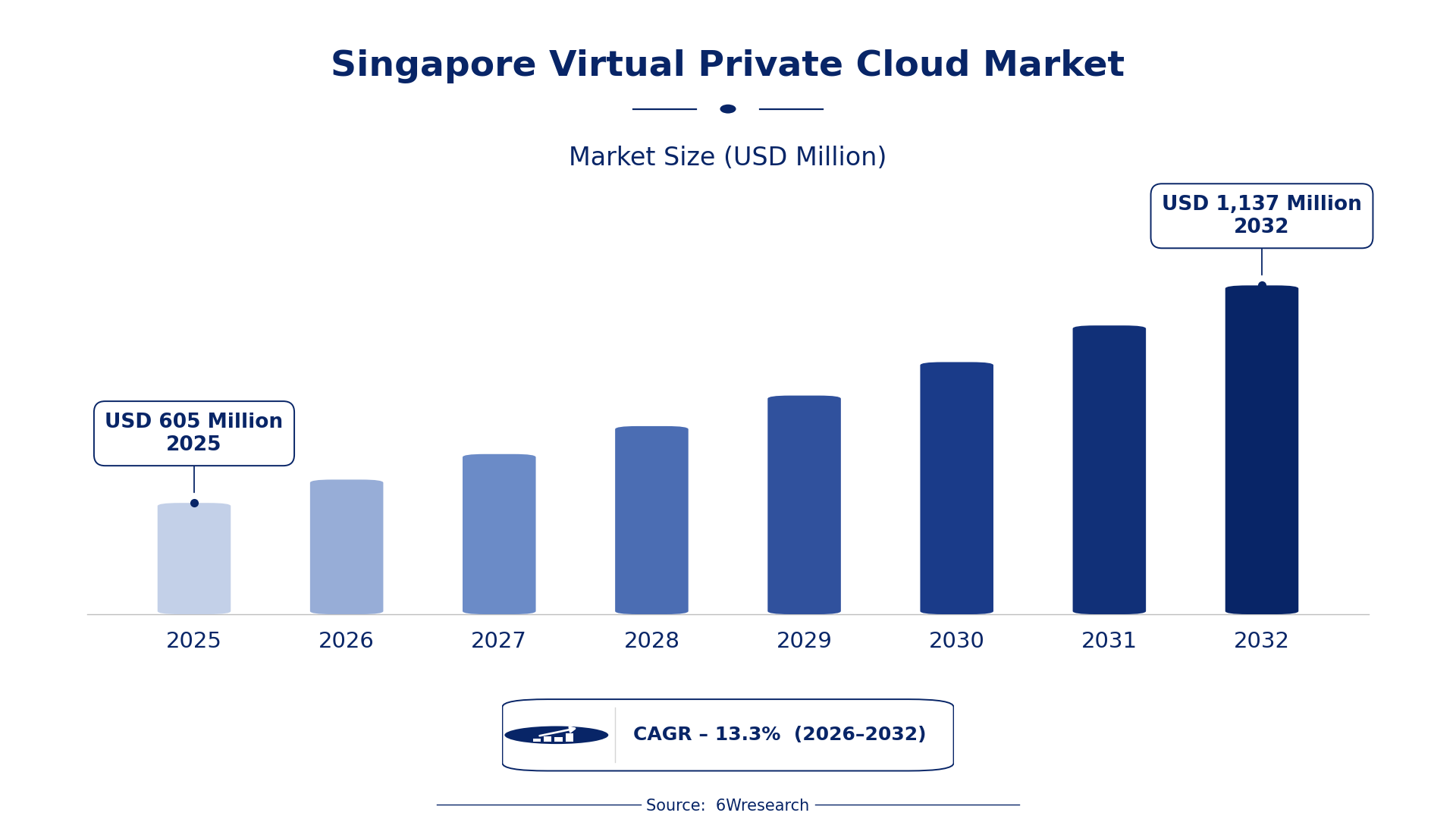
The Singapore Virtual Private Cloud Market was estimated at USD 605 Million in 2025 and is projected to reach USD 1137 Million by 2032, growing at a CAGR of 13.3% from 2026 to 2032.
Singapore Virtual Private Cloud Market Synopsis
In Singapore, the virtual private cloud market is rapidly becoming indispensable for organizations prioritizing data security and compliance. Businesses are increasingly opting for customized cloud environments that balance privacy and scalability, especially in a market that demands stringent adherence to regulatory standards.
As enterprises transition to cloud-based solutions, the demand for virtual private cloud services is growing. This trend is driven by the need for secure, isolated environments that can protect sensitive data while providing the flexibility that modern businesses require.
Singapore Virtual Private Cloud Market Year-wise Growth Rate and Key Drivers
This graph illustrates the annual growth rates of the Singapore Virtual Private Cloud Market from 2021 to 2032, highlighting a steady upward trajectory and projected expansion over the forecast period.
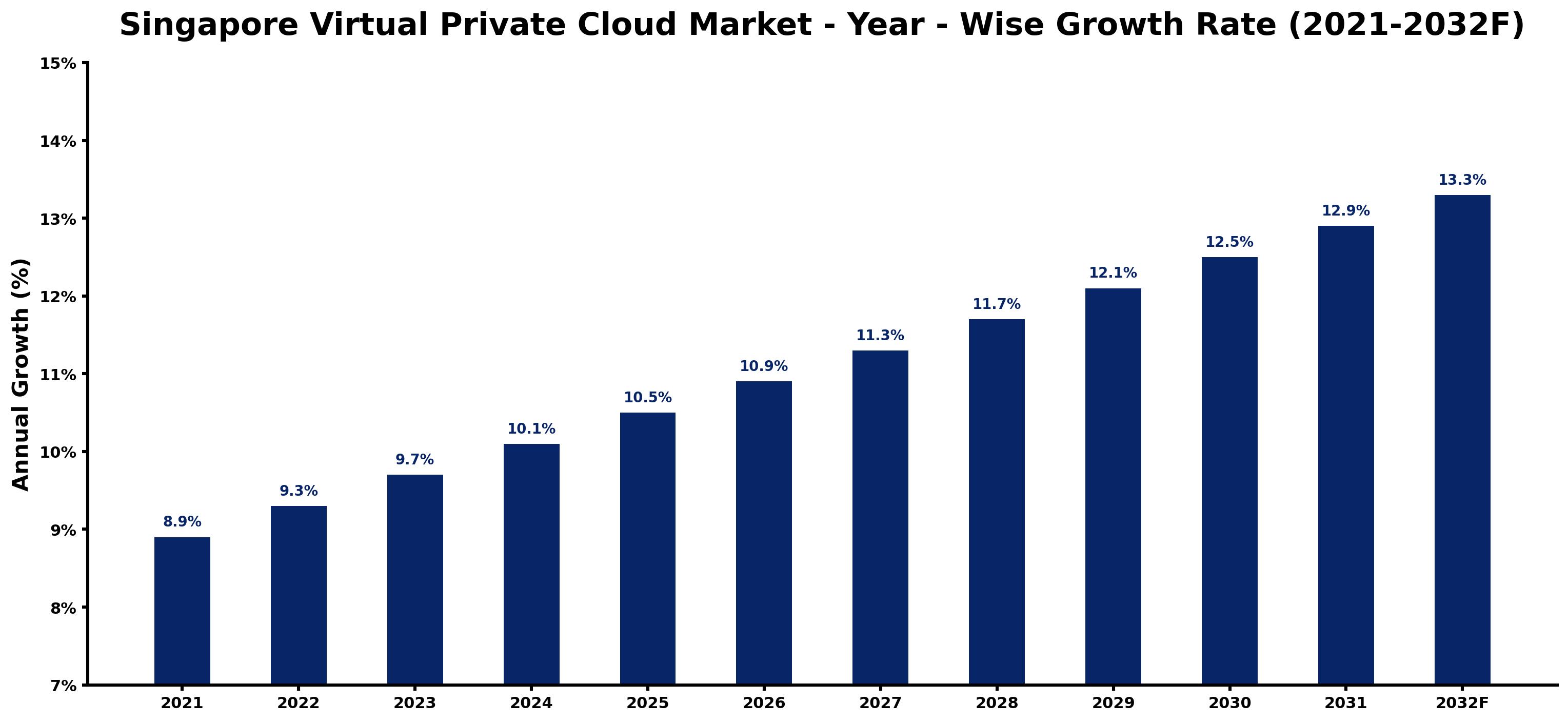
The table below presents the year‑wise growth rates along with the key drivers influencing the market
| Year | Growth Rate | Major Drivers |
| 2021 | 8.9% | Increased cybersecurity regulations enhancing data protection standards. |
| 2022 | 9.3% | Government-backed grants for SMEs adopting cloud solutions. |
| 2023 | 9.7% | Proliferation of IoT devices driving cloud service usage. |
| 2024 | 10.1% | Rising e-commerce activities necessitating scalable virtual infrastructure. |
| 2025 | 10.5% | Emerging startups focusing on cloud-native application development. |
| 2026 | 10.9% | Collaborations between tech firms and universities for cloud innovation. |
| 2027 | 11.3% | Growing big data utilization among local enterprises. |
| 2028 | 11.7% | Regulatory push for enhanced digital identity verification solutions. |
| 2029 | 12.1% | Local adoption of hybrid cloud strategies for business agility. |
| 2030 | 12.5% | Singapore's smart nation initiative supporting digital transformation efforts. |
| 2031 | 12.9% | Increasing investments in AI technologies requiring robust cloud platforms. |
| 2032 | 13.3% | Growth of remote healthcare services needing secure cloud access. |
Note: Market size estimations and growth projections presented in this report are based on 6Wresearch's proprietary forecasting methodology, utilizing the latest available industry data, government publications, and primary research inputs.
Singapore Virtual Private Cloud Market Key Takeaways
Below are some of the specific key takeaways from the market, including:
- The market is witnessing a shift towards more secure cloud solutions due to rising concerns about data breaches.
- Compliance with local regulations is a significant driver for the adoption of virtual private clouds.
- Organizations are increasingly interested in hybrid cloud solutions that integrate both public and private clouds.
- Rapid digital transformation across industries is pushing businesses to seek scalable cloud environments.
- Key players are enhancing their offerings to provide tailored solutions that meet specific industry needs.
Evaluation of Restraints in Singapore Virtual Private Cloud Market
One of the primary limitations facing the Singapore virtual private cloud market is the complex landscape of network security and isolation. As businesses strive to secure their data, the challenge lies in delivering high-performance networks without compromising security. Providers must navigate compliance issues and data sovereignty concerns, which can hinder the speed at which new solutions are developed and implemented. This intricate balance between security and performance remains a critical hurdle for many stakeholders in the market.
Singapore Virtual Private Cloud Market Trends
Several key trends are shaping the Singapore virtual private cloud market. First, there is a noticeable rise in demand for multi-cloud strategies, as organizations seek to avoid vendor lock-in while optimizing costs. Additionally, the push for greater automation and AI integration within cloud services is gaining momentum, enabling businesses to streamline operations and improve efficiency. on top of that, the emphasis on sustainability is leading to a preference for cloud solutions that demonstrate energy efficiency and reduced carbon footprints.
Singapore Virtual Private Cloud Market Opportunities
The landscape presents numerous opportunities for growth within the Singapore virtual private cloud market. Increasing regulatory demands create a fertile environment for providers offering compliance-ready solutions. Additionally, the rise of remote work has generated heightened interest in secure cloud solutions tailored for remote access. Companies looking to expand their digital capabilities can find value in partnerships with cloud service providers that offer innovative features and robust security measures, opening the door for collaborative growth.
Government Initiatives in the Singapore Virtual Private Cloud Market
The Singapore government is actively fostering a supportive environment for the virtual private cloud market through various initiatives. By emphasizing data security, privacy, and digital infrastructure development, the government aims to enhance the nation’s technological capabilities. These policies are crucial for aligning local businesses with global standards while ensuring that the virtual private cloud sector thrives amid increasing regulatory scrutiny.
- A national digital infrastructure upgrade programme launched in early 2023 aimed at enhancing cloud security protocols.
- Current initiatives are underway to establish a regulatory framework focusing on cloud data sovereignty, expected to roll out by 2025.
- Plans for a public-private partnership initiative targeting cloud service accessibility across various sectors are set to begin in 2026.
- A recently completed cybersecurity strategy introduced in late 2022 mandates stricter guidelines for cloud service providers.
- Ongoing assessments of compliance regulations are being conducted to adapt to changing market demands and technologies.
Future Insights of the Singapore Virtual Private Cloud Market
Looking ahead to 2026-2032, the Singapore virtual private cloud market is expected to continue its upward trajectory, driven by the ongoing digitization of businesses. Companies will increasingly seek solutions that not only meet their security and compliance needs but also offer flexibility and scalability. The integration of advanced technologies like artificial intelligence and machine learning will further enhance service offerings, providing businesses with tools to analyze data and improve operations effectively. As demand grows, the competitive landscape will likely evolve, prompting providers to innovate rapidly to maintain their market positions.
Singapore Virtual Private Cloud Market Latest Developments
In the last year, activity in the Singapore virtual private cloud market has intensified as organizations recognize the critical importance of secure cloud solutions. Providers are responding with innovative offerings that cater to the unique needs of local enterprises. This period has also seen increased collaboration between tech companies and governmental bodies to bolster the overall cloud infrastructure.
- A leading regional operator announced a new suite of security features for its virtual private cloud service, launched in Q2 2023.
- A major technology vendor is currently upgrading its data centers to enhance capacity and speed, expected to be completed by late 2024.
- A partnership formed in early 2023 between a cloud service provider and a cybersecurity firm aims to deliver enhanced data protection solutions.
- A new service enhancement initiative is currently underway, focusing on integrating AI capabilities into existing virtual private cloud platforms.
- An upcoming expansion of cloud service coverage to underserved regions is planned to begin in mid-2025.
Singapore Virtual Private Cloud Market - Key Attractiveness of the Report
- 10 Years of Market Numbers
- Historical Data Starting from 2022 to 2025
- Base Year: 2025
- Forecast Data until 2032
- Key Performance Indicators Impacting the Market
- Major Upcoming Developments and Projects
Investing in virtual private cloud solutions allows businesses to enhance their data security, maintain compliance, and achieve greater flexibility in managing their IT resources, which is increasingly critical in today’s digital environment.
Key Highlights of the Report:
- Singapore Virtual Private Cloud Market Outlook
- Market Size of Singapore Virtual Private Cloud Market, 2025
- Forecast of Singapore Virtual Private Cloud Market, 2032
- Historical Data and Forecast of Singapore Virtual Private Cloud Revenues & Volume for the Period 2022-2032F
- Singapore Virtual Private Cloud Market Trend Evolution
- Singapore Virtual Private Cloud Market Drivers and Challenges
- Singapore Virtual Private Cloud Price Trends
- Singapore Virtual Private Cloud Porter's Five Forces
- Singapore Virtual Private Cloud Industry Life Cycle
- Historical Data and Forecast of Singapore Virtual Private Cloud Market Revenues & Volume By Component for the Period 2022-2032F
- Historical Data and Forecast of Singapore Virtual Private Cloud Market Revenues & Volume By Software for the Period 2022-2032F
- Historical Data and Forecast of Singapore Virtual Private Cloud Market Revenues & Volume By Services for the Period 2022-2032F
- Historical Data and Forecast of Singapore Virtual Private Cloud Market Revenues & Volume By Vertical for the Period 2022-2032F
- Historical Data and Forecast of Singapore Virtual Private Cloud Market Revenues & Volume By Banking, Financial Services, and Insurance for the Period 2022-2032F
- Historical Data and Forecast of Singapore Virtual Private Cloud Market Revenues & Volume By IT and Telecom for the Period 2022-2032F
- Historical Data and Forecast of Singapore Virtual Private Cloud Market Revenues & Volume By Government and Defense for the Period 2022-2032F
- Historical Data and Forecast of Singapore Virtual Private Cloud Market Revenues & Volume By Healthcare for the Period 2022-2032F
- Historical Data and Forecast of Singapore Virtual Private Cloud Market Revenues & Volume By Media and Entertainment for the Period 2022-2032F
- Historical Data and Forecast of Singapore Virtual Private Cloud Market Revenues & Volume By Retail for the Period 2022-2032F
- Historical Data and Forecast of Singapore Virtual Private Cloud Market Revenues & Volume By Manufacturing for the Period 2022-2032F
- Historical Data and Forecast of Singapore Virtual Private Cloud Market Revenues & Volume By Others for the Period 2022-2032F
- Historical Data and Forecast of Singapore Virtual Private Cloud Market Revenues & Volume By Service for the Period 2022-2032F
- Historical Data and Forecast of Singapore Virtual Private Cloud Market Revenues & Volume By Training for the Period 2022-2032F
- Historical Data and Forecast of Singapore Virtual Private Cloud Market Revenues & Volume By Consulting for the Period 2022-2032F
- Historical Data and Forecast of Singapore Virtual Private Cloud Market Revenues & Volume By Integration for the Period 2022-2032F
- Historical Data and Forecast of Singapore Virtual Private Cloud Market Revenues & Volume By Deployment for the Period 2022-2032F
- Historical Data and Forecast of Singapore Virtual Private Cloud Market Revenues & Volume By Support for the Period 2022-2032F
- Historical Data and Forecast of Singapore Virtual Private Cloud Market Revenues & Volume By Maintenance for the Period 2022-2032F
- Historical Data and Forecast of Singapore Virtual Private Cloud Market Revenues & Volume By Managed Services for the Period 2022-2032F
- Historical Data and Forecast of Singapore Virtual Private Cloud Market Revenues & Volume By Organization Size for the Period 2022-2032F
- Historical Data and Forecast of Singapore Virtual Private Cloud Market Revenues & Volume By Small and Medium-Sized Enterprises for the Period 2022-2032F
- Historical Data and Forecast of Singapore Virtual Private Cloud Market Revenues & Volume By Large Enterprises for the Period 2022-2032F
- Singapore Virtual Private Cloud Import Export Trade Statistics
- Market Opportunity Assessment By Component
- Market Opportunity Assessment By Vertical
- Market Opportunity Assessment By Service
- Market Opportunity Assessment By Organization Size
- Singapore Virtual Private Cloud Top Companies Market Share
- Singapore Virtual Private Cloud Competitive Benchmarking By Technical and Operational Parameters
- Singapore Virtual Private Cloud Company Profiles
- Singapore Virtual Private Cloud Key Strategic Recommendations






































