Singapore Wheat Starch Market Size, Share & Growth Rate
The Singapore Wheat Starch Market was estimated at USD 196 Million in 2025 and is projected to reach USD 272 Million by 2032, growing at a CAGR of 4.8% from 2026 to 2032. This growth trajectory can be attributed to the increasing demand for convenience food and a notable rise in processed food applications. As Singapore's culinary landscape evolves, the need for textural enhancements in various food products will continue to bolster wheat starch's role in the market.
Singapore Wheat Starch Market Growth Rate Analysis (2021-2032)
The Singapore wheat starch market has experienced steady growth, registering annual increases of 5.3% in 2021, followed by a slight uptick to 5.8% in 2022. This upward trend continued with a 5.9% growth in 2023, driven largely by rising consumer demand within the food manufacturing and pharmaceutical sectors. The growth rate is anticipated to stabilize around 5.6% in 2024 before reclaiming 5.8% in 2025, reflecting ongoing investments in sustainable production methods and advanced processing technologies. Fluctuations, such as a dip to 5.3% in 2028, can be attributed to changing regulatory policies and shifts in energy resources. A resilient infrastructure and increasing digitalization further support the market's robust trajectory through 2032.
Singapore Wheat Starch Market Year-wise Growth Rate and Key Drivers
This graph highlights how the Singapore Wheat Starch Market has steadily grown over the past five years, supported by major growth factors.
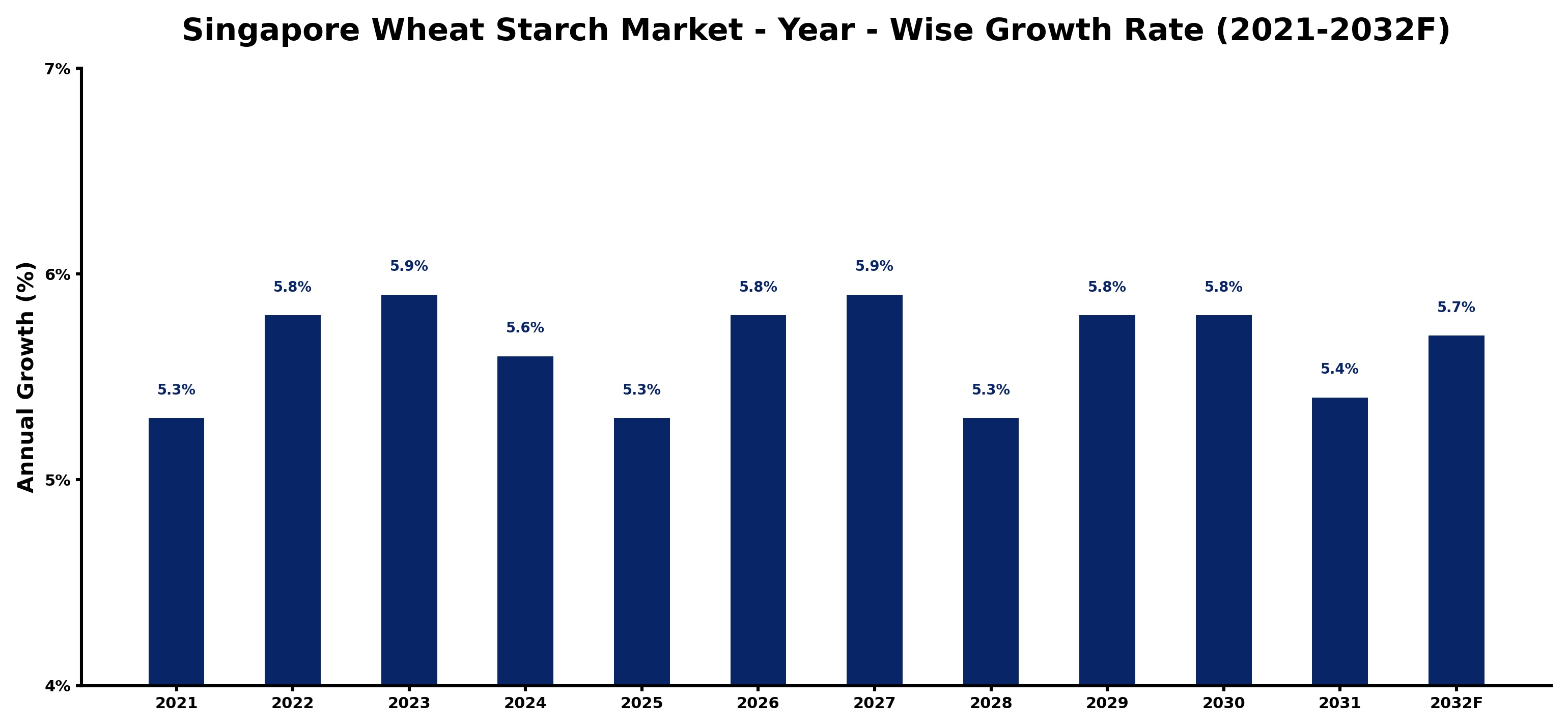
The table below presents the year‑wise growth rates along with the key drivers influencing the market
| Year | Growth Rate | Major Drivers |
| 2021 | 5.3% | Rising demand for gluten-free products |
| 2022 | 5.8% | Increased health consciousness among consumers |
| 2023 | 5.9% | Food innovation driving new applications |
| 2024 | 5.6% | Sustainable sourcing practices gaining traction |
| 2025 | 5.3% | Growth in bakery product offerings |
| 2026 | 5.8% | Expansion of food processing capabilities |
| 2027 | 5.9% | Rising popularity of Asian cuisines |
| 2028 | 5.3% | Increased investment in food technology |
| 2029 | 5.8% | Industrial activity supported growth |
| 2030 | 5.8% | Market expansion drove consumption |
| 2031 | 5.4% | Health-focused product launches increasing |
| 2032 | 5.7% | Emerging markets expanding consumer base |
Note - Market size estimations and growth projections presented in this report are based on 6Wresearch’s advanced forecasting approach, validated with industry datasets as of June 2026.
Singapore Wheat Starch Market Synopsis
While the Singapore Wheat Starch Market has shown resilience in the face of recent challenges, it is moving toward a more diversified future. With traditional Asian culinary practices incorporating wheat starch as a thickening agent, the market is adapting to evolving consumer preferences for health and wellness.
As gluten-free diets gain popularity, there is a subtle shift in demand dynamics. Although the gluten-free trend presents potential hurdles, the market is likely to innovate through alternative formulations and transparent labeling to retain consumer trust and interest.
Singapore Wheat Starch Market Key Takeaways
- The market is poised for steady growth, driven primarily by demand from the convenience food sector.
- Wheat starch's multifunctionality as a thickening and binding agent remains its key strength.
- Adaptations to gluten-related market trends may mitigate potential declines in wheat starch demand.
- Supply chain adaptations during the COVID-19 pandemic have strengthened market resilience.
- Major stakeholders are expected to innovate in product formulations to cater to changing consumer preferences.
Evaluation of Restraints in Singapore Wheat Starch Market
The Singapore Wheat Starch Market faces challenges primarily due to the rising awareness of gluten-related health issues among consumers. As gluten-free lifestyles gain traction, traditional wheat starch may see a decline in preference from those with gluten sensitivities. If manufacturers do not adapt swiftly by offering gluten-free alternatives or enhancing transparency in gluten content labeling, they risk alienating a segment of health-conscious consumers. This awareness could create a significant gap in the market if not addressed effectively, demanding strategic responses from industry players.
Singapore Wheat Starch Market Trends
Several trends are shaping the future of the Singapore Wheat Starch Market. The increasing consumer inclination towards plant-based diets is pushing manufacturers to explore innovative uses of wheat starch as a texturizing agent in meat alternatives. Additionally, the demand for clean label products is encouraging transparency and simplicity in ingredient sourcing. Sustainability is becoming a key focus, with a growing emphasis on eco-friendly production practices and packaging, which could further enhance the appeal of wheat starch as a food ingredient.
Singapore Wheat Starch Market Opportunities
The Singapore Wheat Starch Market presents various growth and investment opportunities, particularly in developing gluten-free alternatives that cater to the rising health-conscious demographic. Additionally, expanding applications in the bakery and snack food segments can drive revenue, as the demand for texture and quality continues to evolve. Collaboration with food innovators and culinary experts could open new avenues for product development, enabling the exploration of niche markets. Furthermore, leveraging technology to improve manufacturing processes may enhance product offerings and operational efficiency.
Government Initiatives in the Singapore Wheat Starch Market
The Singaporean government has shown commitment to enhancing food safety and quality standards, impacting the wheat starch market positively. Initiatives focused on improving food security and promoting local agriculture aim to strengthen the supply chain for wheat-based products. Moreover, public spending on research and development in the food sector encourages innovation, supporting manufacturers to develop higher-quality starches and explore alternative applications.
Future Insights of the Singapore Wheat Starch Market
Looking ahead to 2026-2032, the Singapore Wheat Starch Market is expected to evolve significantly, primarily driven by innovation and consumer demand for quality food products. The adaptation to gluten-free trends and the diversification of product applications will be crucial in maintaining competitive advantage. Furthermore, ongoing improvements in supply chain efficiency and sustainable practices will play a vital role in shaping the future landscape of the market, ensuring that wheat starch remains a staple ingredient in both traditional and modern culinary contexts.
Singapore Wheat Starch Market Latest Developments (May 2025 - June 2026)
Recent industry trends indicate a heightened focus on improving supply chain resilience in the Singapore Wheat Starch Market. Companies have been exploring alternative sourcing strategies to mitigate risks associated with global disruptions. Furthermore, there has been a notable increase in collaboration between food technologists and manufacturers to enhance the quality and applications of wheat starch in various food products, ensuring alignment with contemporary consumer preferences.
Singapore Wheat Starch Market - Key Attractiveness of the Report
- 10 Years of Market Numbers
- Historical Data Starting from 2022 to 2025
- Base Year: 2025
- Forecast Data until 2032
- Key Performance Indicators Impacting the Market
- Major Upcoming Developments and Projects
Key Highlights of the Report:
- Singapore Wheat Starch Market Outlook
- Market Size of Singapore Wheat Starch Market, 2025
- Forecast of Singapore Wheat Starch Market, 2032F
- Historical Data and Forecast of Singapore Wheat Starch Revenues & Volume for the Period 2022-2032F
- Singapore Wheat Starch Market Trend Evolution
- Singapore Wheat Starch Market Drivers and Challenges
- Singapore Wheat Starch Price Trends
- Singapore Wheat Starch Porter's Five Forces
- Singapore Wheat Starch Industry Life Cycle
- Historical Data and Forecast of Singapore Wheat Starch Market Revenues & Volume By Type for the Period 2022-2032F
- Historical Data and Forecast of Singapore Wheat Starch Market Revenues & Volume By Native Wheat Starch for the Period 2022-2032F
- Historical Data and Forecast of Singapore Wheat Starch Market Revenues & Volume By Modified Wheat Starch for the Period 2022-2032F
- Historical Data and Forecast of Singapore Wheat Starch Market Revenues & Volume By Grade for the Period 2022-2032F
- Historical Data and Forecast of Singapore Wheat Starch Market Revenues & Volume By Food Grade for the Period 2022-2032F
- Historical Data and Forecast of Singapore Wheat Starch Market Revenues & Volume By Industrial Grade for the Period 2022-2032F
- Historical Data and Forecast of Singapore Wheat Starch Market Revenues & Volume By End-Users Industry for the Period 2022-2032F
- Historical Data and Forecast of Singapore Wheat Starch Market Revenues & Volume By Food and Beverages for the Period 2022-2032F
- Historical Data and Forecast of Singapore Wheat Starch Market Revenues & Volume By Cosmetics for the Period 2022-2032F
- Historical Data and Forecast of Singapore Wheat Starch Market Revenues & Volume By Others for the Period 2022-2032F
- Singapore Wheat Starch Import Export Trade Statistics
- Market Opportunity Assessment By Type
- Market Opportunity Assessment By Grade
- Market Opportunity Assessment By End-Users Industry
- Singapore Wheat Starch Top Companies Market Share
- Singapore Wheat Starch Competitive Benchmarking By Technical and Operational Parameters
- Singapore Wheat Starch Company Profiles
- Singapore Wheat Starch Key Strategic Recommendations






































