Singapore Winding Wire Market Size, Share & Growth Rate
The Singapore Winding Wire Market was estimated at USD 286 Million in 2025 and is projected to reach USD 379 Million by 2032, growing at a CAGR of 4.1% from 2026 to 2032. This trajectory is strongly influenced by the surge in electrical and electronics manufacturing, spurred by advancements in technology and a growing demand for energy-efficient products. Additionally, the automotive sector's pivot towards electric vehicles is creating a new wave of demand for high-performance winding wires.
Singapore Winding Wire Market Year-wise Growth Rate and Key Drivers
This graph highlights how the Singapore Winding Wire Market has steadily grown over the years, supported by major growth factors.
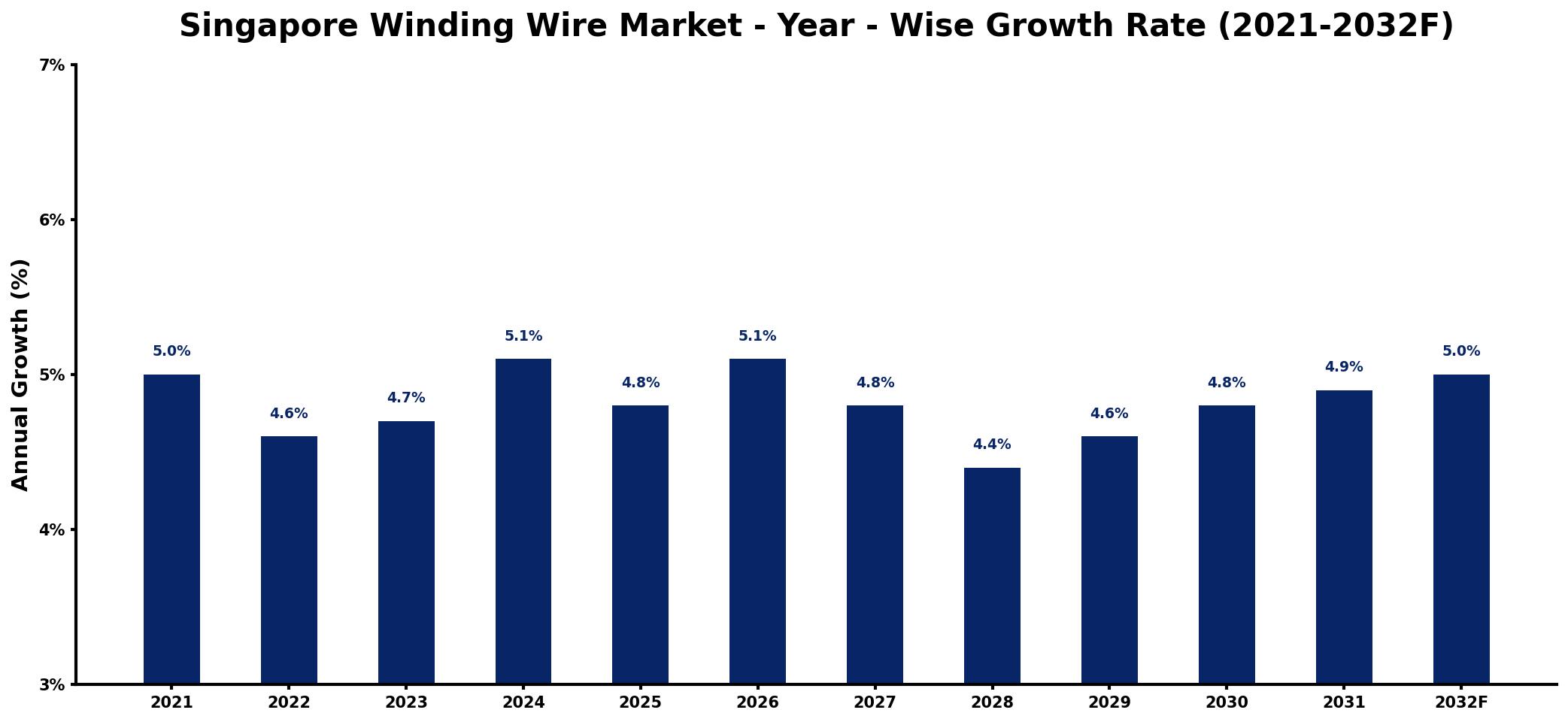
The table below presents the year‑wise growth rates along with the key drivers influencing the market
| Year | Growth Rate | Major Drivers |
| 2021 | 5.0% | Rise in construction activities |
| 2022 | 4.6% | Increased demand from electronics |
| 2023 | 4.7% | Growth in renewable energy sector |
| 2024 | 5.1% | Expansion of automotive industry |
| 2025 | 4.8% | Surge in infrastructure projects |
| 2026 | 5.1% | Investments in energy efficiency |
| 2027 | 4.8% | Technological advancements in manufacturing |
| 2028 | 4.4% | Demand from telecommunications sector |
| 2029 | 4.6% | growing automotive sector requirements |
| 2030 | 4.8% | Rising demand for smart devices |
| 2031 | 4.9% | Increase in industrial automation |
| 2032 | 5.0% | improved processing technologies adoption |
Note: Market size estimations and growth projections presented in this report are based on 6Wresearch's proprietary forecasting methodology, utilizing the latest available industry data, government publications, and primary research inputs.
Singapore Winding Wire Market Synopsis
The most significant force shaping the Singapore winding wire market today is the remarkable growth in the electronics and automotive sectors. These industries depend heavily on winding wires for the manufacturing of vital components such as electric motors and transformers, reflecting a broader trend of technological integration within production processes.
Furthermore, as Singapore positions itself as a leading regional trade and manufacturing hub, the demand for high-quality winding wires is intensifying. Manufacturers are increasingly focusing on innovation, aiming to enhance electrical conductivity and thermal stability to meet the rigorous demands of modern applications in various industries.
Singapore Winding Wire Market Key Takeaways
- The market is experiencing robust growth driven by the increasing demand from the electrical and electronics manufacturing sectors.
- Technological advancements and the rise of electric vehicles are significant contributors to market expansion.
- Manufacturers are prioritizing quality and performance to address the stringent requirements of modern applications.
- Supply chain resilience and material sourcing are critical for sustaining market competitiveness.
- The market is expected to recover and grow following challenges posed by the COVID-19 pandemic.
Evaluation of Restraints in Singapore Winding Wire Market
Despite the promising growth prospects, the Singapore winding wire market faces notable restraints. Material sourcing remains a significant challenge, as manufacturers must ensure a stable supply of high-quality raw materials to maintain production standards. Additionally, rigorous quality control measures are necessary to adhere to industry regulations and customer expectations. Price competitiveness is also a concern, with local manufacturers needing to optimize their production processes to remain viable amid global competition. These factors necessitate a strategic approach to overcome the hurdles that could potentially limit market growth.
Singapore Winding Wire Market Trends
Current trends in the Singapore winding wire market include a push towards eco-friendly and energy-efficient products, driven by both consumer preferences and regulatory pressures. Innovations in wire design and materials are enhancing performance characteristics, such as electrical efficiency and thermal resistance. Additionally, the automotive industry's shift towards electric mobility is fostering the development of specialized winding wires tailored for electric motor applications, indicating a strong alignment between market needs and technological advancements.
Singapore Winding Wire Market Opportunities
The winding wire market presents numerous opportunities for growth and investment, particularly in the realm of electric vehicles and renewable energy technologies. As the demand for electric motors escalates, there is a corresponding need for high-performance winding wires that can enhance efficiency and reduce energy losses. Additionally, the increasing focus on smart technologies in appliances offers manufacturers the chance to innovate and expand their product lines, thus tapping into new market segments.
Government Initiatives in the Singapore Winding Wire Market
The Singaporean government has implemented several initiatives aimed at fostering growth in the manufacturing sector, which directly benefits the winding wire market. Policies promoting research and development, as well as investments in advanced manufacturing technologies, are encouraging local companies to enhance their production capabilities. Furthermore, incentives for sustainable manufacturing practices align with global trends towards energy efficiency, providing a conducive environment for innovation within the winding wire sector.
Future Insights of the Singapore Winding Wire Market
Looking ahead to the period between 2026 and 2032, the Singapore winding wire market is poised for significant evolution. The ongoing technological advancements in the electrical and automotive sectors will likely drive demand for specialized winding wires, particularly as electric vehicle production ramps up. The emphasis on energy efficiency and sustainability will further shape product development, compelling manufacturers to innovate continuously. As market players adapt to shifting consumer needs and regulatory standards, the future landscape is expected to be characterized by increased competition and enhanced product offerings.
Singapore Winding Wire Market Latest Developments (2025 - 2026)
Recent developments in the Singapore winding wire market reflect a shift towards higher-quality, technologically advanced products. Manufacturers are increasingly investing in R&D to explore new materials that enhance the efficiency and performance of winding wires. Additionally, collaborations among industry stakeholders are emerging as a strategy to address common challenges, such as supply chain disruptions. The focus on sustainability is also becoming more prominent, with companies exploring eco-friendly materials and production methods to meet the expectations of a more environmentally conscious market.
Singapore Winding Wire Market - Key Attractiveness of the Report
- 10 Years of Market Numbers
- Historical Data Starting from 2022 to 2025
- Base Year: 2025
- Forecast Data until 2032
- Key Performance Indicators Impacting the Market
- Major Upcoming Developments and Projects
Key Highlights of the Report:
- Singapore Winding Wire Market Outlook
- Market Size of Singapore Winding Wire Market, 2025
- Forecast of Singapore Winding Wire Market, 2032
- Historical Data and Forecast of Singapore Winding Wire Revenues & Volume for the Period 2022-2032F
- Singapore Winding Wire Market Trend Evolution
- Singapore Winding Wire Market Drivers and Challenges
- Singapore Winding Wire Price Trends
- Singapore Winding Wire Porter's Five Forces
- Singapore Winding Wire Industry Life Cycle
- Historical Data and Forecast of Singapore Winding Wire Market Revenues & Volume By Product for the Period 2022-2032F
- Historical Data and Forecast of Singapore Winding Wire Market Revenues & Volume By Copper Winding Wire for the Period 2022-2032F
- Historical Data and Forecast of Singapore Winding Wire Market Revenues & Volume By Aluminum Winding Wire for the Period 2022-2032F
- Singapore Winding Wire Import Export Trade Statistics
- Market Opportunity Assessment By Product
- Singapore Winding Wire Top Companies Market Share
- Singapore Winding Wire Competitive Benchmarking By Technical and Operational Parameters
- Singapore Winding Wire Company Profiles
- Singapore Winding Wire Key Strategic Recommendations






































