Singapore Wine production Machinery Market Summary
The singapore wine production machinery market was estimated at USD 312 Million in 2025 and is projected to reach USD 423 Million by 2032, growing at a CAGR of 5.2% from 2026 to 2032.
Singapore Wine production Machinery Market Year-wise Growth Rate and Key Drivers
This graph highlights how the Singapore Wine production Machinery Market has steadily grown over the past five years, supported by major growth factors.
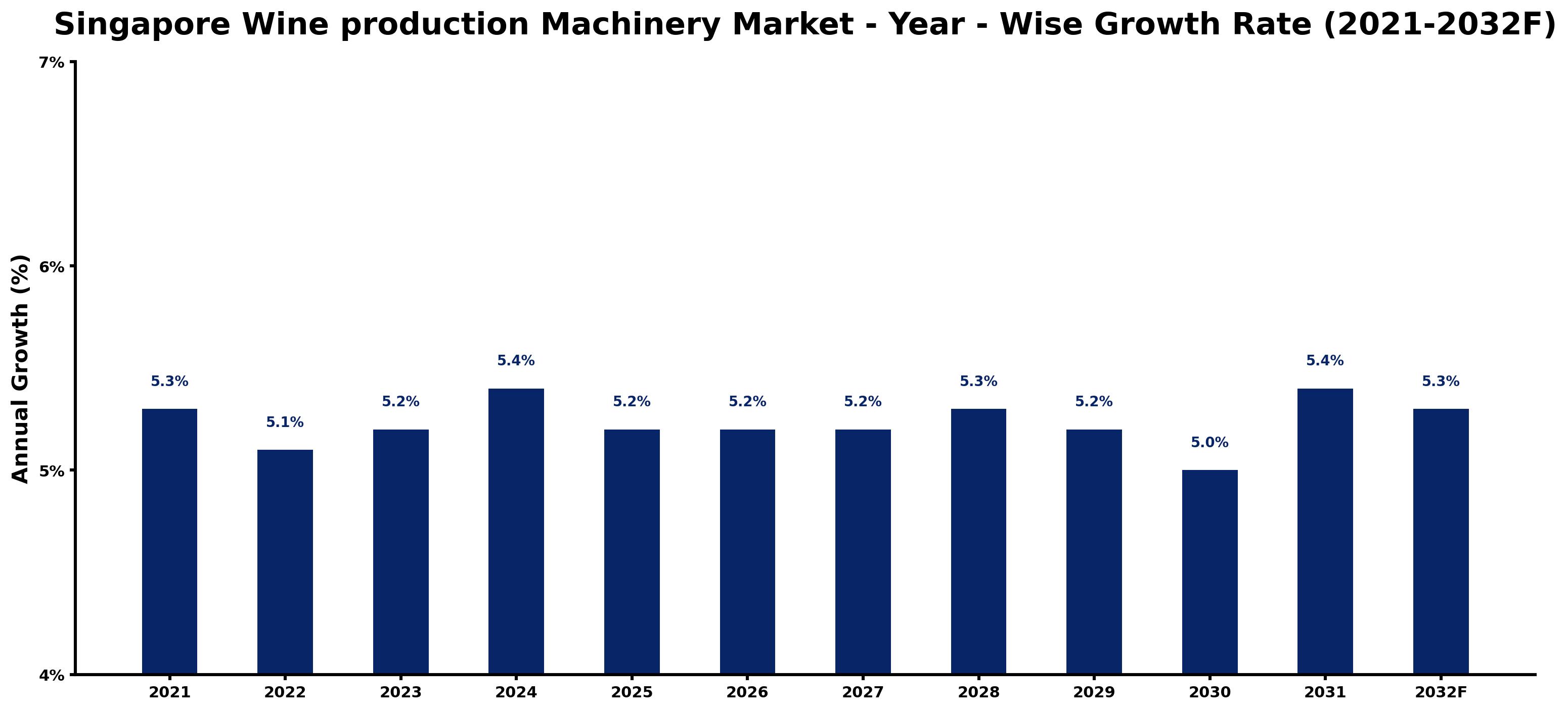
The table below presents the year wise growth rates along with the key drivers influencing the market
| Year | Growth Rate | Major Drivers |
| 2021 | 5.3% | Post-pandemic consumer interest in local wine production surged significantly among enthusiasts. |
| 2022 | 5.1% | Increased investment in eco-friendly machinery aligns with sustainability trends across the industry. |
| 2023 | 5.2% | Local wineries sought advanced technology to enhance efficiency and production quality. |
| 2024 | 5.4% | Rising tourism in Singapore highlighted the demand for locally produced wine experiences. |
| 2025 | 5.2% | Technological partnerships emerged, enhancing machinery capabilities through innovative solutions and support. |
| 2026 | 5.2% | A focus on premium quality wines attracted investments in high-end production equipment. |
| 2027 | 5.2% | E-commerce platforms expanded, increasing the need for efficient production and distribution machinery. |
| 2028 | 5.3% | Local regulations incentivized sustainable practices, prompting shifts towards eco-friendly machinery options. |
| 2029 | 5.2% | Emerging wineries began prioritizing automation to streamline operations and reduce labor costs. |
| 2030 | 5.0% | Consumer preferences shifted towards artisanal products, driving demand for specialized production tools. |
| 2031 | 5.4% | Collaborations between machinery producers and winemakers fostered innovation in equipment design. |
| 2032 | 5.3% | The competitive landscape evolved, emphasizing the importance of advanced technology in production. |
Note - Market size estimations and growth projections presented in this report are based on 6Wresearch's advanced forecasting approach, validated with industry datasets as of June 2026.
Singapore Wine production Machinery Market Synopsis
The Singapore Wine production Machinery Market is projected to reach 5.2% and witness significant growth during the forecast period (2026-2032). The market is influenced by various factors such as the rising consumption of wine, advancements in technology, and increased investments from global firms. Furthermore, the robust economic landscape and the enhancement of infrastructure have positively impacted the demand for wine production machinery within the country.
Singapore Wine production Machinery Market Growth Drivers
The growth trajectory of the Singapore Wine production Machinery Market is primarily driven by a variety of factors:
- The increasing consumption of alcoholic beverages, particularly wine, has been a significant contributor to market expansion, reflecting changing consumer preferences towards premium products.
- There is a notable rise in the number of wineries, distilleries, and breweries in Singapore, leading to heightened demand for advanced wine production equipment.
- Technological advancements in automation have greatly enhanced operational efficiency, allowing for more cost-effective wine production processes.
- Government initiatives, including tax exemptions on machinery used in alcohol production, have fostered a favorable investment climate, encouraging manufacturers to upgrade their facilities.
- The overall growth of the Singaporean economy and improvements in infrastructure have created a supportive environment for the expansion of the wine industry, which in turn stimulates the demand for specific production machinery.
Singapore Wine production Machinery Market Challenges and Restraints
Despite the positive outlook for the Singapore Wine production Machinery Market, several challenges exist that may impede growth:
- The high capital investment required to establish automated wine production facilities poses a significant barrier for potential investors, particularly for smaller companies or startups that may struggle to secure sufficient funding.
- There is a limited availability of skilled labor essential for operating sophisticated wine production machinery, which can hinder the adoption rate among small-scale producers.
- As a result of the high costs associated with implementing advanced technology, smaller wineries may hesitate to invest, diminishing their competitive edge in the market.
- Stringent regulatory standards regarding quality control can lead to additional expenses for compliance, impacting overall profitability for manufacturers.
- Market uncertainties stemming from economic fluctuations can also lead to hesitance in investment, further challenging the overall development of the industry.
Singapore Wine production Machinery Market Government Investment and Initiatives
The Singapore government has actively participated in promoting the wine production machinery sector through various initiatives:
- Strategic programs aimed at enhancing the capabilities of the local wine industry have been introduced to facilitate technological advancements in wine production.
- Government funding and grants are available for businesses looking to modernize their production processes, which directly benefits the machinery market.
- Incentives such as tax rebates for investments in new technology and equipment have been implemented to stimulate growth and encourage innovation in the wine sector.
- Public spending on infrastructure improvements has supported the development of facilities necessary for modern wine production, fostering an environment conducive to market expansion.
- Collaborative efforts between the public and private sectors aim to address skill gaps in the workforce, ensuring that skilled labor is available to operate advanced machinery.
Singapore Wine production Machinery Market Latest Developments (May 2025 - June 2026)
Recent developments in the Singapore Wine production Machinery Market indicate a dynamic environment marked by significant industry shifts:
- Leading manufacturers in the region have focused on innovation, launching next-generation machinery featuring cutting-edge technology and automation capabilities to enhance efficiency.
- There has been a noticeable increase in collaboration among local wineries to share resources and knowledge, further driving industry improvements.
- Trade shows and industry exhibitions have resumed, providing platforms for stakeholders to showcase advancements in wine production machinery.
- Research and development investments have surged as companies seek to create more sustainable practices within the wine production process, addressing growing environmental concerns.
- Market players are increasingly focusing on digital transformation strategies, integrating IoT and data analytics into production processes to optimize operations.
Singapore Wine production Machinery Market - Key Attractiveness of the Report
- 10 Years of Market Numbers
- Historical Data Starting from 2022 to 2025
- Base Year: 2025
- Forecast Data until 2032
- Key Performance Indicators Impacting the Market
- Major Upcoming Developments and Projects
Key Highlights of the Report:
- Singapore Wine production Machinery Market Outlook
- Market Size of Singapore Wine production Machinery Market, 2025
- Forecast of Singapore Wine production Machinery Market, 2032F
- Historical Data and Forecast of Singapore Wine production Machinery Revenues & Volume for the Period 2022-2032F
- Singapore Wine production Machinery Market Trend Evolution
- Singapore Wine production Machinery Market Drivers and Challenges
- Singapore Wine production Machinery Price Trends
- Singapore Wine production Machinery Porter's Five Forces
- Singapore Wine production Machinery Industry Life Cycle
- Historical Data and Forecast of Singapore Wine production Machinery Market Revenues & Volume By Type for the Period 2022-2032F
- Historical Data and Forecast of Singapore Wine production Machinery Market Revenues & Volume By Tanks & fermenters for the Period 2022-2032F
- Historical Data and Forecast of Singapore Wine production Machinery Market Revenues & Volume By Crushing & Pressing Equipment for the Period 2022-2032F
- Historical Data and Forecast of Singapore Wine production Machinery Market Revenues & Volume By Temperature Control Equipment for the Period 2022-2032F
- Historical Data and Forecast of Singapore Wine production Machinery Market Revenues & Volume By Filtration Equipment for the Period 2022-2032F
- Historical Data and Forecast of Singapore Wine production Machinery Market Revenues & Volume By Others for the Period 2022-2032F
- Singapore Wine production Machinery Import Export Trade Statistics
- Market Opportunity Assessment By Type
- Singapore Wine production Machinery Top Companies Market Share
- Singapore Wine production Machinery Competitive Benchmarking By Technical and Operational Parameters
- Singapore Wine production Machinery Company Profiles
- Singapore Wine production Machinery Key Strategic Recommendations






































