Singapore Wireless Mesh Network Market Size & Growth Rate (2026-2032)
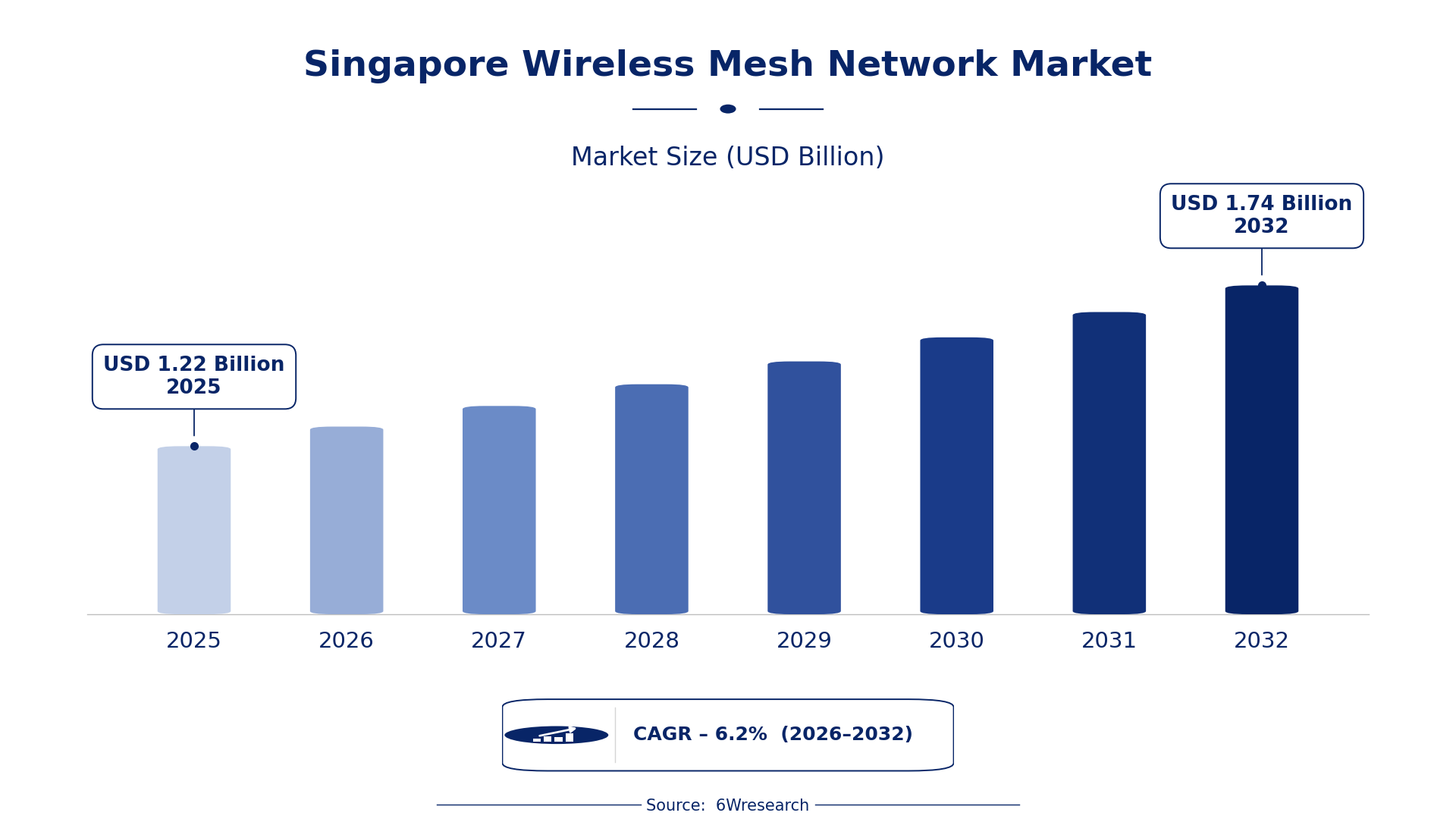
The Singapore Wireless Mesh Network Market was estimated at USD 1215 Million in 2025 and is projected to reach USD 1738 Million by 2032, growing at a CAGR of 6.2% from 2026 to 2032.
Singapore Wireless Mesh Network Market Synopsis
The wireless mesh network market in Singapore has witnessed substantial momentum, particularly in the wake of increasing demand for reliable connectivity. This growth is being driven by the urbanization trend and the rapid expansion of smart city projects, which require high-capacity wireless solutions to meet the connectivity needs of diverse applications.
Looking ahead, the Singapore Wireless Mesh Network Market is expected to evolve further, with an emphasis on scalability and security. As public sector initiatives ramp up to enhance digital infrastructure, mesh networks will play a crucial role in creating resilient communication channels across urban landscapes.
Singapore Wireless Mesh Network Market Year-wise Growth Rate and Key Drivers
This graph illustrates the annual growth rates of the Singapore Wireless Mesh Network Market from 2021 to 2032, highlighting a steady upward trajectory and projected expansion over the forecast period.
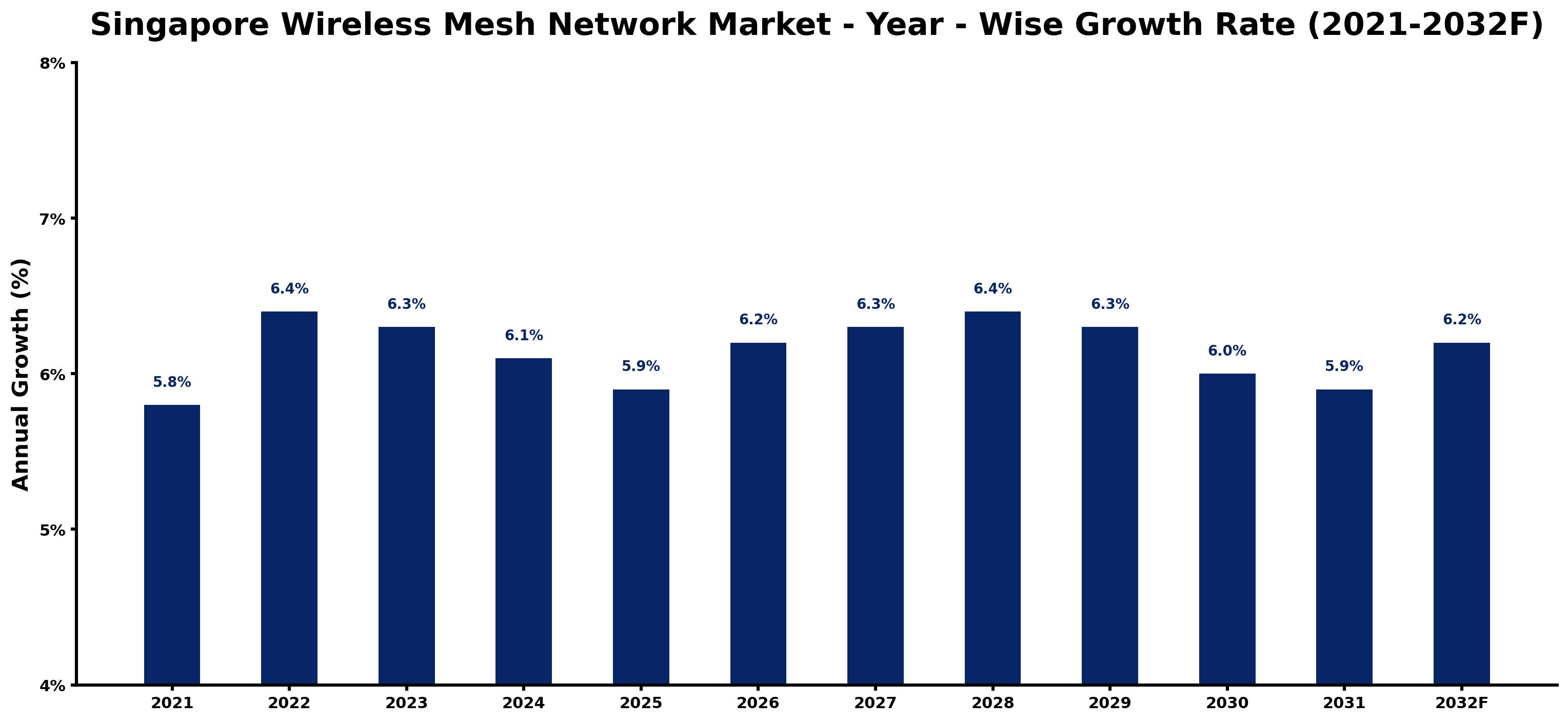
The table below presents the year‑wise growth rates along with the key drivers influencing the market
| Year | Growth Rate | Major Drivers |
| 2021 | 5.8% | Smart Nation initiative boosting connected services deployment. |
| 2022 | 6.4% | Increased investment in public Wi-Fi by local authorities. |
| 2023 | 6.3% | Growing adoption of IoT devices driving mesh network demand. |
| 2024 | 6.1% | Financial incentives for smart building technology integration. |
| 2025 | 5.9% | Government policies favoring telecommunications infrastructure upgrades. |
| 2026 | 6.2% | Rising urban density necessitating advanced network solutions. |
| 2027 | 6.3% | Cybersecurity regulations pushing for robust network frameworks. |
| 2028 | 6.4% | Expanding use of 5G enhancing mesh network opportunities. |
| 2029 | 6.3% | Enhanced urban mobility solutions requiring better wireless coverage. |
| 2030 | 6.0% | Government initiatives promoting digital innovation across industries. |
| 2031 | 5.9% | Surge in smart home device usage amplifying network requirements. |
| 2032 | 6.2% | Focus on disaster recovery plans necessitating resilient communication systems. |
Note: Market size estimations and growth projections presented in this report are based on 6Wresearch's proprietary forecasting methodology, utilizing the latest available industry data, government publications, and primary research inputs.
Singapore Wireless Mesh Network Market Key Takeaways
Below are some of the specific key takeaways from the market, including:
- Increased demand for seamless connectivity in urban environments is driving mesh network deployments.
- Government initiatives are prioritizing smart city projects that utilize wireless mesh technology.
- Challenges related to network scalability and interference management remain critical concerns.
- The COVID-19 pandemic accelerated the adoption of mesh networks across various sectors.
- Key technological advancements are set to enhance the functionality of wireless mesh networks.
Evaluation of Restraints in Singapore Wireless Mesh Network Market
Several real constraints are influencing the growth trajectory of the wireless mesh network market in Singapore. Network scalability presents a notable challenge, particularly as the number of connected devices continues to rise. Managing interference in highly populated areas complicates efforts to optimize performance, requiring innovative solutions. Furthermore, the need for stringent security measures adds an additional layer of complexity, as stakeholders are increasingly concerned about data breaches and system vulnerabilities.
Singapore Wireless Mesh Network Market Trends
One of the primary trends influencing the Singapore Wireless Mesh Network Market is the integration of IoT applications, where mesh networks provide the necessary infrastructure for smart devices. This trend complements the ongoing smart city initiatives, as cities strive to enhance connectivity for public services. The rise in demand for high-density public Wi-Fi in urban locations is another emerging trend, prompting more businesses and municipal authorities to invest in mesh networking solutions. As technology advances, there is a growing focus on enhancing network security protocols to protect sensitive data, driving innovation in this sector.
Singapore Wireless Mesh Network Market Opportunities
The Singapore Wireless Mesh Network Market presents numerous opportunities for growth and investment. With the government's ongoing push for smart cities, there is an urgent need for reliable connectivity solutions across various sectors, including transportation, healthcare, and public safety. The increasing emphasis on sustainability in urban planning also opens avenues for mesh networks that facilitate energy-efficient operations. Businesses looking to enhance customer experiences through robust wireless networks will find significant opportunities to invest in this technology as demand expands.
Government Initiatives in the Singapore Wireless Mesh Network Market
The Singapore government is actively shaping the wireless mesh network market through various initiatives aimed at enhancing national connectivity. Emphasis is placed on improving digital infrastructure to support the nation’s smart city vision, which aligns with current public sector priorities. Policymakers recognize the need for strong regulatory frameworks that can foster innovation while ensuring data security and network reliability.
- A national digital infrastructure upgrade program recently completed aims to enhance connectivity in urban centers.
- Currently, an initiative is underway focused on expanding public Wi-Fi access in community spaces, utilizing wireless mesh technology.
- A planned public-private partnership expected to launch in the next year seeks to improve emergency communication systems using mesh networks.
- Regulatory frameworks are being developed to address network security concerns as mesh networks become more prevalent.
- Ongoing investments in research and development will foster innovations in wireless technology over the coming years.
Future Insights of the Singapore Wireless Mesh Network Market
As we look towards 2026-2032, the Singapore Wireless Mesh Network Market is set for transformative growth. The convergence of smart technologies and increasing urban density will necessitate the widespread adoption of mesh networks. Emerging applications in sectors such as transportation and healthcare will demand greater connectivity and resilience, ensuring that mesh networks become fundamental to Singapore's digital strategy. Investment in cybersecurity measures will likely evolve in parallel, as the focus on protecting data integrity intensifies.
Singapore Wireless Mesh Network Market Latest Developments
In recent months, the Singapore Wireless Mesh Network Market has seen increased activity driven by advancements in technology and growing demand for connectivity solutions. Organizations are recognizing the importance of robust networks, leading to innovative projects and collaborations across the sector.
- A leading regional operator launched a new wireless mesh product aimed at enhancing connectivity for smart city projects in Q1 2025.
- A major technology vendor is currently deploying an upgrade of its mesh networking systems that began in early 2025, enhancing network security and performance.
- An ongoing initiative aims to integrate IoT devices into existing wireless mesh networks, expected to reach completion by late 2025.
- In mid-2026, a rollout is planned for a network expansion project to improve coverage in high-density urban areas.
- A collaborative effort among telecommunications firms is expected to start in late 2025, focused on developing next-generation mesh technologies.
Singapore Wireless Mesh Network Market - Key Attractiveness of the Report
- 10 Years of Market Numbers
- Historical Data Starting from 2022 to 2025
- Base Year: 2025
- Forecast Data until 2032
- Key Performance Indicators Impacting the Market
- Major Upcoming Developments and Projects
Key Highlights of the Report:
- Singapore Wireless Mesh Network Market Outlook
- Market Size of Singapore Wireless Mesh Network Market, 2025
- Forecast of Singapore Wireless Mesh Network Market, 2032
- Historical Data and Forecast of Singapore Wireless Mesh Network Revenues & Volume for the Period 2022-2032F
- Singapore Wireless Mesh Network Market Trend Evolution
- Singapore Wireless Mesh Network Market Drivers and Challenges
- Singapore Wireless Mesh Network Price Trends
- Singapore Wireless Mesh Network Porter's Five Forces
- Singapore Wireless Mesh Network Industry Life Cycle
- Historical Data and Forecast of Singapore Wireless Mesh Network Market Revenues & Volume By Component for the Period 2022-2032F
- Historical Data and Forecast of Singapore Wireless Mesh Network Market Revenues & Volume By Physical Appliances for the Period 2022-2032F
- Historical Data and Forecast of Singapore Wireless Mesh Network Market Revenues & Volume By Mesh Platform for the Period 2022-2032F
- Historical Data and Forecast of Singapore Wireless Mesh Network Market Revenues & Volume By Services for the Period 2022-2032F
- Historical Data and Forecast of Singapore Wireless Mesh Network Market Revenues & Volume By Mesh Design for the Period 2022-2032F
- Historical Data and Forecast of Singapore Wireless Mesh Network Market Revenues & Volume By Infrastructure Wireless Mesh for the Period 2022-2032F
- Historical Data and Forecast of Singapore Wireless Mesh Network Market Revenues & Volume By Ad-Hoc Mesh for the Period 2022-2032F
- Historical Data and Forecast of Singapore Wireless Mesh Network Market Revenues & Volume By Applications for the Period 2022-2032F
- Historical Data and Forecast of Singapore Wireless Mesh Network Market Revenues & Volume By Video Streaming and Surveillance for the Period 2022-2032F
- Historical Data and Forecast of Singapore Wireless Mesh Network Market Revenues & Volume By Telecommunication for the Period 2022-2032F
- Historical Data and Forecast of Singapore Wireless Mesh Network Market Revenues & Volume By Disaster Management and Public Safety for the Period 2022-2032F
- Historical Data and Forecast of Singapore Wireless Mesh Network Market Revenues & Volume By Smart Mobility for the Period 2022-2032F
- Historical Data and Forecast of Singapore Wireless Mesh Network Market Revenues & Volume By Border Security (GPS Tracking) for the Period 2022-2032F
- Historical Data and Forecast of Singapore Wireless Mesh Network Market Revenues & Volume By Smart Manufacturing for the Period 2022-2032F
- Historical Data and Forecast of Singapore Wireless Mesh Network Market Revenues & Volume By Smart Building and Home Automation for the Period 2022-2032F
- Historical Data and Forecast of Singapore Wireless Mesh Network Market Revenues & Volume By Others (Environment Monitoring, and Smart Grids and Meters) for the Period 2022-2032F
- Historical Data and Forecast of Singapore Wireless Mesh Network Market Revenues & Volume By Radio Frequency for the Period 2022-2032F
- Historical Data and Forecast of Singapore Wireless Mesh Network Market Revenues & Volume By Sub 1 GHz Band for the Period 2022-2032F
- Historical Data and Forecast of Singapore Wireless Mesh Network Market Revenues & Volume By 2.4 GHz Band for the Period 2022-2032F
- Historical Data and Forecast of Singapore Wireless Mesh Network Market Revenues & Volume By 4.9 GHz Band for the Period 2022-2032F
- Historical Data and Forecast of Singapore Wireless Mesh Network Market Revenues & Volume By 5 GHz Band for the Period 2022-2032F
- Singapore Wireless Mesh Network Import Export Trade Statistics
- Market Opportunity Assessment By Component
- Market Opportunity Assessment By Mesh Design
- Market Opportunity Assessment By Applications
- Market Opportunity Assessment By Radio Frequency
- Singapore Wireless Mesh Network Top Companies Market Share
- Singapore Wireless Mesh Network Competitive Benchmarking By Technical and Operational Parameters
- Singapore Wireless Mesh Network Company Profiles
- Singapore Wireless Mesh Network Key Strategic Recommendations






































