Singapore Wood Processing Market Size, Share & Growth Rate
The Singapore Wood Processing Market was estimated at USD 784 Million in 2025 and is projected to reach USD 1128 Million by 2032, growing at a CAGR of 5.3% from 2026 to 2032. This growth trajectory is underpinned by the increasing demand for high-quality and customized wood products, particularly in the construction and interior design sectors. Additionally, as urbanization continues and sustainable building practices gain traction, the market is poised to leverage these trends for further expansion.
Singapore Wood Processing Market Year-wise Growth Rate and Key Drivers
This graph highlights how the Singapore Wood Processing Market has steadily grown over the years, supported by major growth factors.
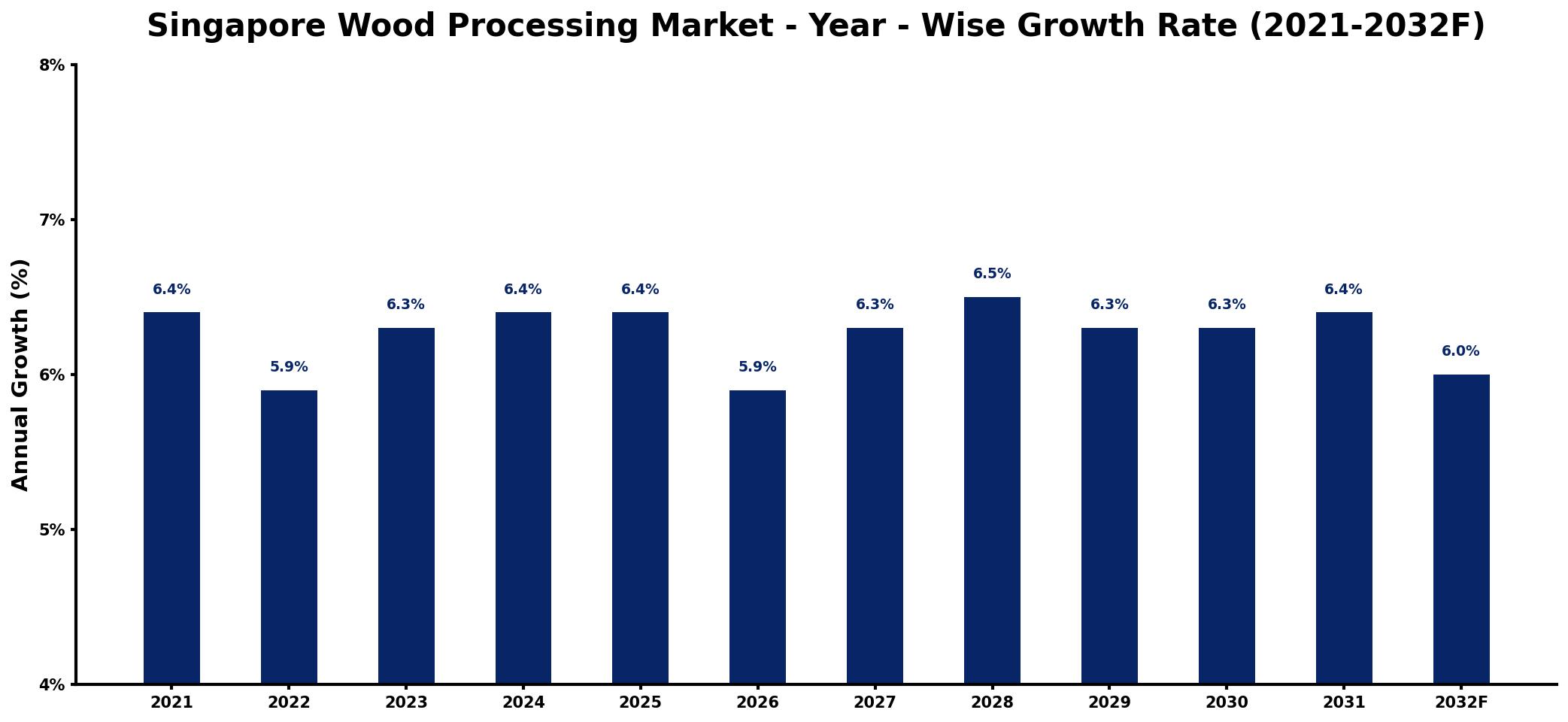
The table below presents the year‑wise growth rates along with the key drivers influencing the market
| Year | Growth Rate | Major Drivers |
| 2021 | 6.4% | Rising construction sector activities |
| 2022 | 5.9% | Increased exports to regional markets |
| 2023 | 6.3% | Growing demand for sustainable materials |
| 2024 | 6.4% | Expansion of furniture manufacturing industry |
| 2025 | 6.4% | Investment in eco-friendly technologies |
| 2026 | 5.9% | Strengthening local supply chains |
| 2027 | 6.3% | Surge in home renovation projects |
| 2028 | 6.5% | Growth in interior design sector |
| 2029 | 6.3% | Increased government infrastructure spending |
| 2030 | 6.3% | Development of new product lines |
| 2031 | 6.4% | Rising demand for custom solutions |
| 2032 | 6.0% | Emergence of innovative startups |
Note: Market size estimations and growth projections presented in this report are based on 6Wresearch's proprietary forecasting methodology, utilizing the latest available industry data, government publications, and primary research inputs.
Singapore Wood Processing Market Synopsis
The wood processing market in Singapore is currently witnessing a paradigm shift driven by evolving consumer preferences for bespoke and sustainable products. As construction activities ramp up, so does the critical role of wood processors in providing essential materials for furniture and interior design.
Investments in advanced processing technologies are becoming increasingly vital, as companies strive to enhance efficiency and maintain competitiveness in a market characterized by rising expectations. This dynamic landscape creates opportunities for innovation and sustainable practices across the industry.
Singapore Wood Processing Market Key Takeaways
- The market is expected to reach USD 1128 Million by 2032, reflecting a robust growth opportunity.
- Custom wood products are in high demand, driven by trends in interior design and urban development.
- Sustainable sourcing and advanced technologies are key focus areas for market players aiming to improve efficiency.
- Post-pandemic recovery efforts are reshaping operational strategies within the wood processing sector.
- The industry's growth is intricately linked to the broader construction and furniture manufacturing sectors.
Evaluation of Restraints in Singapore Wood Processing Market
Despite its promising growth, the Singapore wood processing market faces notable restraints. Key among these is the ongoing challenge of timber supply chain disruptions that can hinder production schedules and impact overall output. Furthermore, increasing regulatory scrutiny around sustainable practices requires companies to adapt swiftly, often necessitating additional investments in compliance measures. The need for advanced processing technologies to keep pace with demand also places pressure on smaller players who may struggle with capitalizing on such innovations.
Singapore Wood Processing Market Trends
The landscape of the Singapore wood processing market is being reshaped by several emerging trends. Increasingly, consumers are gravitating towards eco-friendly products, pushing manufacturers to adopt sustainable sourcing methods. Technological advancements, particularly in automated processing techniques, are becoming pivotal in improving productivity and product quality. Additionally, the trend towards customization is prompting businesses to rethink their production capabilities to meet diverse consumer needs.
Singapore Wood Processing Market Opportunities
As the market evolves, significant growth and investment opportunities are emerging, particularly in the realm of sustainable wood products. Companies that embrace eco-friendly practices not only meet regulatory requirements but also cater to a growing consumer base that values sustainability. Furthermore, expanding into online retail channels can enhance market reach, allowing businesses to tap into the e-commerce trend and connect with a broader audience.
Government Initiatives in the Singapore Wood Processing Market
The Singapore government is actively promoting sustainable practices within the wood processing sector through various initiatives and policy frameworks. These efforts include funding programs for research and development focused on sustainable materials and technologies, as well as incentives for companies adopting environmentally responsible sourcing methods. Public spending on infrastructure projects also supports the demand for processed wood, reinforcing the sector's significance in national development goals.
Future Insights of the Singapore Wood Processing Market
Looking ahead to 2026-2032, the Singapore wood processing market is poised for transformative growth. As urbanization continues to accelerate, the demand for wood in both residential and commercial projects is expected to surge. Companies that innovate and adopt sustainable practices will likely gain a competitive advantage in this rapidly evolving landscape. Furthermore, the integration of advanced technologies will reshape production capabilities, enhancing efficiency and expanding product offerings.
Singapore Wood Processing Market Latest Developments (2025 - 2026)
In recent months, the Singapore wood processing industry has seen a resurgence as businesses adapt to post-pandemic realities. Many companies are pivoting towards sustainable practices, investing in eco-friendly materials and processes. Additionally, there is a noticeable shift towards digital platforms for marketing and sales, reflecting changing consumer behaviors. Innovations in automation and precision engineering are also being integrated to boost production efficiency and product quality.
Singapore Wood Processing Market - Key Attractiveness of the Report
- 10 Years of Market Numbers
- Historical Data Starting from 2022 to 2025
- Base Year: 2025
- Forecast Data until 2032
- Key Performance Indicators Impacting the Market
- Major Upcoming Developments and Projects
Key Highlights of the Report:
- Singapore Wood Processing Market Outlook
- Market Size of Singapore Wood Processing Market, 2025
- Forecast of Singapore Wood Processing Market, 2032
- Historical Data and Forecast of Singapore Wood Processing Revenues & Volume for the Period 2022-2032F
- Singapore Wood Processing Market Trend Evolution
- Singapore Wood Processing Market Drivers and Challenges
- Singapore Wood Processing Price Trends
- Singapore Wood Processing Porter's Five Forces
- Singapore Wood Processing Industry Life Cycle
- Historical Data and Forecast of Singapore Wood Processing Market Revenues & Volume By Type for the Period 2022-2032F
- Historical Data and Forecast of Singapore Wood Processing Market Revenues & Volume By Wood Chips for the Period 2022-2032F
- Historical Data and Forecast of Singapore Wood Processing Market Revenues & Volume By Sawn Wood Lumber for the Period 2022-2032F
- Historical Data and Forecast of Singapore Wood Processing Market Revenues & Volume By Others for the Period 2022-2032F
- Singapore Wood Processing Import Export Trade Statistics
- Market Opportunity Assessment By Type
- Singapore Wood Processing Top Companies Market Share
- Singapore Wood Processing Competitive Benchmarking By Technical and Operational Parameters
- Singapore Wood Processing Company Profiles
- Singapore Wood Processing Key Strategic Recommendations






































