Singapore Wood Wool Insulation Market Size, Share & Growth Rate
The Singapore Wood Wool Insulation Market was estimated at USD 227 Million in 2025 and is projected to reach USD 297 Million by 2032, growing at a CAGR of 3.9% from 2026 to 2032. This growth is fueled by an increasing emphasis on energy efficiency and sustainable building practices within the construction sector. As Singapore continues to advance its green building initiatives, the demand for eco-friendly insulation solutions like wood wool is expected to gain significant traction.
Singapore Wood Wool Insulation Market Year-wise Growth Rate and Key Drivers
This graph highlights how the Singapore Wood Wool Insulation Market has steadily grown over the years, supported by major growth factors.
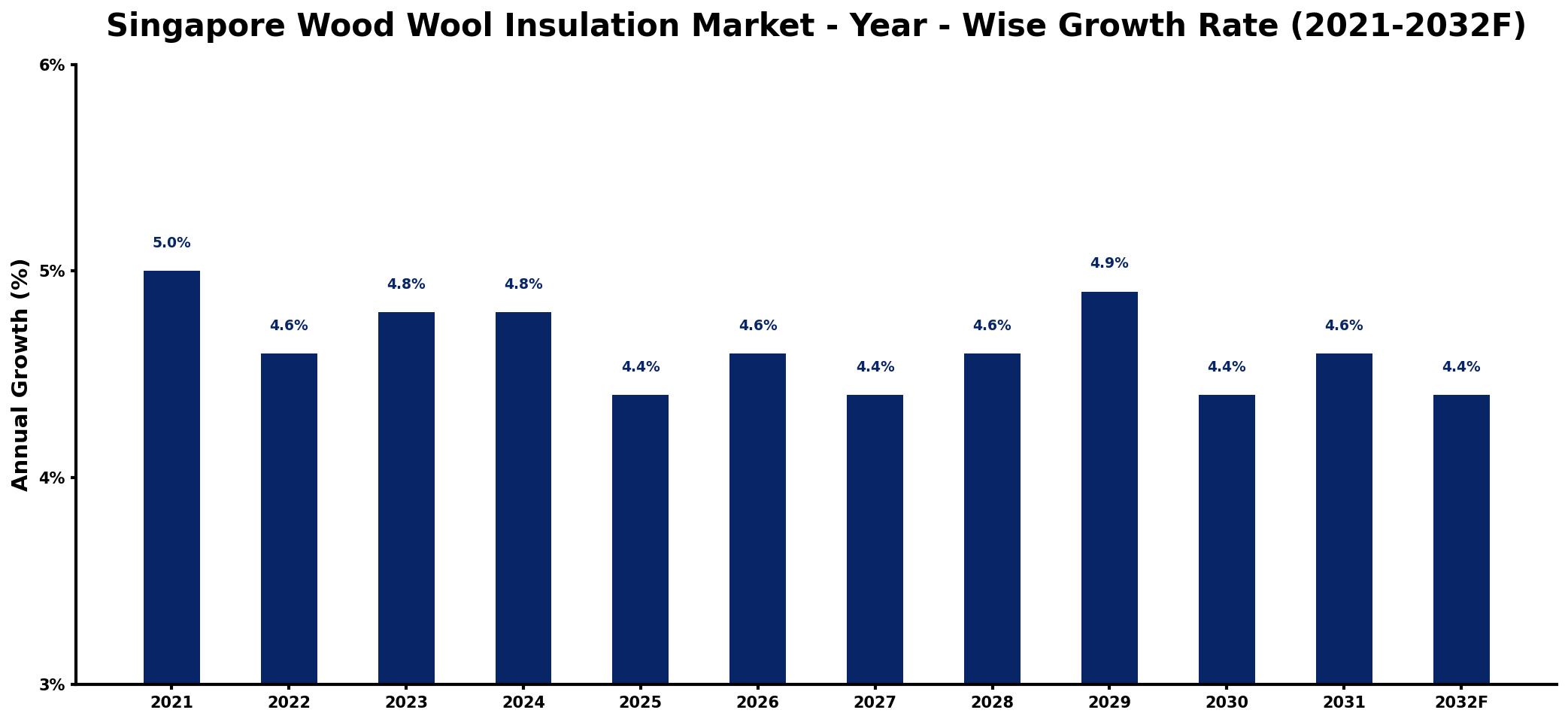
The table below presents the year‑wise growth rates along with the key drivers influencing the market
| Year | Growth Rate | Major Drivers |
| 2021 | 5.0% | Rising construction sector activities |
| 2022 | 4.6% | Increased focus on sustainability |
| 2023 | 4.8% | Growing awareness of energy efficiency |
| 2024 | 4.8% | Expansion of green building initiatives |
| 2025 | 4.4% | Higher investments in eco-friendly materials |
| 2026 | 4.6% | Demand from residential projects |
| 2027 | 4.4% | Regulatory support for renewable solutions |
| 2028 | 4.6% | Surge in commercial sector projects |
| 2029 | 4.9% | Technological advancements in materials |
| 2030 | 4.4% | Growing preference for natural products |
| 2031 | 4.6% | Increased renovation and retrofitting projects |
| 2032 | 4.4% | Heightened awareness of climate change |
Note: Market size estimations and growth projections presented in this report are based on 6Wresearch's proprietary forecasting methodology, utilizing the latest available industry data, government publications, and primary research inputs.
Singapore Wood Wool Insulation Market Synopsis
Wood wool insulation in Singapore serves not just as an effective thermal barrier but also significantly enhances acoustic comfort in residential and commercial spaces. The materials natural composition aligns seamlessly with the countrys growing commitment to sustainability, making it a preferred choice for green building projects.
As urbanization accelerates and construction projects multiply, wood wool insulations unique properties are being recognized. Its ability to regulate indoor temperatures efficiently while reducing noise pollution offers a compelling case for architects and builders seeking innovative materials in the bustling Singaporean market.
Singapore Wood Wool Insulation Market Key Takeaways
- The growing focus on sustainability in construction is a primary driver of market growth.
- Wood wool insulation provides excellent thermal and acoustic properties, making it ideal for varied applications.
- Compliance with evolving building codes and fire safety regulations is critical for manufacturers in this space.
- The COVID-19 pandemic temporarily disrupted the market, but recovery is underway with renewed construction efforts.
- Leading companies are focusing on enhancing the ecological benefits of their products to resonate with environmentally conscious consumers.
Evaluation of Restraints in Singapore Wood Wool Insulation Market
Despite the positive outlook, the market faces several restraints, including stringent thermal efficiency standards and evolving fire safety regulations. Manufacturers must navigate these challenges while ensuring their products not only meet compliance but also deliver on performance expectations. The need for sustainable materials can also limit options for insulation, as stakeholders increasingly prioritize environmentally-friendly solutions. This landscape demands that players in the market remain agile and adaptive, aligning with regulatory developments while emphasizing the long-term benefits of wood wool insulation.
Singapore Wood Wool Insulation Market Trends
The trend towards sustainable construction materials continues to rise, with wood wool insulation at the forefront. Innovations in manufacturing processes are enhancing the performance characteristics of this insulation type, making it more competitive against synthetic alternatives. Theres also an increasing emphasis on lifecycle analysis, helping builders make informed decisions based on the environmental impact of materials used. Furthermore, as the smart building movement grows, integrating advanced building technologies with wood wool insulation offers significant potential for improved energy efficiency.
Singapore Wood Wool Insulation Market Opportunities
Significant growth opportunities lie within government-funded green building initiatives and retrofitting projects in Singapore. As the country aims to achieve ambitious carbon reduction goals, the adoption of eco-friendly insulation materials is becoming essential. Additionally, expanding collaborations between architects, builders, and insulation manufacturers can foster innovation and create tailored solutions that address specific market needs. Engaging in research and development to enhance the functionality of wood wool insulation could also unveil new markets within the region.
Government Initiatives in the Singapore Wood Wool Insulation Market
The Singaporean government has launched various programs aimed at promoting sustainable building practices, which include incentives for using green materials like wood wool insulation. Public spending on infrastructure development and renovations is increasingly focused on reducing carbon footprints, thus encouraging the integration of energy-efficient insulation solutions in construction projects. These initiatives underline a robust commitment to enhancing building sustainability standards and fostering innovation in the building materials sector.
Future Insights of the Singapore Wood Wool Insulation Market
Looking ahead to 2026-2032, the Singapore Wood Wool Insulation Market is set to experience substantial growth, driven by the convergence of eco-conscious consumer preferences and regulatory support for sustainable building practices. Increasing urban density will prompt developers to prioritize space-saving, efficient insulation solutions. As technological advancements in manufacturing continue to improve the cost-effectiveness and application of wood wool insulation, it will likely become a staple in both new builds and renovations. This trajectory positions wood wool insulation not just as a viable alternative, but as a crucial component in Singapores sustainable construction landscape.
Singapore Wood Wool Insulation Market Latest Developments (2025 - 2026)
Recent trends indicate a shift towards more innovative applications of wood wool insulation, especially in high-rise buildings and commercial spaces. Manufacturers are exploring advanced formulations to enhance performance, particularly in areas of fire resistance and thermal efficiency. As the market landscape evolves, strategic partnerships and collaborations are on the rise, with companies working together to create bespoke insulation solutions that meet specific architectural and engineering challenges.
Singapore Wood Wool Insulation Market - Key Attractiveness of the Report
- 10 Years of Market Numbers
- Historical Data Starting from 2022 to 2025
- Base Year: 2025
- Forecast Data until 2032
- Key Performance Indicators Impacting the Market
- Major Upcoming Developments and Projects
Key Highlights of the Report:
- Singapore Wood Wool Insulation Market Outlook
- Market Size of Singapore Wood Wool Insulation Market, 2025
- Forecast of Singapore Wood Wool Insulation Market, 2032
- Historical Data and Forecast of Singapore Wood Wool Insulation Revenues & Volume for the Period 2022-2032F
- Singapore Wood Wool Insulation Market Trend Evolution
- Singapore Wood Wool Insulation Market Drivers and Challenges
- Singapore Wood Wool Insulation Price Trends
- Singapore Wood Wool Insulation Porter's Five Forces
- Singapore Wood Wool Insulation Industry Life Cycle
- Historical Data and Forecast of Singapore Wood Wool Insulation Market Revenues & Volume By Product Type for the Period 2022-2032F
- Historical Data and Forecast of Singapore Wood Wool Insulation Market Revenues & Volume By Stable for the Period 2022-2032F
- Historical Data and Forecast of Singapore Wood Wool Insulation Market Revenues & Volume By Flexible for the Period 2022-2032F
- Historical Data and Forecast of Singapore Wood Wool Insulation Market Revenues & Volume By Application for the Period 2022-2032F
- Historical Data and Forecast of Singapore Wood Wool Insulation Market Revenues & Volume By Thermal Insulation for the Period 2022-2032F
- Historical Data and Forecast of Singapore Wood Wool Insulation Market Revenues & Volume By Acoustic Insulation for the Period 2022-2032F
- Historical Data and Forecast of Singapore Wood Wool Insulation Market Revenues & Volume By Electrical Insulation for the Period 2022-2032F
- Singapore Wood Wool Insulation Import Export Trade Statistics
- Market Opportunity Assessment By Product Type
- Market Opportunity Assessment By Application
- Singapore Wood Wool Insulation Top Companies Market Share
- Singapore Wood Wool Insulation Competitive Benchmarking By Technical and Operational Parameters
- Singapore Wood Wool Insulation Company Profiles
- Singapore Wood Wool Insulation Key Strategic Recommendations






































