Singapore Wooden Packaging Market Size, Share & Growth Rate
The Singapore Wooden Packaging Market was estimated at USD 271 Million in 2025 and is projected to reach USD 382 Million by 2032, growing at a CAGR of 5.0% from 2026 to 2032. This growth trajectory is primarily driven by Singapore's robust logistics and shipping sectors, which continue to flourish as the nation strengthens its position as a key trade hub in Asia. The increasing demand for durable and secure packaging solutions from various industries, particularly e-commerce, underlines the essential role that wooden packaging plays in facilitating safe product transportation and storage.
Singapore Wooden Packaging Market Year-wise Growth Rate and Key Drivers
This graph highlights how the Singapore Wooden Packaging Market has steadily grown over the years, supported by major growth factors.
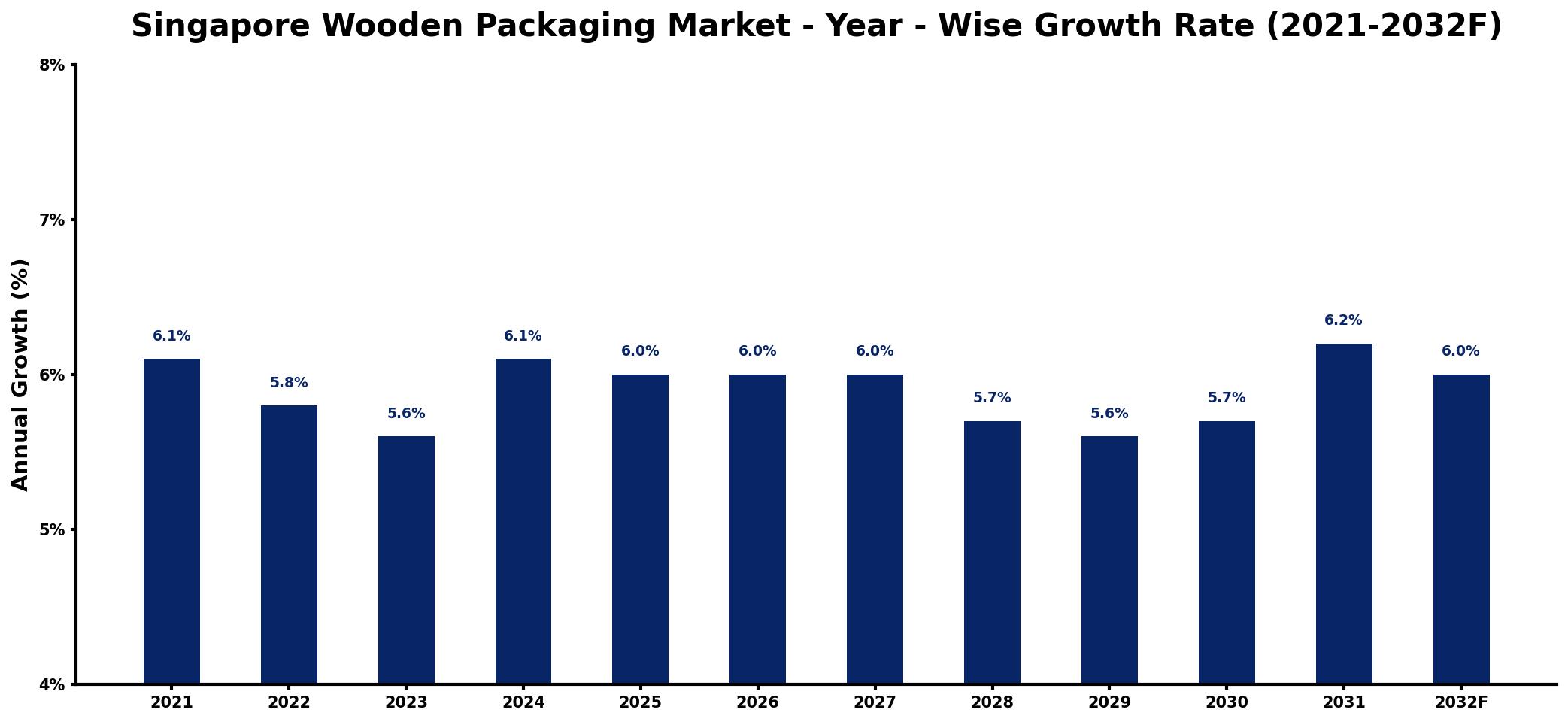
The table below presents the year‑wise growth rates along with the key drivers influencing the market
| Year | Growth Rate | Major Drivers |
| 2021 | 6.1% | Rising e-commerce sales volumes |
| 2022 | 5.8% | Increased exports from manufacturing |
| 2023 | 5.6% | Growing demand from logistics sector |
| 2024 | 6.1% | Expansion of retail distribution networks |
| 2025 | 6.0% | Surge in sustainable sourcing initiatives |
| 2026 | 6.0% | Investments in green technologies |
| 2027 | 6.0% | Strengthening local supply chains |
| 2028 | 5.7% | Emergence of new industry players |
| 2029 | 5.6% | Enhanced focus on export markets |
| 2030 | 5.7% | Growth in online grocery services |
| 2031 | 6.2% | Increased collaborations with retailers |
| 2032 | 6.0% | Rising consumer preference for sustainability |
Note: Market size estimations and growth projections presented in this report are based on 6Wresearch's proprietary forecasting methodology, utilizing the latest available industry data, government publications, and primary research inputs.
Singapore Wooden Packaging Market Synopsis
In Singapore, wooden packaging, such as crates, pallets, and boxes, is integral to the logistics and shipping industries. As a trade hub, the city-state's reliance on effective packaging solutions continues to grow, reflecting the evolving needs of businesses involved in domestic and international trade.
The market for wooden packaging is characterized by its adaptability to changing consumer preferences and regulatory requirements. In recent years, manufacturers have started incorporating sustainable practices, aligning their products with increasing environmental consciousness among consumers and businesses alike.
Singapore Wooden Packaging Market Key Takeaways
- The market is poised for growth, fueled by the expanding logistics, shipping, and e-commerce sectors in Singapore.
- Companies are increasingly focusing on sustainable packaging solutions to meet environmental regulations and consumer demand.
- There is a growing trend towards customization of wooden packaging products to cater to specific client needs.
- Wooden packaging plays a critical role in ensuring the safe transport and storage of a diverse range of goods.
- Ongoing advancements in manufacturing processes are enhancing the durability and functionality of wooden packaging materials.
Evaluation of Restraints in Singapore Wooden Packaging Market
Despite the promising growth, the Singapore Wooden Packaging Market is confronted with several restraints that could impede progress. The increasing emphasis on sustainability has led to heightened scrutiny over sourcing practices, compelling manufacturers to adopt responsible forestry techniques. Moreover, compliance with international shipping regulations poses a challenge, as stringent guidelines on packaging materials and treatments are enforced. Additionally, the demand for eco-friendly packaging materials creates pressure on the wooden packaging sector to innovate while maintaining affordability. These factors necessitate strategic adaptations within the industry to ensure long-term viability and competitiveness.
Singapore Wooden Packaging Market Trends
Several trends are shaping the landscape of the Singapore Wooden Packaging Market. One significant trend is the increasing demand for customized wooden packaging solutions that cater to unique shipping and storage requirements. Companies are also leaning towards incorporating technology in packaging design, enhancing both functionality and sustainability. Furthermore, the rise of eco-conscious consumers is prompting a shift towards the use of responsibly sourced and recyclable wooden materials, thereby fostering a market that prioritizes sustainability. The ongoing integration of automated manufacturing processes is another trend, as it streamlines production and reduces operational costs.
Singapore Wooden Packaging Market Opportunities
The Singapore Wooden Packaging Market presents numerous growth and investment opportunities, particularly for businesses willing to innovate. Companies focusing on developing biodegradable and recyclable packaging solutions stand to gain a competitive advantage. Additionally, partnerships with e-commerce businesses can open new revenue streams, as the demand for customized and secure packaging continues to rise. Investments in advanced manufacturing technologies also hold potential for enhancing efficiency and sustainability, ultimately benefiting both producers and consumers in the long run.
Government Initiatives in the Singapore Wooden Packaging Market
The Singapore government has implemented various initiatives to promote sustainable practices within the packaging sector, including the adoption of eco-friendly materials. Public funding programs encourage research and development in innovative packaging solutions while regulatory frameworks are in place to ensure compliance with environmental standards. Additionally, the government collaborates with industry stakeholders to promote awareness of sustainability in packaging, thus creating a conducive environment for businesses operating in the wooden packaging market.
Future Insights of the Singapore Wooden Packaging Market
Looking ahead to 2026-2032, the Singapore Wooden Packaging Market is expected to evolve significantly. As sustainability becomes a central pillar of business operations, the industry will likely shift towards greener practices, with manufacturers investing in renewable materials and technologies. The market is projected to benefit from enhanced logistics infrastructure, further solidifying Singapore's status as a trade hub. Companies that adapt to consumer demands for innovative and sustainable solutions will find ample opportunities for growth, fostering a dynamic market landscape.
Singapore Wooden Packaging Market Latest Developments (2025 - 2026)
Recent industry developments indicate a push towards greater sustainability within the Singapore Wooden Packaging Market. A notable trend is the increasing collaboration among manufacturers to share best practices for responsible sourcing and production. Additionally, innovations in biodegradable wooden packaging solutions are gaining traction as companies seek to enhance their environmental credentials. The demand for customized packaging continues to rise, prompting manufacturers to invest in advanced technologies that cater to diverse client needs. Overall, the market is adapting swiftly to changes in consumer preferences and regulatory frameworks.
Singapore Wooden Packaging Market - Key Attractiveness of the Report
- 10 Years of Market Numbers
- Historical Data Starting from 2022 to 2025
- Base Year: 2025
- Forecast Data until 2032
- Key Performance Indicators Impacting the Market
- Major Upcoming Developments and Projects
Key Highlights of the Report:
- Singapore Wooden Packaging Market Outlook
- Market Size of Singapore Wooden Packaging Market, 2025
- Forecast of Singapore Wooden Packaging Market, 2032
- Historical Data and Forecast of Singapore Wooden Packaging Revenues & Volume for the Period 2022-2032F
- Singapore Wooden Packaging Market Trend Evolution
- Singapore Wooden Packaging Market Drivers and Challenges
- Singapore Wooden Packaging Price Trends
- Singapore Wooden Packaging Porter's Five Forces
- Singapore Wooden Packaging Industry Life Cycle
- Historical Data and Forecast of Singapore Wooden Packaging Market Revenues & Volume By Type for the Period 2022-2032F
- Historical Data and Forecast of Singapore Wooden Packaging Market Revenues & Volume By Pallets for the Period 2022-2032F
- Historical Data and Forecast of Singapore Wooden Packaging Market Revenues & Volume By Boxes and Bins for the Period 2022-2032F
- Historical Data and Forecast of Singapore Wooden Packaging Market Revenues & Volume By Crates and Cases for the Period 2022-2032F
- Historical Data and Forecast of Singapore Wooden Packaging Market Revenues & Volume By Spools for the Period 2022-2032F
- Historical Data and Forecast of Singapore Wooden Packaging Market Revenues & Volume By Dunnage for the Period 2022-2032F
- Historical Data and Forecast of Singapore Wooden Packaging Market Revenues & Volume By Others for the Period 2022-2032F
- Historical Data and Forecast of Singapore Wooden Packaging Market Revenues & Volume By Application for the Period 2022-2032F
- Historical Data and Forecast of Singapore Wooden Packaging Market Revenues & Volume By Food & Beverages Storage for the Period 2022-2032F
- Historical Data and Forecast of Singapore Wooden Packaging Market Revenues & Volume By Transportation for the Period 2022-2032F
- Historical Data and Forecast of Singapore Wooden Packaging Market Revenues & Volume By Industrial for the Period 2022-2032F
- Historical Data and Forecast of Singapore Wooden Packaging Market Revenues & Volume By Shipping for the Period 2022-2032F
- Historical Data and Forecast of Singapore Wooden Packaging Market Revenues & Volume By Others for the Period 2022-2032F
- Singapore Wooden Packaging Import Export Trade Statistics
- Market Opportunity Assessment By Type
- Market Opportunity Assessment By Application
- Singapore Wooden Packaging Top Companies Market Share
- Singapore Wooden Packaging Competitive Benchmarking By Technical and Operational Parameters
- Singapore Wooden Packaging Company Profiles
- Singapore Wooden Packaging Key Strategic Recommendations






































