Singapore Wool Market Size, Share & Growth Rate
The Singapore Wool Market was estimated at USD 252 Million in 2025 and is projected to reach USD 345 Million by 2032, growing at a CAGR of 4.6% from 2026 to 2032. This growth is driven primarily by increasing consumer awareness regarding sustainable fashion and the demand for versatile clothing that fits both seasonal shifts and the tropical climate. As travel resumes, there is also a notable uptick in demand for wool garments among tourists seeking comfortable and high-quality fabrics.
Singapore Wool Market Year-wise Growth Rate and Key Drivers
This graph highlights how the Singapore Wool Market has steadily grown over the years, supported by major growth factors.
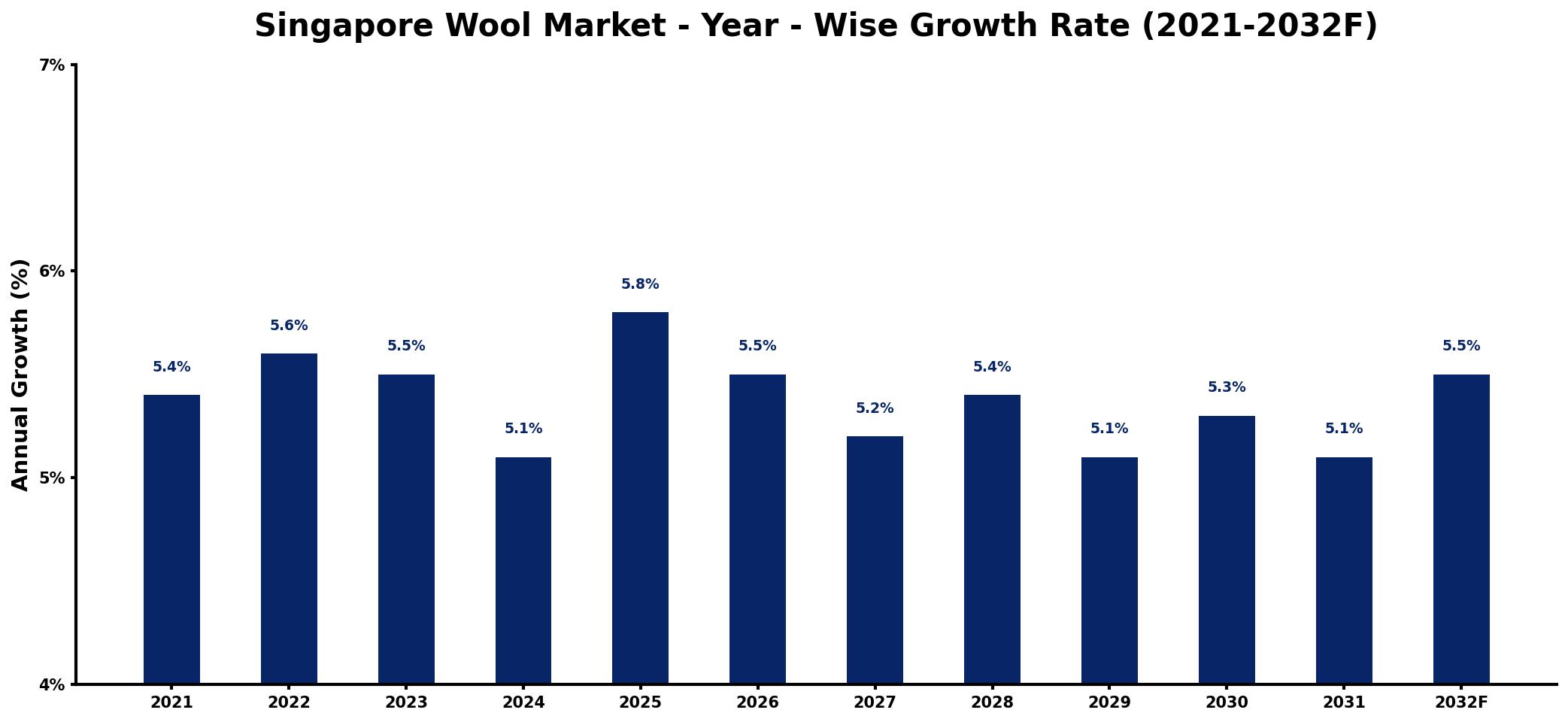
The table below presents the year‑wise growth rates along with the key drivers influencing the market
| Year | Growth Rate | Major Drivers |
| 2021 | 5.4% | Rising consumer interest in sustainability |
| 2022 | 5.6% | Increased investments in textile innovation |
| 2023 | 5.5% | Growing demand for luxury apparel |
| 2024 | 5.1% | Expansion of eco-friendly fashion brands |
| 2025 | 5.8% | Higher exports to Asian markets |
| 2026 | 5.5% | Surge in online retail platforms |
| 2027 | 5.2% | Development of advanced textile technologies |
| 2028 | 5.4% | Increase in fashion collaborations |
| 2029 | 5.1% | Emergence of ethical fashion trends |
| 2030 | 5.3% | Growth in performance apparel sector |
| 2031 | 5.1% | Boost in artisan craftsmanship appreciation |
| 2032 | 5.5% | Rising popularity of sustainable living |
Note: Market size estimations and growth projections presented in this report are based on 6Wresearch's proprietary forecasting methodology, utilizing the latest available industry data, government publications, and primary research inputs.
Singapore Wool Market Synopsis
The strongest force currently shaping the Singapore wool market is the growing consumer demand for sustainable and ethically produced products. As environmentally conscious choices become more significant, brands focusing on sustainable sourcing and processing are likely to thrive. Furthermore, the influence of international fashion trends continues to drive interest in innovative wool blends that cater to local climate conditions.
Despite Singapore's tropical climate limiting the usage of pure wool, there remains a consistent demand for wool products during cooler months and among tourists. Market dynamics are heavily influenced by the retail sector's vibrancy, with international fashion brands actively contributing to the demand for high-quality wool textiles.
Singapore Wool Market Key Takeaways
- The market is projected to grow from USD 252 Million in 2025 to USD 345 Million by 2032.
- Sustainable and ethically produced wool products are gaining traction among consumers.
- Seasonal demand and fashion trends are significant drivers of market growth.
- Versatile wool blends are increasingly preferred to cater to Singapore's climate.
- International brands play a crucial role in stimulating market demand.
Evaluation of Restraints in Singapore Wool Market
While the Singapore wool market shows promising growth, it grapples with several restraints. Volatile wool prices pose a significant challenge, impacting the cost structures for manufacturers and retailers. Import competition from synthetic textiles and other natural fibers complicates market positioning. Additionally, rising concerns regarding animal welfare and the environmental impact of wool processing raise questions among consumers, creating pressure on companies to adopt more transparent and ethical practices in their supply chains.
Singapore Wool Market Trends
Current trends in the Singapore wool market reflect a shift toward multifunctional designs that merge style with practicality. The influence of sustainability continues to shape consumer preferences, leading to a heightened interest in biodegradable and recyclable materials. Furthermore, technological advancements in fabric treatment and blending techniques are enabling the production of lighter, breathable wool fabrics suitable for tropical conditions. Fashion cycles are also seeing increased collaboration between local designers and international brands, making wool a more appealing choice for fashion-forward consumers.
Singapore Wool Market Opportunities
The opportunities within the Singapore wool market are abundant, particularly in the realm of sustainable fashion. Companies focusing on innovative wool blends that cater to local climate and seasonal fluctuations can capture a growing consumer base. Additionally, the burgeoning interest in travel, especially post-pandemic, presents a chance for wool apparel brands to tap into the tourist demographic. Collaboration with local designers and participation in fashion events can also bolster brand visibility and market share.
Government Initiatives in the Singapore Wool Market
The Singapore government is actively promoting sustainable practices across various industries, including textiles. Initiatives aimed at encouraging environmentally friendly production methods and supporting local designers can positively impact the wool market. Additionally, public spending in fashion and retail sectors fosters innovation and encourages international brands to establish a presence in Singapore, further stimulating market growth.
Future Insights of the Singapore Wool Market
Looking ahead to 2026-2032, the Singapore wool market is likely to experience sustained growth as consumer preferences shift more decisively toward sustainable and ethical products. The integration of technology into the wool production process will facilitate innovations in product design and functionality, further aligning with consumer demands. As the market rebounds post-COVID, the anticipated increase in travel and tourism will create additional demand, particularly for premium wool products. Overall, the trajectory appears promising as brands adapt to the evolving landscape of consumer expectations.
Singapore Wool Market Latest Developments (2025 - 2026)
In recent months, the Singapore wool market has witnessed a marked increase in collaboration between local fashion designers and international brands, amplifying the appeal of wool textiles. Additionally, several initiatives focused on sustainability have emerged, encouraging brands to adopt more transparent sourcing and processing practices. Retailers are also exploring innovative marketing strategies to highlight the advantages of wool products, particularly during cooler months, thereby enhancing consumer engagement.
Singapore Wool Market - Key Attractiveness of the Report
- 10 Years of Market Numbers
- Historical Data Starting from 2022 to 2025
- Base Year: 2025
- Forecast Data until 2032
- Key Performance Indicators Impacting the Market
- Major Upcoming Developments and Projects
Key Highlights of the Report:
- Singapore Wool Market Outlook
- Market Size of Singapore Wool Market, 2025
- Forecast of Singapore Wool Market, 2032
- Historical Data and Forecast of Singapore Wool Revenues & Volume for the Period 2022-2032F
- Singapore Wool Market Trend Evolution
- Singapore Wool Market Drivers and Challenges
- Singapore Wool Price Trends
- Singapore Wool Porter's Five Forces
- Singapore Wool Industry Life Cycle
- Historical Data and Forecast of Singapore Wool Market Revenues & Volume By Source for the Period 2022-2032F
- Historical Data and Forecast of Singapore Wool Market Revenues & Volume By Merino Wool for the Period 2022-2032F
- Historical Data and Forecast of Singapore Wool Market Revenues & Volume By Peruvian Highland Wool for the Period 2022-2032F
- Historical Data and Forecast of Singapore Wool Market Revenues & Volume By Teeswater Wool for the Period 2022-2032F
- Historical Data and Forecast of Singapore Wool Market Revenues & Volume By Shetland Wool for the Period 2022-2032F
- Historical Data and Forecast of Singapore Wool Market Revenues & Volume By Cashmere Wool for the Period 2022-2032F
- Historical Data and Forecast of Singapore Wool Market Revenues & Volume By others for the Period 2022-2032F
- Historical Data and Forecast of Singapore Wool Market Revenues & Volume By Type for the Period 2022-2032F
- Historical Data and Forecast of Singapore Wool Market Revenues & Volume By Fine wool (? 25 ) for the Period 2022-2032F
- Historical Data and Forecast of Singapore Wool Market Revenues & Volume By Medium wool (25 to 35 ) for the Period 2022-2032F
- Historical Data and Forecast of Singapore Wool Market Revenues & Volume By Coarse wool (? 35 ) for the Period 2022-2032F
- Historical Data and Forecast of Singapore Wool Market Revenues & Volume By Application for the Period 2022-2032F
- Historical Data and Forecast of Singapore Wool Market Revenues & Volume By Apparels for the Period 2022-2032F
- Historical Data and Forecast of Singapore Wool Market Revenues & Volume By Interior Textiles for the Period 2022-2032F
- Singapore Wool Import Export Trade Statistics
- Market Opportunity Assessment By Source
- Market Opportunity Assessment By Type
- Market Opportunity Assessment By Application
- Singapore Wool Top Companies Market Share
- Singapore Wool Competitive Benchmarking By Technical and Operational Parameters
- Singapore Wool Company Profiles
- Singapore Wool Key Strategic Recommendations






































