Singapore Workforce Management Market Size & Growth Rate (2026-2032)
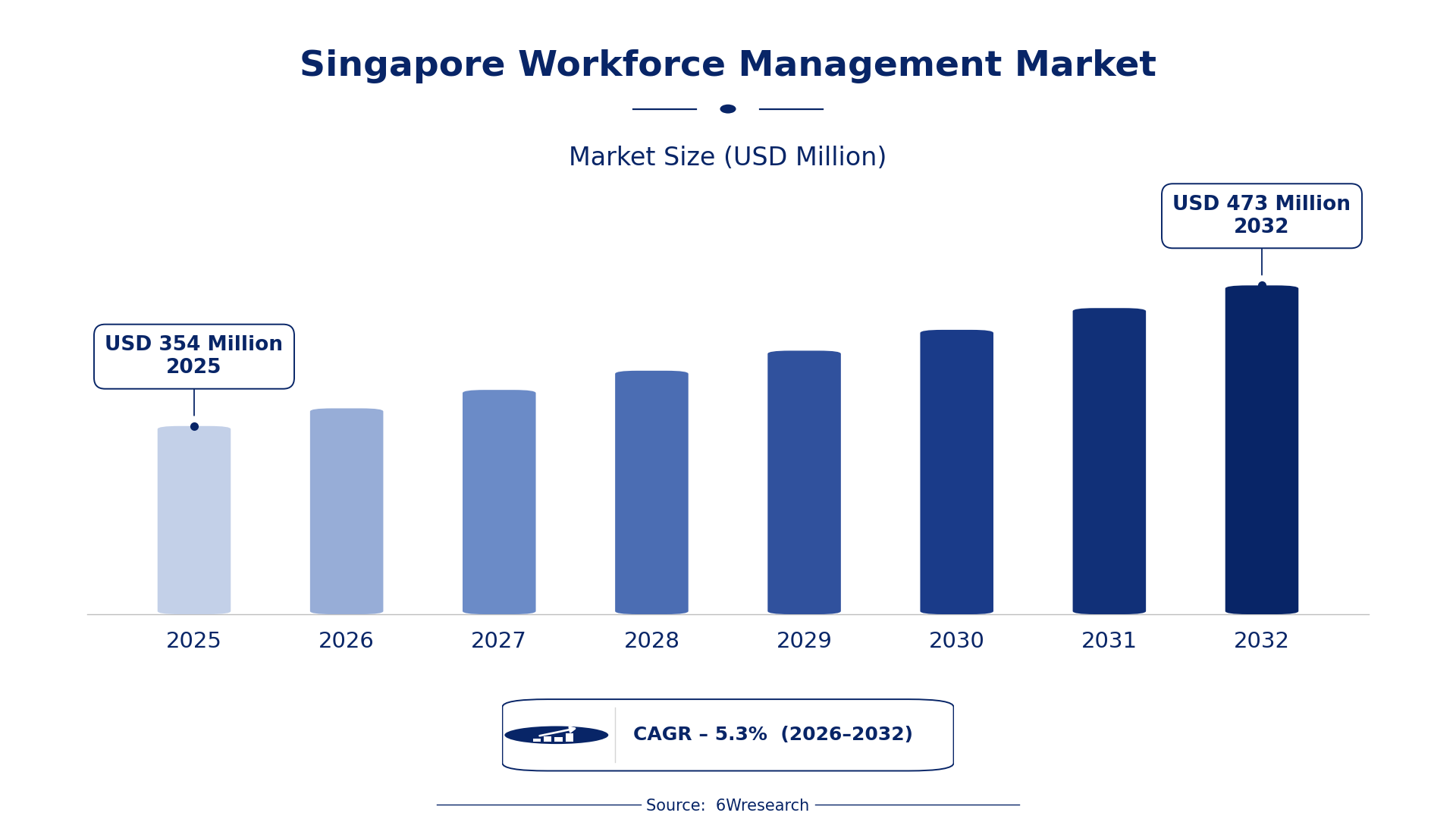
The Singapore Workforce Management Market was estimated at USD 354 Million in 2025 and is projected to reach USD 473 Million by 2032, growing at a CAGR of 5.3% from 2026 to 2032.
Singapore Workforce Management Market Synopsis
The Singapore Workforce Management Market is at a critical juncture, driven by the pressing need for operational efficiency and effective employee management. Organizations are increasingly adopting sophisticated solutions to enhance scheduling, attendance tracking, and performance evaluation, reflecting a shift towards data-driven decision-making.
As remote work and hybrid models become the norm, businesses are seeking tools that can adapt to these changes without sacrificing compliance and productivity. The market's evolution is not just about technology; it's also about reshaping workplace culture and employee engagement.
Singapore Workforce Management Market Year-wise Growth Rate and Key Drivers
This graph illustrates the annual growth rates of the Singapore Workforce Management Market from 2021 to 2032, highlighting a steady upward trajectory and projected expansion over the forecast period.
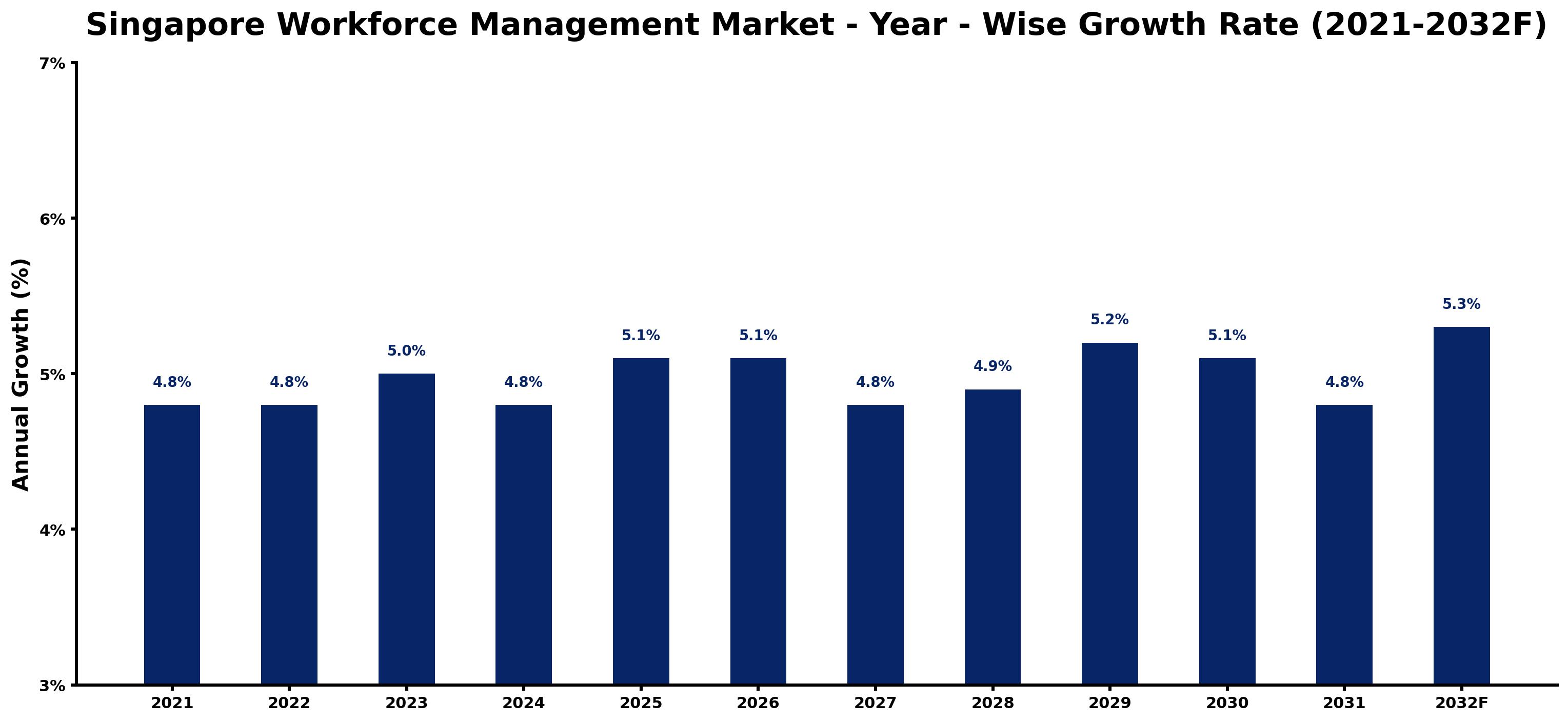
The table below presents the year‑wise growth rates along with the key drivers influencing the market
| Year | Growth Rate | Major Drivers |
| 2021 | 4.8% | SkillsFuture initiative boosting workforce upskilling efforts. |
| 2022 | 4.8% | Government grants incentivizing digital workforce management upgrades. |
| 2023 | 5.0% | Increased focus on employee well-being and work-life balance. |
| 2024 | 4.8% | Growing gig economy driving demand for flexible scheduling tools. |
| 2025 | 5.1% | Rise of remote work prompting enhanced workforce analytics needs. |
| 2026 | 5.1% | Integration of AI in HR processes improving efficiencies. |
| 2027 | 4.8% | Focus on diversity hiring driving recruitment management solutions. |
| 2028 | 4.9% | Emerging tech startups enhancing workforce flexibility solutions. |
| 2029 | 5.2% | Aging population increases demand for workforce planning tools. |
| 2030 | 5.1% | Regulatory changes promoting workplace inclusivity and accessibility. |
| 2031 | 4.8% | Government initiatives encouraging lifelong learning and talent retention. |
| 2032 | 5.3% | Increased data privacy regulations shaping workforce data management. |
Note: Market size estimations and growth projections presented in this report are based on 6Wresearch's proprietary forecasting methodology, utilizing the latest available industry data, government publications, and primary research inputs.
Singapore Workforce Management Market Key Takeaways
Below are some of the specific key takeaways from the market, including:
- Demand for workforce management solutions is driven by the need for improved productivity and operational efficiency.
- Companies are increasingly focusing on employee satisfaction as a key metric for success.
- Remote work has accelerated the adoption of digital workforce management tools.
- Compliance with labor regulations remains a top priority for organizations.
- Emerging technologies are reshaping the capabilities of workforce management solutions.
Evaluation of Restraints in Singapore Workforce Management Market
The Singapore Workforce Management Market faces notable constraints that can hinder its growth trajectory. One major issue is the challenge of integrating new solutions with existing systems, which can lead to disruptions during implementation. Additionally, organizations struggle with workforce optimization in the face of evolving work models, particularly as they adapt to hybrid and remote environments. Concerns over employee privacy and compliance with labor laws further complicate the landscape, as companies must ensure that their management practices respect individual rights while maximizing operational efficiency.
Singapore Workforce Management Market Trends
Several trends are currently shaping the Singapore Workforce Management Market. The rise of artificial intelligence and machine learning is leading to smarter scheduling and predictive analytics, allowing companies to anticipate labor needs more accurately. There is also a growing focus on employee engagement and well-being, with organizations recognizing that satisfied employees contribute to overall productivity. on top of that, the integration of mobile solutions is enabling on-the-go access for managers and employees alike, facilitating real-time updates and communication.
Singapore Workforce Management Market Opportunities
There are ample opportunities for growth within the Singapore Workforce Management Market, particularly in areas like advanced analytics and AI-driven insights. As businesses continue to transition to hybrid work models, demand for flexible, scalable solutions will rise. on top of that, industries such as healthcare and retail are increasingly looking for customized workforce solutions tailored to their specific needs, offering a ripe area for innovation and investment. Companies that can provide comprehensive, user-friendly platforms will likely capture significant market share.
Government Initiatives in the Singapore Workforce Management Market
The Singaporean government plays a crucial role in shaping the Workforce Management Market, promoting policies that enhance productivity while ensuring employee welfare. Current regulatory frameworks focus on encouraging digital transformation within organizations, which aligns with national priorities for economic growth and innovation. As such, government initiatives are increasingly focused on providing support for technology adoption and ensuring compliance with labor standards.
- A recently completed initiative aimed at enhancing digital infrastructure has provided organizations with the tools necessary for better workforce management.
- Currently ongoing is a public-private partnership designed to facilitate training programs for workforce management software, aimed at improving user competence and system integration.
- Planned for the upcoming years is a regulatory framework expected to mandate transparency in workforce management practices, promoting fair treatment and accountability.
- A national campaign focusing on employee wellness and engagement is in its initial phases, aiming to boost workplace morale across sectors.
Future Insights of the Singapore Workforce Management Market
Looking ahead to 2026-2032, the Singapore Workforce Management Market is expected to undergo significant transformation. With a continuous shift toward hybrid work environments, businesses will increasingly prioritize adaptable solutions that can cater to fluctuating workforce dynamics. The integration of emerging technologies such as AI and IoT will further enhance capabilities, leading to improved workforce analytics and management efficiency. As the market matures, organizations that invest in innovative solutions will be better positioned to thrive amidst evolving challenges.
Singapore Workforce Management Market Latest Developments
In the past year, the Singapore Workforce Management Market has seen a flurry of activity as companies seek to enhance their operations and adapt to changing workforce dynamics. The demand for advanced solutions has led to increased collaboration among technology providers and businesses aiming for streamlined implementation of workforce management systems. This trend reflects a growing recognition of the importance of effective workforce management in driving business success.
- A major technology vendor launched an upgraded workforce management platform in Q2 2025, incorporating advanced analytics features that allow for better forecasting.
- An initiative to integrate mobile access for workforce management tools began in early 2025 and remains ongoing, aimed at facilitating remote employee engagement.
- A recent partnership between a leading regional operator and a software provider was established to develop tailored solutions for the retail sector, set to launch by mid-2026.
- A new employee engagement program, focusing on mental health and wellness, is currently underway and expected to enhance retention rates.
Singapore Workforce Management Market - Key Attractiveness of the Report
- 10 Years of Market Numbers
- Historical Data Starting from 2022 to 2025
- Base Year: 2025
- Forecast Data until 2032
- Key Performance Indicators Impacting the Market
- Major Upcoming Developments and Projects
Key Highlights of the Report:
- Singapore Workforce Management Market Outlook
- Market Size of Singapore Workforce Management Market, 2025
- Forecast of Singapore Workforce Management Market, 2032
- Historical Data and Forecast of Singapore Workforce Management Revenues & Volume for the Period 2022-2032F
- Singapore Workforce Management Market Trend Evolution
- Singapore Workforce Management Market Drivers and Challenges
- Singapore Workforce Management Price Trends
- Singapore Workforce Management Porter's Five Forces
- Singapore Workforce Management Industry Life Cycle
- Historical Data and Forecast of Singapore Workforce Management Market Revenues & Volume By Solution for the Period 2022-2032F
- Historical Data and Forecast of Singapore Workforce Management Market Revenues & Volume By Time and Attendance Management for the Period 2022-2032F
- Historical Data and Forecast of Singapore Workforce Management Market Revenues & Volume By Leave and Absence Management for the Period 2022-2032F
- Historical Data and Forecast of Singapore Workforce Management Market Revenues & Volume By Workforce Scheduling for the Period 2022-2032F
- Historical Data and Forecast of Singapore Workforce Management Market Revenues & Volume By Workforce Analytics for the Period 2022-2032F
- Historical Data and Forecast of Singapore Workforce Management Market Revenues & Volume By Others for the Period 2022-2032F
- Historical Data and Forecast of Singapore Workforce Management Market Revenues & Volume By Component for the Period 2022-2032F
- Historical Data and Forecast of Singapore Workforce Management Market Revenues & Volume By Solutions for the Period 2022-2032F
- Historical Data and Forecast of Singapore Workforce Management Market Revenues & Volume By Services for the Period 2022-2032F
- Historical Data and Forecast of Singapore Workforce Management Market Revenues & Volume By Service for the Period 2022-2032F
- Historical Data and Forecast of Singapore Workforce Management Market Revenues & Volume By Consulting for the Period 2022-2032F
- Historical Data and Forecast of Singapore Workforce Management Market Revenues & Volume By Implementation for the Period 2022-2032F
- Historical Data and Forecast of Singapore Workforce Management Market Revenues & Volume By Training, Support and Maintenance for the Period 2022-2032F
- Historical Data and Forecast of Singapore Workforce Management Market Revenues & Volume By Deployment Type for the Period 2022-2032F
- Historical Data and Forecast of Singapore Workforce Management Market Revenues & Volume By On-Premises for the Period 2022-2032F
- Historical Data and Forecast of Singapore Workforce Management Market Revenues & Volume By Cloud for the Period 2022-2032F
- Historical Data and Forecast of Singapore Workforce Management Market Revenues & Volume By Organization Size for the Period 2022-2032F
- Historical Data and Forecast of Singapore Workforce Management Market Revenues & Volume By Large Enterprises for the Period 2022-2032F
- Historical Data and Forecast of Singapore Workforce Management Market Revenues & Volume By Small and Medium-sized Enterprises (SMEs) for the Period 2022-2032F
- Historical Data and Forecast of Singapore Workforce Management Market Revenues & Volume By Vertical for the Period 2022-2032F
- Historical Data and Forecast of Singapore Workforce Management Market Revenues & Volume By Banking, Financial Services and Insurance (BFSI) for the Period 2022-2032F
- Historical Data and Forecast of Singapore Workforce Management Market Revenues & Volume By Telecom for the Period 2022-2032F
- Historical Data and Forecast of Singapore Workforce Management Market Revenues & Volume By Government for the Period 2022-2032F
- Historical Data and Forecast of Singapore Workforce Management Market Revenues & Volume By Consumer Goods and Retail for the Period 2022-2032F
- Historical Data and Forecast of Singapore Workforce Management Market Revenues & Volume By Manufacturing for the Period 2022-2032F
- Historical Data and Forecast of Singapore Workforce Management Market Revenues & Volume By Energy and Utilities for the Period 2022-2032F
- Historical Data and Forecast of Singapore Workforce Management Market Revenues & Volume By Transportation and Logistics for the Period 2022-2032F
- Historical Data and Forecast of Singapore Workforce Management Market Revenues & Volume By Healthcare and Life Sciences for the Period 2022-2032F
- Singapore Workforce Management Import Export Trade Statistics
- Market Opportunity Assessment By Solution
- Market Opportunity Assessment By Component
- Market Opportunity Assessment By Service
- Market Opportunity Assessment By Deployment Type
- Market Opportunity Assessment By Organization Size
- Market Opportunity Assessment By Vertical
- Singapore Workforce Management Top Companies Market Share
- Singapore Workforce Management Competitive Benchmarking By Technical and Operational Parameters
- Singapore Workforce Management Company Profiles
- Singapore Workforce Management Key Strategic Recommendations






































