Singapore Workplace Safety Market Size & Growth Rate (2026-2032)
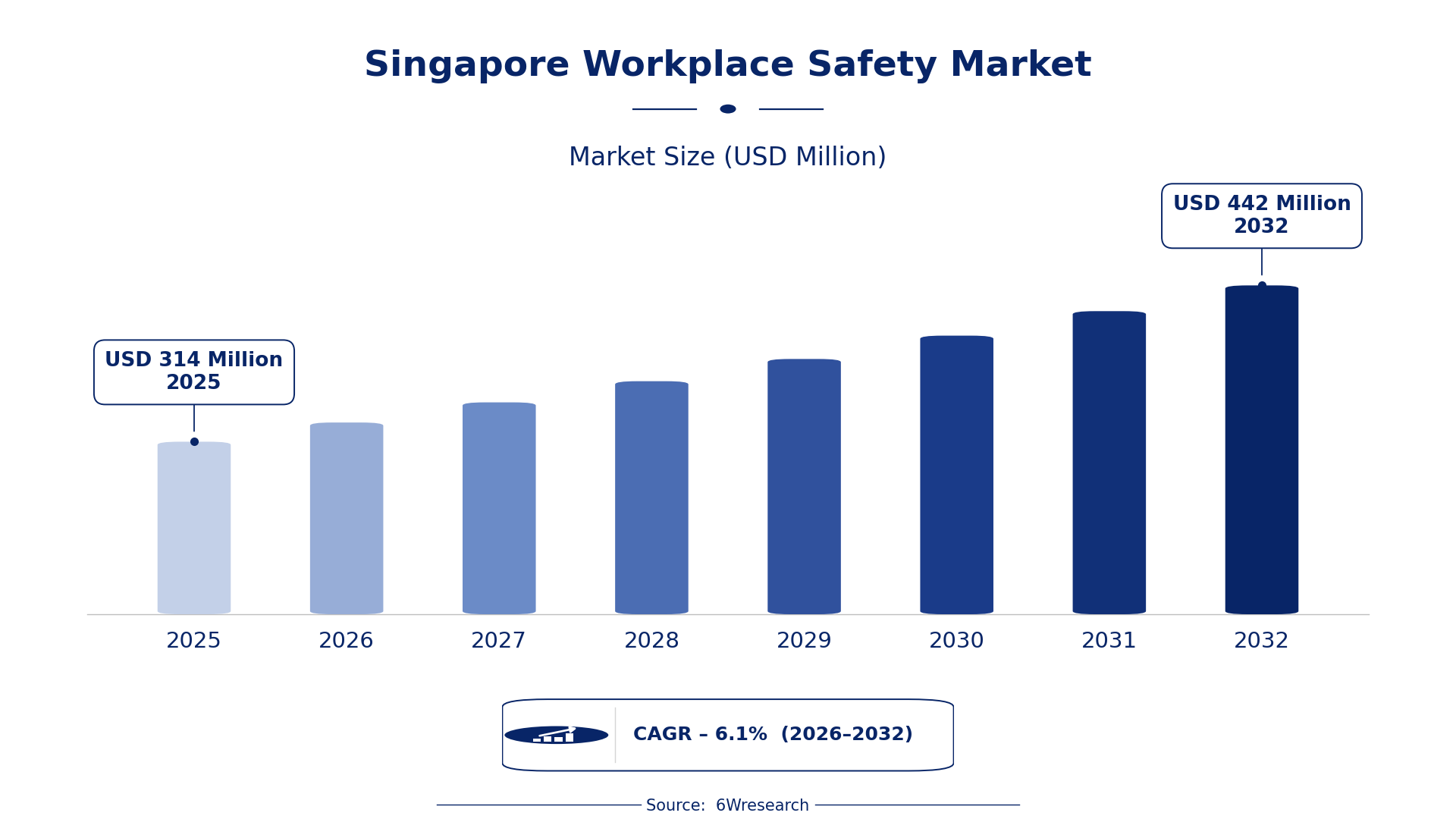
The Singapore Workplace Safety Market was estimated at USD 314 Million in 2025 and is projected to reach USD 442 Million by 2032, growing at a CAGR of 6.1% from 2026 to 2032.
Singapore Workplace Safety Market Synopsis
The driving force behind the Singapore Workplace Safety Market is the unwavering commitment to employee well-being and regulatory compliance. As businesses recognize the necessity of creating safe environments, the market is witnessing a marked rise in investments aimed at minimizing workplace hazards.
In Singapore, government initiatives further amplify the focus on workplace safety, compelling organizations to adhere to stringent regulations. As companies adapt to a culture of safety, they’re increasingly turning to advanced technologies that not only enhance safety measures but also streamline compliance processes.
Singapore Workplace Safety Market Year-wise Growth Rate and Key Drivers
This graph illustrates the annual growth rates of the Singapore Workplace Safety Market from 2021 to 2032, highlighting a steady upward trajectory and projected expansion over the forecast period.
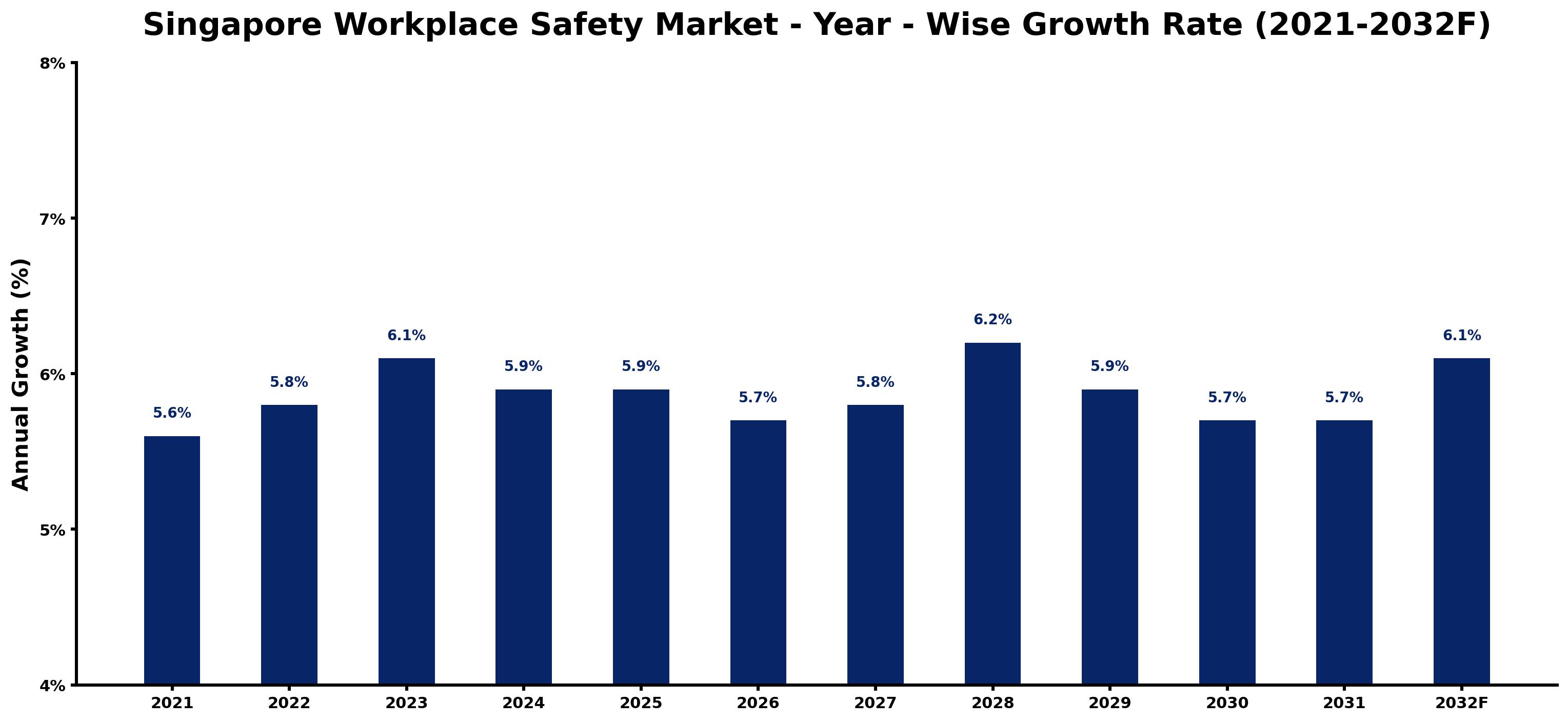
The table below presents the year‑wise growth rates along with the key drivers influencing the market
| Year | Growth Rate | Major Drivers |
| 2021 | 5.6% | Stricter Ministry of Manpower enforcement actions implemented. |
| 2022 | 5.8% | Increased focus on ergonomic workplace safety initiatives. |
| 2023 | 6.1% | Government-funded training programs for safety compliance launched. |
| 2024 | 5.9% | Enhanced safety regulations for construction workers established. |
| 2025 | 5.9% | Rise in construction due to Singapore’s housing demands. |
| 2026 | 5.7% | Local companies adopt advanced safety management systems. |
| 2027 | 5.8% | Increased public awareness of workplace safety issues. |
| 2028 | 6.2% | Technology integration in safety protocols accelerated. |
| 2029 | 5.9% | Corporate sponsorship for safety awareness campaigns increased. |
| 2030 | 5.7% | Sustainability requirements drive safety innovations in industries. |
| 2031 | 5.7% | Emphasis on mental health in workplace safety initiatives. |
| 2032 | 6.1% | New workplace safety standards introduced by local authorities. |
Note: Market size estimations and growth projections presented in this report are based on 6Wresearch's proprietary forecasting methodology, utilizing the latest available industry data, government publications, and primary research inputs.
Singapore Workplace Safety Market Key Takeaways
Below are some of the specific key takeaways from the market, including:
- The market is heavily influenced by stringent regulatory frameworks and a proactive approach from employers to ensure worker safety.
- Investment in advanced safety technologies, such as IoT and AI, is on the rise, enhancing overall workplace safety management.
- The COVID-19 pandemic acted as a catalyst for innovation in workplace safety solutions, accelerating the adoption of tech-driven measures.
- Government regulations are becoming more rigorous, requiring organizations to adapt quickly to new compliance standards.
- Ongoing training and development programs are critical for fostering a safety culture within organizations.
Evaluation of Restraints in Singapore Workplace Safety Market
Despite the positive momentum, the Singapore Workplace Safety Market faces notable challenges. Rapid changes in safety regulations, particularly in response to health crises, complicate compliance efforts for many organizations. Furthermore, the ongoing need for continual training and investment in updated technologies places a strain on resources. Businesses often grapple with balancing operational costs while striving to maintain safe environments.
Singapore Workplace Safety Market Trends
Several key trends are shaping the demand for safety solutions in Singapore. The integration of smart technologies such as wearable safety devices and real-time monitoring systems is gaining traction, significantly enhancing situational awareness. A notable shift towards psychological safety is emerging, highlighting the mental health aspects of workplace safety alongside physical protections. This evolving focus is prompting companies to invest more in holistic safety strategies.
Singapore Workplace Safety Market Opportunities
The current environment presents various opportunities for growth in the Singapore Workplace Safety Market. Companies are increasingly seeking partnerships with tech providers to create customized safety solutions. There’s also a burgeoning demand for training programs that focus on both compliance and culture-building. As organizations place greater emphasis on employee engagement and well-being, innovative safety products and services are well-positioned to capture market share.
Government Initiatives in the Singapore Workplace Safety Market
Government policies play a critical role in shaping the Singapore Workplace Safety Market. With a strong focus on enhancing workplace safety standards, regulatory bodies are continually introducing new measures to protect workers across various sectors. This proactive stance not only encourages compliance but also fosters a culture of safety that permeates throughout industries.
- A recently completed review of the Workplace Safety and Health Act has introduced stricter compliance deadlines for safety reporting.
- Currently underway is the rollout of a national training initiative aimed at upskilling workers in safety protocols, expected to reach thousands of employees by the end of 2025.
- There’s a planned government campaign set for 2027 that will focus on promoting mental health awareness in conjunction with traditional safety measures.
- The Ministry of Manpower is developing an online platform for safety training resources, anticipated to be launched in early 2026.
- An ongoing public-private partnership initiative is enhancing safety monitoring systems in high-risk industries, with pilot projects expected to be completed by mid-2026.
Future Insights of the Singapore Workplace Safety Market
As we look ahead to 2026-2032, the Singapore Workplace Safety Market is anticipated to experience substantial evolution. The increasing integration of technology will redefine safety measures, with organizations prioritizing data-driven decision-making to enhance compliance and risk management. The emerging trends focusing on mental health will also dictate how safety programs are designed, ensuring a more comprehensive approach to workforce well-being.
Singapore Workplace Safety Market Latest Developments
In the last year, the Singapore Workplace Safety Market has been characterized by dynamic advancements in safety technology and regulatory shifts. Companies are rapidly adopting new tools to adapt to evolving health standards. Initiatives aimed at increasing awareness and compliance have also gained traction, underscoring the market's response to contemporary challenges.
- A major technology vendor launched an advanced workplace monitoring system in early 2025, which utilizes AI to predict and prevent safety incidents.
- An ongoing collaboration between leading safety firms and the government aims to enhance training programs, with initial workshops already in progress.
- By mid-2026, a planned series of public seminars will address emerging safety challenges, with a focus on regulatory compliance.
- In Q3 2025, a prominent safety equipment provider introduced a new line of ergonomic protective gear designed for enhanced comfort and usability.
- A regional operator is currently developing a comprehensive digital safety management platform, with rollout expected by early 2026.
Singapore Workplace Safety Market - Key Attractiveness of the Report
- 10 Years of Market Numbers
- Historical Data Starting from 2022 to 2025
- Base Year: 2025
- Forecast Data until 2032
- Key Performance Indicators Impacting the Market
- Major Upcoming Developments and Projects
Key Highlights of the Report:
- Singapore Workplace Safety Market Outlook
- Market Size of Singapore Workplace Safety Market, 2025
- Forecast of Singapore Workplace Safety Market, 2032
- Historical Data and Forecast of Singapore Workplace Safety Revenues & Volume for the Period 2022-2032F
- Singapore Workplace Safety Market Trend Evolution
- Singapore Workplace Safety Market Drivers and Challenges
- Singapore Workplace Safety Price Trends
- Singapore Workplace Safety Porter's Five Forces
- Singapore Workplace Safety Industry Life Cycle
- Historical Data and Forecast of Singapore Workplace Safety Market Revenues & Volume By Component for the Period 2022-2032F
- Historical Data and Forecast of Singapore Workplace Safety Market Revenues & Volume By Hardware for the Period 2022-2032F
- Historical Data and Forecast of Singapore Workplace Safety Market Revenues & Volume By Software for the Period 2022-2032F
- Historical Data and Forecast of Singapore Workplace Safety Market Revenues & Volume By Services for the Period 2022-2032F
- Historical Data and Forecast of Singapore Workplace Safety Market Revenues & Volume By Application for the Period 2022-2032F
- Historical Data and Forecast of Singapore Workplace Safety Market Revenues & Volume By Incident for the Period 2022-2032F
- Historical Data and Forecast of Singapore Workplace Safety Market Revenues & Volume By Emergency Management for the Period 2022-2032F
- Historical Data and Forecast of Singapore Workplace Safety Market Revenues & Volume By Asset Tracking for the Period 2022-2032F
- Historical Data and Forecast of Singapore Workplace Safety Market Revenues & Volume By PPE Detection for the Period 2022-2032F
- Historical Data and Forecast of Singapore Workplace Safety Market Revenues & Volume By System for the Period 2022-2032F
- Historical Data and Forecast of Singapore Workplace Safety Market Revenues & Volume By Environmental Health and Safety for the Period 2022-2032F
- Historical Data and Forecast of Singapore Workplace Safety Market Revenues & Volume By Access Control and Surveillance System for the Period 2022-2032F
- Historical Data and Forecast of Singapore Workplace Safety Market Revenues & Volume By Real Time Location Monitoring for the Period 2022-2032F
- Historical Data and Forecast of Singapore Workplace Safety Market Revenues & Volume By Others for the Period 2022-2032F
- Historical Data and Forecast of Singapore Workplace Safety Market Revenues & Volume By Deployment Mode for the Period 2022-2032F
- Historical Data and Forecast of Singapore Workplace Safety Market Revenues & Volume By On-premise for the Period 2022-2032F
- Historical Data and Forecast of Singapore Workplace Safety Market Revenues & Volume By Cloud for the Period 2022-2032F
- Historical Data and Forecast of Singapore Workplace Safety Market Revenues & Volume By End User for the Period 2022-2032F
- Historical Data and Forecast of Singapore Workplace Safety Market Revenues & Volume By Energy and Utilities for the Period 2022-2032F
- Historical Data and Forecast of Singapore Workplace Safety Market Revenues & Volume By Construction and Engineering for the Period 2022-2032F
- Historical Data and Forecast of Singapore Workplace Safety Market Revenues & Volume By Chemical and Materials for the Period 2022-2032F
- Historical Data and Forecast of Singapore Workplace Safety Market Revenues & Volume By Government and Defense for the Period 2022-2032F
- Historical Data and Forecast of Singapore Workplace Safety Market Revenues & Volume By Healthcare for the Period 2022-2032F
- Historical Data and Forecast of Singapore Workplace Safety Market Revenues & Volume By Food and Beverages for the Period 2022-2032F
- Historical Data and Forecast of Singapore Workplace Safety Market Revenues & Volume By Others for the Period 2022-2032F
- Singapore Workplace Safety Import Export Trade Statistics
- Market Opportunity Assessment By Component
- Market Opportunity Assessment By Application
- Market Opportunity Assessment By System
- Market Opportunity Assessment By Deployment Mode
- Market Opportunity Assessment By End User
- Singapore Workplace Safety Top Companies Market Share
- Singapore Workplace Safety Competitive Benchmarking By Technical and Operational Parameters
- Singapore Workplace Safety Company Profiles
- Singapore Workplace Safety Key Strategic Recommendations






































