Singapore Workspace as a Service Market Size & Growth Rate (2026-2032)
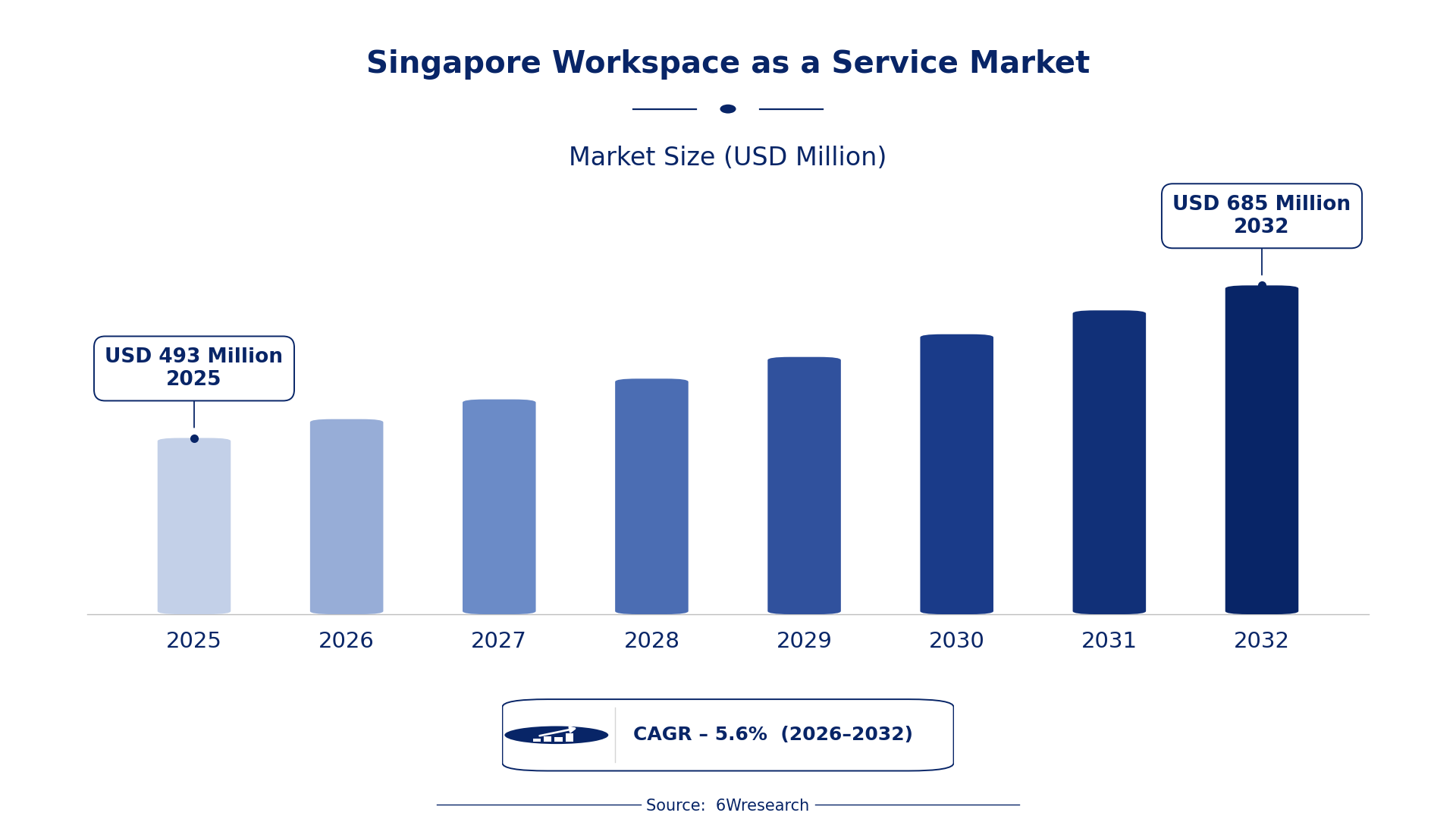
The Singapore Workspace as a Service Market was estimated at USD 493 Million in 2025 and is projected to reach USD 685 Million by 2032, growing at a CAGR of 5.6% from 2026 to 2032.
Singapore Workspace as a Service Market Synopsis
The rapid shift towards remote work is the most significant force reshaping the Singapore Workspace as a Service market. Businesses are increasingly recognizing the need for flexible, cloud-based solutions that empower employees to work from virtually anywhere, thus driving demand for WaaS offerings.
As organizations adapt to a new normal, the emphasis on secure and user-friendly digital workspaces has surged. This not only supports employee productivity but also enhances collaboration, making WaaS a vital component in the modern workplace ecosystem.
Singapore Workspace as a Service Market Year-wise Growth Rate and Key Drivers
This graph illustrates the annual growth rates of the Singapore Workspace as a Service Market from 2021 to 2032, highlighting a steady upward trajectory and projected expansion over the forecast period.
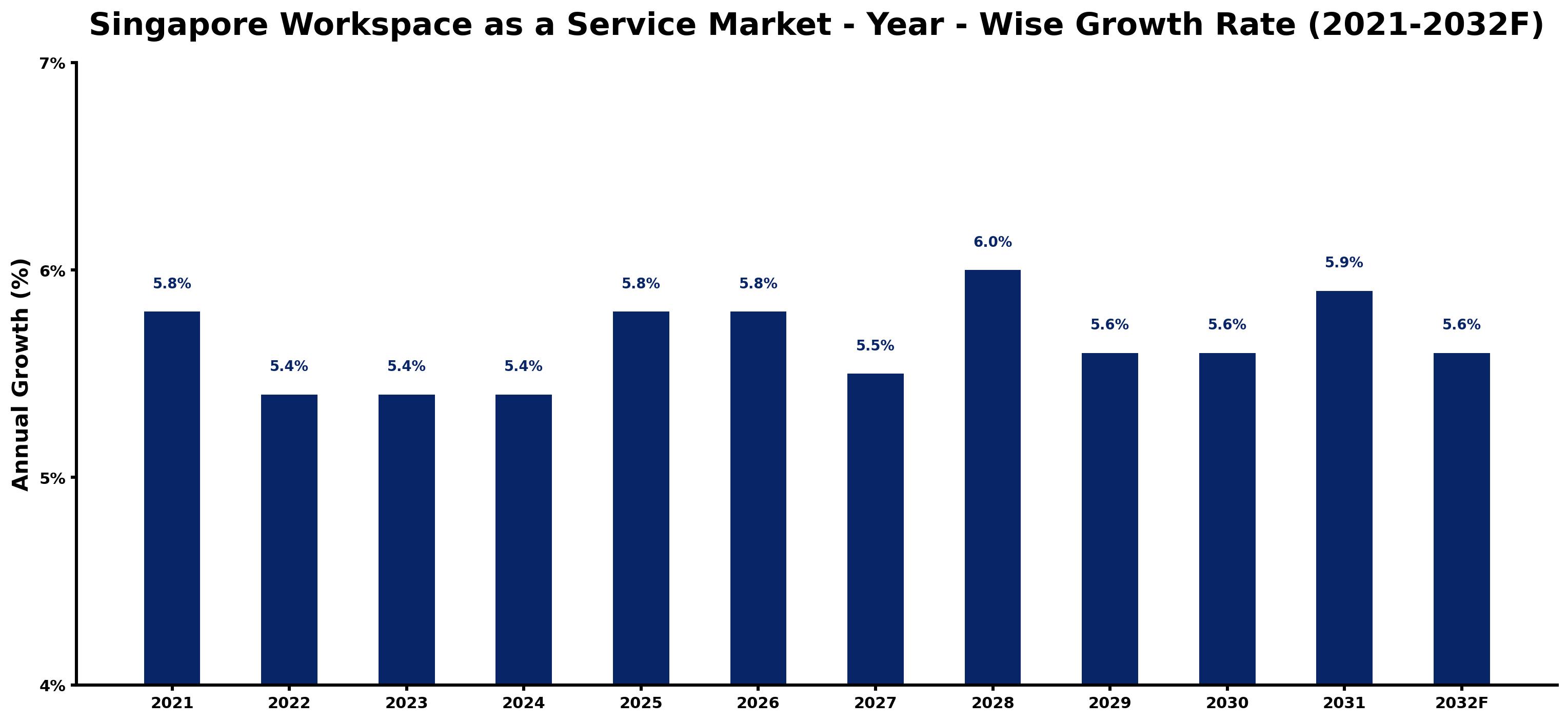
The table below presents the year‑wise growth rates along with the key drivers influencing the market
| Year | Growth Rate | Major Drivers |
| 2021 | 5.8% | Government remote work policies boost workspace flexibility. |
| 2022 | 5.4% | Rise of digital nomad culture increases coworking demand. |
| 2023 | 5.4% | Increased hybrid workforce drives demand for adaptable spaces. |
| 2024 | 5.4% | Singapore's Smart Nation initiative promotes workspace innovation. |
| 2025 | 5.8% | Growing entrepreneurship fosters demand for collaborative environments. |
| 2026 | 5.8% | Surge in tech startups bolsters workspace service needs. |
| 2027 | 5.5% | Increase in foreign investment drives office space requirements. |
| 2028 | 6.0% | Sustainability initiatives emphasize eco-friendly workspace solutions. |
| 2029 | 5.6% | Rising corporate sustainability commitments enhance shared office adoption. |
| 2030 | 5.6% | Government incentives support green building workspace developments. |
| 2031 | 5.9% | Digital transformation accelerates demand for agile workspaces. |
| 2032 | 5.6% | Urbanization trends lead to increased flexible workspace needs. |
Note: Market size estimations and growth projections presented in this report are based on 6Wresearch's proprietary forecasting methodology, utilizing the latest available industry data, government publications, and primary research inputs.
Singapore Workspace as a Service Market Key Takeaways
Below are some of the specific key takeaways from the market, including:
- The market is driven by the increasing adoption of remote work policies.
- Data security and compliance are primary concerns for businesses implementing WaaS solutions.
- Cloud-based collaboration tools are becoming essential for effective team communication.
- Companies are prioritizing flexible work arrangements to attract and retain talent.
- The ongoing evolution of technology continues to enhance WaaS offerings.
Evaluation of Restraints in Singapore Workspace as a Service Market
The Singapore Workspace as a Service market faces a few notable constraints that could limit its growth potential. One significant barrier is the necessity for stringent security measures to protect sensitive data, especially in a landscape where data breaches can have severe implications. Companies must also navigate the complexities of ensuring a user-friendly experience across various devices and platforms. Compliance with data protection laws, particularly under the Personal Data Protection Act (PDPA), adds another layer of complexity. These factors can deter smaller businesses from adopting WaaS solutions, hindering broader market penetration.
Singapore Workspace as a Service Market Trends
Current trends indicate a strong push towards integrating artificial intelligence and machine learning into WaaS solutions. These technologies enhance user experience by providing personalized workspace environments and automating routine tasks. Additionally, the growing emphasis on sustainability is influencing companies to adopt greener cloud solutions, aligning with corporate social responsibility goals.
Another emerging trend is the increasing demand for hybrid work models that combine both remote and in-office work arrangements. This flexibility is reshaping the way businesses approach workspace management, pushing for solutions that can cater to both settings seamlessly.
Singapore Workspace as a Service Market Opportunities
Genuine opportunities lie in developing tailored WaaS solutions for specific industries, such as healthcare and finance, where regulatory compliance and data security are paramount. on top of that, as more companies embrace the concept of a flexible workforce, there is an expanding market for platforms that facilitate collaboration and communication among dispersed teams. Investments in cybersecurity measures tailored for WaaS environments also present significant growth potential, as businesses become increasingly aware of the risks associated with remote work.
Government Initiatives in the Singapore Workspace as a Service Market
The Singaporean government is actively fostering a conducive environment for the Workspace as a Service market through various initiatives. With a focus on digital transformation, public policy is geared towards enhancing the technological infrastructure necessary for remote work and cloud solutions. This regulatory landscape is essential for encouraging businesses to invest in WaaS offerings.
- A recently completed initiative involved the launch of a national digital infrastructure upgrade programme aimed at improving connectivity across urban and suburban areas.
- Currently underway is a public-private partnership focused on expanding cloud computing resources for small and medium-sized enterprises (SMEs), enhancing their access to WaaS solutions.
- A planned regulatory framework is expected to be introduced in 2026, which will mandate data protection measures for companies using WaaS platforms.
- The government is also investing in training programmes aimed at upskilling the workforce in digital tools and technologies, set to roll out in late 2025.
- An upcoming initiative aims to create a centralized platform for businesses to easily access various WaaS providers and services, expected to launch by mid-2027.
Future Insights of the Singapore Workspace as a Service Market
Looking ahead to 2026-2032, the Singapore Workspace as a Service market is expected to witness substantial growth. The continued integration of advanced technologies such as AI and machine learning will redefine user experiences, while the increasing importance of data security will drive innovation. Companies will likely invest more in comprehensive WaaS solutions that provide not only flexibility but also security and compliance, ensuring they can adapt to changing work environments.
Singapore Workspace as a Service Market Latest Developments
In the past year, the Singapore Workspace as a Service market has seen several pivotal developments. Companies are actively refining their offerings to meet the growing demand for remote work solutions, with a clear focus on enhancing security and user experience.
- A major technology vendor announced a significant upgrade to its WaaS platform in early 2025, enhancing security features to better protect remote workers.
- In Q1 2025, a leading regional operator launched a new collaborative tool specifically designed for hybrid work environments, receiving positive feedback from users.
- An initiative that began in mid-2025 aims to integrate AI capabilities into existing WaaS solutions, with a projected completion by late 2025.
- A rollout expected to begin in the second half of 2026 will introduce new compliance features to help businesses adhere to the PDPA.
- A partnership between local tech startups is currently underway, aimed at developing innovative solutions tailored to SMEs, enhancing accessibility to WaaS services.
Singapore Workspace as a Service Market - Key Attractiveness of the Report
- 10 Years of Market Numbers
- Historical Data Starting from 2022 to 2025
- Base Year: 2025
- Forecast Data until 2032
- Key Performance Indicators Impacting the Market
- Major Upcoming Developments and Projects
Key Highlights of the Report:
- Singapore Workspace as a Service Market Outlook
- Market Size of Singapore Workspace as a Service Market, 2025
- Forecast of Singapore Workspace as a Service Market, 2032
- Historical Data and Forecast of Singapore Workspace as a Service Revenues & Volume for the Period 2022-2032F
- Singapore Workspace as a Service Market Trend Evolution
- Singapore Workspace as a Service Market Drivers and Challenges
- Singapore Workspace as a Service Price Trends
- Singapore Workspace as a Service Porter's Five Forces
- Singapore Workspace as a Service Industry Life Cycle
- Historical Data and Forecast of Singapore Workspace as a Service Market Revenues & Volume By Solutions for the Period 2022-2032F
- Historical Data and Forecast of Singapore Workspace as a Service Market Revenues & Volume By VDI and Applications for the Period 2022-2032F
- Historical Data and Forecast of Singapore Workspace as a Service Market Revenues & Volume By Desktop as a Service for the Period 2022-2032F
- Historical Data and Forecast of Singapore Workspace as a Service Market Revenues & Volume By Hosted Applications (Unified Communication Applications) for the Period 2022-2032F
- Historical Data and Forecast of Singapore Workspace as a Service Market Revenues & Volume By Security Solutions for the Period 2022-2032F
- Historical Data and Forecast of Singapore Workspace as a Service Market Revenues & Volume By Others (Browser-based WaaS solutions) for the Period 2022-2032F
- Historical Data and Forecast of Singapore Workspace as a Service Market Revenues & Volume By Services for the Period 2022-2032F
- Historical Data and Forecast of Singapore Workspace as a Service Market Revenues & Volume By System Integration for the Period 2022-2032F
- Historical Data and Forecast of Singapore Workspace as a Service Market Revenues & Volume By Consulting services for the Period 2022-2032F
- Historical Data and Forecast of Singapore Workspace as a Service Market Revenues & Volume By Managed services for the Period 2022-2032F
- Historical Data and Forecast of Singapore Workspace as a Service Market Revenues & Volume By Deployment Type for the Period 2022-2032F
- Historical Data and Forecast of Singapore Workspace as a Service Market Revenues & Volume By Public for the Period 2022-2032F
- Historical Data and Forecast of Singapore Workspace as a Service Market Revenues & Volume By Private for the Period 2022-2032F
- Historical Data and Forecast of Singapore Workspace as a Service Market Revenues & Volume By Hybrid for the Period 2022-2032F
- Historical Data and Forecast of Singapore Workspace as a Service Market Revenues & Volume By End-Users for the Period 2022-2032F
- Historical Data and Forecast of Singapore Workspace as a Service Market Revenues & Volume By Enterprises for the Period 2022-2032F
- Historical Data and Forecast of Singapore Workspace as a Service Market Revenues & Volume By Small and medium businesses(SMB) for the Period 2022-2032F
- Historical Data and Forecast of Singapore Workspace as a Service Market Revenues & Volume By Verticals for the Period 2022-2032F
- Historical Data and Forecast of Singapore Workspace as a Service Market Revenues & Volume By Banking, Financial Services and Insurance (BFSI) for the Period 2022-2032F
- Historical Data and Forecast of Singapore Workspace as a Service Market Revenues & Volume By Retail for the Period 2022-2032F
- Historical Data and Forecast of Singapore Workspace as a Service Market Revenues & Volume By Government for the Period 2022-2032F
- Historical Data and Forecast of Singapore Workspace as a Service Market Revenues & Volume By Healthcare for the Period 2022-2032F
- Historical Data and Forecast of Singapore Workspace as a Service Market Revenues & Volume By Manufacturing for the Period 2022-2032F
- Historical Data and Forecast of Singapore Workspace as a Service Market Revenues & Volume By Telecom and IT for the Period 2022-2032F
- Historical Data and Forecast of Singapore Workspace as a Service Market Revenues & Volume By Utilities for the Period 2022-2032F
- Historical Data and Forecast of Singapore Workspace as a Service Market Revenues & Volume By Travel and Hospitality for the Period 2022-2032F
- Singapore Workspace as a Service Import Export Trade Statistics
- Market Opportunity Assessment By Solutions
- Market Opportunity Assessment By Services
- Market Opportunity Assessment By Deployment Type
- Market Opportunity Assessment By End-Users
- Market Opportunity Assessment By Verticals
- Singapore Workspace as a Service Top Companies Market Share
- Singapore Workspace as a Service Competitive Benchmarking By Technical and Operational Parameters
- Singapore Workspace as a Service Company Profiles
- Singapore Workspace as a Service Key Strategic Recommendations






































