Singapore Zinc Sulphate Market Size, Share & Growth Rate
The Singapore Zinc Sulphate Market was estimated at USD 477 Million in 2025 and is projected to reach USD 626 Million by 2032, growing at a CAGR of 4.0% from 2026 to 2032. This robust growth trajectory can be attributed to an increasing demand for micronutrients in agriculture and animal nutrition, reflecting a heightened focus on sustainable farming practices. Additionally, the expanding recognition of zinc's significance in dietary supplements is likely to further fuel market expansion, positioning Singapore as a key player in the regional and global supply chains.
Singapore Zinc Sulphate Market Year-wise Growth Rate and Key Drivers
This graph highlights how the Singapore Zinc Sulphate Market has steadily grown over the years, supported by major growth factors.
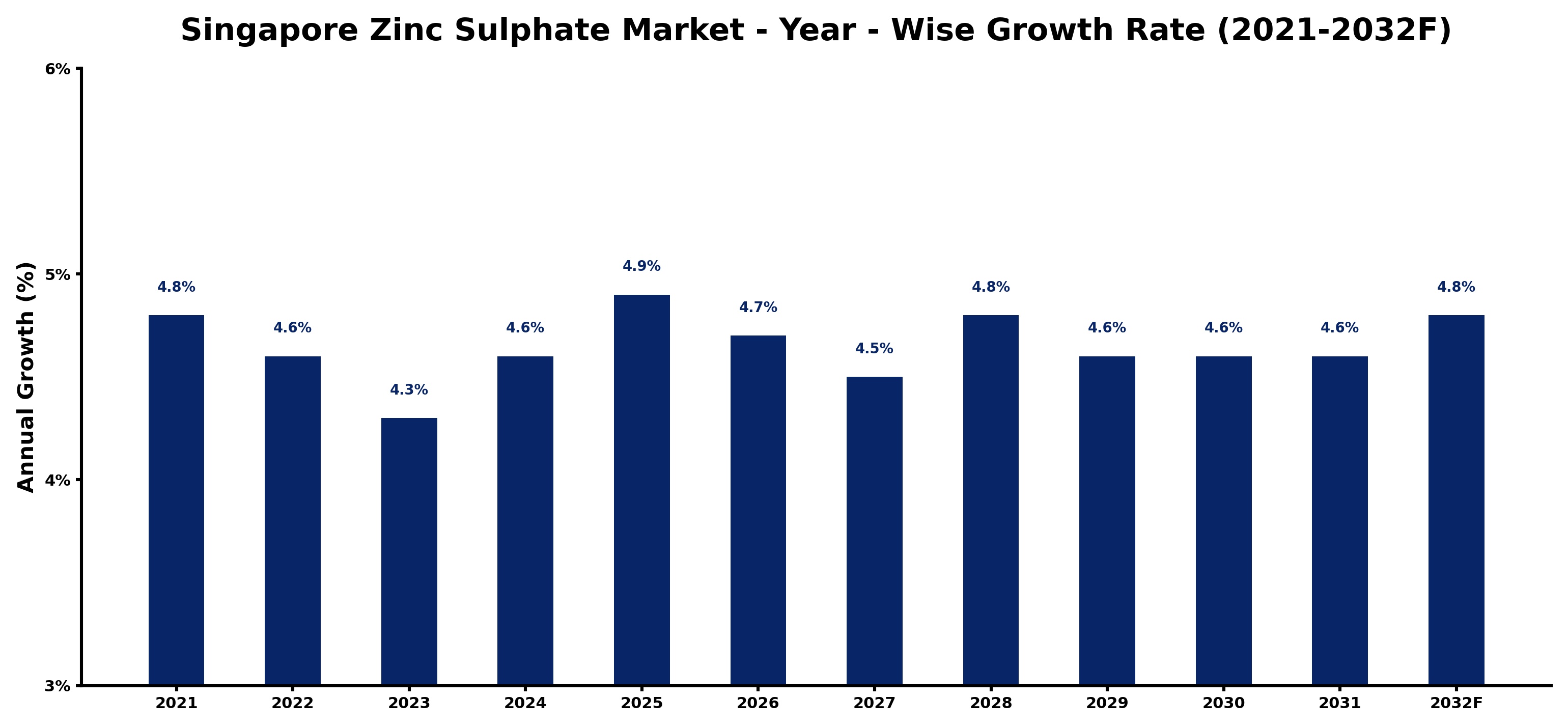
The table below presents the year‑wise growth rates along with the key drivers influencing the market
| Year | Growth Rate | Major Drivers |
| 2021 | 4.8% | Agricultural demand for fertilizers increased |
| 2022 | 4.6% | Industrial applications expanded significantly |
| 2023 | 4.3% | Health awareness drove supplement usage |
| 2024 | 4.6% | Export opportunities enhanced market growth |
| 2025 | 4.9% | Technological advancements improved production |
| 2026 | 4.7% | Sustainable farming practices gained traction |
| 2027 | 4.5% | Research and development investments increased |
| 2028 | 4.8% | Consumer education on nutrients expanded |
| 2029 | 4.6% | Regulatory support for agriculture strengthened |
| 2030 | 4.6% | Partnerships with manufacturers grew stronger |
| 2031 | 4.6% | Zinc deficiency awareness increased demand |
| 2032 | 4.8% | Global market trends influenced growth |
Note - Market size estimations and growth projections presented in this report are based on 6Wresearch’s advanced forecasting approach, validated with industry datasets as of June 2026.
Singapore Zinc Sulphate Market Synopsis
The demand for zinc sulfate in Singapore is largely propelled by its essential role in agricultural fertilizers and as a nutrient in animal feed. As urban farming and precision agriculture gain momentum within the region, the use of zinc sulfate as a micronutrient is becoming increasingly critical for enhancing crop yields and livestock health.
Furthermore, ongoing research into the health benefits of zinc is generating excitement across the health and wellness sectors. With dietary supplements containing zinc sulfate gaining traction, there is a growing market for these products in Singapore, driven by an increasingly health-conscious population.
Singapore Zinc Sulphate Market Key Takeaways
- The market is experiencing growth due to rising agricultural and livestock nutritional needs.
- Health sector trends highlighting the importance of zinc are driving dietary supplement demand.
- Urban farming practices are reinforcing the use of zinc sulfate in crop cultivation.
- Regulatory frameworks are enhancing product quality and safety standards.
- Strategic location offers Singapore a significant advantage as a distribution hub for zinc sulfate.
Evaluation of Restraints in Singapore Zinc Sulphate Market
Despite the market's growth potential, certain restraints may impede progress. Fluctuations in agricultural practices and changing trends may lead to inconsistent demand for zinc sulfate. Additionally, ensuring the quality and purity of zinc sulfate products is vital, as any deviations could undermine consumer confidence. Price volatility, influenced by global zinc production and trade dynamics, poses another challenge, potentially impacting profitability and market stability.
Singapore Zinc Sulphate Market Trends
Emerging trends in the Singapore zinc sulfate market include a shift towards organic and sustainable farming practices. As more growers adopt these techniques, the demand for high-quality micronutrients, including zinc sulfate, is expected to rise. Additionally, innovations in production and formulation processes are likely to enhance product efficacy, leading to greater adoption across various agricultural sectors.
Singapore Zinc Sulphate Market Opportunities
Investment opportunities within the Singapore zinc sulfate market abound, particularly in research and development to explore new applications. The increasing focus on health supplements creates avenues for the introduction of innovative dietary products, catering to a growing demographic interested in wellness. Furthermore, collaborations between agricultural producers and research institutions could pave the way for breakthroughs in crop nutrition strategies.
Government Initiatives in the Singapore Zinc Sulphate Market
The Singapore government has been proactive in promoting sustainable agriculture and food security through various initiatives. Public spending aimed at enhancing agricultural practices, including the use of micronutrients, is encouraging increased production and consumption of zinc sulfate. Supportive policies aimed at encouraging research into the health benefits of zinc further bolster market growth, creating a conducive environment for investments in this sector.
Future Insights of the Singapore Zinc Sulphate Market
Looking ahead to the period between 2026 and 2032, the Singapore zinc sulfate market is expected to witness significant transformation. As the demand for sustainable agricultural practices rises, coupled with growing awareness of micronutrient importance, the market is well-positioned for sustained growth. Furthermore, as dietary preferences evolve and health supplementation becomes more mainstream, zinc sulfate will likely secure a central role in meeting both agricultural and nutritional needs.
Singapore Zinc Sulphate Market Latest Developments (May 2025 - June 2026)
Recent developments in the Singapore zinc sulfate market point towards a strategic shift in production and distribution channels. There has been a notable increase in collaborations between agricultural producers and technology firms, aimed at enhancing the efficacy and application of zinc sulfate in crops. In addition, a rise in educational initiatives focusing on the health benefits of zinc is influencing consumer behaviors, further driving demand for zinc-enriched dietary supplements.
Singapore Zinc Sulphate Market - Key Attractiveness of the Report
- 10 Years of Market Numbers
- Historical Data Starting from 2022 to 2025
- Base Year: 2025
- Forecast Data until 2032
- Key Performance Indicators Impacting the Market
- Major Upcoming Developments and Projects
Key Highlights of the Report:
- Singapore Zinc Sulphate Market Outlook
- Market Size of Singapore Zinc Sulphate Market, 2025
- Forecast of Singapore Zinc Sulphate Market, 2032
- Historical Data and Forecast of Singapore Zinc Sulphate Revenues & Volume for the Period 2022-2032F
- Singapore Zinc Sulphate Market Trend Evolution
- Singapore Zinc Sulphate Market Drivers and Challenges
- Singapore Zinc Sulphate Price Trends
- Singapore Zinc Sulphate Porter's Five Forces
- Singapore Zinc Sulphate Industry Life Cycle
- Historical Data and Forecast of Singapore Zinc Sulphate Market Revenues & Volume By Type for the Period 2022-2032F
- Historical Data and Forecast of Singapore Zinc Sulphate Market Revenues & Volume By Zinc Sulphate Anhydrous for the Period 2022-2032F
- Historical Data and Forecast of Singapore Zinc Sulphate Market Revenues & Volume By Zinc Sulphate Hexahydrate for the Period 2022-2032F
- Historical Data and Forecast of Singapore Zinc Sulphate Market Revenues & Volume By Zinc Sulphate Heptahydrate for the Period 2022-2032F
- Historical Data and Forecast of Singapore Zinc Sulphate Market Revenues & Volume By Zinc Sulphate Monohydrate for the Period 2022-2032F
- Historical Data and Forecast of Singapore Zinc Sulphate Market Revenues & Volume By Application for the Period 2022-2032F
- Historical Data and Forecast of Singapore Zinc Sulphate Market Revenues & Volume By Agrochemicals for the Period 2022-2032F
- Historical Data and Forecast of Singapore Zinc Sulphate Market Revenues & Volume By Chemicals for the Period 2022-2032F
- Historical Data and Forecast of Singapore Zinc Sulphate Market Revenues & Volume By Pharmaceuticals for the Period 2022-2032F
- Historical Data and Forecast of Singapore Zinc Sulphate Market Revenues & Volume By Synthetic Fibers for the Period 2022-2032F
- Historical Data and Forecast of Singapore Zinc Sulphate Market Revenues & Volume By Water Treatment for the Period 2022-2032F
- Historical Data and Forecast of Singapore Zinc Sulphate Market Revenues & Volume By Others for the Period 2022-2032F
- Singapore Zinc Sulphate Import Export Trade Statistics
- Market Opportunity Assessment By Type
- Market Opportunity Assessment By Application
- Singapore Zinc Sulphate Top Companies Market Share
- Singapore Zinc Sulphate Competitive Benchmarking By Technical and Operational Parameters
- Singapore Zinc Sulphate Company Profiles
- Singapore Zinc Sulphate Key Strategic Recommendations






































