Slovakia 5G Core Market Size, Share & Growth Rate
The Slovakia 5G Core Market was estimated at USD 511 Million in 2025 and is projected to reach USD 740 Million by 2032, growing at a CAGR of 5.4% from 2026 to 2032. This growth trajectory is primarily fueled by the rising demand for faster, more reliable connectivity as sectors such as healthcare, automotive, and manufacturing increasingly embrace digital transformation. The government's commitment to supporting 5G deployment further strengthens this market, creating fertile ground for innovation and infrastructure investment.
Slovakia 5G Core Market Year-wise Growth Rate and Key Drivers
This graph highlights how the Slovakia 5G Core Market has steadily grown over the years, supported by major growth factors.
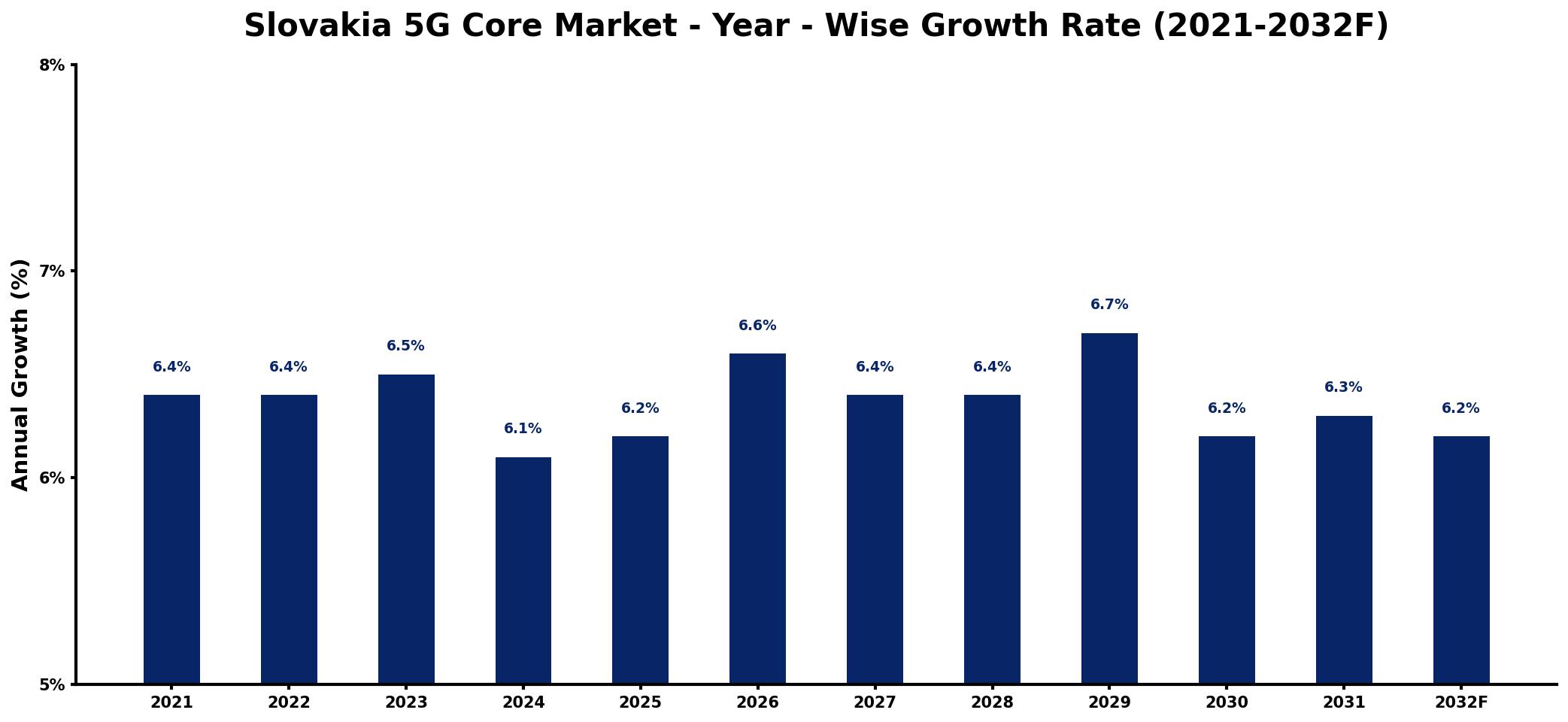
The table below presents the year‑wise growth rates along with the key drivers influencing the market
| Year | Growth Rate | Major Drivers |
| 2021 | 6.4% | Rising demand for connectivity solutions |
| 2022 | 6.4% | Increased investment in infrastructure |
| 2023 | 6.5% | Expansion of smart city initiatives |
| 2024 | 6.1% | Growth in IoT applications deployment |
| 2025 | 6.2% | Surge in mobile data consumption |
| 2026 | 6.6% | Advancements in network technology adoption |
| 2027 | 6.4% | Boost in enterprise digital transformation |
| 2028 | 6.4% | Increase in remote work solutions |
| 2029 | 6.7% | Development of automated industrial processes |
| 2030 | 6.2% | rising end-use demand growth |
| 2031 | 6.3% | increased production capacity utilization |
| 2032 | 6.2% | Rise in connected vehicle technologies |
Note: Market size estimations and growth projections presented in this report are based on 6Wresearch's proprietary forecasting methodology, utilizing the latest available industry data, government publications, and primary research inputs.
Slovakia 5G Core Market Synopsis
Currently, Slovakia is positioned at the forefront of 5G implementation within the Central European landscape. The rapid rollout of 5G networks is set to enhance mobile broadband services significantly, enabling smarter solutions across various industries.
In this dynamic environment, telecom operators are investing heavily in cloud-native architectures and network slicing capabilities. This enables them to cater to diverse service demands, setting the stage for a more robust digital ecosystem.
Slovakia 5G Core Market Key Takeaways
- Robust market growth is projected, with the 5G core market expected to reach USD 740 Million by 2032.
- The demand for IoT applications and low-latency connectivity is a primary driver of market expansion.
- Cloud-native network architectures are gaining traction, enhancing flexibility and scalability in operations.
- Investment in security measures is critical due to increased risks associated with enhanced connectivity.
- Partnerships with local telecom operators are essential for market entry and growth.
Evaluation of Restraints in Slovakia 5G Core Market
Despite the optimistic outlook, several restraints impact the Slovakia 5G Core Market. Significant capital investment is required to upgrade existing infrastructure and adopt new technologies. Additionally, the complexity of integrating 5G core networks with legacy systems poses a considerable challenge, necessitating careful planning and execution. Furthermore, the heightened focus on data privacy and cybersecurity introduces another layer of complexity, as organizations must adopt rigorous measures to safeguard sensitive information and communication channels.
Slovakia 5G Core Market Trends
A key trend in the Slovakia 5G Core Market is the increasing deployment of cloud-native core networks that allow telecom operators to maintain scalability while optimizing resource usage. Network slicing is also gaining prominence, enabling tailored service offerings for specific industries and applications. As the industry embraces automation and artificial intelligence, there's a notable focus on enhancing network performance and user experience, ensuring that Slovakian consumers and enterprises can leverage the full benefits of 5G connectivity.
Slovakia 5G Core Market Opportunities
The market presents numerous investment opportunities, particularly in developing advanced 5G core network infrastructure. Companies focusing on innovative solutions such as virtualized network functions and software-defined networking can capitalize on the increasing adoption of 5G technology. Moreover, collaborating with local telecom operators and navigating regulatory landscapes effectively will position businesses favorably as the market continues to evolve.
Government Initiatives in the Slovakia 5G Core Market
The Slovakian government is actively fostering a competitive environment in the 5G core market through a set of favorable policies. Regulations aimed at promoting fair competition encourage open access to infrastructure and efficient spectrum allocation. Furthermore, the government emphasizes national security and data privacy, requiring telecom operators to adhere to stringent cybersecurity protocols. Collaborative efforts with industry stakeholders and funding initiatives are also underway to support the development of 5G technologies.
Future Insights of the Slovakia 5G Core Market
Looking ahead to 2026-2032, the Slovakia 5G Core Market is poised for remarkable growth driven by the ongoing digital transformation across various sectors. The increasing need for high-speed, low-latency connectivity will stimulate continued infrastructure development. The expansion of IoT applications and smart city initiatives will further accelerate this growth, with telecom operators investing in upgrading their networks to meet rising demands. As technological advancements continue, such as network slicing and edge computing, the landscape will evolve to support an interconnected and data-driven economy.
Slovakia 5G Core Market Latest Developments (2025 - 2026)
In recent months, there has been significant momentum in the rollout of 5G networks across Slovakia. Telecom operators are making strides in enhancing their core network capabilities, focusing on cloud-native solutions to streamline operations. Additionally, partnerships among telecom players are becoming increasingly common as they seek to leverage each other's strengths in the evolving landscape. Initiatives aimed at bolstering cybersecurity measures are also being prioritized to protect sensitive data and ensure trust in the expanding digital ecosystem.
Slovakia 5G Core Market - Key Attractiveness of the Report
- 10 Years of Market Numbers
- Historical Data Starting from 2022 to 2025
- Base Year: 2025
- Forecast Data until 2032
- Key Performance Indicators Impacting the Market
- Major Upcoming Developments and Projects
Key Highlights of the Report:
- Slovakia 5G Core Market Outlook
- Market Size of Slovakia 5G Core Market, 2025
- Forecast of Slovakia 5G Core Market, 2032
- Historical Data and Forecast of Slovakia 5G Core Revenues & Volume for the Period 2022-2032F
- Slovakia 5G Core Market Trend Evolution
- Slovakia 5G Core Market Drivers and Challenges
- Slovakia 5G Core Price Trends
- Slovakia 5G Core Porter's Five Forces
- Slovakia 5G Core Industry Life Cycle
- Historical Data and Forecast of Slovakia 5G Core Market Revenues & Volume By Component for the Period 2022-2032F
- Historical Data and Forecast of Slovakia 5G Core Market Revenues & Volume By Solutions for the Period 2022-2032F
- Historical Data and Forecast of Slovakia 5G Core Market Revenues & Volume By Services for the Period 2022-2032F
- Historical Data and Forecast of Slovakia 5G Core Market Revenues & Volume By Network Function for the Period 2022-2032F
- Historical Data and Forecast of Slovakia 5G Core Market Revenues & Volume By Access for the Period 2022-2032F
- Historical Data and Forecast of Slovakia 5G Core Market Revenues & Volume By Mobility Management Function for the Period 2022-2032F
- Historical Data and Forecast of Slovakia 5G Core Market Revenues & Volume By Policy Control Function for the Period 2022-2032F
- Historical Data and Forecast of Slovakia 5G Core Market Revenues & Volume By Unified Data Management for the Period 2022-2032F
- Historical Data and Forecast of Slovakia 5G Core Market Revenues & Volume By Deployment Model for the Period 2022-2032F
- Historical Data and Forecast of Slovakia 5G Core Market Revenues & Volume By Cloud for the Period 2022-2032F
- Historical Data and Forecast of Slovakia 5G Core Market Revenues & Volume By On-premises for the Period 2022-2032F
- Historical Data and Forecast of Slovakia 5G Core Market Revenues & Volume By End User for the Period 2022-2032F
- Historical Data and Forecast of Slovakia 5G Core Market Revenues & Volume By Telecom Operators for the Period 2022-2032F
- Historical Data and Forecast of Slovakia 5G Core Market Revenues & Volume By Enterprises for the Period 2022-2032F
- Slovakia 5G Core Import Export Trade Statistics
- Market Opportunity Assessment By Component
- Market Opportunity Assessment By Network Function
- Market Opportunity Assessment By Deployment Model
- Market Opportunity Assessment By End User
- Slovakia 5G Core Top Companies Market Share
- Slovakia 5G Core Competitive Benchmarking By Technical and Operational Parameters
- Slovakia 5G Core Company Profiles
- Slovakia 5G Core Key Strategic Recommendations






































