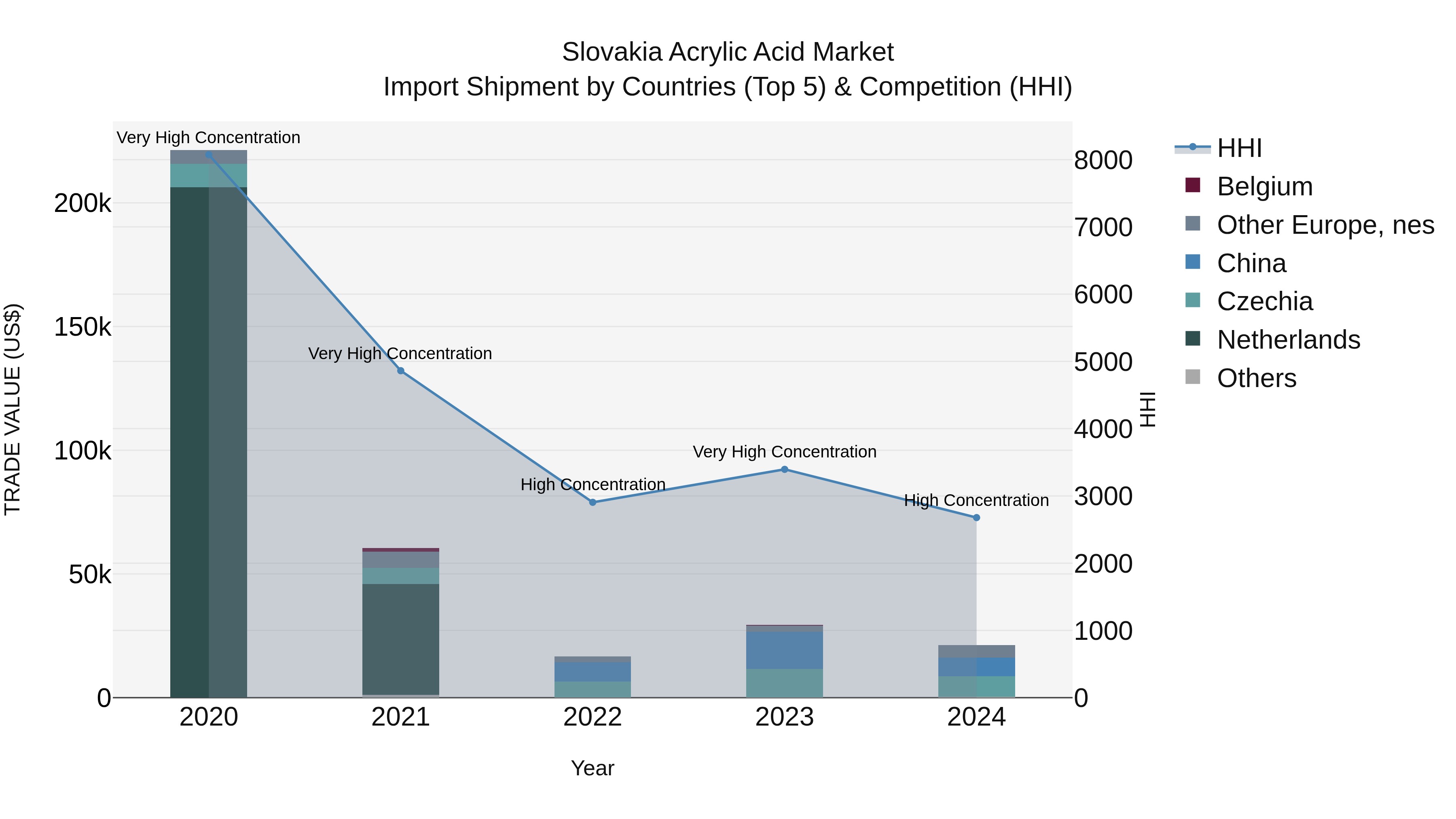
Slovakia Acrylic Acid Market Top 5 Importing Countries and Market Competition (HHI) Analysis
Slovakia`s acrylic acid import Market Top 5 Importing Countries and Market Competition (HHI) Analysis in 2024 saw significant concentration among top exporters such as Czechia, China, and India, with high Herfindahl-Hirschman Index (HHI) reflecting Market Top 5 Importing Countries and Market Competition (HHI) Analysis dominance. The compound annual growth rate (CAGR) from 2020 to 2024 experienced a notable decline at -44.32%, while the growth rate from 2023 to 2024 decreased by -27.52%, indicating a challenging Market Top 5 Importing Countries and Market Competition (HHI) Analysis environment. Monitoring these trends is crucial for stakeholders to navigate the evolving landscape of acrylic acid imports in Slovakia.
Acrylic acid Market: Slovak Republic vs Top 5 Major Economies in 2027 (Europe)
By 2027, the Acrylic acid market in Slovak Republic is anticipated to reach a growth rate of 3.60%, as part of an increasingly competitive Europe region, where Germany remains at the forefront, supported by United Kingdom, France, Italy and Russia, driving innovations and market adoption across sectors.

Slovakia Acrylic acid Market Overview
The Slovakia acrylic acid market is witnessing steady growth driven by increasing demand from various industries such as paints and coatings, adhesives, textiles, and personal care products. The market is primarily dominated by key players such as BASF SE, Dow Chemical Company, and Arkema SA, who are investing in research and development to introduce innovative products and expand their market presence. The rising focus on sustainable and eco-friendly products is also influencing market dynamics, leading to the development of bio-based acrylic acid products. Additionally, the growing construction and automotive sectors in Slovakia are further fueling the demand for acrylic acid-based products, driving market growth in the region. Overall, the Slovakia acrylic acid market is poised for continued expansion and innovation in the coming years.
Slovakia Acrylic acid Market Trends
The Slovakia Acrylic Acid Market is experiencing growth due to increasing demand from end-use industries such as coatings, adhesives, and textiles. The market is witnessing a shift towards sustainable and eco-friendly products, leading to a rise in the production of bio-based acrylic acid. Manufacturers are focusing on developing innovative technologies to reduce the environmental impact of acrylic acid production. Additionally, the growing construction sector in Slovakia is driving the demand for acrylic acid-based products like paints and coatings. Market players are also investing in research and development to expand their product portfolios and cater to the evolving needs of customers. Overall, the Slovakia Acrylic Acid Market is expected to continue growing in the coming years, driven by technological advancements and increasing applications in various industries.
Slovakia Acrylic acid Market Challenges
In the Slovakia acrylic acid market, some of the key challenges faced include fluctuating raw material prices, increasing competition from international suppliers, and the need for continuous innovation to meet changing customer demands. Additionally, regulatory hurdles and environmental concerns surrounding the production and usage of acrylic acid pose challenges for market players. Ensuring consistent quality standards and maintaining cost competitiveness in the face of rising operational costs also remain significant obstacles in the Slovakia acrylic acid market. Companies operating in this sector need to navigate these challenges effectively through strategic partnerships, technological advancements, and market diversification to sustain growth and profitability in the highly competitive environment.
Slovakia Acrylic acid Market Investment Opportunities
The Slovakia acrylic acid market presents several investment opportunities for potential investors. With increasing demand for acrylic acid in various industries such as adhesives, coatings, and textiles, there is a growing market for acrylic acid-based products in Slovakia. Investing in the production and supply chain of acrylic acid could prove to be lucrative due to the market`s potential for growth. Additionally, advancements in technology and innovation in acrylic acid production processes offer opportunities for investment in research and development. Furthermore, the increasing focus on sustainable and eco-friendly products in Slovakia creates a demand for bio-based acrylic acid, providing an additional avenue for investment in this market. Overall, the Slovakia acrylic acid market offers diverse investment opportunities with the potential for long-term growth and profitability.
Slovakia Acrylic acid Market Government Policy
The Slovakia government has implemented various policies related to the Acrylic acid Market to promote domestic production and consumption. These include regulations on environmental protection and safety standards for acrylic acid production facilities to ensure sustainable practices. Additionally, the government has introduced tax incentives and subsidies to encourage investment in the sector, aiming to boost competitiveness and drive innovation within the domestic market. Furthermore, trade agreements and partnerships with other countries have been established to facilitate exports of acrylic acid products, thereby expanding market opportunities for Slovakian producers. Overall, the government`s policies are focused on fostering a favorable business environment for the acrylic acid market in Slovakia while also promoting responsible and sustainable growth.
Slovakia Acrylic acid Market Future Outlook
The Slovakia acrylic acid market is expected to witness steady growth in the coming years, driven by factors such as increasing demand from end-use industries like adhesives, textiles, and personal care products. The country`s growing construction sector is also anticipated to contribute to the market`s expansion, as acrylic acid is widely used in paints and coatings. Additionally, the rising trend towards sustainable and eco-friendly products is likely to propel the demand for bio-based acrylic acid in Slovakia. However, challenges such as fluctuating raw material prices and stringent environmental regulations may hinder market growth to some extent. Overall, with increasing industrialization and innovation in product development, the Slovakia acrylic acid market is poised for a positive outlook in the foreseeable future.
Key Highlights of the Report:
- Slovakia Acrylic acid Market Outlook
- Market Size of Slovakia Acrylic acid Market, 2021
- Forecast of Slovakia Acrylic acid Market, 2031
- Historical Data and Forecast of Slovakia Acrylic acid Revenues & Volume for the Period 2021 - 2031
- Slovakia Acrylic acid Market Trend Evolution
- Slovakia Acrylic acid Market Drivers and Challenges
- Slovakia Acrylic acid Price Trends
- Slovakia Acrylic acid Porter's Five Forces
- Slovakia Acrylic acid Industry Life Cycle
- Historical Data and Forecast of Slovakia Acrylic acid Market Revenues & Volume By Product for the Period 2021 - 2031
- Historical Data and Forecast of Slovakia Acrylic acid Market Revenues & Volume By Acrylate Esters for the Period 2021 - 2031
- Historical Data and Forecast of Slovakia Acrylic acid Market Revenues & Volume By Glacial Acrylic Acid for the Period 2021 - 2031
- Historical Data and Forecast of Slovakia Acrylic acid Market Revenues & Volume By Others for the Period 2021 - 2031
- Historical Data and Forecast of Slovakia Acrylic acid Market Revenues & Volume By End-users for the Period 2021 - 2031
- Historical Data and Forecast of Slovakia Acrylic acid Market Revenues & Volume By Surfactants and Surface Coatings for the Period 2021 - 2031
- Historical Data and Forecast of Slovakia Acrylic acid Market Revenues & Volume By Organic Chemicals for the Period 2021 - 2031
- Historical Data and Forecast of Slovakia Acrylic acid Market Revenues & Volume By Water Filtration for the Period 2021 - 2031
- Historical Data and Forecast of Slovakia Acrylic acid Market Revenues & Volume By Adhesives and Sealants for the Period 2021 - 2031
- Historical Data and Forecast of Slovakia Acrylic acid Market Revenues & Volume By Textiles for the Period 2021 - 2031
- Historical Data and Forecast of Slovakia Acrylic acid Market Revenues & Volume By Water Treatment for the Period 2021 - 2031
- Historical Data and Forecast of Slovakia Acrylic acid Market Revenues & Volume By Personal Care Products for the Period 2021 - 2031
- Historical Data and Forecast of Slovakia Acrylic acid Market Revenues & Volume By Others for the Period 2021 - 2031
- Slovakia Acrylic acid Import Export Trade Statistics
- Market Opportunity Assessment By Product
- Market Opportunity Assessment By End-users
- Slovakia Acrylic acid Top Companies Market Share
- Slovakia Acrylic acid Competitive Benchmarking By Technical and Operational Parameters
- Slovakia Acrylic acid Company Profiles
- Slovakia Acrylic acid Key Strategic Recommendations






































