Slovakia Artificial Intelligence in Retail Market Size & Growth Rate (2026-2032)
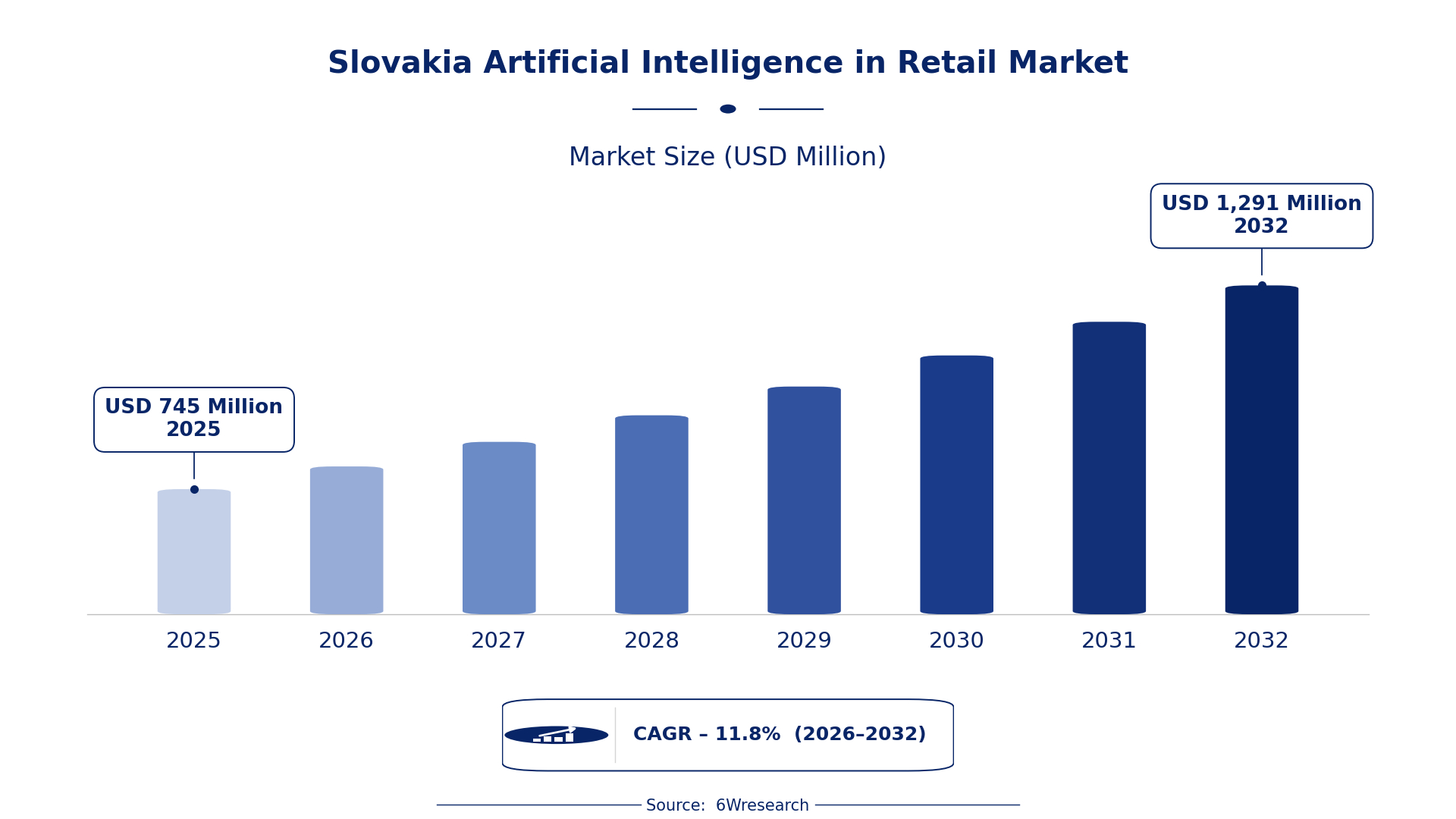
The Slovakia Artificial Intelligence in Retail Market was estimated at USD 745 Million in 2025 and is projected to reach USD 1291 Million by 2032, growing at a CAGR of 11.8% from 2026 to 2032.
Slovakia Artificial Intelligence in Retail Market Synopsis
The Slovakia Artificial Intelligence in Retail Market is experiencing a dynamic shift, fueled by an increasing appetite for technology-driven solutions among retailers. This momentum is evident as businesses invest in AI to enhance customer interactions and streamline operations, reflecting a broader trend in the retail sector.
Looking forward, the market is on a trajectory of sustained growth, driven by advancements in machine learning, predictive analytics, and customer data analysis. As retailers seek to differentiate themselves through personalized experiences and operational efficiencies, the role of AI will only become more pivotal in shaping the future of retail in Slovakia.
Slovakia Artificial Intelligence in Retail Market Year-wise Growth Rate and Key Drivers
This graph illustrates the annual growth rates of the Slovakia Artificial Intelligence in Retail Market from 2021 to 2032, highlighting a steady upward trajectory and projected expansion over the forecast period.
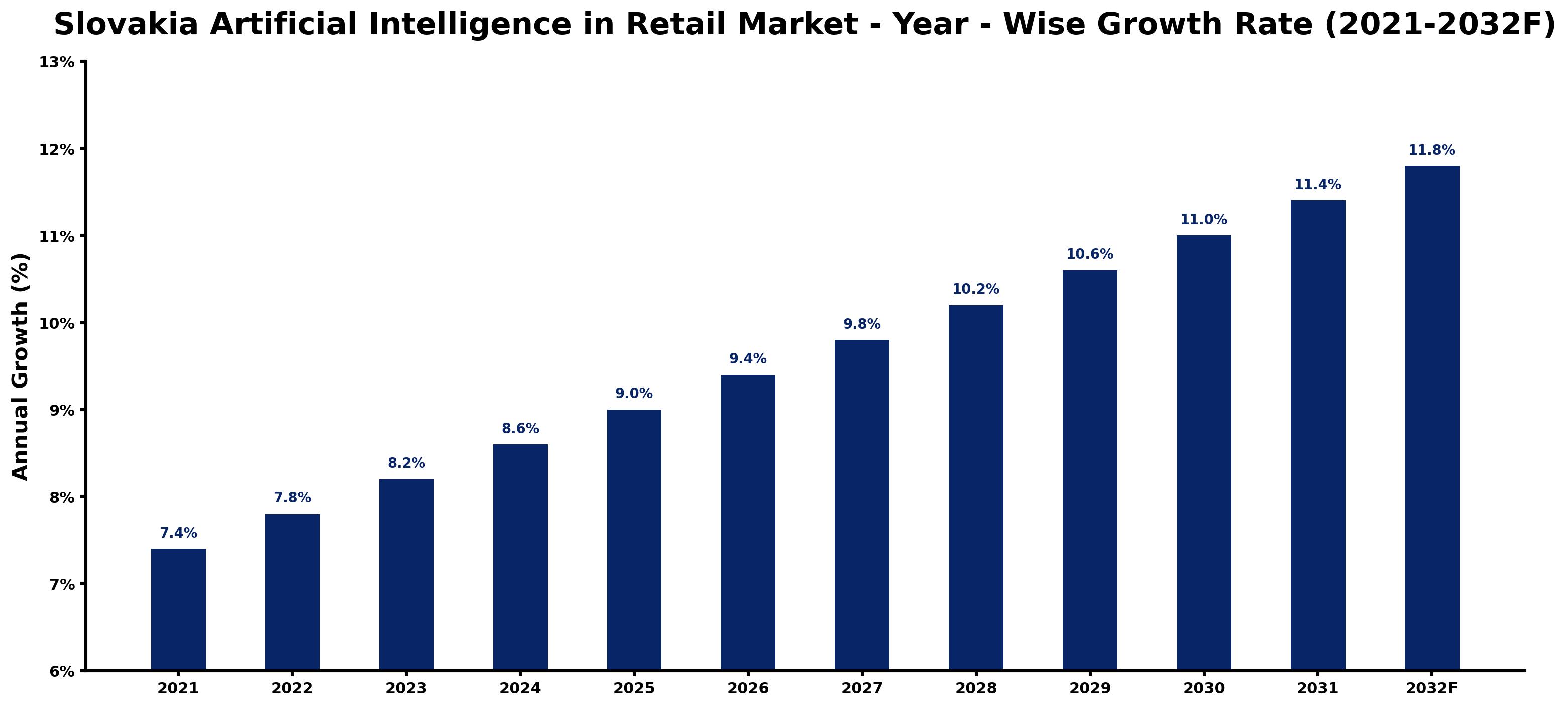
The table below presents the year‑wise growth rates along with the key drivers influencing the market
| Year | Growth Rate | Major Drivers |
| 2021 | 7.4% | Implementation of Slovakia’s AI Strategy boosting retail tech. |
| 2022 | 7.8% | Growing adoption of chatbots for customer support. |
| 2023 | 8.2% | Rise in e-commerce driving AI integration in retail. |
| 2024 | 8.6% | Establishment of AI Innovation Hub in Bratislava. |
| 2025 | 9.0% | Increased investment in retail analytics for strategic decisions. |
| 2026 | 9.4% | Partnerships between retailers and local AI startups rising. |
| 2027 | 9.8% | Implementation of GDPR driving need for AI compliance. |
| 2028 | 10.2% | Government incentives for technology adoption in small retailers. |
| 2029 | 10.6% | Emphasis on data-driven customer insights in retail strategies. |
| 2030 | 11.0% | Market shift toward AI-enabled supply chain efficiencies. |
| 2031 | 11.4% | Collaboration with universities enhancing AI research in retail. |
| 2032 | 11.8% | Consumer trust in AI technologies improving shopping experiences. |
Note: Market size estimations and growth projections presented in this report are based on 6Wresearch's proprietary forecasting methodology, utilizing the latest available industry data, government publications, and primary research inputs.
Slovakia Artificial Intelligence in Retail Market Key Takeaways
Below are some of the specific key takeaways from the market, including:
- The market is projected to grow substantially, reaching USD 1291 Million by 2032.
- Key applications of AI include personalized marketing, demand forecasting, and inventory management.
- Integration of AI technologies is enhancing operational efficiencies and customer experiences.
- Challenges such as talent shortages and data privacy concerns are impacting market growth.
- Government initiatives are increasingly supportive of AI adoption in the retail sector.
Evaluation of Restraints in Slovakia Artificial Intelligence in Retail Market
Despite the promising growth, the Slovakia Artificial Intelligence in Retail Market faces several constraints. One pressing issue is the scarcity of skilled professionals who possess both retail knowledge and AI expertise. This gap makes it challenging for retailers to implement AI solutions effectively. Additionally, the complexity of integrating AI into existing systems requires significant investment, both financially and in terms of time. Data privacy concerns are also paramount, as retailers must navigate stringent regulations to ensure customer data is protected, impacting their willingness to adopt AI technologies. Resistance from employees and customers to these technological changes further complicates the landscape, necessitating strategic approaches to facilitate smoother transitions.
Slovakia Artificial Intelligence in Retail Market Trends
The integration of AI technologies is becoming increasingly sophisticated within Slovakia's retail sector. Retailers are now focusing on utilizing predictive analytics to anticipate customer needs and preferences, which is proving vital in tailoring marketing strategies. Additionally, the rise of chatbots and virtual assistants is transforming customer service operations, allowing for round-the-clock support while reducing operational costs. The emphasis on omnichannel experiences is also notable, as AI facilitates seamless transitions between online and offline shopping, enhancing customer engagement.
Slovakia Artificial Intelligence in Retail Market Opportunities
Investors looking at the Slovakia Artificial Intelligence in Retail Market will find several lucrative avenues for growth. AI-powered personalized marketing solutions are on the rise, allowing retailers to craft targeted campaigns that resonate with consumers. The demand for advanced inventory management systems presents another opportunity, as these technologies can significantly reduce stock shortages and optimize supply chains. on top of that, chatbots and virtual assistants are gaining traction, offering cost-effective customer support solutions that enhance service quality. Additionally, investing in AI-driven fraud detection systems is becoming increasingly relevant, particularly as online transactions grow.
Government Initiatives in the Slovakia Artificial Intelligence in Retail Market
The Slovakian government acknowledges the transformative potential of artificial intelligence within the retail sector, enacting policies to encourage innovation and adoption. Emphasis is placed on promoting collaborations between academia and industry while ensuring ethical practices in AI deployment. These initiatives are crucial for building a trustworthy environment for consumers and businesses alike.
- A recently completed initiative focused on funding research and development in AI technologies specifically for the retail sector.
- Currently ongoing, a public-private partnership aims to enhance digital infrastructure to support AI integration in retail operations.
- A planned regulatory framework is set to be introduced by 2026, promoting transparency in AI usage and data handling.
- The government is providing incentives for small and medium-sized enterprises to adopt AI solutions in their business models.
- Future initiatives include a campaign to raise public awareness about AI benefits and ethical practices, expected to launch in early 2027.
Future Insights of the Slovakia Artificial Intelligence in Retail Market
From 2026 to 2032, the Slovakia Artificial Intelligence in Retail Market is set to experience transformative growth. With retailers increasingly recognizing the strategic advantages of AI, investments will likely surge, particularly in personalized marketing and operational efficiencies. As technology continues to evolve, AI applications such as advanced customer analytics and automated supply chain management will reshape retail practices, positioning businesses to better meet consumer expectations. This growth trajectory indicates a vibrant future for AI in retail, underpinned by continuous innovation and enhanced competitive dynamics.
Slovakia Artificial Intelligence in Retail Market Latest Developments
In the past year, the Slovakia Artificial Intelligence in Retail Market has seen a flurry of activity, indicating strong interest and investment in AI technologies. Retailers are increasingly implementing AI solutions, driven by the need to enhance customer experiences and streamline operations, which is resulting in a more competitive environment.
- A major technology vendor launched an AI-powered recommendation engine in early 2025, aiming to boost sales for e-commerce platforms.
- An ongoing initiative began in mid-2025 to integrate AI chatbots across various retail websites, enhancing customer service efficiency.
- A rollout of an AI-driven inventory management system is expected to begin in the second half of 2026, promising to reduce stockouts and improve supply chain dynamics.
- A partnership between a leading regional operator and a data analytics firm was formed in Q1 2025 to develop AI solutions tailored for the retail sector.
- By mid-2026, a new public campaign is anticipated to educate retailers on the benefits and implementation strategies for AI technologies.
Slovakia Artificial Intelligence in Retail Market - Key Attractiveness of the Report
- 10 Years of Market Numbers
- Historical Data Starting from 2022 to 2025
- Base Year: 2025
- Forecast Data until 2032
- Key Performance Indicators Impacting the Market
- Major Upcoming Developments and Projects
The Slovakian government has implemented policies focused on funding R&D, promoting collaboration between industry and academia, and ensuring ethical AI practices to foster a supportive environment for AI adoption.
Key Highlights of the Report:
- Slovakia Artificial Intelligence in Retail Market Outlook
- Market Size of Slovakia Artificial Intelligence in Retail Market, 2025
- Forecast of Slovakia Artificial Intelligence in Retail Market, 2032
- Historical Data and Forecast of Slovakia Artificial Intelligence in Retail Revenues & Volume for the Period 2022-2032F
- Slovakia Artificial Intelligence in Retail Market Trend Evolution
- Slovakia Artificial Intelligence in Retail Market Drivers and Challenges
- Slovakia Artificial Intelligence in Retail Price Trends
- Slovakia Artificial Intelligence in Retail Porter's Five Forces
- Slovakia Artificial Intelligence in Retail Industry Life Cycle
- Historical Data and Forecast of Slovakia Artificial Intelligence in Retail Market Revenues & Volume By Type for the Period 2022-2032F
- Historical Data and Forecast of Slovakia Artificial Intelligence in Retail Market Revenues & Volume By Online for the Period 2022-2032F
- Historical Data and Forecast of Slovakia Artificial Intelligence in Retail Market Revenues & Volume By Offline for the Period 2022-2032F
- Historical Data and Forecast of Slovakia Artificial Intelligence in Retail Market Revenues & Volume By Service for the Period 2022-2032F
- Historical Data and Forecast of Slovakia Artificial Intelligence in Retail Market Revenues & Volume By Professional for the Period 2022-2032F
- Historical Data and Forecast of Slovakia Artificial Intelligence in Retail Market Revenues & Volume By Managed for the Period 2022-2032F
- Historical Data and Forecast of Slovakia Artificial Intelligence in Retail Market Revenues & Volume By Technology for the Period 2022-2032F
- Historical Data and Forecast of Slovakia Artificial Intelligence in Retail Market Revenues & Volume By Machine Learning for the Period 2022-2032F
- Historical Data and Forecast of Slovakia Artificial Intelligence in Retail Market Revenues & Volume By Deep Learning for the Period 2022-2032F
- Historical Data and Forecast of Slovakia Artificial Intelligence in Retail Market Revenues & Volume By NLP for the Period 2022-2032F
- Slovakia Artificial Intelligence in Retail Import Export Trade Statistics
- Market Opportunity Assessment By Type
- Market Opportunity Assessment By Service
- Market Opportunity Assessment By Technology
- Slovakia Artificial Intelligence in Retail Top Companies Market Share
- Slovakia Artificial Intelligence in Retail Competitive Benchmarking By Technical and Operational Parameters
- Slovakia Artificial Intelligence in Retail Company Profiles
- Slovakia Artificial Intelligence in Retail Key Strategic Recommendations






































