Slovakia Bathroom Furniture Market Summary
The slovakia bathroom furniture market was estimated at USD 369 Million in 2025 and is projected to reach USD 519 Million by 2032, growing at a CAGR of 6.0% from 2026 to 2032.
Slovakia Bathroom Furniture Market Year-wise Growth Rate and Key Drivers
This graph highlights how the Slovakia Bathroom Furniture Market has steadily grown over the past five years, supported by major growth factors.
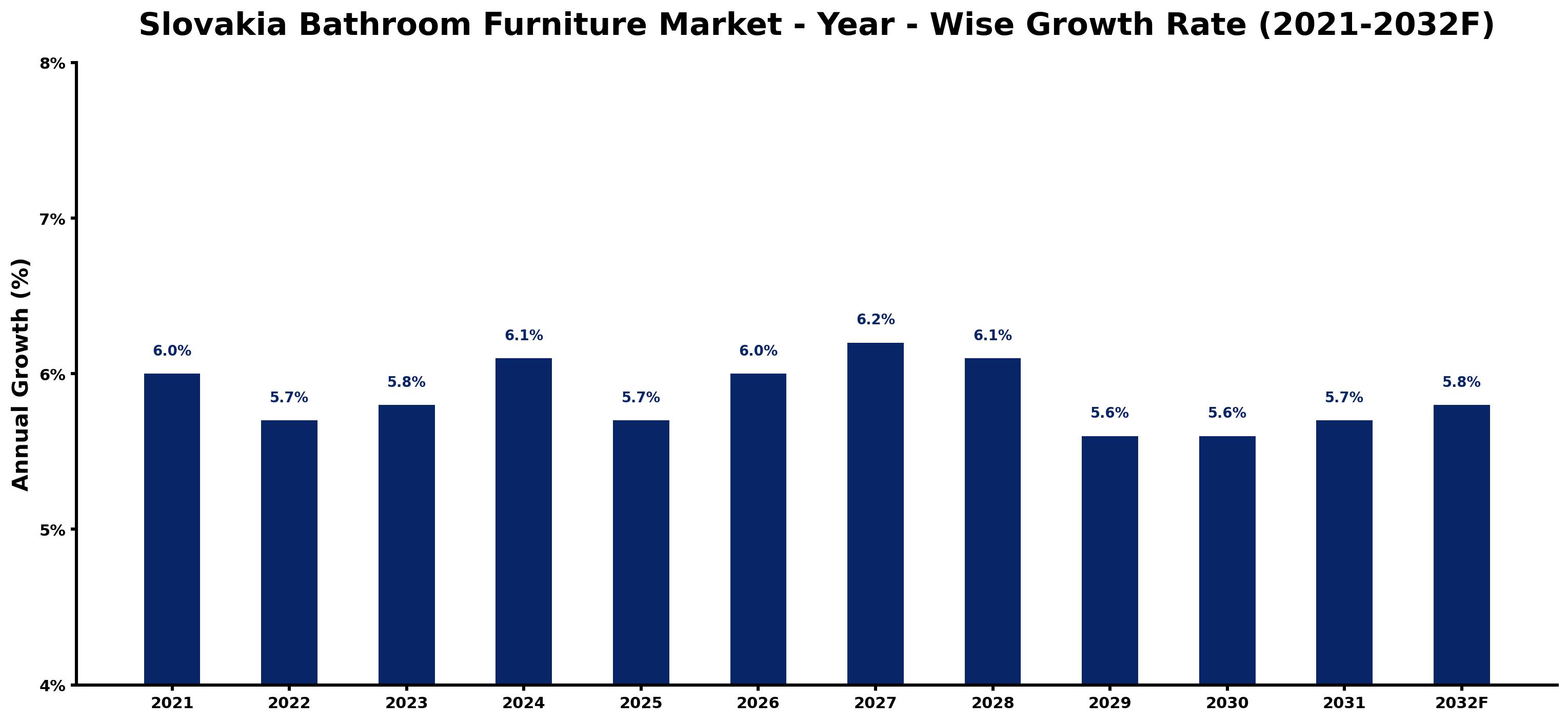
The table below presents the year wise growth rates along with the key drivers influencing the market
| Year | Growth Rate | Major Drivers |
| 2021 | 6.0% | Post-lockdown retail projects initiated a rebound in home renovation expenditures. |
| 2022 | 5.7% | Consumers focused on eco-friendly materials solidified sustainability as a key market trend. |
| 2023 | 5.8% | The influx of foreign investment supported premium bathroom furniture brands entering Slovakia. |
| 2024 | 6.1% | High construction activity in urban areas boosted demand for stylish bathroom interiors. |
| 2025 | 5.7% | Technological integration in manufacturing led to enhanced product customization options. |
| 2026 | 6.0% | Growing interest in wellness trends encouraged the inclusion of spa-like features in bathrooms. |
| 2027 | 6.2% | Digital platforms gained traction for purchasing, reshaping traditional retail dynamics significantly. |
| 2028 | 6.1% | A shift towards minimalism influenced design preferences, favoring clean lines and simplicity. |
| 2029 | 5.6% | Increased urbanization created a greater need for efficient space utilization in bathrooms. |
| 2030 | 5.6% | Economic recovery spurred disposable income, allowing consumers to invest in luxury items. |
| 2031 | 5.7% | Sustained infrastructure improvements enhanced distribution networks for bathroom furniture sales. |
| 2032 | 5.8% | Consumer education around smart home technology integrated seamlessly with bathroom designs. |
Note - Market size estimations and growth projections presented in this report are based on 6Wresearch's advanced forecasting approach, validated with industry datasets as of June 2026.
Slovakia Bathroom Furniture Market Synopsis
The Slovakia Bathroom Furniture Market is projected to reach 6.0% and witness significant growth during the forecast period (2026-2032). Factors contributing to this growth include increasing urbanization, rising disposable incomes, and heightened consumer awareness regarding home aesthetics. With a diverse range of products available, including bathroom vanities, cabinets, mirrors, and storage units, the market is experiencing a strong demand for modern, space-saving designs that cater to evolving consumer preferences.
Slovakia Bathroom Furniture Market Growth Drivers
Several key drivers are propelling growth within the Slovakia Bathroom Furniture Market. First, urbanization is leading to an increase in housing developments, prompting greater demand for aesthetically appealing bathroom solutions. Second, the rise in disposable incomes allows consumers to invest more in their homes, particularly in bathroom renovations. Third, an increased focus on home aesthetics is pushing consumers to seek stylish and functional bathroom furniture. Fourth, product innovation and customization options are enhancing consumer engagement, as companies adapt to diverse preferences and lifestyles. Finally, the expansion of online retail channels offers convenience and competitive pricing, attracting a wider customer base.
Slovakia Bathroom Furniture Market Trends and Opportunities
The Slovakia Bathroom Furniture Market is currently embracing several notable trends that present opportunities for growth. The shift towards minimalist and modern designs emphasizes functionality and efficient use of space, which aligns with contemporary consumer preferences. Consumers are increasingly interested in multifunctional furniture that offers storage solutions, responding to the challenges of limited bathroom space. Moreover, the use of eco-friendly materials and sustainable production practices is rising, particularly among environmentally-conscious buyers. Additionally, color trends lean towards neutral tones like white and gray, while bold accents and geometric patterns are being integrated for added visual appeal. The integration of smart technology into bathroom furniture, such as LED lighting and Bluetooth connectivity, is also on the rise, as consumers seek enhanced experiences in their bathrooms.
Slovakia Bathroom Furniture Market Challenges and Restraints
Despite the positive growth outlook, the Slovakia Bathroom Furniture Market faces several challenges. Intense competition from both domestic and international manufacturers necessitates continuous innovation and differentiation. Additionally, fluctuating raw material prices can impact production costs, creating uncertainties for manufacturers. Changing consumer preferences further complicate market dynamics, as companies must stay agile and responsive to evolving demands for modern designs. Furthermore, economic instability and variations in consumer spending patterns can adversely affect demand for bathroom furniture. Compliance with stringent regulations regarding product safety and environmental sustainability also poses challenges for manufacturers trying to balance cost-efficiency with compliance.
Slovakia Bathroom Furniture Market Investment Opportunities
The Slovakia Bathroom Furniture Market presents numerous investment opportunities, particularly for stakeholders looking to capitalize on the increasing urbanization and heightened focus on home renovations. The growing consumer demand for modern and stylish bathroom furniture supports the introduction of innovative and high-quality products into the market. Additionally, the push for environmentally friendly materials in production practices opens avenues for manufacturers specializing in sustainable solutions. Collaborations with interior designers and home renovation companies could also foster growth by addressing the demand for customized products that resonate with local aesthetics.
Slovakia Bathroom Furniture Market Government Investment and Initiatives
Government policies impacting the Slovakia Bathroom Furniture Market are primarily focused on consumer protection, quality standards, and environmental sustainability. Regulatory frameworks ensure that manufacturers and suppliers adhere to established safety and quality guidelines, thereby safeguarding consumer interests. Furthermore, government initiatives promote sustainable practices within the industry, encouraging the adoption of eco-friendly materials and production processes. The government also actively monitors market competition to deter anti-competitive behaviors, ensuring fairness in pricing and availability of products to consumers. Overall, these policies aim to foster an environment that enhances market growth while prioritizing safety and sustainability.
Slovakia Bathroom Furniture Market Latest Developments (May 2025 - June 2026)
The period from May 2025 to June 2026 has seen significant developments in the Slovakia Bathroom Furniture Market. There is a notable increase in consumer demand for innovative bathroom solutions, leading to heightened activity in product development specifically targeting modern design and functionality. Sustainability has continued to remain at the forefront, with more manufacturers investing in eco-friendly materials and sustainable practices, appealing to an environmentally-conscious consumer base. The growth of online retail platforms has further transformed purchasing dynamics, making it easier for consumers to access a broader array of products. As the market evolves, manufacturers are expected to adapt swiftly to trends in technology integration, particularly features enhancing smart home experiences.
Slovakia Bathroom Furniture Market - Key Attractiveness of the Report
- 10 Years of Market Numbers
- Historical Data Starting from 2022 to 2025
- Base Year: 2025
- Forecast Data until 2032
- Key Performance Indicators Impacting the Market
- Major Upcoming Developments and Projects
Key Highlights of the Report:
- Slovakia Bathroom Furniture Market Outlook
- Market Size of Slovakia Bathroom Furniture Market, 2025
- Forecast of Slovakia Bathroom Furniture Market, 2032F
- Historical Data and Forecast of Slovakia Bathroom Furniture Revenues & Volume for the Period 2022-2032F
- Slovakia Bathroom Furniture Market Trend Evolution
- Slovakia Bathroom Furniture Market Drivers and Challenges
- Slovakia Bathroom Furniture Price Trends
- Slovakia Bathroom Furniture Porter's Five Forces
- Slovakia Bathroom Furniture Industry Life Cycle
- Historical Data and Forecast of Slovakia Bathroom Furniture Market Revenues & Volume By Type for the Period 2022-2032F
- Historical Data and Forecast of Slovakia Bathroom Furniture Market Revenues & Volume By Bath Vanities for the Period 2022-2032F
- Historical Data and Forecast of Slovakia Bathroom Furniture Market Revenues & Volume By Console Vanity for the Period 2022-2032F
- Historical Data and Forecast of Slovakia Bathroom Furniture Market Revenues & Volume By Vanity Tops for the Period 2022-2032F
- Historical Data and Forecast of Slovakia Bathroom Furniture Market Revenues & Volume By Bathroom Mirrors for the Period 2022-2032F
- Historical Data and Forecast of Slovakia Bathroom Furniture Market Revenues & Volume By Other for the Period 2022-2032F
- Historical Data and Forecast of Slovakia Bathroom Furniture Market Revenues & Volume By Application for the Period 2022-2032F
- Historical Data and Forecast of Slovakia Bathroom Furniture Market Revenues & Volume By Household for the Period 2022-2032F
- Historical Data and Forecast of Slovakia Bathroom Furniture Market Revenues & Volume By Commercial for the Period 2022-2032F
- Historical Data and Forecast of Slovakia Bathroom Furniture Market Revenues & Volume By Other for the Period 2022-2032F
- Slovakia Bathroom Furniture Import Export Trade Statistics
- Market Opportunity Assessment By Type
- Market Opportunity Assessment By Application
- Slovakia Bathroom Furniture Top Companies Market Share
- Slovakia Bathroom Furniture Competitive Benchmarking By Technical and Operational Parameters
- Slovakia Bathroom Furniture Company Profiles
- Slovakia Bathroom Furniture Key Strategic Recommendations






































