Slovakia Canvas Market Size, Share & Growth Rate
The Slovakia Canvas Market was estimated at USD 320 Million in 2025 and is projected to reach USD 434 Million by 2032, growing at a CAGR of 4.4% from 2026 to 2032. This upward trajectory is driven by an escalating demand for high-quality canvas products across various industries, particularly in art, fashion, and home decor. The increasing consumer inclination towards sustainable and customized options further fuels this growth, creating a vibrant landscape for both local manufacturers and suppliers.
Slovakia Canvas Market Year-wise Growth Rate and Key Drivers
This graph highlights how the Slovakia Canvas Market has steadily grown over the years, supported by major growth factors.
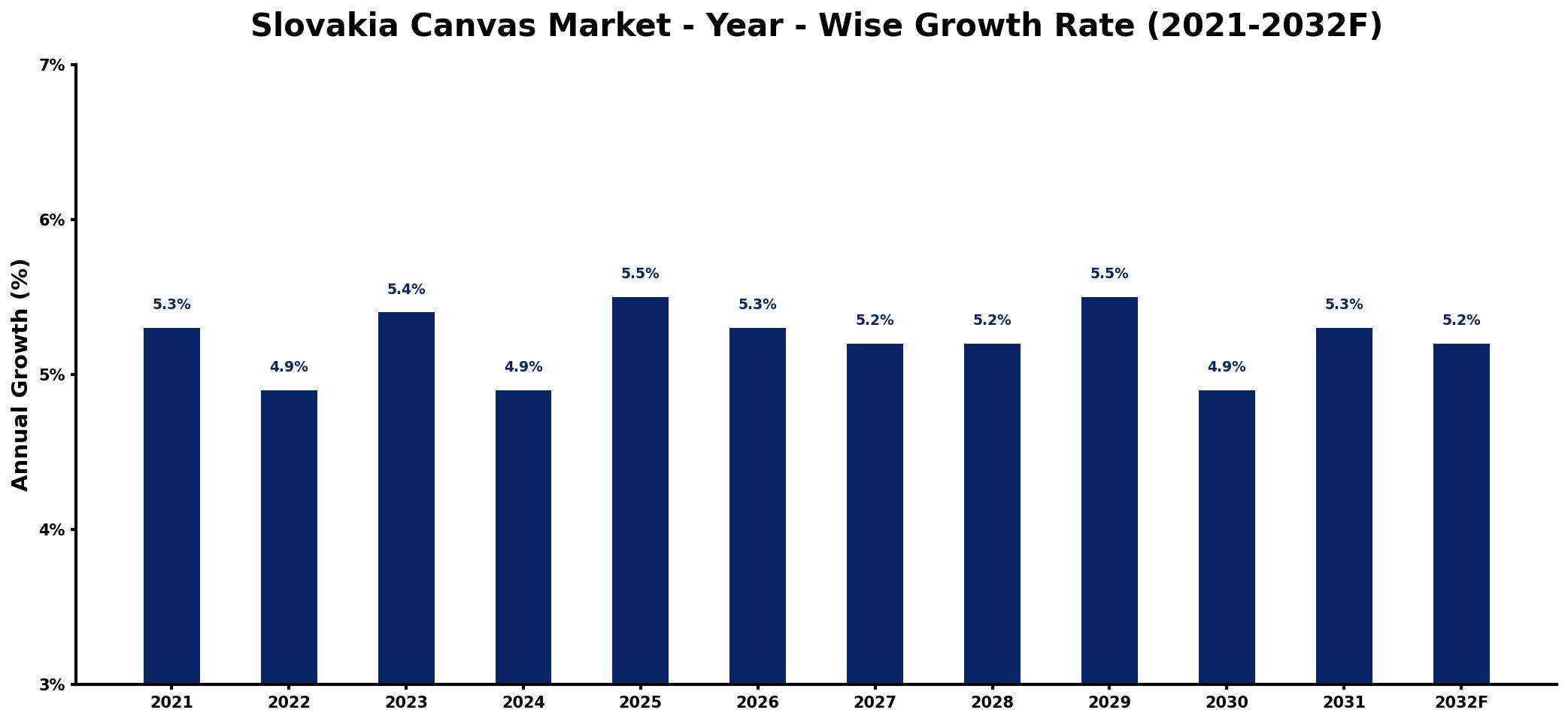
The table below presents the year‑wise growth rates along with the key drivers influencing the market
| Year | Growth Rate | Major Drivers |
| 2021 | 5.3% | Rising demand for art supplies |
| 2022 | 4.9% | Increased consumer spending on hobbies |
| 2023 | 5.4% | Growth in online art courses |
| 2024 | 4.9% | Expansion of retail art outlets |
| 2025 | 5.5% | Surge in DIY home projects |
| 2026 | 5.3% | Growing interest in sustainable materials |
| 2027 | 5.2% | Increased popularity of art therapy |
| 2028 | 5.2% | Rise in community art programs |
| 2029 | 5.5% | growing downstream application demand |
| 2030 | 4.9% | rising infrastructure development spending |
| 2031 | 5.3% | Increase in collaborative art projects |
| 2032 | 5.2% | improved processing technologies adoption |
Note: Market size estimations and growth projections presented in this report are based on 6Wresearch's proprietary forecasting methodology, utilizing the latest available industry data, government publications, and primary research inputs.
Slovakia Canvas Market Synopsis
The Slovakia canvas market is marked by a burgeoning interest in eco-friendly materials and custom designs. As consumers become more conscious of their environmental footprint, there is a noticeable shift towards ethically sourced canvas options. This change is not only reflected in consumer preferences but also in the commitment of local manufacturers to innovate and provide high-quality products that meet these standards.
The range of canvas products available in Slovakia includes stretched canvases, canvas rolls, and canvas panels, catering to the diverse needs of artists, designers, and decor enthusiasts. This diversity is crucial in addressing the demand for personalized and unique art pieces that resonate with consumers seeking to make bold statements in their living and working spaces.
Slovakia Canvas Market Key Takeaways
- The market is increasingly leaning towards sustainable and eco-friendly canvas materials.
- There is a growing consumer demand for customized and personalized canvas options.
- Technological advancements in digital printing are facilitating intricate designs and high-resolution prints.
- Local manufacturers are adapting to competitive pressures by focusing on quality and innovation.
- Trends indicate a shift towards larger canvas sizes for impactful art displays in homes and businesses.
Evaluation of Restraints in Slovakia Canvas Market
Despite its growth, the Slovakia canvas market faces several challenges. Intense competition among domestic and international suppliers creates a price-sensitive environment that can strain profit margins for smaller local businesses. Furthermore, fluctuating raw material prices, especially for cotton and polyester, pose additional risk factors, impacting cost structures. Additionally, the market is influenced by broader economic conditions and shifting consumer preferences, necessitating agility and strategic foresight from industry players to navigate these complexities.
Slovakia Canvas Market Trends
The landscape of the Slovakia canvas market is continually evolving, with notable trends emerging. There is an increasing preference for digital art and photography prints, driven by advancements in digital printing technology. Consumers are not only looking for unique and personalized artworks but also for options that reflect their values, leading to heightened interest in sustainable materials. Additionally, larger canvas sizes are becoming more popular, with homeowners and designers opting for statement pieces that transform spaces into bold expressions of style.
Slovakia Canvas Market Opportunities
Investors looking at the Slovakia canvas market will find substantial opportunities in multiple areas. The rising demand for canvas products across various sectors, such as art, fashion, and interior design, highlights the potential for investment in both manufacturing and distribution. Online platforms that specialize in custom canvas prints are also gaining traction, driven by the growth of e-commerce in the region. Additionally, supporting local artists through investments in art galleries and collaborative projects offers a unique avenue for growth while fostering cultural appreciation.
Government Initiatives in the Slovakia Canvas Market
The regulatory environment in Slovakia significantly impacts the canvas market, especially as it pertains to quality standards and environmental regulations. As a member of the European Union, Slovakia adheres to stringent guidelines on product quality, which can influence local manufacturing practices. Trade agreements facilitate the import and export of raw materials, while VAT rates and import duties play a crucial role in shaping market pricing and competitiveness. Overall, supportive government initiatives towards sustainable practices can further bolster the growth of this market.
Future Insights of the Slovakia Canvas Market
Looking ahead to 2026-2032, the Slovakia canvas market is expected to maintain its growth momentum, driven by an ongoing increase in the demand for canvas products. The emphasis on customization and personalization will likely continue to rise, offering substantial opportunities for innovative design solutions. E-commerce growth will further enhance the accessibility of canvas products to a wider audience. However, market players must remain vigilant to external pressures such as raw material price fluctuations and competition from alternative materials to sustain their market position.
Slovakia Canvas Market Latest Developments (2025 - 2026)
Recent months have seen a shift in consumer preferences towards locally produced canvas options, with an increasing emphasis on quality and sustainability. As various local manufacturers adapt to meet these demands, collaborations between artists and canvas producers have become more prevalent, fostering innovation in product design. Additionally, e-commerce platforms have expanded their offerings, catering to the growing trend of online shopping for custom canvas prints, which is reshaping market dynamics.
Slovakia Canvas Market - Key Attractiveness of the Report
- 10 Years of Market Numbers
- Historical Data Starting from 2022 to 2025
- Base Year: 2025
- Forecast Data until 2032
- Key Performance Indicators Impacting the Market
- Major Upcoming Developments and Projects
Key Highlights of the Report:
- Slovakia Canvas Market Outlook
- Market Size of Slovakia Canvas Market, 2025
- Forecast of Slovakia Canvas Market, 2032
- Historical Data and Forecast of Slovakia Canvas Revenues & Volume for the Period 2022-2032F
- Slovakia Canvas Market Trend Evolution
- Slovakia Canvas Market Drivers and Challenges
- Slovakia Canvas Price Trends
- Slovakia Canvas Porter's Five Forces
- Slovakia Canvas Industry Life Cycle
- Historical Data and Forecast of Slovakia Canvas Market Revenues & Volume By Types for the Period 2022-2032F
- Historical Data and Forecast of Slovakia Canvas Market Revenues & Volume By Plane Canvas for the Period 2022-2032F
- Historical Data and Forecast of Slovakia Canvas Market Revenues & Volume By Duck Canvas for the Period 2022-2032F
- Historical Data and Forecast of Slovakia Canvas Market Revenues & Volume By Application for the Period 2022-2032F
- Historical Data and Forecast of Slovakia Canvas Market Revenues & Volume By Tent for the Period 2022-2032F
- Historical Data and Forecast of Slovakia Canvas Market Revenues & Volume By Luggage Fabric for the Period 2022-2032F
- Historical Data and Forecast of Slovakia Canvas Market Revenues & Volume By Automotive Fabric for the Period 2022-2032F
- Historical Data and Forecast of Slovakia Canvas Market Revenues & Volume By Apparel for the Period 2022-2032F
- Historical Data and Forecast of Slovakia Canvas Market Revenues & Volume By Others for the Period 2022-2032F
- Slovakia Canvas Import Export Trade Statistics
- Market Opportunity Assessment By Types
- Market Opportunity Assessment By Application
- Slovakia Canvas Top Companies Market Share
- Slovakia Canvas Competitive Benchmarking By Technical and Operational Parameters
- Slovakia Canvas Company Profiles
- Slovakia Canvas Key Strategic Recommendations






































