Slovakia Cellulose Acetate Fiber Market Size, Share & Growth Rate
The Slovakia Cellulose Acetate Fiber Market was estimated at USD 664 Million in 2025 and is projected to reach USD 957 Million by 2032, growing at a CAGR of 5.4% from 2026 to 2032. This upward trajectory is propelled by increasing applications in the textile, automotive, and healthcare sectors, where cellulose acetate fibers unique properties—such as durability and chemical resistance—are highly valued. The growing consumer preference for sustainable and eco-friendly materials is also significantly influencing this growth, positioning cellulose acetate fiber as an attractive alternative to traditional synthetic options.
Slovakia Cellulose Acetate Fiber Market Year-wise Growth Rate and Key Drivers
This graph highlights how the Slovakia Cellulose Acetate Fiber Market has steadily grown over the years, supported by major growth factors.
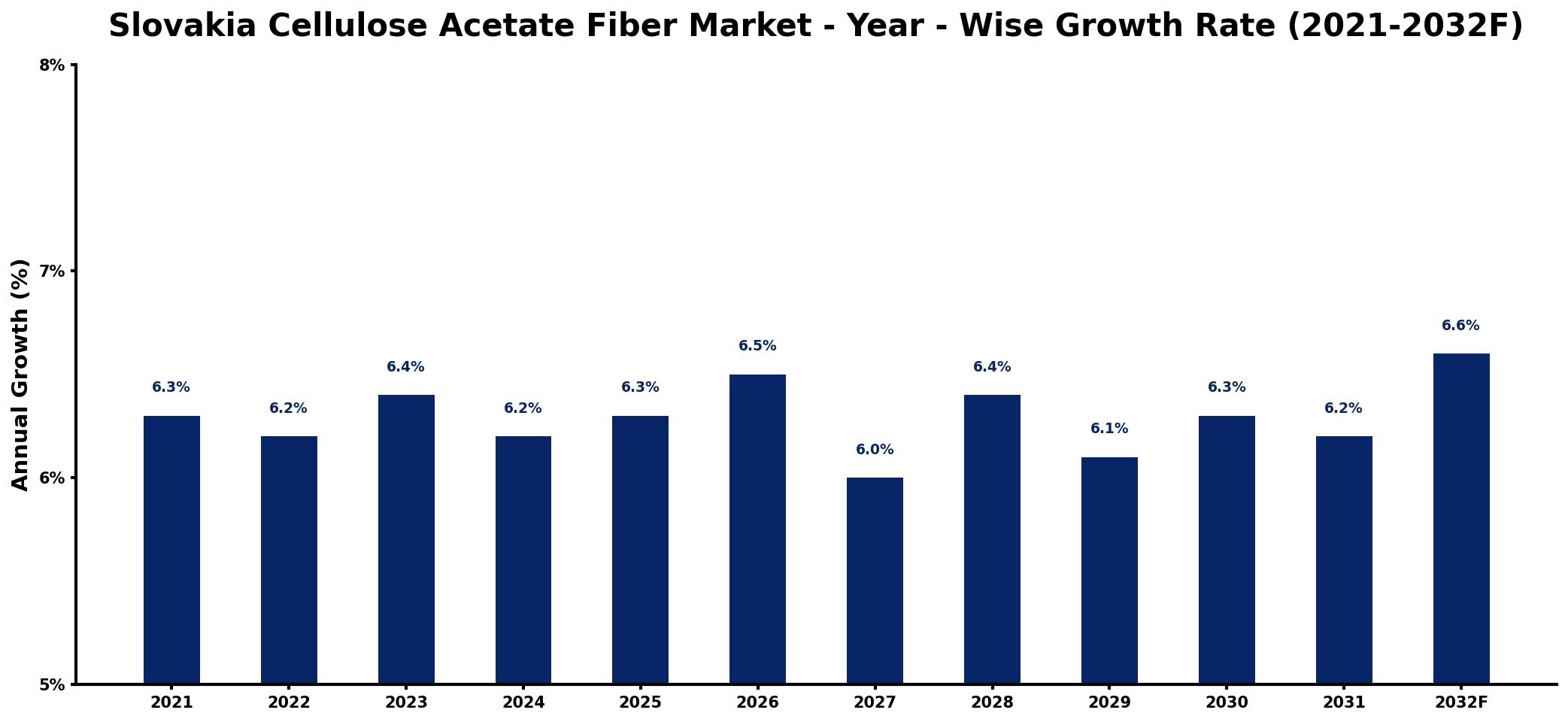
The table below presents the year‑wise growth rates along with the key drivers influencing the market
| Year | Growth Rate | Major Drivers |
| 2021 | 6.3% | Rising demand for sustainable materials |
| 2022 | 6.2% | Increased investment in renewable resources |
| 2023 | 6.4% | Expansion of textile manufacturing capabilities |
| 2024 | 6.2% | Growth in eco-friendly product offerings |
| 2025 | 6.3% | Enhanced consumer awareness on sustainability |
| 2026 | 6.5% | Development of innovative production techniques |
| 2027 | 6.0% | Emergence of new application markets |
| 2028 | 6.4% | Strengthening of supply chain networks |
| 2029 | 6.1% | Boost in fashion industry collaborations |
| 2030 | 6.3% | Surge in retail market opportunities |
| 2031 | 6.2% | Growing popularity of biodegradable options |
| 2032 | 6.6% | Advancements in recycling technologies |
Note: Market size estimations and growth projections presented in this report are based on 6Wresearch's proprietary forecasting methodology, utilizing the latest available industry data, government publications, and primary research inputs.
Slovakia Cellulose Acetate Fiber Market Synopsis
In Slovakia, the textile industry remains the dominant consumer of cellulose acetate fiber, utilizing it in a wide array of products ranging from clothing to home textiles. This sector's reliance on high-quality, sustainable materials is a pivotal driver for market growth.
Meanwhile, the automotive industry increasingly adopts cellulose acetate for upholstery and other interior components, attracted by its robust characteristics. Additionally, the healthcare segment recognizes the value of this fiber in medical textiles, further enhancing its market presence.
Slovakia Cellulose Acetate Fiber Market Key Takeaways
- The market is on a growth trajectory, with a strong focus on sustainable practices.
- Textile and automotive industries are primary consumers of cellulose acetate fiber in Slovakia.
- Healthcare applications are expanding, further diversifying the market demand.
- Technological advancements are improving the quality and performance of cellulose acetate fibers.
- Government policies play a crucial role in shaping market dynamics and competitiveness.
Evaluation of Restraints in Slovakia Cellulose Acetate Fiber Market
Despite the promising outlook, the Slovakia Cellulose Acetate Fiber Market faces notable constraints, chiefly stemming from competition with lower-cost synthetic fibers like polyester and nylon. These alternatives often provide similar physical properties, presenting a pricing challenge for cellulose acetate producers. Additionally, the volatility in raw material prices, particularly wood pulp, can significantly impact production costs and profitability. Environmental regulations regarding the manufacturing process pose another challenge, as companies strive to balance sustainable practices with financial viability.
Slovakia Cellulose Acetate Fiber Market Trends
A prominent trend in the Slovakia Cellulose Acetate Fiber Market is the shift toward sustainability, as consumers increasingly prefer biodegradable options over traditional synthetic fibers. This has led manufacturers to enhance their production processes and source renewable materials. Furthermore, innovations in production technology are resulting in higher quality fibers that exhibit superior performance attributes, further solidifying cellulose acetate's position across diverse applications.
Slovakia Cellulose Acetate Fiber Market Opportunities
Investment opportunities in the Slovakia Cellulose Acetate Fiber Market are burgeoning, particularly as industries seek out eco-friendly alternatives to synthetic materials. The growing recognition of cellulose acetate's benefits—such as breathability and softness—positions it favorably for further penetration into the fashion and healthcare sectors. Investors and manufacturers who can leverage consumer preferences for sustainability while optimizing production processes are likely to reap significant rewards.
Government Initiatives in the Slovakia Cellulose Acetate Fiber Market
The Slovak government is actively promoting sustainable manufacturing practices through various policies and initiatives. These may include subsidies for green technologies, regulatory frameworks that encourage environmentally friendly production methods, and quality control standards to ensure safety and reliability. Such measures aim to enhance the competitiveness of domestic cellulose acetate fiber producers while fostering innovation within the industry.
Future Insights of the Slovakia Cellulose Acetate Fiber Market
Looking forward to 2026-2032, the Slovakia Cellulose Acetate Fiber Market is expected to thrive, driven by the enduring demand for sustainable textile materials. As consumer awareness regarding environmental issues continues to rise, industries will likely expand their adoption of cellulose acetate fibers. Innovations in fiber technology and production methods will further support market growth, ensuring that the industry adapts to and meets evolving consumer needs.
Slovakia Cellulose Acetate Fiber Market Latest Developments (2025 - 2026)
Recent developments in the Slovakia Cellulose Acetate Fiber Market indicate a stronger focus on sustainable practices, with companies increasingly investing in eco-friendly production processes. There is a noticeable uptick in collaborations between manufacturers and research institutions aimed at enhancing fiber properties and performance. Additionally, the market is witnessing a gradual shift in consumer preferences, favoring products that are biodegradable and sourced from renewable materials.
Slovakia Cellulose Acetate Fiber Market - Key Attractiveness of the Report
- 10 Years of Market Numbers
- Historical Data Starting from 2022 to 2025
- Base Year: 2025
- Forecast Data until 2032
- Key Performance Indicators Impacting the Market
- Major Upcoming Developments and Projects
Key Highlights of the Report:
- Slovakia Cellulose Acetate Fiber Market Outlook
- Market Size of Slovakia Cellulose Acetate Fiber Market, 2025
- Forecast of Slovakia Cellulose Acetate Fiber Market, 2032
- Historical Data and Forecast of Slovakia Cellulose Acetate Fiber Revenues & Volume for the Period 2022-2032F
- Slovakia Cellulose Acetate Fiber Market Trend Evolution
- Slovakia Cellulose Acetate Fiber Market Drivers and Challenges
- Slovakia Cellulose Acetate Fiber Price Trends
- Slovakia Cellulose Acetate Fiber Porter's Five Forces
- Slovakia Cellulose Acetate Fiber Industry Life Cycle
- Historical Data and Forecast of Slovakia Cellulose Acetate Fiber Market Revenues & Volume By Type for the Period 2022-2032F
- Historical Data and Forecast of Slovakia Cellulose Acetate Fiber Market Revenues & Volume By Plastic for the Period 2022-2032F
- Historical Data and Forecast of Slovakia Cellulose Acetate Fiber Market Revenues & Volume By Fiber for the Period 2022-2032F
- Historical Data and Forecast of Slovakia Cellulose Acetate Fiber Market Revenues & Volume By Application for the Period 2022-2032F
- Historical Data and Forecast of Slovakia Cellulose Acetate Fiber Market Revenues & Volume By Photographic Films for the Period 2022-2032F
- Historical Data and Forecast of Slovakia Cellulose Acetate Fiber Market Revenues & Volume By Cigarette Filters for the Period 2022-2032F
- Historical Data and Forecast of Slovakia Cellulose Acetate Fiber Market Revenues & Volume By Tapes & Labels for the Period 2022-2032F
- Historical Data and Forecast of Slovakia Cellulose Acetate Fiber Market Revenues & Volume By Textiles & Apparel for the Period 2022-2032F
- Slovakia Cellulose Acetate Fiber Import Export Trade Statistics
- Market Opportunity Assessment By Type
- Market Opportunity Assessment By Application
- Slovakia Cellulose Acetate Fiber Top Companies Market Share
- Slovakia Cellulose Acetate Fiber Competitive Benchmarking By Technical and Operational Parameters
- Slovakia Cellulose Acetate Fiber Company Profiles
- Slovakia Cellulose Acetate Fiber Key Strategic Recommendations






































