Slovakia Cloud Infrastructure Services Market Size & Growth Rate (2026-2032)
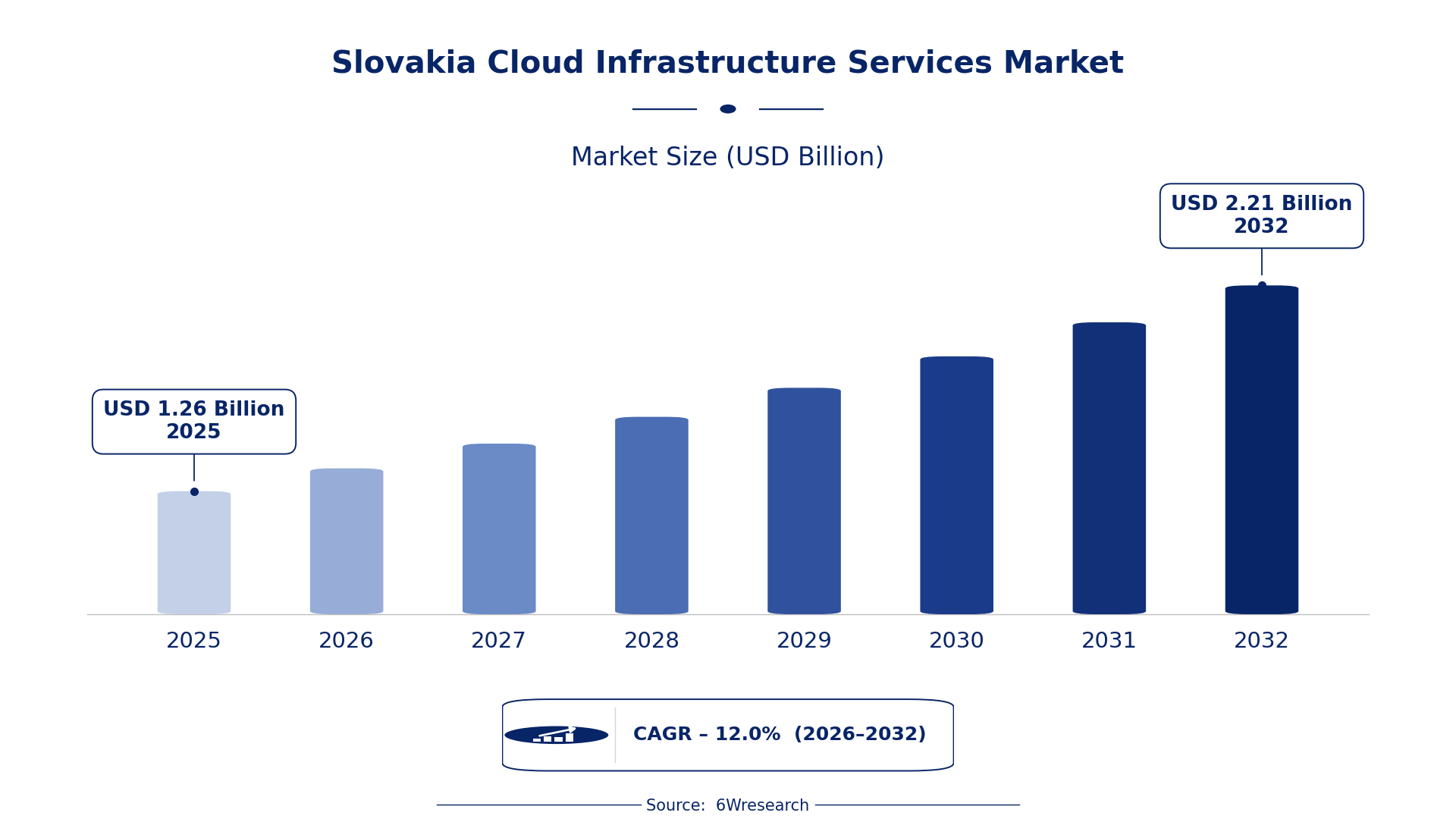
The Slovakia Cloud Infrastructure Services Market was estimated at USD 1259 Million in 2025 and is projected to reach USD 2206 Million by 2032, growing at a CAGR of 12.0% from 2026 to 2032.
Slovakia Cloud Infrastructure Services Market Synopsis
The increasing adoption of cloud computing technologies is the most powerful force driving the Slovakia Cloud Infrastructure Services Market. Businesses across various sectors are eager to modernize their IT infrastructure, leveraging the benefits of cloud solutions.
As organizations seek scalability, flexibility, and cost-efficiency, the demand for services like IaaS, PaaS, and SaaS is surging. This trend reflects a broader digital transformation that is reshaping how businesses operate, making cloud services essential for competitive advantage.
Slovakia Cloud Infrastructure Services Market Year-wise Growth Rate and Key Drivers
This graph illustrates the annual growth rates of the Slovakia Cloud Infrastructure Services Market from 2021 to 2032, highlighting a steady upward trajectory and projected expansion over the forecast period.
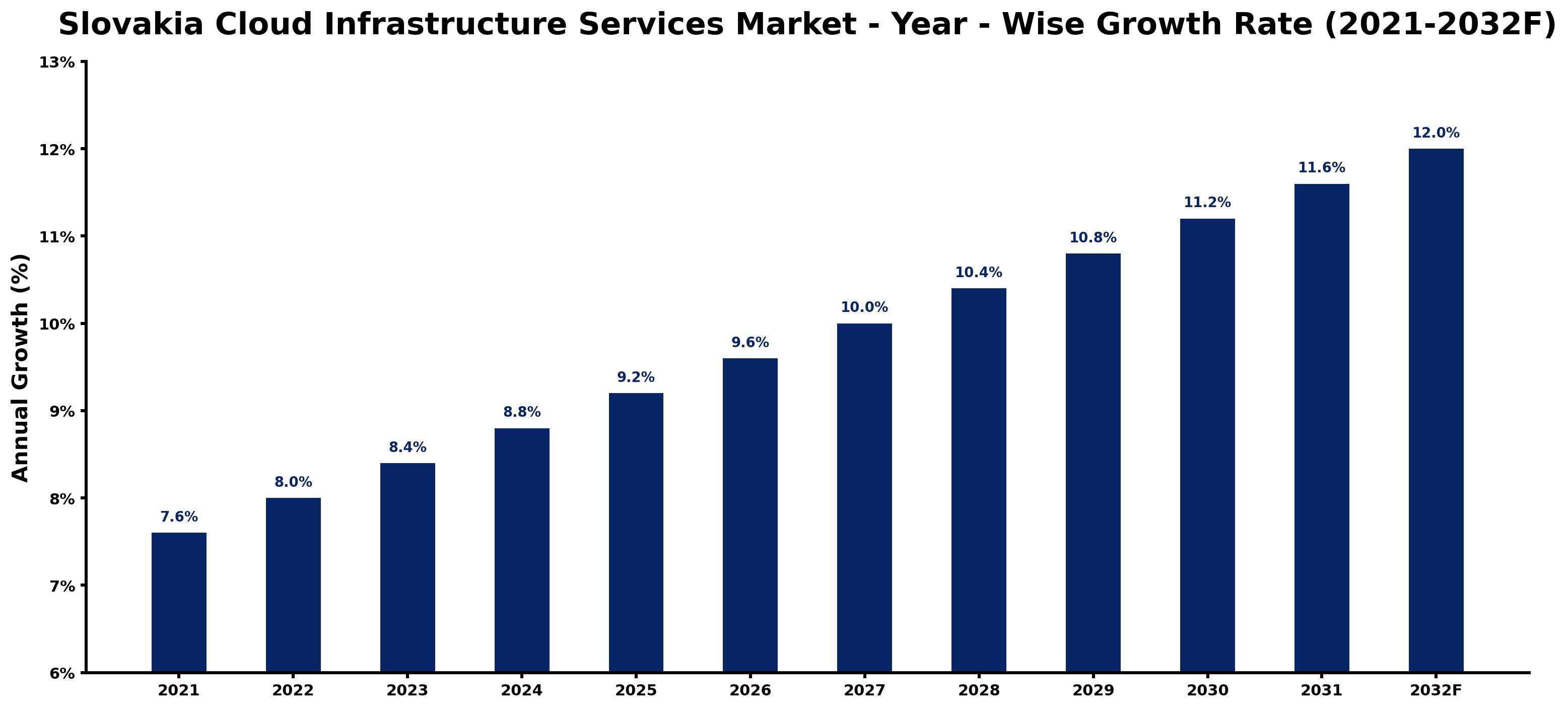
The table below presents the year‑wise growth rates along with the key drivers influencing the market
| Year | Growth Rate | Major Drivers |
| 2021 | 7.6% | Increased investment in IT infrastructure by Slovak companies. |
| 2022 | 8.0% | Emergence of local cloud service providers in Slovakia. |
| 2023 | 8.4% | Adoption of hybrid cloud solutions by regional businesses. |
| 2024 | 8.8% | Government incentives for SMEs to embrace cloud technologies. |
| 2025 | 9.2% | Partnerships between tech firms to enhance cloud services. |
| 2026 | 9.6% | Rise of remote work increasing cloud service reliance. |
| 2027 | 10.0% | Slovakia's strategic location attracting foreign cloud investments. |
| 2028 | 10.4% | Growing number of startups seeking cloud scalability. |
| 2029 | 10.8% | Local universities enhancing cloud computing curriculum for students. |
| 2030 | 11.2% | Increasing cybersecurity regulations boosting demand for cloud security. |
| 2031 | 11.6% | Slovak market embracing edge computing alongside cloud growth. |
| 2032 | 12.0% | Collaboration with EU on cloud infrastructure projects. |
Note: Market size estimations and growth projections presented in this report are based on 6Wresearch's proprietary forecasting methodology, utilizing the latest available industry data, government publications, and primary research inputs.
Slovakia Cloud Infrastructure Services Market Key Takeaways
Below are some of the specific key takeaways from the market, including:
- The market is projected to grow from USD 1259 Million in 2025 to USD 2206 Million by 2032.
- Demand for hybrid and multi-cloud environments is on the rise as businesses look for diverse solutions.
- Edge computing solutions are gaining traction, driven by the need for real-time data processing.
- Security concerns and regulatory compliance continue to challenge market growth.
- Investment in specialized cloud solutions for different industries is expected to create new opportunities.
Evaluation of Restraints in Slovakia Cloud Infrastructure Services Market
Despite the promising outlook, several restraints hinder the growth of the Slovakia Cloud Infrastructure Services Market. Data security and privacy concerns remain paramount as businesses migrate sensitive information to cloud platforms. A lack of understanding about the benefits of cloud services hampers adoption, particularly among smaller enterprises. on top of that, legacy systems in certain organizations complicate the integration of new cloud technologies, creating barriers to entry for many potential users. Compliance with regulatory requirements adds another layer of complexity, making it crucial for providers to address these issues to foster growth.
Slovakia Cloud Infrastructure Services Market Trends
Several trends are shaping the Slovakia Cloud Infrastructure Services Market. A notable shift towards hybrid and multi-cloud strategies is evident, as organizations seek to optimize their cloud environments for flexibility and resilience. Additionally, the integration of artificial intelligence and machine learning into cloud services is becoming increasingly common, enhancing the capabilities of these solutions.
on top of that, the demand for edge computing is rising, driven by the need for low-latency processing and real-time analytics. As businesses continue to embrace digital transformation, these trends indicate a move towards more sophisticated and specialized cloud infrastructure solutions.
Slovakia Cloud Infrastructure Services Market Opportunities
Opportunities in the Slovakia Cloud Infrastructure Services Market are abundant, particularly in developing tailored solutions for specific industries such as healthcare and finance. The expansion of data center infrastructure is essential to accommodate the growing workloads associated with cloud services. on top of that, organizations are increasingly looking for managed services to optimize their cloud environments, presenting a significant avenue for providers.
As businesses continue to digitize their operations, the demand for advanced cloud solutions that enhance efficiency and security will likely drive investment in this sector.
Government Initiatives in the Slovakia Cloud Infrastructure Services Market
The Slovak government is actively shaping the Cloud Infrastructure Services Market through various initiatives aimed at fostering growth and innovation. By implementing supportive regulations and providing incentives for data center investments, the government is creating a conducive environment for cloud service providers. Cybersecurity regulations have been enhanced to ensure the protection of data, which is increasingly important in today’s digital economy.
- A recently completed initiative focused on offering tax incentives for investments in cloud infrastructure to stimulate growth in the sector.
- Currently ongoing programs are enhancing cybersecurity measures across cloud services, aimed at improving data protection for businesses.
- A planned public-private partnership is expected to expand digital infrastructure access by 2028, facilitating better connectivity for cloud services.
- New regulations introduced in 2025 are mandating transparency in billing practices for cloud service providers to improve customer trust.
Future Insights of the Slovakia Cloud Infrastructure Services Market
Looking ahead to 2026-2032, the Slovakia Cloud Infrastructure Services Market is set for substantial growth. As more businesses recognize the importance of cloud technologies, demand for IaaS, PaaS, and SaaS solutions will continue to rise. Companies will focus on expanding their service offerings to meet evolving customer needs, particularly regarding security and data management.
The ongoing digital transformation across various sectors will drive innovation, positioning cloud computing as a critical component of future business strategies. As organizations strive for agility and efficiency, the market will likely witness new entrants and increased competition, ultimately benefiting end-users.
Slovakia Cloud Infrastructure Services Market Latest Developments
Recent activity in the Slovakia Cloud Infrastructure Services Market has been characterized by a surge in investments and partnerships aimed at enhancing service offerings. Companies are increasingly focused on developing advanced technologies to meet the growing demand for cloud solutions.
- A major technology vendor launched a new suite of cloud services in early 2025, designed to cater to small and medium-sized enterprises.
- An initiative that began in mid-2025 is currently underway to upgrade existing data centers to support higher capacity and improved performance.
- A strategic partnership was formed in late 2025 between a regional operator and a global cloud provider to enhance service delivery across Slovakia.
- A rollout expected to begin in the second half of 2026 will introduce AI-driven analytics tools within cloud platforms, offering customers greater insights.
Slovakia Cloud Infrastructure Services Market - Key Attractiveness of the Report
- 10 Years of Market Numbers
- Historical Data Starting from 2022 to 2025
- Base Year: 2025
- Forecast Data until 2032
- Key Performance Indicators Impacting the Market
- Major Upcoming Developments and Projects
Key Highlights of the Report:
- Slovakia Cloud Infrastructure Services Market Outlook
- Market Size of Slovakia Cloud Infrastructure Services Market, 2025
- Forecast of Slovakia Cloud Infrastructure Services Market, 2032
- Historical Data and Forecast of Slovakia Cloud Infrastructure Services Revenues & Volume for the Period 2022-2032F
- Slovakia Cloud Infrastructure Services Market Trend Evolution
- Slovakia Cloud Infrastructure Services Market Drivers and Challenges
- Slovakia Cloud Infrastructure Services Price Trends
- Slovakia Cloud Infrastructure Services Porter's Five Forces
- Slovakia Cloud Infrastructure Services Industry Life Cycle
- Historical Data and Forecast of Slovakia Cloud Infrastructure Services Market Revenues & Volume By Service Type for the Period 2022-2032F
- Historical Data and Forecast of Slovakia Cloud Infrastructure Services Market Revenues & Volume By Compute as a Service for the Period 2022-2032F
- Historical Data and Forecast of Slovakia Cloud Infrastructure Services Market Revenues & Volume By Storage as a Service for the Period 2022-2032F
- Historical Data and Forecast of Slovakia Cloud Infrastructure Services Market Revenues & Volume By Disaster Recovery and Backup as a Service for the Period 2022-2032F
- Historical Data and Forecast of Slovakia Cloud Infrastructure Services Market Revenues & Volume By Networking as a Service for the Period 2022-2032F
- Historical Data and Forecast of Slovakia Cloud Infrastructure Services Market Revenues & Volume By Desktop as a Service for the Period 2022-2032F
- Historical Data and Forecast of Slovakia Cloud Infrastructure Services Market Revenues & Volume By Managed Hosting for the Period 2022-2032F
- Historical Data and Forecast of Slovakia Cloud Infrastructure Services Market Revenues & Volume By Deployment Type for the Period 2022-2032F
- Historical Data and Forecast of Slovakia Cloud Infrastructure Services Market Revenues & Volume By On-premises for the Period 2022-2032F
- Historical Data and Forecast of Slovakia Cloud Infrastructure Services Market Revenues & Volume By Cloud for the Period 2022-2032F
- Historical Data and Forecast of Slovakia Cloud Infrastructure Services Market Revenues & Volume By Organization Size for the Period 2022-2032F
- Historical Data and Forecast of Slovakia Cloud Infrastructure Services Market Revenues & Volume By Small and Medium-sized Enterprises (SMEs) for the Period 2022-2032F
- Historical Data and Forecast of Slovakia Cloud Infrastructure Services Market Revenues & Volume By Large Enterprises for the Period 2022-2032F
- Historical Data and Forecast of Slovakia Cloud Infrastructure Services Market Revenues & Volume By Vertical for the Period 2022-2032F
- Historical Data and Forecast of Slovakia Cloud Infrastructure Services Market Revenues & Volume By Banking, Financial Services, and Insurance (BFSI) for the Period 2022-2032F
- Historical Data and Forecast of Slovakia Cloud Infrastructure Services Market Revenues & Volume By IT and Telecommunications for the Period 2022-2032F
- Historical Data and Forecast of Slovakia Cloud Infrastructure Services Market Revenues & Volume By Government and Public Sector for the Period 2022-2032F
- Historical Data and Forecast of Slovakia Cloud Infrastructure Services Market Revenues & Volume By Retail and Consumer Goods for the Period 2022-2032F
- Historical Data and Forecast of Slovakia Cloud Infrastructure Services Market Revenues & Volume By Manufacturing for the Period 2022-2032F
- Historical Data and Forecast of Slovakia Cloud Infrastructure Services Market Revenues & Volume By Energy and Utilities for the Period 2022-2032F
- Historical Data and Forecast of Slovakia Cloud Infrastructure Services Market Revenues & Volume By Media and Entertainment for the Period 2022-2032F
- Historical Data and Forecast of Slovakia Cloud Infrastructure Services Market Revenues & Volume By Healthcare and Life Sciences for the Period 2022-2032F
- Slovakia Cloud Infrastructure Services Import Export Trade Statistics
- Market Opportunity Assessment By Service Type
- Market Opportunity Assessment By Deployment Type
- Market Opportunity Assessment By Organization Size
- Market Opportunity Assessment By Vertical
- Slovakia Cloud Infrastructure Services Top Companies Market Share
- Slovakia Cloud Infrastructure Services Competitive Benchmarking By Technical and Operational Parameters
- Slovakia Cloud Infrastructure Services Company Profiles
- Slovakia Cloud Infrastructure Services Key Strategic Recommendations






































