Slovakia Construction Vehicles Market Size (2020-2030)
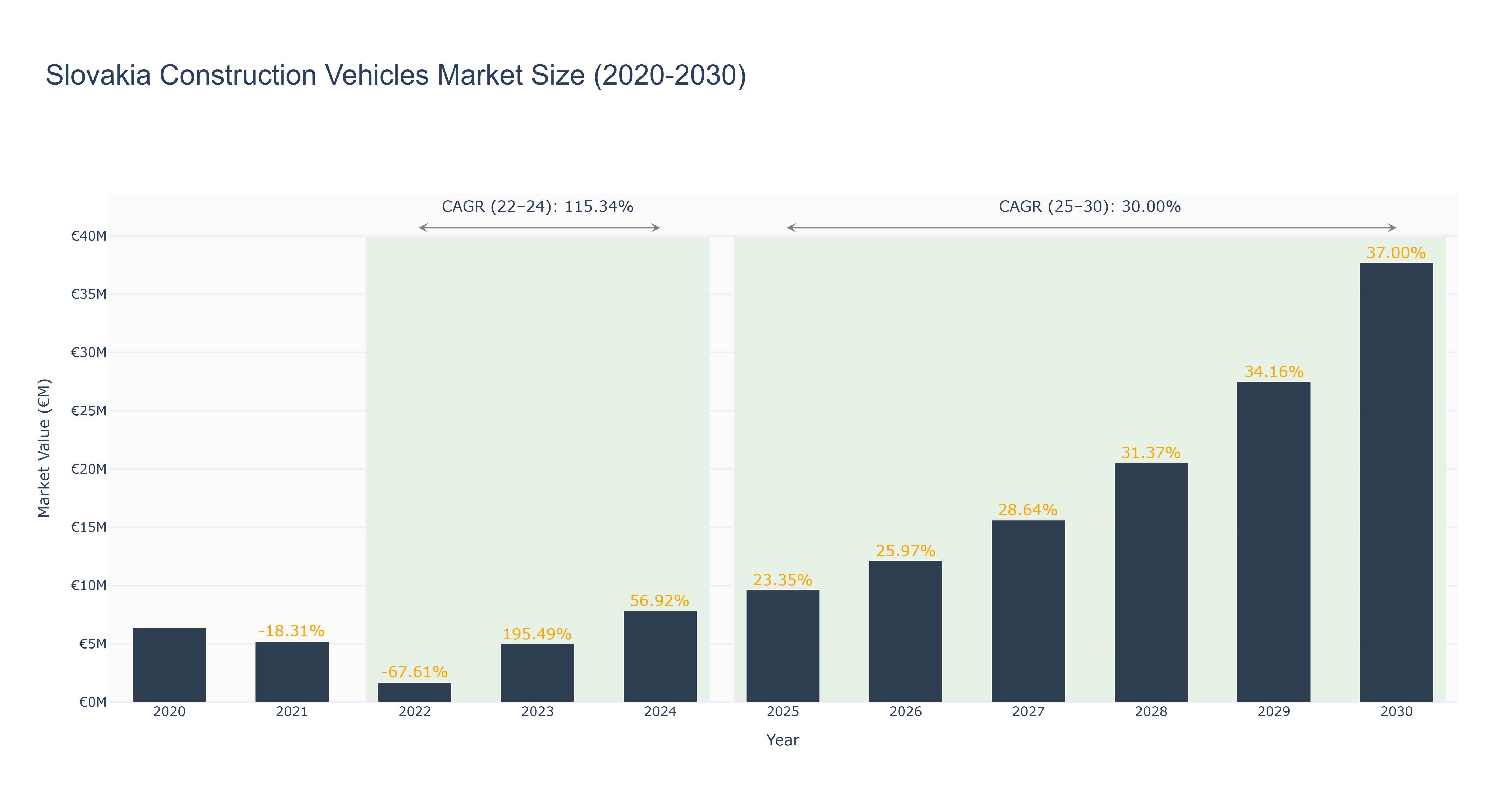
The Slovakia Construction Vehicles Market experienced significant volatility from 2020 to 2024, peaking at €6.36 million in 2020 before declining sharply to €1.68 million in 2022, reflecting a drastic growth rate of -67.61%. However, a remarkable recovery ensued in 2023, with the market rebounding to €4.98 million, culminating in a robust growth of 195.49%. This upward trend is projected to continue, with market size expected to reach €9.63 million by 2025, reflecting a CAGR of 30.00% from 2025 to 2030. Industry drivers such as increased infrastructure development and government investments in construction projects are anticipated to fuel this growth. Notably, ongoing initiatives to enhance transport networks and urban development in Slovakia are likely to further stimulate demand for construction vehicles, positioning the market for sustained expansion in the coming years.
Slovakia Construction Vehicles Market: Production & Trade Performance (2019-2025)
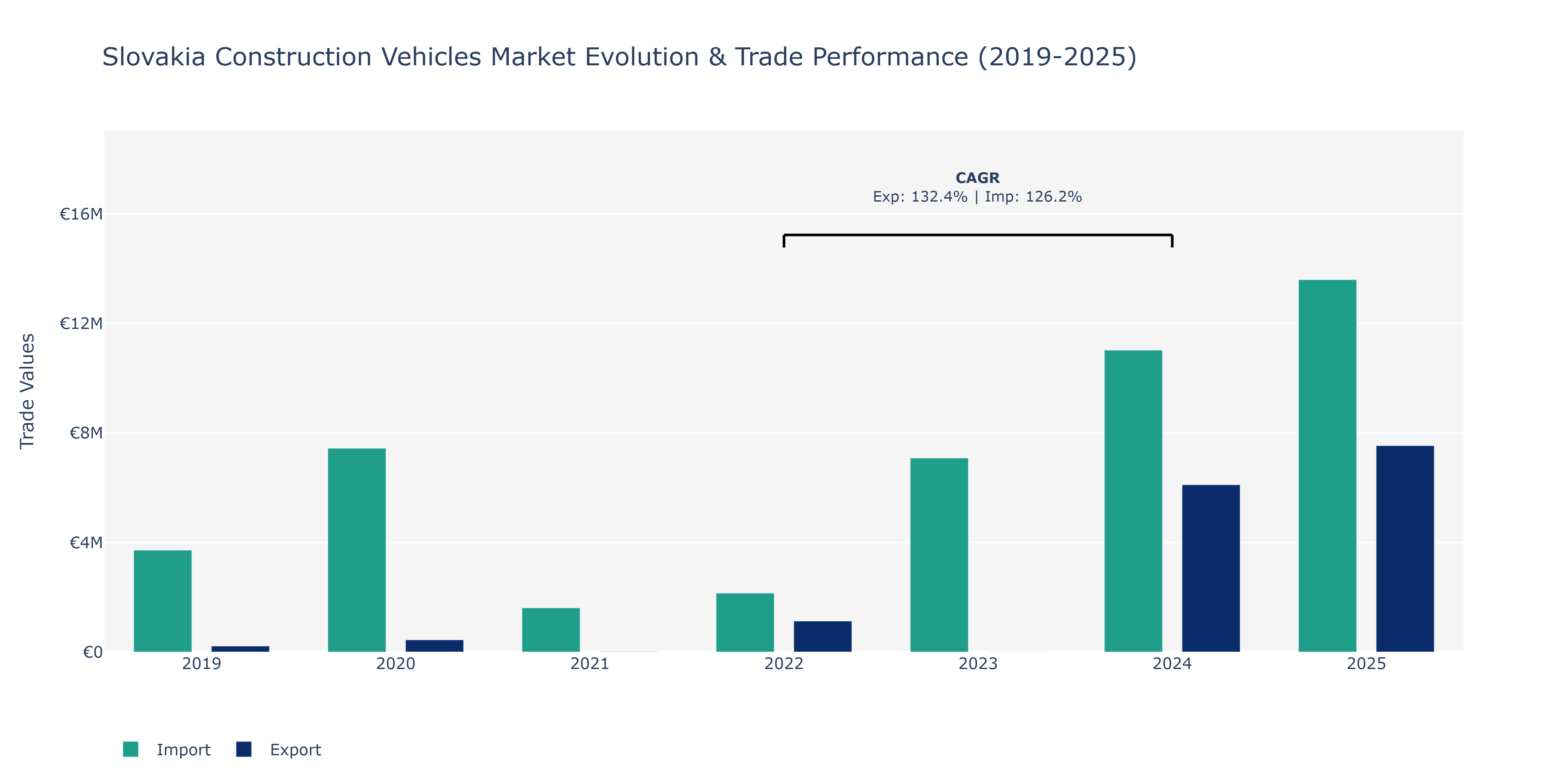
The Slovakia Construction Vehicles Market witnessed varied performance in terms of Exports and Imports from 2019 to 2025. In 2019, Exports stood at €221.87 thousand, experiencing a notable surge to €448.7 thousand in 2020, reflecting increased international trade activities. However, there was a sharp decline in 2021 to €23.5 thousand, possibly due to economic uncertainties impacting export demand. The trend reversed in 2022 with Exports soaring to €1.13 million, indicating a strong recovery and market expansion. This growth continued in 2023, reaching €6.59 thousand, and peaked at €7.54 million in 2025, showcasing sustained market demand. On the other hand, Imports surged from €3.72 million in 2019 to €11.03 million in 2024, signifying heightened equipment acquisitions for infrastructure projects. The peak import value was recorded in 2025 at €13.6 million, aligning with the growing construction sector's demand for advanced machinery and technology. These fluctuations can be attributed to Slovakia's infrastructure development initiatives and increasing construction projects, driving the need for modernized vehicles to enhance operational efficiency and meet sustainability targets, as noted by industry reports on the construction equipment market in Eastern Europe.
Key Highlights of the Report:
- Slovakia Construction Vehicles Market Outlook
- Market Size of Slovakia Construction Vehicles Market, 2025
- Forecast of Slovakia Construction Vehicles Market, 2032
- Historical Data and Forecast of Slovakia Construction Vehicles Revenues & Volume for the Period 2022 - 2032F
- Slovakia Construction Vehicles Market Trend Evolution
- Slovakia Construction Vehicles Market Drivers and Challenges
- Slovakia Construction Vehicles Price Trends
- Slovakia Construction Vehicles Porter's Five Forces
- Slovakia Construction Vehicles Industry Life Cycle
- Historical Data and Forecast of Slovakia Construction Vehicles Market Revenues & Volume By Vehicle Type for the Period 2022 - 2032F
- Historical Data and Forecast of Slovakia Construction Vehicles Market Revenues & Volume By Excavators for the Period 2022 - 2032F
- Historical Data and Forecast of Slovakia Construction Vehicles Market Revenues & Volume By Loaders for the Period 2022 - 2032F
- Historical Data and Forecast of Slovakia Construction Vehicles Market Revenues & Volume By Bulldozers for the Period 2022 - 2032F
- Historical Data and Forecast of Slovakia Construction Vehicles Market Revenues & Volume By Dump Trucks for the Period 2022 - 2032F
- Historical Data and Forecast of Slovakia Construction Vehicles Market Revenues & Volume By Others for the Period 2022 - 2032F
- Historical Data and Forecast of Slovakia Construction Vehicles Market Revenues & Volume By Application for the Period 2022 - 2032F
- Historical Data and Forecast of Slovakia Construction Vehicles Market Revenues & Volume By Earthmoving for the Period 2022 - 2032F
- Historical Data and Forecast of Slovakia Construction Vehicles Market Revenues & Volume By Material Handling for the Period 2022 - 2032F
- Historical Data and Forecast of Slovakia Construction Vehicles Market Revenues & Volume By Road Construction for the Period 2022 - 2032F
- Historical Data and Forecast of Slovakia Construction Vehicles Market Revenues & Volume By Others for the Period 2022 - 2032F
- Historical Data and Forecast of Slovakia Construction Vehicles Market Revenues & Volume By End User for the Period 2022 - 2032F
- Historical Data and Forecast of Slovakia Construction Vehicles Market Revenues & Volume By Construction for the Period 2022 - 2032F
- Historical Data and Forecast of Slovakia Construction Vehicles Market Revenues & Volume By Mining for the Period 2022 - 2032F
- Historical Data and Forecast of Slovakia Construction Vehicles Market Revenues & Volume By Oil & Gas for the Period 2022 - 2032F
- Historical Data and Forecast of Slovakia Construction Vehicles Market Revenues & Volume By Others for the Period 2022 - 2032F
- Slovakia Construction Vehicles Import Export Trade Statistics
- Market Opportunity Assessment By Vehicle Type
- Market Opportunity Assessment By Application
- Market Opportunity Assessment By End User
- Slovakia Construction Vehicles Top Companies Market Share
- Slovakia Construction Vehicles Competitive Benchmarking By Technical and Operational Parameters
- Slovakia Construction Vehicles Company Profiles
- Slovakia Construction Vehicles Key Strategic Recommendations






































