Slovakia Critical Infrastructure Protection Market Size & Growth Rate (2026-2032)
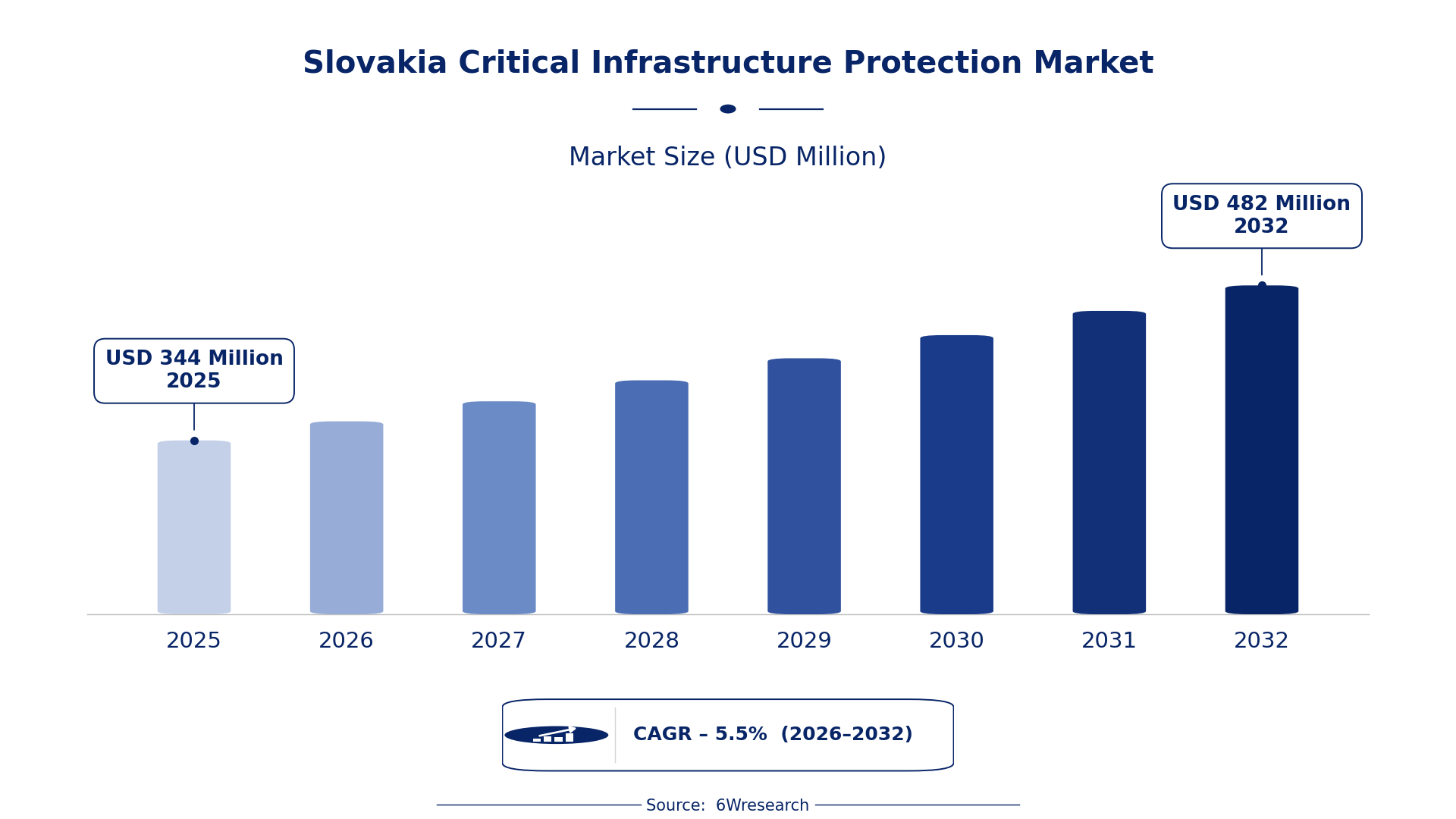
The Slovakia Critical Infrastructure Protection Market was estimated at USD 344 Million in 2025 and is projected to reach USD 482 Million by 2032, growing at a CAGR of 5.5% from 2026 to 2032.
Slovakia Critical Infrastructure Protection Market Synopsis
The Slovakia Critical Infrastructure Protection Market has seen recent momentum driven by heightened awareness of cybersecurity risks across crucial sectors. With a growing focus on modernizing infrastructure and adopting digital systems, demand for comprehensive security solutions is on the rise.
Looking ahead, the market is set to capitalize on advancements in technology to bolster defense mechanisms against evolving threats. This shift underscores the necessity for effective strategies to safeguard critical assets as organizations prioritize security investments.
Slovakia Critical Infrastructure Protection Market Year-wise Growth Rate and Key Drivers
This graph illustrates the annual growth rates of the Slovakia Critical Infrastructure Protection Market from 2021 to 2032, highlighting a steady upward trajectory and projected expansion over the forecast period.
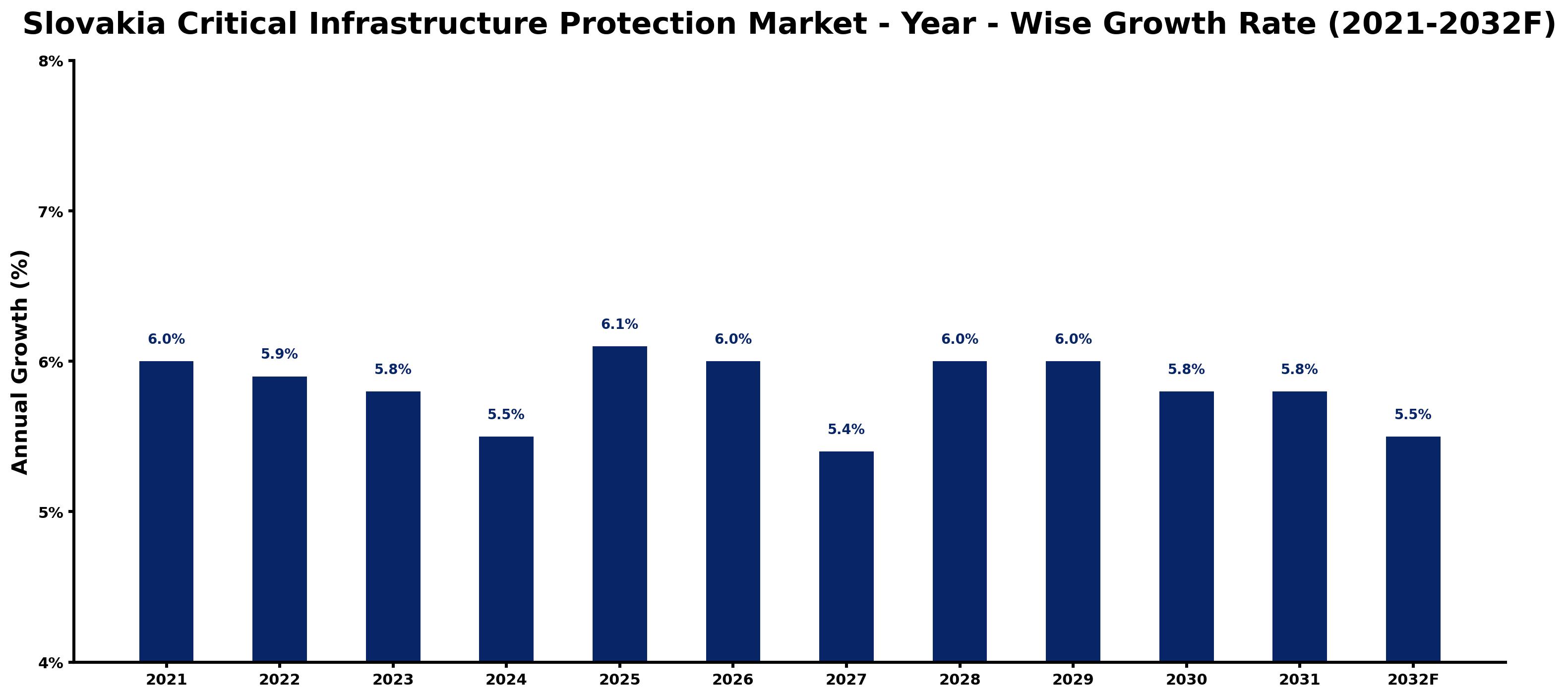
The table below presents the year‑wise growth rates along with the key drivers influencing the market
| Year | Growth Rate | Major Drivers |
| 2021 | 6.0% | Implementation of EU Cybersecurity Strategy in Slovakia |
| 2022 | 5.9% | Increased local investments in critical infrastructure upgrades |
| 2023 | 5.8% | Slovak government's focus on energy security measures |
| 2024 | 5.5% | Heightened cybersecurity regulations from National Security Authority |
| 2025 | 6.1% | Growing awareness of cybersecurity threats among enterprises |
| 2026 | 6.0% | Mandatory compliance with new EU data protection laws |
| 2027 | 5.4% | Adoption of advanced surveillance technologies in urban areas |
| 2028 | 6.0% | Public-private partnerships enhancing disaster recovery readiness |
| 2029 | 6.0% | Rising incidents of cyberattacks driving protective measures |
| 2030 | 5.8% | Strengthening cross-border security collaborations within V4 nations |
| 2031 | 5.8% | Local initiatives promoting resilience in critical services |
| 2032 | 5.5% | Legislation incentivizing investments in infrastructure resilience |
Note: Market size estimations and growth projections presented in this report are based on 6Wresearch's proprietary forecasting methodology, utilizing the latest available industry data, government publications, and primary research inputs.
Slovakia Critical Infrastructure Protection Market Key Takeaways
Below are some of the specific key takeaways from the market, including:
- Increased investment in cybersecurity solutions, particularly in the energy and healthcare sectors.
- Growing demand for advanced technologies, including AI and machine learning, to enhance security protocols.
- Stricter compliance requirements driven by EU regulations, prompting organizations to adopt advanced CIP technologies.
- Emerging emphasis on developing robust incident response plans and regular security assessments.
- Collaborative efforts between private and public sectors to address vulnerabilities in critical infrastructure.
Evaluation of Restraints in Slovakia Critical Infrastructure Protection Market
Despite the growth potential, the market faces significant restraints. The increasing sophistication of cyber threats targeting critical infrastructure raises the stakes for security measures. Organizations must continuously invest in advanced cybersecurity solutions to counteract these threats effectively.
on top of that, the lack of standardized regulations can lead to inconsistencies in security practices, making comprehensive protection challenging. Budget constraints further limit the resources available for implementing robust security protocols, leaving critical infrastructure vulnerable to attacks.
Slovakia Critical Infrastructure Protection Market Trends
Currently, a significant trend in the Slovakia Critical Infrastructure Protection Market is the adoption of cloud-based security solutions, reflecting a shift towards greater flexibility and efficiency. Organizations are increasingly integrating AI and machine learning technologies to bolster their defense capabilities against sophisticated cyber threats.
Additionally, a proactive approach to risk management is taking root, with firms developing robust incident response plans and conducting regular assessments to identify vulnerabilities. This trend emphasizes the necessity for organizations to remain ahead of potential threats.
Slovakia Critical Infrastructure Protection Market Opportunities
The market offers several compelling investment opportunities. As digitalization grows, sectors like transportation and healthcare require enhanced security measures to protect against diverse threats. This creates a demand for comprehensive cybersecurity services and innovative physical security systems.
Investors should also explore avenues in developing specialized training programs aimed at improving the resilience of critical infrastructure assets. on top of that, R&D focused on integrated solutions that combine both cybersecurity and physical security is essential for addressing the challenges faced by infrastructure operators.
Government Initiatives in the Slovakia Critical Infrastructure Protection Market
Government policies are critical in shaping the Slovakia Critical Infrastructure Protection Market. The Slovak government is committed to enhancing national security by implementing robust regulatory frameworks to protect essential services. Recent legislative actions and collaborative efforts with international partners are fostering a more secure environment for critical infrastructure.
- A recently completed initiative includes the implementation of the Act on Cyber Security, aiming to fortify defenses against cyber threats.
- Currently ongoing is a national digital infrastructure upgrade program, designed to enhance the security of telecommunications and energy sectors.
- Planned for 2026 is a comprehensive strategy to align national cybersecurity standards with EU regulations, emphasizing increased cooperation between public and private sectors.
- An initiative focusing on enhancing public awareness regarding cybersecurity practices is currently being rolled out across key sectors.
- A scheduled review of the National Security Strategy is set for 2027 to evaluate and improve existing protective measures for critical infrastructure.
Future Insights of the Slovakia Critical Infrastructure Protection Market
From 2026 to 2032, the Slovakia Critical Infrastructure Protection Market is expected to experience steady growth fueled by heightened investments in cybersecurity. With the rise of new threats, organizations will increasingly prioritize the security of critical assets to ensure operational continuity.
The integration of cutting-edge technologies such as AI and blockchain will drive market expansion, providing innovative solutions to counteract evolving risks. Stakeholders must remain vigilant and adapt their strategies to navigate these challenges effectively.
Slovakia Critical Infrastructure Protection Market Latest Developments
Over the past 12 months, the Slovakia Critical Infrastructure Protection Market has seen a surge in industry activity, primarily focusing on enhancing cybersecurity measures across various sectors. Organizations are actively pursuing partnerships and adopting advanced technologies to better secure critical infrastructure.
- A major technology vendor launched a cloud-based security platform in early 2025, specifically designed for the energy sector to improve threat detection capabilities.
- A partnership formed in Q3 2025 between public agencies and private firms aims to provide specialized training for cybersecurity personnel in critical infrastructure sectors.
- An initiative focused on upgrading surveillance systems is currently underway, with implementation expected to be completed by early 2026.
- A public-private collaboration is planned for mid-2026 to develop a comprehensive framework for incident response management in healthcare facilities.
- A major telecommunications operator announced in late 2025 its commitment to enhancing network resilience through new encryption technologies, now in the rollout phase.
Slovakia Critical Infrastructure Protection Market - Key Attractiveness of the Report
- 10 Years of Market Numbers
- Historical Data Starting from 2022 to 2025
- Base Year: 2025
- Forecast Data until 2032
- Key Performance Indicators Impacting the Market
- Major Upcoming Developments and Projects
Key Highlights of the Report:
- Slovakia Critical Infrastructure Protection Market Outlook
- Market Size of Slovakia Critical Infrastructure Protection Market, 2025
- Forecast of Slovakia Critical Infrastructure Protection Market, 2032
- Historical Data and Forecast of Slovakia Critical Infrastructure Protection Revenues & Volume for the Period 2022-2032F
- Slovakia Critical Infrastructure Protection Market Trend Evolution
- Slovakia Critical Infrastructure Protection Market Drivers and Challenges
- Slovakia Critical Infrastructure Protection Price Trends
- Slovakia Critical Infrastructure Protection Porter's Five Forces
- Slovakia Critical Infrastructure Protection Industry Life Cycle
- Historical Data and Forecast of Slovakia Critical Infrastructure Protection Market Revenues & Volume By Solution for the Period 2022-2032F
- Historical Data and Forecast of Slovakia Critical Infrastructure Protection Market Revenues & Volume By Physical Safety for the Period 2022-2032F
- Historical Data and Forecast of Slovakia Critical Infrastructure Protection Market Revenues & Volume By Security Video Surveillance Systems for the Period 2022-2032F
- Historical Data and Forecast of Slovakia Critical Infrastructure Protection Market Revenues & Volume By Screening for the Period 2022-2032F
- Historical Data and Forecast of Slovakia Critical Infrastructure Protection Market Revenues & Volume By Scanning for the Period 2022-2032F
- Historical Data and Forecast of Slovakia Critical Infrastructure Protection Market Revenues & Volume By Cybersecurity for the Period 2022-2032F
- Historical Data and Forecast of Slovakia Critical Infrastructure Protection Market Revenues & Volume By Encryption for the Period 2022-2032F
- Historical Data and Forecast of Slovakia Critical Infrastructure Protection Market Revenues & Volume By Threat Intelligence for the Period 2022-2032F
- Historical Data and Forecast of Slovakia Critical Infrastructure Protection Market Revenues & Volume By Component for the Period 2022-2032F
- Historical Data and Forecast of Slovakia Critical Infrastructure Protection Market Revenues & Volume By Solution for the Period 2022-2032F
- Historical Data and Forecast of Slovakia Critical Infrastructure Protection Market Revenues & Volume By Services for the Period 2022-2032F
- Historical Data and Forecast of Slovakia Critical Infrastructure Protection Market Revenues & Volume By Vertical for the Period 2022-2032F
- Historical Data and Forecast of Slovakia Critical Infrastructure Protection Market Revenues & Volume By Financial Institutions for the Period 2022-2032F
- Historical Data and Forecast of Slovakia Critical Infrastructure Protection Market Revenues & Volume By Government for the Period 2022-2032F
- Historical Data and Forecast of Slovakia Critical Infrastructure Protection Market Revenues & Volume By Defense for the Period 2022-2032F
- Historical Data and Forecast of Slovakia Critical Infrastructure Protection Market Revenues & Volume By Transport and Logistics for the Period 2022-2032F
- Historical Data and Forecast of Slovakia Critical Infrastructure Protection Market Revenues & Volume By Energy and Power for the Period 2022-2032F
- Historical Data and Forecast of Slovakia Critical Infrastructure Protection Market Revenues & Volume By Commercial Sector for the Period 2022-2032F
- Historical Data and Forecast of Slovakia Critical Infrastructure Protection Market Revenues & Volume By Telecom for the Period 2022-2032F
- Historical Data and Forecast of Slovakia Critical Infrastructure Protection Market Revenues & Volume By Chemicals and Manufacturing for the Period 2022-2032F
- Slovakia Critical Infrastructure Protection Import Export Trade Statistics
- Market Opportunity Assessment By Solution
- Market Opportunity Assessment By Cybersecurity
- Market Opportunity Assessment By Component
- Market Opportunity Assessment By Vertical
- Slovakia Critical Infrastructure Protection Top Companies Market Share
- Slovakia Critical Infrastructure Protection Competitive Benchmarking By Technical and Operational Parameters
- Slovakia Critical Infrastructure Protection Company Profiles
- Slovakia Critical Infrastructure Protection Key Strategic Recommendations






































