Slovakia Electric Mobility Market Top 5 Importing Countries and Market Competition (HHI) Analysis
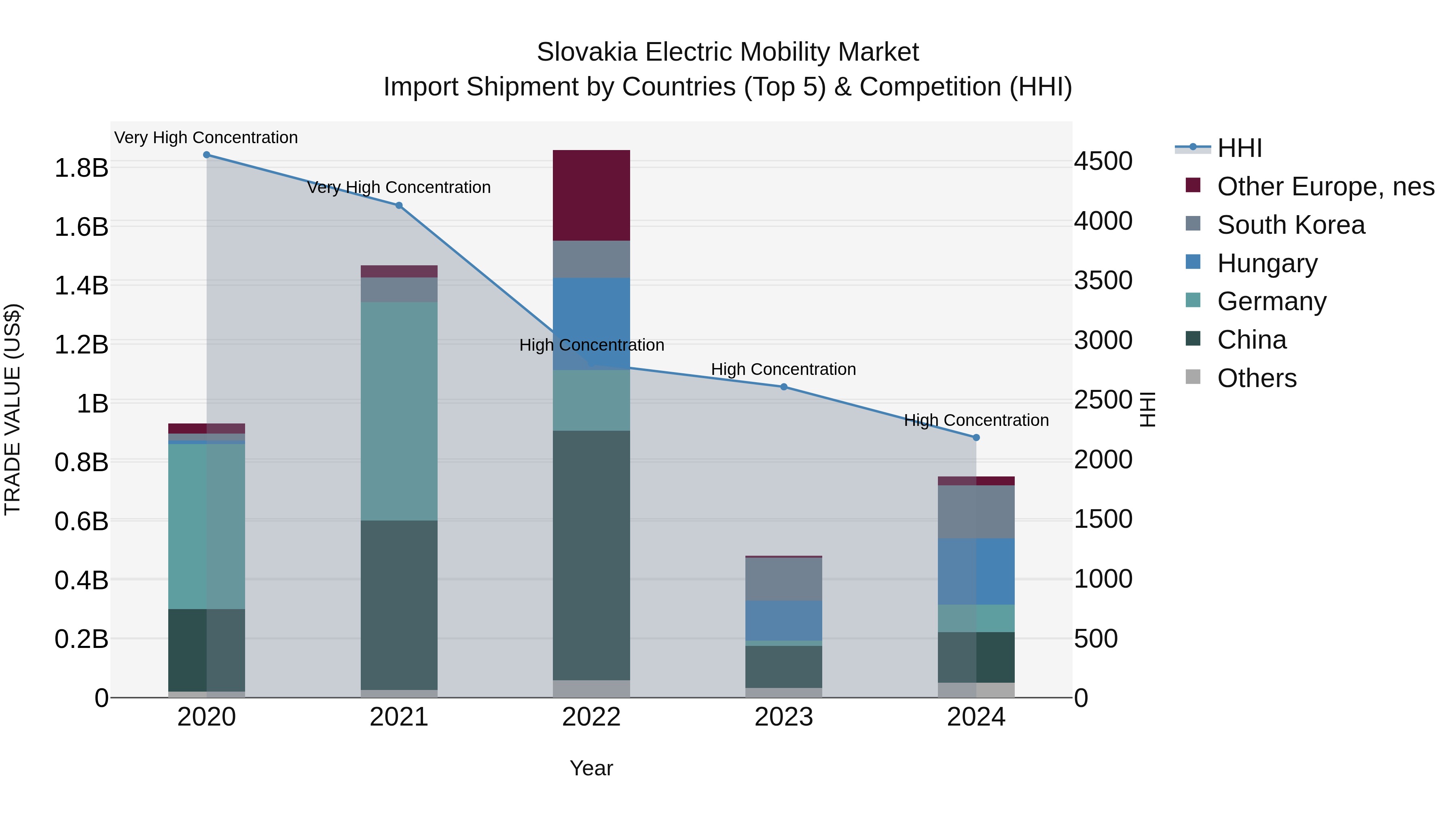
Slovakia`s import shipments of electric mobility products in 2024 saw significant growth, with top exporting countries being Hungary, South Korea, China, Germany, and Czechia. Despite a challenging CAGR of -5.24% from 2020 to 2024, there was a remarkable growth rate of 55.63% from 2023 to 2024. The high Herfindahl-Hirschman Index (HHI) indicates concentration in the Market Top 5 Importing Countries and Market Competition (HHI) Analysis, suggesting that these top exporting countries have a strong presence in Slovakia`s electric mobility sector. This data highlights the evolving landscape of electric mobility imports in Slovakia and the continued interest in sustainable transportation solutions.
Slovakia Electric Mobility Market Overview
The Slovakia Electric Mobility Market is experiencing steady growth driven by increasing environmental awareness, government incentives, and improving charging infrastructure. The adoption of electric vehicles (EVs) is on the rise in Slovakia, with a growing number of charging stations being installed across the country. Major automotive manufacturers are also introducing more electric vehicle models to cater to the increasing demand. The government`s support for electric mobility, including subsidies for EV purchases and the development of charging infrastructure, is further propelling the market forward. Challenges such as high initial costs and range anxiety still exist, but overall, the Slovakia Electric Mobility Market presents significant opportunities for growth and innovation in the coming years.
Slovakia Electric Mobility Market Trends and Opportunities
The Slovakia Electric Mobility Market is experiencing significant growth due to increasing environmental concerns and government initiatives promoting electric vehicles. One key trend is the expansion of charging infrastructure across the country, making electric vehicles more accessible to consumers. Additionally, there is a growing interest in electric buses and commercial vehicles as businesses look to reduce their carbon footprint. The market also presents opportunities for collaboration between automakers, technology companies, and energy providers to develop innovative solutions for sustainable transportation. With supportive policies and incentives in place, the Slovakia Electric Mobility Market is poised for further expansion, offering prospects for investment and development in the electric vehicle ecosystem.
Slovakia Electric Mobility Market Challenges
In the Slovakia Electric Mobility Market, several challenges are being faced. These include limited charging infrastructure, range anxiety among consumers, high initial costs of electric vehicles, and a lack of government incentives or policies to promote electric mobility. The insufficient availability of charging stations hinders the widespread adoption of electric vehicles, as consumers are concerned about the convenience of recharging. Range anxiety, or the fear of running out of battery power, also plays a significant role in the slow uptake of electric vehicles. Furthermore, the higher upfront costs of electric cars compared to traditional vehicles present a barrier to entry for many potential buyers. Without strong government support in the form of incentives or regulations to encourage electric vehicle adoption, the market in Slovakia struggles to reach its full potential.
Slovakia Electric Mobility Market Drivers
The Slovakia Electric Mobility Market is primarily driven by government incentives and policies aimed at reducing carbon emissions and promoting sustainable transportation solutions. The government offers subsidies for the purchase of electric vehicles, tax benefits, and incentives for installing charging infrastructure. Additionally, increasing environmental awareness among consumers, concerns about air pollution, and a growing emphasis on corporate social responsibility are driving the demand for electric vehicles in Slovakia. The availability of a wider range of electric vehicle models, improvements in battery technology leading to longer driving ranges, and the expanding charging network are also key drivers accelerating the adoption of electric mobility in the country.
Slovakia Electric Mobility Market Government Policy
The Slovakian government has implemented various policies to promote the growth of the electric mobility market in the country. These include financial incentives such as subsidies for the purchase of electric vehicles, tax reductions for electric car owners, and grants for the development of charging infrastructure. Additionally, the government has set targets to increase the number of electric vehicles on the road and is investing in research and development initiatives to support the advancement of electric vehicle technology. Furthermore, there are efforts to expand public transportation options using electric vehicles and to encourage the adoption of sustainable mobility solutions. Overall, these policies aim to reduce greenhouse gas emissions, improve air quality, and support the transition to a more sustainable transportation sector in Slovakia.
Slovakia Electric Mobility Market Future Outlook
The future outlook for the Slovakia Electric Mobility Market is promising, with a growing trend towards sustainable transportation solutions and government initiatives promoting electric vehicle adoption. The market is expected to witness significant growth in the coming years, driven by factors such as increasing environmental awareness, advancements in technology, and declining costs of electric vehicles. Additionally, the development of charging infrastructure and supportive policies are likely to further boost the adoption of electric vehicles in Slovakia. As consumers and businesses increasingly prioritize sustainability and energy efficiency, the demand for electric vehicles is anticipated to rise, creating opportunities for manufacturers, service providers, and investors in the electric mobility sector in Slovakia.
Key Highlights of the Report:
- Slovakia Electric Mobility Market Outlook
- Market Size of Slovakia Electric Mobility Market, 2024
- Forecast of Slovakia Electric Mobility Market, 2031
- Historical Data and Forecast of Slovakia Electric Mobility Revenues & Volume for the Period 2021- 2031
- Slovakia Electric Mobility Market Trend Evolution
- Slovakia Electric Mobility Market Drivers and Challenges
- Slovakia Electric Mobility Price Trends
- Slovakia Electric Mobility Porter's Five Forces
- Slovakia Electric Mobility Industry Life Cycle
- Historical Data and Forecast of Slovakia Electric Mobility Market Revenues & Volume By Product for the Period 2021- 2031
- Historical Data and Forecast of Slovakia Electric Mobility Market Revenues & Volume By Electric Bikes for the Period 2021- 2031
- Historical Data and Forecast of Slovakia Electric Mobility Market Revenues & Volume By Electric Scooters for the Period 2021- 2031
- Historical Data and Forecast of Slovakia Electric Mobility Market Revenues & Volume By Electric Motorized Scooters for the Period 2021- 2031
- Historical Data and Forecast of Slovakia Electric Mobility Market Revenues & Volume By Electric Motorcycles for the Period 2021- 2031
- Historical Data and Forecast of Slovakia Electric Mobility Market Revenues & Volume By Drive for the Period 2021- 2031
- Historical Data and Forecast of Slovakia Electric Mobility Market Revenues & Volume By Belt Drive for the Period 2021- 2031
- Historical Data and Forecast of Slovakia Electric Mobility Market Revenues & Volume By Chain Drive for the Period 2021- 2031
- Historical Data and Forecast of Slovakia Electric Mobility Market Revenues & Volume By Hub Drive for the Period 2021- 2031
- Historical Data and Forecast of Slovakia Electric Mobility Market Revenues & Volume By Battery for the Period 2021- 2031
- Historical Data and Forecast of Slovakia Electric Mobility Market Revenues & Volume By Lead Acid Battery for the Period 2021- 2031
- Historical Data and Forecast of Slovakia Electric Mobility Market Revenues & Volume By Li-Ion Battery for the Period 2021- 2031
- Historical Data and Forecast of Slovakia Electric Mobility Market Revenues & Volume By End-use for the Period 2021- 2031
- Historical Data and Forecast of Slovakia Electric Mobility Market Revenues & Volume By Personal for the Period 2021- 2031
- Historical Data and Forecast of Slovakia Electric Mobility Market Revenues & Volume By Commercial for the Period 2021- 2031
- Slovakia Electric Mobility Import Export Trade Statistics
- Market Opportunity Assessment By Product
- Market Opportunity Assessment By Drive
- Market Opportunity Assessment By Battery
- Market Opportunity Assessment By End-use
- Slovakia Electric Mobility Top Companies Market Share
- Slovakia Electric Mobility Competitive Benchmarking By Technical and Operational Parameters
- Slovakia Electric Mobility Company Profiles
- Slovakia Electric Mobility Key Strategic Recommendations






































