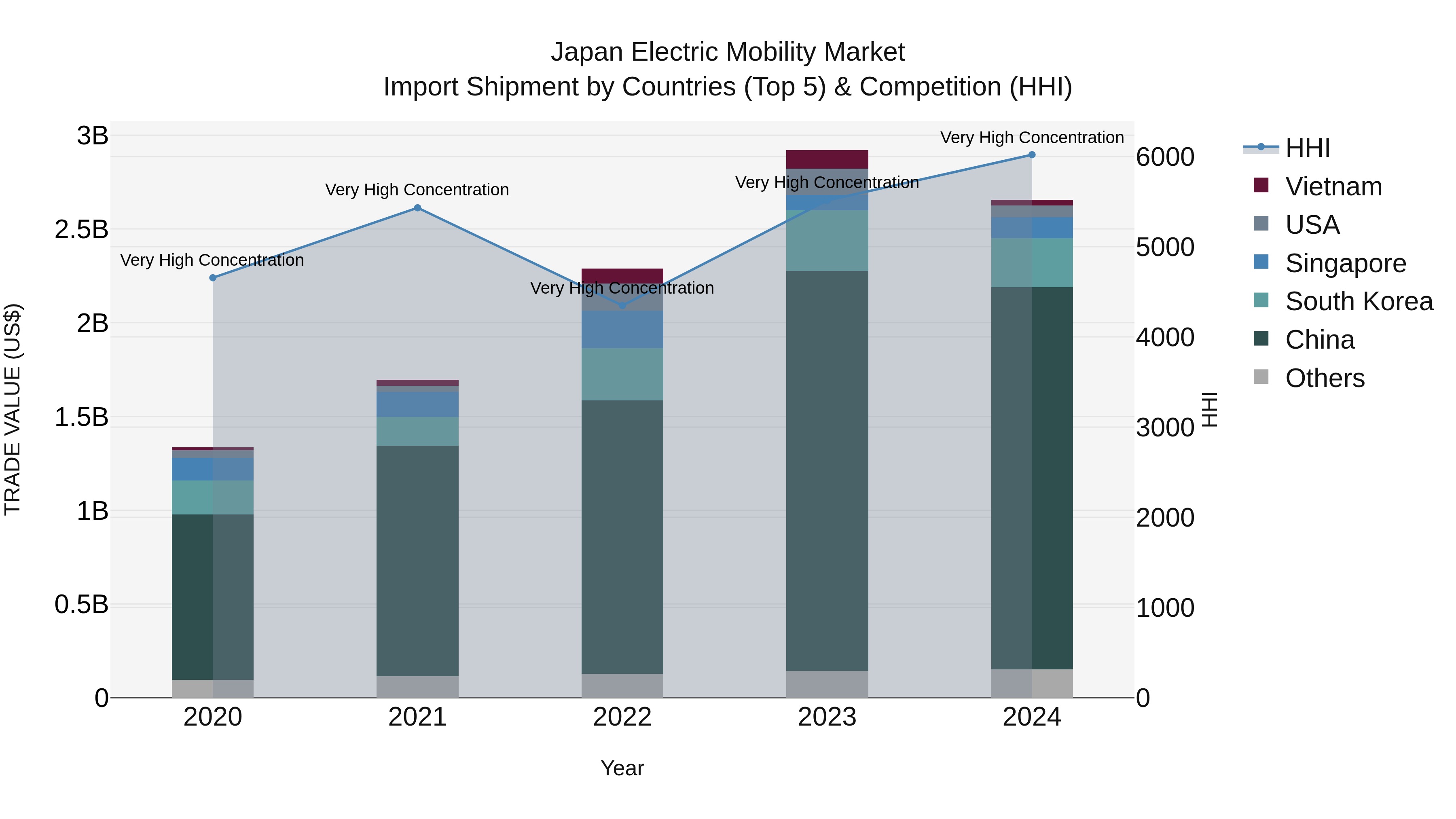
Japan Electric Mobility Market Import Shipment by Countries (Top 5) & Competition (HHI)
Japan's electric mobility import shipments in 2024 continued to see significant contributions from top exporting countries such as China, South Korea, Singapore, USA, and Taiwan. Despite a slight decline in growth rate from 2023 to 2024, the industry maintained a high level of concentration, as indicated by the Herfindahl-Hirschman Index (HHI). With a strong compound annual growth rate (CAGR) of 18.72% from 2020 to 2024, the Japanese electric mobility market remains dynamic and poised for further development.
Japan Electric Mobility Market Overview
The Japan Electric Mobility Market is witnessing significant growth driven by government initiatives promoting electric vehicles (EVs) to reduce carbon emissions and dependence on fossil fuels. The country aims to achieve carbon neutrality by 2050, leading to a surge in electric vehicle adoption. The market is characterized by a strong presence of domestic automakers such as Nissan, Toyota, and Honda, alongside international players like Tesla and BMW. Charging infrastructure development is a key focus area to support the growing EV fleet, with various public and private initiatives underway. Additionally, technological advancements in battery technology and the increasing range of EVs are further boosting market growth. Overall, the Japan Electric Mobility Market presents lucrative opportunities for manufacturers, service providers, and investors looking to capitalize on the evolving landscape of sustainable transportation.
Japan Electric Mobility Market Trends and Opportunities
The Japan Electric Mobility Market is experiencing rapid growth due to increasing environmental awareness and government initiatives to reduce carbon emissions. Key trends include the rising adoption of electric vehicles (EVs) and the expansion of charging infrastructure. Companies are focusing on developing advanced EV technologies, such as longer battery life and faster charging capabilities, to meet consumer demands. Additionally, the market is seeing a shift towards electric scooters and bicycles as sustainable urban transportation options. Opportunities in the Japan Electric Mobility Market lie in partnerships between automakers and energy companies to enhance charging infrastructure, as well as collaborations with technology firms to drive innovation in EV technology. Overall, the market presents promising prospects for growth and investment in the coming years.
Japan Electric Mobility Market Challenges
The Japan Electric Mobility Market faces challenges such as high initial costs for electric vehicles (EVs) compared to traditional vehicles, limited availability of charging infrastructure, and range anxiety among consumers. Government incentives and subsidies are critical for promoting EV adoption, but the inconsistency and uncertainty surrounding these policies can hinder market growth. Additionally, the lack of standardization in charging connectors and protocols creates interoperability issues, making it difficult for EV users to access charging stations from different providers. To overcome these challenges, collaboration between government, industry stakeholders, and utilities is essential to develop a comprehensive infrastructure plan and ensure a seamless transition to electric mobility in Japan.
Japan Electric Mobility Market Drivers
The Japan Electric Mobility Market is primarily being driven by government initiatives promoting the adoption of electric vehicles (EVs) to reduce carbon emissions and combat climate change. Substantial financial incentives, tax breaks, and infrastructure development for EV charging stations have accelerated the shift towards electric mobility. Additionally, rising environmental awareness among consumers, coupled with advancements in EV technology leading to improved range and performance, are fueling the market growth. Major automakers in Japan are investing heavily in research and development of electric vehicles to meet the increasing demand for sustainable transportation options. Furthermore, the country`s ambitious targets for phasing out internal combustion engine vehicles in the future are driving the rapid expansion of the electric mobility market in Japan.
Japan Electric Mobility Market Government Policy
The Japanese government has been actively promoting the adoption of electric mobility through various policies and initiatives. These include subsidies and incentives for purchasing electric vehicles (EVs), tax breaks for eco-friendly cars, investments in charging infrastructure development, and research and development funding for advanced battery technologies. Additionally, the government has set ambitious targets to increase the number of EVs on the roads, with a goal of phasing out internal combustion engine vehicles by 2035. Furthermore, Japan has implemented regulations to reduce greenhouse gas emissions from transportation and promote sustainable mobility solutions. Overall, the government`s policies aim to accelerate the transition towards electric mobility, reduce carbon emissions, and build a more sustainable transportation ecosystem in Japan.
Japan Electric Mobility Market Future Outlook
The Japan Electric Mobility Market is poised for substantial growth in the coming years due to government initiatives promoting electric vehicle adoption, increasing environmental concerns, and advancements in technology driving product innovation. The market is expected to witness a surge in demand for electric vehicles, with a focus on enhancing charging infrastructure and expanding the range of electric vehicle models available to consumers. The shift towards sustainable transportation solutions is likely to drive further investments and partnerships in the industry, fostering a competitive landscape and boosting market expansion. Overall, the Japan Electric Mobility Market is projected to experience significant growth opportunities as consumers and businesses increasingly prioritize eco-friendly transportation alternatives.
Key Highlights of the Report:
- Japan Electric Mobility Market Outlook
- Market Size of Japan Electric Mobility Market, 2024
- Forecast of Japan Electric Mobility Market, 2031
- Historical Data and Forecast of Japan Electric Mobility Revenues & Volume for the Period 2021- 2031
- Japan Electric Mobility Market Trend Evolution
- Japan Electric Mobility Market Drivers and Challenges
- Japan Electric Mobility Price Trends
- Japan Electric Mobility Porter's Five Forces
- Japan Electric Mobility Industry Life Cycle
- Historical Data and Forecast of Japan Electric Mobility Market Revenues & Volume By Product for the Period 2021- 2031
- Historical Data and Forecast of Japan Electric Mobility Market Revenues & Volume By Electric Bikes for the Period 2021- 2031
- Historical Data and Forecast of Japan Electric Mobility Market Revenues & Volume By Electric Scooters for the Period 2021- 2031
- Historical Data and Forecast of Japan Electric Mobility Market Revenues & Volume By Electric Motorized Scooters for the Period 2021- 2031
- Historical Data and Forecast of Japan Electric Mobility Market Revenues & Volume By Electric Motorcycles for the Period 2021- 2031
- Historical Data and Forecast of Japan Electric Mobility Market Revenues & Volume By Drive for the Period 2021- 2031
- Historical Data and Forecast of Japan Electric Mobility Market Revenues & Volume By Belt Drive for the Period 2021- 2031
- Historical Data and Forecast of Japan Electric Mobility Market Revenues & Volume By Chain Drive for the Period 2021- 2031
- Historical Data and Forecast of Japan Electric Mobility Market Revenues & Volume By Hub Drive for the Period 2021- 2031
- Historical Data and Forecast of Japan Electric Mobility Market Revenues & Volume By Battery for the Period 2021- 2031
- Historical Data and Forecast of Japan Electric Mobility Market Revenues & Volume By Lead Acid Battery for the Period 2021- 2031
- Historical Data and Forecast of Japan Electric Mobility Market Revenues & Volume By Li-Ion Battery for the Period 2021- 2031
- Historical Data and Forecast of Japan Electric Mobility Market Revenues & Volume By End-use for the Period 2021- 2031
- Historical Data and Forecast of Japan Electric Mobility Market Revenues & Volume By Personal for the Period 2021- 2031
- Historical Data and Forecast of Japan Electric Mobility Market Revenues & Volume By Commercial for the Period 2021- 2031
- Japan Electric Mobility Import Export Trade Statistics
- Market Opportunity Assessment By Product
- Market Opportunity Assessment By Drive
- Market Opportunity Assessment By Battery
- Market Opportunity Assessment By End-use
- Japan Electric Mobility Top Companies Market Share
- Japan Electric Mobility Competitive Benchmarking By Technical and Operational Parameters
- Japan Electric Mobility Company Profiles
- Japan Electric Mobility Key Strategic Recommendations






































