Slovakia Fencing Market Size, Share & Growth Rate
The Slovakia Fencing Market was estimated at USD 233 Million in 2025 and is projected to reach USD 325 Million by 2032, growing at a CAGR of 4.9% from 2026 to 2032. This positive trajectory is primarily driven by robust construction activities across both residential and commercial sectors, as well as heightened concerns over security and privacy. Furthermore, government investments aimed at infrastructure improvement and tourism development are bolstering the market's growth.
Slovakia Fencing Market Year-wise Growth Rate and Key Drivers
This graph highlights how the Slovakia Fencing Market has steadily grown over the years, supported by major growth factors.
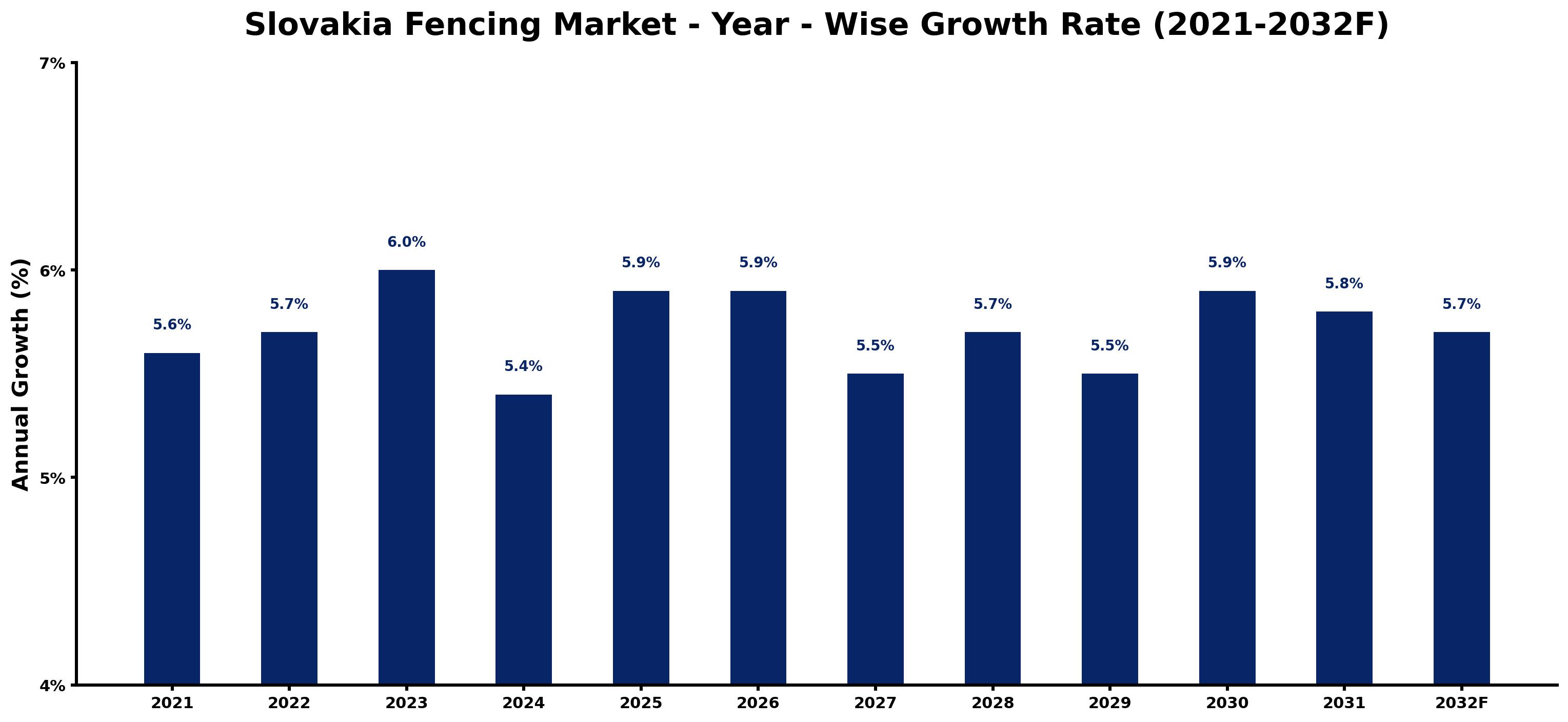
The table below presents the year‑wise growth rates along with the key drivers influencing the market
| Year | Growth Rate | Major Drivers |
| 2021 | 5.6% | Growing renewable energy integration projects |
| 2022 | 5.7% | Rapid growth in telecom and data center sectors |
| 2023 | 6.0% | Increasing industrial infrastructure investments |
| 2024 | 5.4% | Expansion of manufacturing activities |
| 2025 | 5.9% | Increasing industrial automation investments |
| 2026 | 5.9% | Rising electricity demand across industries |
| 2027 | 5.5% | Expansion of manufacturing activities |
| 2028 | 5.7% | Expansion of manufacturing activities |
| 2029 | 5.5% | Increasing adoption of advanced technologies |
| 2030 | 5.9% | Growing renewable energy integration projects |
| 2031 | 5.8% | Increasing smart city development projects |
| 2032 | 5.7% | Increasing industrial infrastructure investments |
Note - Market size estimations and growth projections presented in this report are based on 6Wresearch’s advanced forecasting approach, validated with industry datasets as of June 2026.
Slovakia Fencing Market Synopsis
In Slovakia, the demand for fencing solutions is being significantly influenced by a growing preference for aesthetic enhancement alongside functional security. Homeowners and businesses alike are increasingly investing in a variety of fencing products, particularly those that offer customization and eco-friendly materials.
Moreover, the trend towards DIY fencing kits is gaining traction, appealing to consumers who desire cost-effective and easy-to-install options. This shift is not just about cost savings; it's about allowing consumers to tailor their fencing choices to their specific needs and tastes.
Slovakia Fencing Market Key Takeaways
- The market is expected to witness a steady increase in demand for eco-friendly and sustainable fencing solutions.
- Smart fencing technologies are becoming more popular as consumers look for advanced security features.
- Customization in fencing designs is increasingly sought after, enhancing both aesthetics and functionality.
- Intense competition requires companies to innovate consistently to maintain market relevance.
- Government regulations shape material usage and installation processes, ensuring quality and safety.
Evaluation of Restraints in Slovakia Fencing Market
Despite its growth potential, the Slovakia fencing market faces significant challenges. Intense competition from both local and international manufacturers creates a pricing pressure that can squeeze profit margins for companies. Additionally, the constant demand for innovation necessitates significant investment in research and development, which can be a barrier for smaller firms. Regulatory requirements also impose restrictions on materials and design practices, creating complexities that companies must navigate to remain compliant while still appealing to consumer preferences.
Slovakia Fencing Market Trends
The current trend in the Slovakia fencing market is leaning toward more sustainable and innovative solutions. Consumers are showing a marked preference for composite materials that not only provide durability but also contribute to environmental conservation. Additionally, there is an increasing inclination towards smart fencing options that integrate technology for remote monitoring and control. As aesthetics play a crucial role in consumer choices, fencing designs are also evolving to reflect contemporary architectural styles, emphasizing both security and beauty.
Slovakia Fencing Market Opportunities
The Slovakia fencing market presents numerous investment opportunities that savvy investors should consider. The expanding construction industry offers a fertile ground for supplying various fencing solutions tailored for residential, commercial, and industrial use. Furthermore, the rising interest in smart fencing technologies provides a unique niche for innovative product developers. Investors looking to provide eco-friendly options will find a growing market, as consumer awareness and demand for sustainable practices continue to rise.
Government Initiatives in the Slovakia Fencing Market
Government policies play a pivotal role in shaping the Slovakia fencing market by enforcing safety and quality regulations. Building codes dictate specifications and installation standards, ensuring durability and compliance with safety norms. Additionally, environmental regulations promote sustainability by influencing material choices in the fencing industry. Zoning laws also govern the height and placement of fences, ensuring that aesthetic considerations are met in various regions.
Future Insights of the Slovakia Fencing Market
Looking ahead to the years 2026-2032, the Slovakia fencing market is poised for continued growth driven by ongoing construction activities and an increasing focus on enhanced security and privacy. Customization and aesthetics will likely remain key drivers, as consumers continue to seek unique solutions that reflect their personal style. The emergence of innovative materials and technologies, particularly those that offer low maintenance and sustainability, will play an essential role in shaping the future landscape of the market.
Slovakia Fencing Market Latest Developments (May 2025 - June 2026)
In recent months, the Slovakia fencing market has seen an uptick in the introduction of innovative materials and product lines aimed at sustainability. Companies are increasingly focusing on eco-friendly solutions, aligning their offerings with consumer demand for environmentally responsible products. Furthermore, the rise of e-commerce platforms is transforming how consumers purchase fencing products, allowing for greater accessibility and customization options.
Slovakia Fencing Market - Key Attractiveness of the Report
- 10 Years of Market Numbers
- Historical Data Starting from 2022 to 2025
- Base Year: 2025
- Forecast Data until 2032
- Key Performance Indicators Impacting the Market
- Major Upcoming Developments and Projects
Key Highlights of the Report:
- Slovakia Fencing Market Outlook
- Market Size of Slovakia Fencing Market, 2025
- Forecast of Slovakia Fencing Market, 2032
- Historical Data and Forecast of Slovakia Fencing Revenues & Volume for the Period 2022-2032F
- Slovakia Fencing Market Trend Evolution
- Slovakia Fencing Market Drivers and Challenges
- Slovakia Fencing Price Trends
- Slovakia Fencing Porter's Five Forces
- Slovakia Fencing Industry Life Cycle
- Historical Data and Forecast of Slovakia Fencing Market Revenues & Volume By Material for the Period 2022-2032F
- Historical Data and Forecast of Slovakia Fencing Market Revenues & Volume By Metal for the Period 2022-2032F
- Historical Data and Forecast of Slovakia Fencing Market Revenues & Volume By Wood for the Period 2022-2032F
- Historical Data and Forecast of Slovakia Fencing Market Revenues & Volume By Plastic & Composite for the Period 2022-2032F
- Historical Data and Forecast of Slovakia Fencing Market Revenues & Volume By Concrete for the Period 2022-2032F
- Historical Data and Forecast of Slovakia Fencing Market Revenues & Volume By Distribution Channel for the Period 2022-2032F
- Historical Data and Forecast of Slovakia Fencing Market Revenues & Volume By Online for the Period 2022-2032F
- Historical Data and Forecast of Slovakia Fencing Market Revenues & Volume By Retail for the Period 2022-2032F
- Historical Data and Forecast of Slovakia Fencing Market Revenues & Volume By Installation for the Period 2022-2032F
- Historical Data and Forecast of Slovakia Fencing Market Revenues & Volume By Do-It-Yourself for the Period 2022-2032F
- Historical Data and Forecast of Slovakia Fencing Market Revenues & Volume By Contractor for the Period 2022-2032F
- Historical Data and Forecast of Slovakia Fencing Market Revenues & Volume By Application for the Period 2022-2032F
- Historical Data and Forecast of Slovakia Fencing Market Revenues & Volume By Residential for the Period 2022-2032F
- Historical Data and Forecast of Slovakia Fencing Market Revenues & Volume By Agricultural for the Period 2022-2032F
- Historical Data and Forecast of Slovakia Fencing Market Revenues & Volume By Industrial for the Period 2022-2032F
- Historical Data and Forecast of Slovakia Fencing Market Revenues & Volume By End-users for the Period 2022-2032F
- Historical Data and Forecast of Slovakia Fencing Market Revenues & Volume By Government for the Period 2022-2032F
- Historical Data and Forecast of Slovakia Fencing Market Revenues & Volume By Petroleum & Chemicals for the Period 2022-2032F
- Historical Data and Forecast of Slovakia Fencing Market Revenues & Volume By Military & Defense for the Period 2022-2032F
- Historical Data and Forecast of Slovakia Fencing Market Revenues & Volume By Mining for the Period 2022-2032F
- Historical Data and Forecast of Slovakia Fencing Market Revenues & Volume By Energy & Power for the Period 2022-2032F
- Historical Data and Forecast of Slovakia Fencing Market Revenues & Volume By Transport for the Period 2022-2032F
- Historical Data and Forecast of Slovakia Fencing Market Revenues & Volume By Others for the Period 2022-2032F
- Slovakia Fencing Import Export Trade Statistics
- Market Opportunity Assessment By Material
- Market Opportunity Assessment By Distribution Channel
- Market Opportunity Assessment By Installation
- Market Opportunity Assessment By Application
- Market Opportunity Assessment By End-users
- Slovakia Fencing Top Companies Market Share
- Slovakia Fencing Competitive Benchmarking By Technical and Operational Parameters
- Slovakia Fencing Company Profiles
- Slovakia Fencing Key Strategic Recommendations






































