Slovakia Food & Grocery Retail Market Size, Share & Growth Rate
The Slovakia Food & Grocery Retail Market was estimated at USD 738 Million in 2025 and is projected to reach USD 1365 Million by 2032, growing at a CAGR of 9.2% from 2026 to 2032. This growth trajectory is fueled by rising disposable incomes, which enable consumers to seek out higher-quality food options, and an increasing preference for online grocery shopping that caters to modern lifestyles. The market is also experiencing a significant shift towards healthier and more sustainable food products, aligning with global consumer trends.
Slovakia Food & Grocery Retail Market Year-wise Growth Rate and Key Drivers
This graph highlights how the Slovakia Food & Grocery Retail Market has steadily grown over the years, supported by major growth factors.
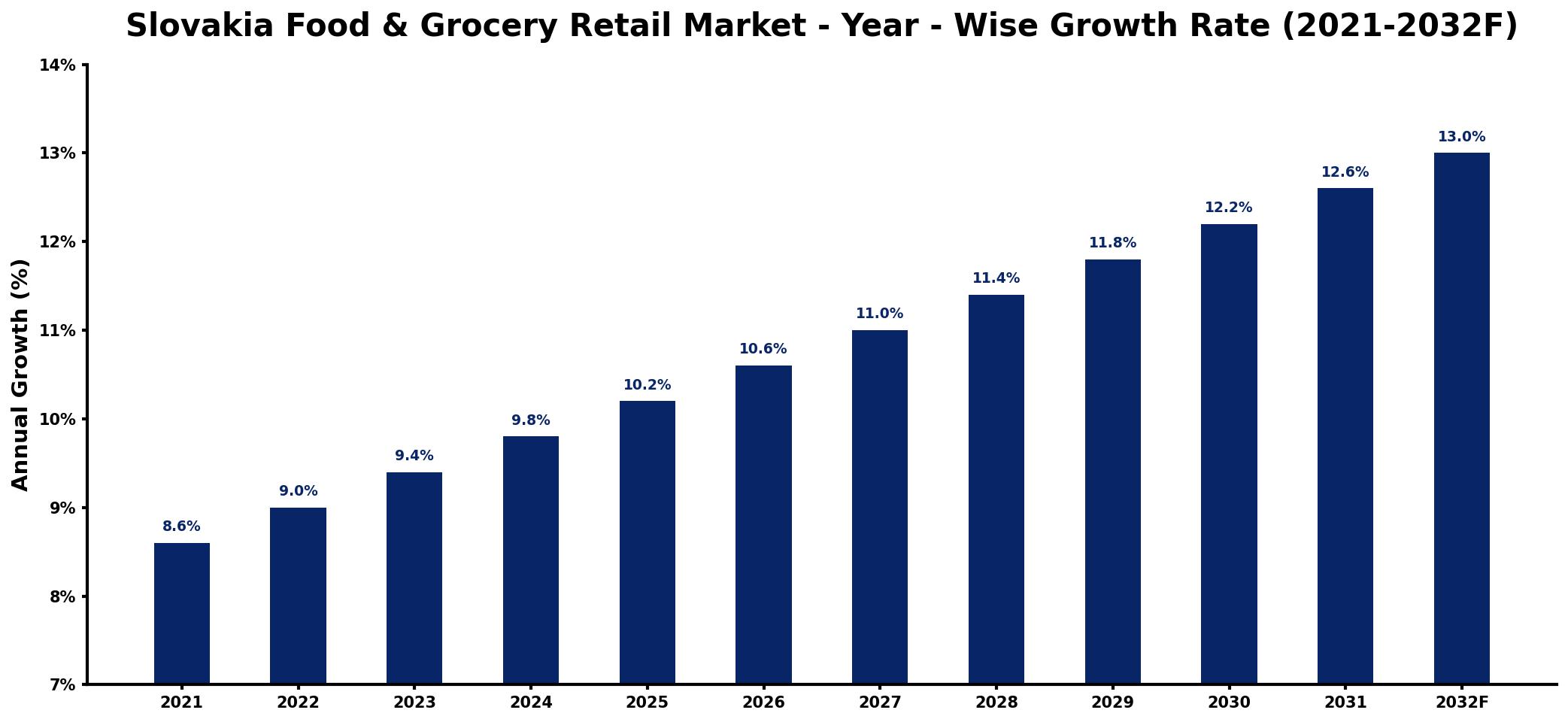
The table below presents the year‑wise growth rates along with the key drivers influencing the market
| Year | Growth Rate | Major Drivers |
| 2021 | 8.6% | E-commerce platform expansion initiatives |
| 2022 | 9.0% | Rising consumer health consciousness trends |
| 2023 | 9.4% | Increased demand for convenience options |
| 2024 | 9.8% | Technological advancements in logistics |
| 2025 | 10.2% | Growing interest in local sourcing |
| 2026 | 10.6% | Expansion of private label offerings |
| 2027 | 11.0% | Investment in sustainable practices growth |
| 2028 | 11.4% | Enhanced digital marketing strategies adoption |
| 2029 | 11.8% | Innovations in supply chain management |
| 2030 | 12.2% | Rising popularity of subscription services |
| 2031 | 12.6% | Focus on personalized shopping experiences |
| 2032 | 13.0% | Increased collaboration with local producers |
Note: Market size estimations and growth projections presented in this report are based on 6Wresearch's proprietary forecasting methodology, utilizing the latest available industry data, government publications, and primary research inputs.
Slovakia Food & Grocery Retail Market Synopsis
Recent momentum in the Slovakia Food & Grocery Retail Market highlights a mature landscape defined by competition among traditional retailers and emerging e-commerce platforms. As the sector evolves, an increasing consumer focus on health and sustainability is reshaping product offerings, pushing retailers to adapt rapidly to these new demands.
Looking ahead, the market is on a promising growth path, with the potential for both physical stores and online platforms to flourish. Retailers are expected to innovate continuously, offering diverse product ranges and enhancing customer experiences, particularly through technology integration and convenience-driven solutions.
- The market is experiencing a shift towards healthier, organic, and ethically produced food options.
- Online grocery shopping is becoming increasingly popular, prompting significant investments in e-commerce solutions.
- Private label products are gaining traction, driven by competitive pricing and perceived quality.
- Consumers are prioritizing convenience, leading to a rise in ready-to-eat and on-the-go food items.
- Intense competition is pushing retailers to optimize product offerings and enhance customer experiences.
The Slovakia Food & Grocery Retail Market faces notable constraints that can hinder growth. Intense competition among both domestic and international retailers creates pressure on pricing and profit margins, compelling retailers to continually innovate or risk losing market share. Furthermore, traditional brick-and-mortar stores must adapt to the rise of e-commerce, which requires investment in technology and logistics. Supply chain disruptions and fluctuating commodity prices add another layer of complexity, necessitating efficient inventory and distribution management to meet consumer expectations while controlling costs.
Current trends in the Slovakia Food & Grocery Retail Market showcase a rising consumer inclination towards healthier, locally sourced, and sustainable food choices. This trend has prompted retailers to expand their portfolios, ensuring a focus on transparency and quality in sourcing. Simultaneously, the demand for convenience is leading to greater availability of ready-to-eat meals and snacks. The growth of online grocery shopping reflects a shift in consumer behavior, with more retailers investing in delivery services and user-friendly platforms to enhance customer engagement.
Opportunities abound in the Slovakia Food & Grocery Retail Market for those willing to adapt to evolving consumer preferences. The increasing economic prosperity and purchasing power in Slovakia create a demand for diverse and high-quality food products. Investing in supermarket chains, specialty food outlets, or online grocery services can yield significant returns. Additionally, innovative technologies that streamline online ordering and delivery processes present lucrative options. A focus on sustainable and organic product lines also aligns with the growing consumer consciousness around health and environmental impact.
The Slovak government plays a crucial role in regulating the Food & Grocery Retail Market through policies aimed at ensuring food safety and competitive practices. Various regulations monitor food quality, labeling, and hygiene standards to protect consumer health. Additionally, there are initiatives supporting local food production and sustainable practices, promoting fair competition among retailers, particularly regarding pricing and promotions. Overall, the government's approach seeks to balance consumer protection, market integrity, and sustainability within the retail sector.
Looking ahead to the 2026-2032 period, the Slovakia Food & Grocery Retail Market is poised for continued growth. Factors driving this expansion include increasing disposable incomes and a sustained shift towards convenience, quality, and health-conscious choices. As retailers enhance their offerings and integrate technology into the shopping experience, they will likely capture a broader customer base. The rise of online shopping will further contribute to market dynamism, leading to a more competitive landscape where both traditional and digital players can thrive.
In the recent months leading up to mid-2026, the Slovakia Food & Grocery Retail Market has seen an acceleration in e-commerce development as retailers respond to consumer preferences for online shopping. Many have introduced user-friendly platforms and efficient delivery options to enhance customer satisfaction. There is also a noticeable uptick in the availability of health-focused and sustainable products, as retailers strive to meet the demand for ethically sourced food items.
- 10 Years of Market Numbers
- Historical Data Starting from 2022 to 2025
- Base Year: 2025
- Forecast Data until 2032
- Key Performance Indicators Impacting the Market
- Major Upcoming Developments and Projects
Key Highlights of the Report:
- Slovakia Food & Grocery Retail Market Outlook
- Market Size of Slovakia Food & Grocery Retail Market, 2025
- Forecast of Slovakia Food & Grocery Retail Market, 2032
- Historical Data and Forecast of Slovakia Food & Grocery Retail Revenues & Volume for the Period 2022-2032F
- Slovakia Food & Grocery Retail Market Trend Evolution
- Slovakia Food & Grocery Retail Market Drivers and Challenges
- Slovakia Food & Grocery Retail Price Trends
- Slovakia Food & Grocery Retail Porter's Five Forces
- Slovakia Food & Grocery Retail Industry Life Cycle
- Historical Data and Forecast of Slovakia Food & Grocery Retail Market Revenues & Volume By Product for the Period 2022-2032F
- Historical Data and Forecast of Slovakia Food & Grocery Retail Market Revenues & Volume By Fresh Food for the Period 2022-2032F
- Historical Data and Forecast of Slovakia Food & Grocery Retail Market Revenues & Volume By Frozen Food for the Period 2022-2032F
- Historical Data and Forecast of Slovakia Food & Grocery Retail Market Revenues & Volume By Food Cupboard for the Period 2022-2032F
- Historical Data and Forecast of Slovakia Food & Grocery Retail Market Revenues & Volume By Beverages for the Period 2022-2032F
- Historical Data and Forecast of Slovakia Food & Grocery Retail Market Revenues & Volume By Cleaning & Household for the Period 2022-2032F
- Historical Data and Forecast of Slovakia Food & Grocery Retail Market Revenues & Volume By Others for the Period 2022-2032F
- Historical Data and Forecast of Slovakia Food & Grocery Retail Market Revenues & Volume By Distribution Channel for the Period 2022-2032F
- Historical Data and Forecast of Slovakia Food & Grocery Retail Market Revenues & Volume By Supermarkets & Hypermarkets for the Period 2022-2032F
- Historical Data and Forecast of Slovakia Food & Grocery Retail Market Revenues & Volume By Convenience Stores for the Period 2022-2032F
- Historical Data and Forecast of Slovakia Food & Grocery Retail Market Revenues & Volume By Departmental Stores & Clubs for the Period 2022-2032F
- Historical Data and Forecast of Slovakia Food & Grocery Retail Market Revenues & Volume By Online for the Period 2022-2032F
- Slovakia Food & Grocery Retail Import Export Trade Statistics
- Market Opportunity Assessment By Product
- Market Opportunity Assessment By Distribution Channel
- Slovakia Food & Grocery Retail Top Companies Market Share
- Slovakia Food & Grocery Retail Competitive Benchmarking By Technical and Operational Parameters
- Slovakia Food & Grocery Retail Company Profiles
- Slovakia Food & Grocery Retail Key Strategic Recommendations






































