Slovakia Fuse Market Top 5 Importing Countries and Market Competition (HHI) Analysis
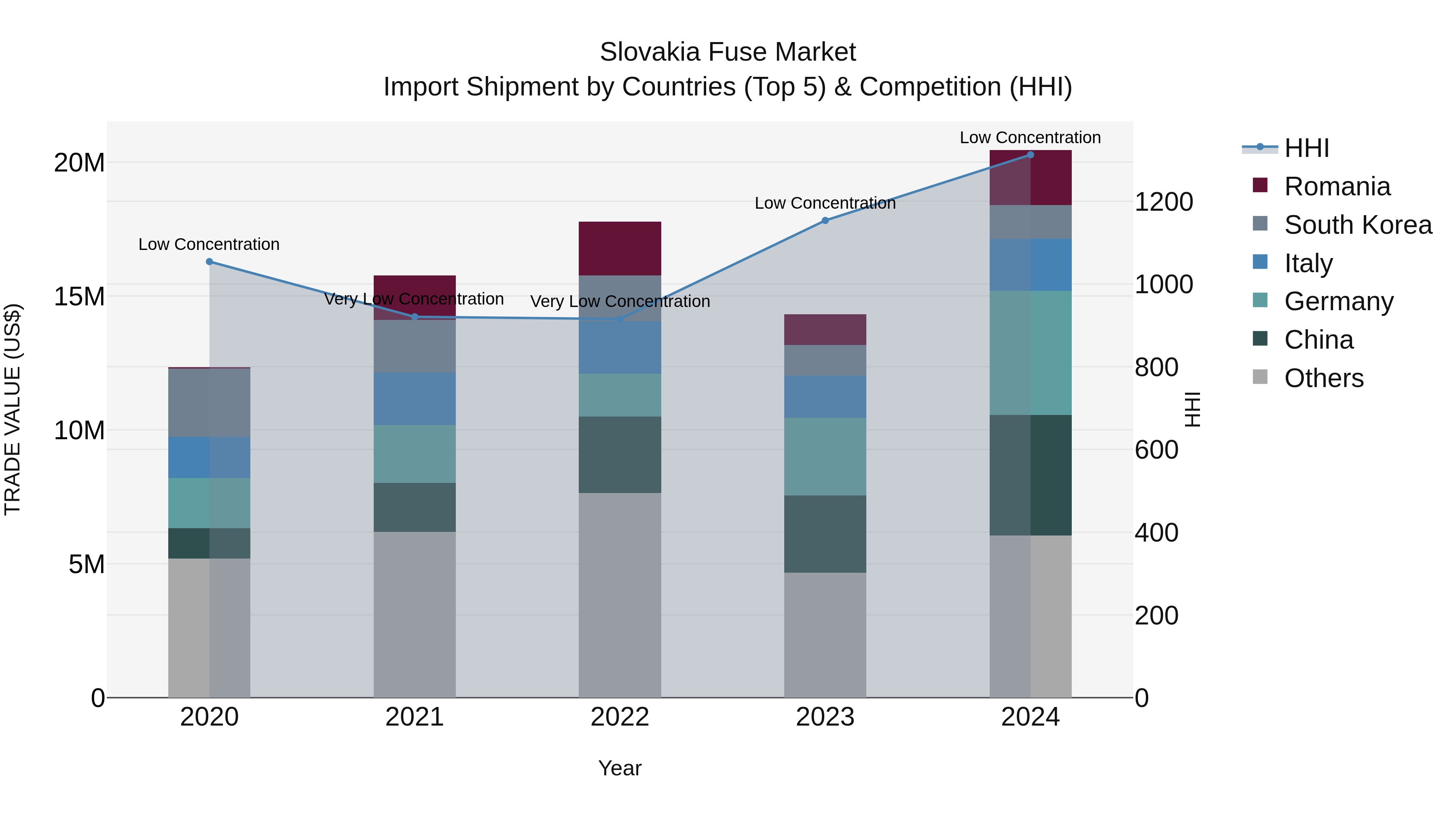
Slovakia`s fuse import Market Top 5 Importing Countries and Market Competition (HHI) Analysis in 2024 saw strong growth with a Compound Annual Growth Rate (CAGR) of 13.46% from 2020 to 2024. The top countries exporting fuses to Slovakia were Germany, China, Romania, Italy, and South Korea. Despite the high growth rate, the Market Top 5 Importing Countries and Market Competition (HHI) Analysis remained relatively competitive with a low Herfindahl-Hirschman Index (HHI) concentration in 2024. The impressive growth rate of 42.84% from 2023 to 2024 indicates a thriving demand for fuses in Slovakia, driven by imports from diverse global sources.
Slovakia Fuse Market Overview
The Slovakia Fuse Market is a growing sector driven by increasing industrialization, construction activities, and the automotive industry. Fuses are essential components used for circuit protection in various electrical applications, ensuring safety and preventing damage from overcurrents. With the rising demand for electricity and technological advancements in various sectors, the market for fuses in Slovakia is expected to expand further. Key players in the market include Schneider Electric, Eaton Corporation, Littelfuse Inc., and Siemens AG. Factors such as stringent safety regulations, infrastructure development, and the adoption of renewable energy sources are anticipated to drive the growth of the Slovakia Fuse Market in the coming years, presenting opportunities for manufacturers to innovate and expand their product offerings to cater to diverse industry needs.
Slovakia Fuse Market Trends and Opportunities
The Slovakia Fuse Market is experiencing a growing demand for smart fuses integrated with IoT technology to enhance monitoring and control capabilities in various industries such as automotive, energy, and electronics. The increasing focus on renewable energy sources like solar and wind power is also driving the market for fuses used in power generation and distribution systems. Furthermore, there is a rising trend towards miniaturization and customization of fuses to meet the specific requirements of modern electronic devices. This presents opportunities for fuse manufacturers to develop innovative products that offer improved efficiency, reliability, and safety features. Collaborations with technology companies for developing advanced fuse solutions and expanding distribution networks to reach a wider customer base are key strategies for companies looking to capitalize on the growing market potential in Slovakia.
Slovakia Fuse Market Challenges
In the Slovakia Fuse Market, challenges are primarily related to increasing competition from international fuse manufacturers, leading to price pressures and the need for local companies to innovate and differentiate their products. Additionally, there are regulatory challenges related to ensuring compliance with safety standards and regulations, which can increase production costs and lead to delays in product launches. The market is also influenced by fluctuations in raw material prices, impacting overall profitability for fuse manufacturers in Slovakia. Keeping up with technological advancements and investing in research and development to offer more efficient and reliable fuse solutions is another challenge faced by players in the Slovakia Fuse Market. Overall, staying competitive in a rapidly evolving market landscape while addressing regulatory requirements and cost pressures are key challenges for companies in this industry.
Slovakia Fuse Market Drivers
The Slovakia fuse market is primarily driven by factors such as increasing industrialization and infrastructure development projects in the country. The growing automotive sector, along with the rising demand for consumer electronics, is also fueling the demand for fuses in Slovakia. Additionally, strict government regulations mandating the use of fuses for safety purposes in various industries are further boosting the market growth. The need for reliable electrical protection systems in residential, commercial, and industrial sectors is driving the adoption of fuses in Slovakia. Furthermore, the ongoing technological advancements in fuse design and the shift towards renewable energy sources are expected to contribute to the growth of the Slovakia fuse market in the coming years.
Slovakia Fuse Market Government Policies
The Slovakia Fuse Market operates within the framework of the European Union regulations and directives regarding electrical equipment safety. Slovakia has adopted the EU directives related to fuses, ensuring that products circulating in the market meet the necessary safety standards. The key regulations that impact the fuse market in Slovakia include the Low Voltage Directive (2014/35/EU) and the Electromagnetic Compatibility Directive (2014/30/EU), which set out requirements for electrical equipment safety and electromagnetic compatibility. Additionally, Slovakia enforces conformity assessment procedures to ensure that fuses comply with these directives before being placed on the market. Manufacturers and distributors operating in the Slovakia Fuse Market must adhere to these government policies to ensure the safety and quality of their products.
Slovakia Fuse Market Future Outlook
The Slovakia Fuse Market is expected to witness steady growth in the coming years due to increasing investments in infrastructure development, automotive production, and renewable energy projects. The growing emphasis on safety measures and the need for reliable electrical systems will drive the demand for fuses in various sectors, including construction, manufacturing, and utilities. Advancements in technology, such as the development of smart fuses with enhanced monitoring capabilities, are also anticipated to contribute to market growth. Additionally, the rising adoption of electric vehicles and the expansion of the electronics industry will further boost the demand for fuses in Slovakia. Overall, the market is forecasted to experience positive growth opportunities driven by these factors in the foreseeable future.
Key Highlights of the Report:
- Slovakia Fuse Market Outlook
- Market Size of Slovakia Fuse Market, 2024
- Forecast of Slovakia Fuse Market, 2031
- Historical Data and Forecast of Slovakia Fuse Revenues & Volume for the Period 2021- 2031
- Slovakia Fuse Market Trend Evolution
- Slovakia Fuse Market Drivers and Challenges
- Slovakia Fuse Price Trends
- Slovakia Fuse Porter's Five Forces
- Slovakia Fuse Industry Life Cycle
- Historical Data and Forecast of Slovakia Fuse Market Revenues & Volume By Type for the Period 2021- 2031
- Historical Data and Forecast of Slovakia Fuse Market Revenues & Volume By AC Fuses for the Period 2021- 2031
- Historical Data and Forecast of Slovakia Fuse Market Revenues & Volume By DC Fuses for the Period 2021- 2031
- Historical Data and Forecast of Slovakia Fuse Market Revenues & Volume By Product Type for the Period 2021- 2031
- Historical Data and Forecast of Slovakia Fuse Market Revenues & Volume By Cartridge Type Fuses for the Period 2021- 2031
- Historical Data and Forecast of Slovakia Fuse Market Revenues & Volume By Rewirable Fuses for the Period 2021- 2031
- Historical Data and Forecast of Slovakia Fuse Market Revenues & Volume By Switch Type Fuses for the Period 2021- 2031
- Historical Data and Forecast of Slovakia Fuse Market Revenues & Volume By Drop Out Type Fuses for the Period 2021- 2031
- Historical Data and Forecast of Slovakia Fuse Market Revenues & Volume By Striker Type Fuses for the Period 2021- 2031
- Historical Data and Forecast of Slovakia Fuse Market Revenues & Volume By expulsion Type HRC Fuses for the Period 2021- 2031
- Historical Data and Forecast of Slovakia Fuse Market Revenues & Volume By Liquid Type HRC Fuses for the Period 2021- 2031
- Historical Data and Forecast of Slovakia Fuse Market Revenues & Volume By cartridge Type HRC Fuses and Accessories for the Period 2021- 2031
- Historical Data and Forecast of Slovakia Fuse Market Revenues & Volume By Voltage Type for the Period 2021- 2031
- Historical Data and Forecast of Slovakia Fuse Market Revenues & Volume By Low Voltage for the Period 2021- 2031
- Historical Data and Forecast of Slovakia Fuse Market Revenues & Volume By Medium Voltage for the Period 2021- 2031
- Historical Data and Forecast of Slovakia Fuse Market Revenues & Volume By High Voltage for the Period 2021- 2031
- Historical Data and Forecast of Slovakia Fuse Market Revenues & Volume By Industry for the Period 2021- 2031
- Historical Data and Forecast of Slovakia Fuse Market Revenues & Volume By Transportation for the Period 2021- 2031
- Historical Data and Forecast of Slovakia Fuse Market Revenues & Volume By Construction for the Period 2021- 2031
- Historical Data and Forecast of Slovakia Fuse Market Revenues & Volume By Oil and Gas for the Period 2021- 2031
- Historical Data and Forecast of Slovakia Fuse Market Revenues & Volume By Electrical and Electronics for the Period 2021- 2031
- Historical Data and Forecast of Slovakia Fuse Market Revenues & Volume By Healthcare for the Period 2021- 2031
- Historical Data and Forecast of Slovakia Fuse Market Revenues & Volume By Mining for the Period 2021- 2031
- Historical Data and Forecast of Slovakia Fuse Market Revenues & Volume By Food and Beverage for the Period 2021- 2031
- Historical Data and Forecast of Slovakia Fuse Market Revenues & Volume By Others for the Period 2021- 2031
- Slovakia Fuse Import Export Trade Statistics
- Market Opportunity Assessment By Type
- Market Opportunity Assessment By Product Type
- Market Opportunity Assessment By Voltage Type
- Market Opportunity Assessment By Industry
- Slovakia Fuse Top Companies Market Share
- Slovakia Fuse Competitive Benchmarking By Technical and Operational Parameters
- Slovakia Fuse Company Profiles
- Slovakia Fuse Key Strategic Recommendations






































