Slovakia Home Textile Market Size (2020-2030)
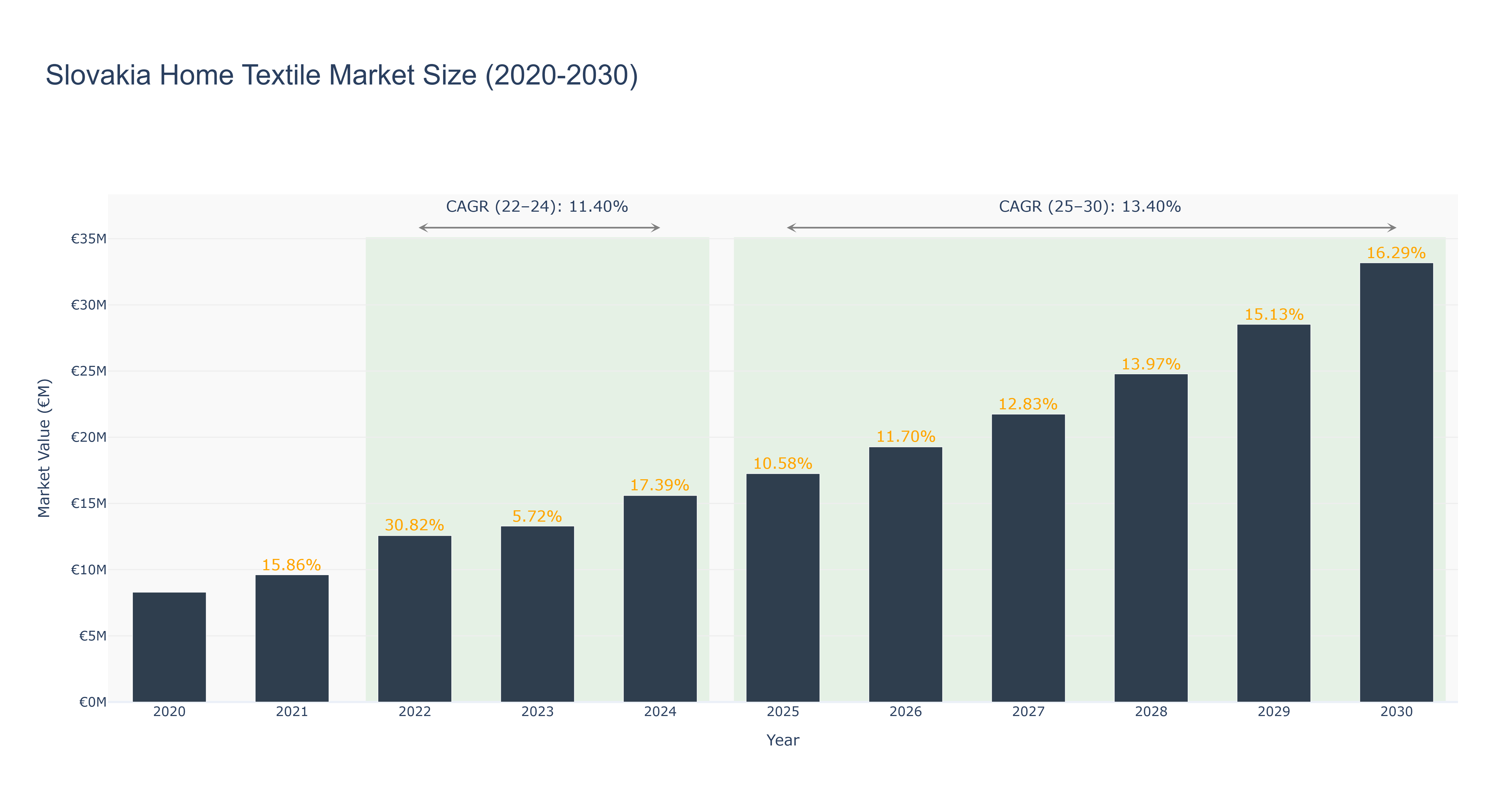
The Slovakia Home Textile Market has demonstrated significant growth in the past few years, peaking at a market size of €12.57 million in 2022, with a remarkable growth rate of 30.82%. This growth trajectory continued into 2023, albeit at a slower pace of 5.72%, before rebounding to €15.60 million in 2024, reflecting a strong growth rate of 17.39%. Looking ahead, the market is projected to expand substantially, with a CAGR of 13.40% from 2025 to 2030, reaching an estimated €33.18 million by 2030. Key drivers for this growth include increasing consumer demand for home improvement products, rising disposable incomes, and a growing trend toward home personalization. Furthermore, ongoing innovations in textile technology and sustainability practices are expected to bolster market expansion. As consumer preferences evolve, the Slovak home textile industry is well-positioned to capitalize on these macro trends, promoting both product diversity and enhanced quality.
Slovakia Home Textile Market: Production & Trade Performance (2019-2025)
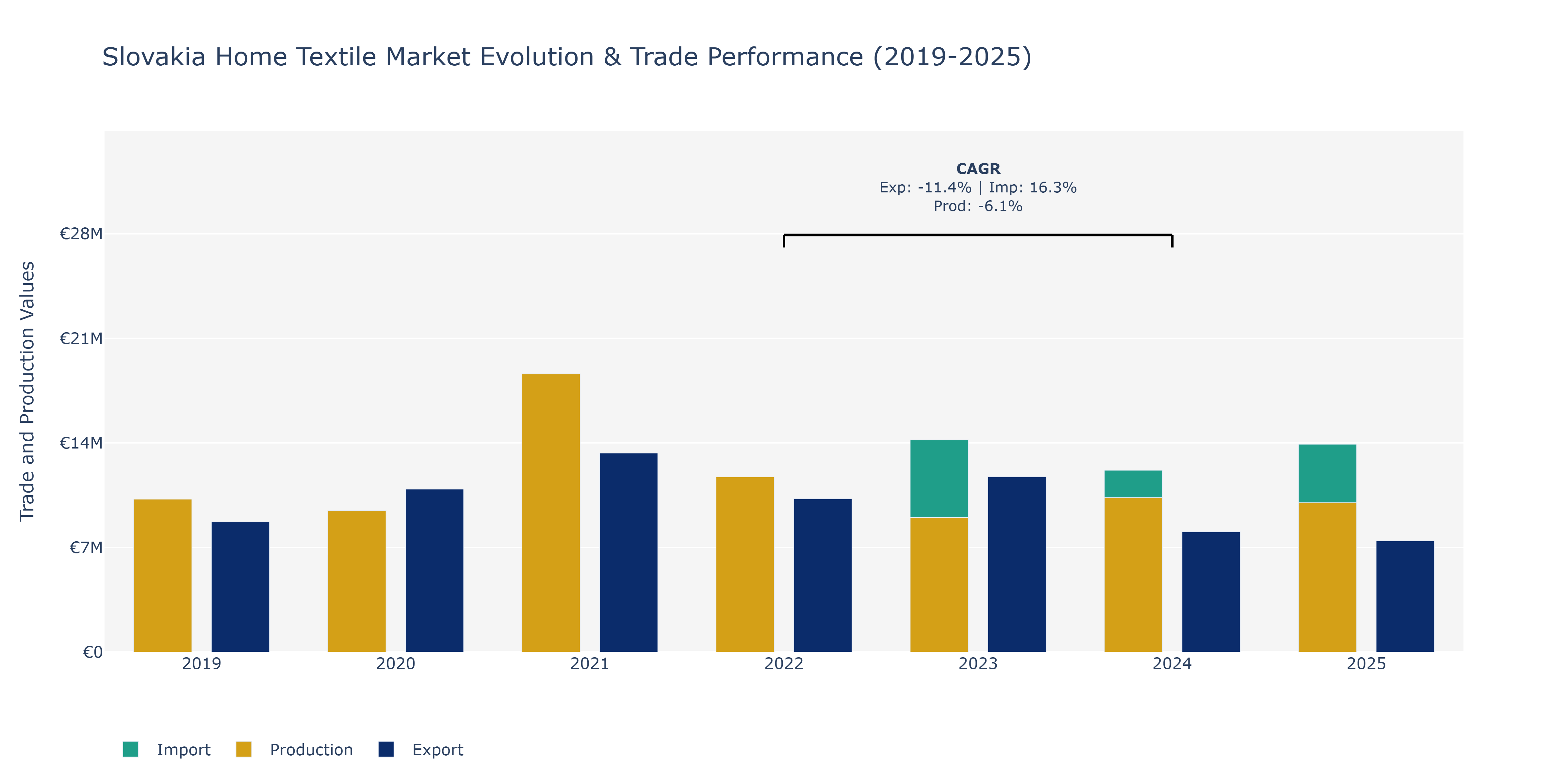
In the Slovakia Home Textile Market, from 2019 to 2025, there were notable fluctuations in exports, imports, and production. Exports peaked in 2021 at €13.32 million, showcasing a significant increase from €8.71 million in 2019, followed by a decline in 2024 to €8.05 million. Imports, on the other hand, experienced fluctuations with a peak in 2023 at €14.2 million after a steady increase from €7.26 million in 2019. Production peaked in 2021 at €18.62 million, showing substantial growth from €10.24 million in 2019. The decline in production to €9.99 million in 2025 may be attributed to shifts in consumer demands due to changing home textile trends or supply chain disruptions affecting manufacturing capabilities. The rise in imports could indicate increased demand for foreign textile products, possibly due to quality or design preferences not met by domestic production, suggesting opportunities for local manufacturers to enhance their offerings to meet evolving market needs.
Key Highlights of the Report:
- Slovakia Home Textile Market Outlook
- Market Size of Slovakia Home Textile Market, 2025
- Forecast of Slovakia Home Textile Market, 2032
- Historical Data and Forecast of Slovakia Home Textile Revenues & Volume for the Period 2022 - 2032F
- Slovakia Home Textile Market Trend Evolution
- Slovakia Home Textile Market Drivers and Challenges
- Slovakia Home Textile Price Trends
- Slovakia Home Textile Porter's Five Forces
- Slovakia Home Textile Industry Life Cycle
- Historical Data and Forecast of Slovakia Home Textile Market Revenues & Volume By Product Type for the Period 2022 - 2032F
- Historical Data and Forecast of Slovakia Home Textile Market Revenues & Volume By Bed Linen for the Period 2022 - 2032F
- Historical Data and Forecast of Slovakia Home Textile Market Revenues & Volume By Curtains and Drapes for the Period 2022 - 2032F
- Historical Data and Forecast of Slovakia Home Textile Market Revenues & Volume By Upholstery Fabrics for the Period 2022 - 2032F
- Historical Data and Forecast of Slovakia Home Textile Market Revenues & Volume By Bathroom Textiles for the Period 2022 - 2032F
- Historical Data and Forecast of Slovakia Home Textile Market Revenues & Volume By Material Type for the Period 2022 - 2032F
- Historical Data and Forecast of Slovakia Home Textile Market Revenues & Volume By Cotton and Silk for the Period 2022 - 2032F
- Historical Data and Forecast of Slovakia Home Textile Market Revenues & Volume By Polyester and Velvet for the Period 2022 - 2032F
- Historical Data and Forecast of Slovakia Home Textile Market Revenues & Volume By Leather and Microfiber for the Period 2022 - 2032F
- Historical Data and Forecast of Slovakia Home Textile Market Revenues & Volume By Terry Cloth and Bamboo Fiber for the Period 2022 - 2032F
- Historical Data and Forecast of Slovakia Home Textile Market Revenues & Volume By End User for the Period 2022 - 2032F
- Historical Data and Forecast of Slovakia Home Textile Market Revenues & Volume By Households and Hotels for the Period 2022 - 2032F
- Historical Data and Forecast of Slovakia Home Textile Market Revenues & Volume By Homeowners and Interior Designers for the Period 2022 - 2032F
- Historical Data and Forecast of Slovakia Home Textile Market Revenues & Volume By Furniture Manufacturers for the Period 2022 - 2032F
- Historical Data and Forecast of Slovakia Home Textile Market Revenues & Volume By Families and Spas for the Period 2022 - 2032F
- Historical Data and Forecast of Slovakia Home Textile Market Revenues & Volume By Application for the Period 2022 - 2032F
- Historical Data and Forecast of Slovakia Home Textile Market Revenues & Volume By Bedroom Furnishing for the Period 2022 - 2032F
- Historical Data and Forecast of Slovakia Home Textile Market Revenues & Volume By Window and Room Dcor for the Period 2022 - 2032F
- Historical Data and Forecast of Slovakia Home Textile Market Revenues & Volume By Sofas and Seating for the Period 2022 - 2032F
- Historical Data and Forecast of Slovakia Home Textile Market Revenues & Volume By Towels and Bathrobes for the Period 2022 - 2032F
- Slovakia Home Textile Import Export Trade Statistics
- Market Opportunity Assessment By Product Type
- Market Opportunity Assessment By Material Type
- Market Opportunity Assessment By End User
- Market Opportunity Assessment By Application
- Slovakia Home Textile Top Companies Market Share
- Slovakia Home Textile Competitive Benchmarking By Technical and Operational Parameters
- Slovakia Home Textile Company Profiles
- Slovakia Home Textile Key Strategic Recommendations






































